This week we spend time with Esther 3 (B) today and consider it as preamble to new grace and blessings.
We see how God’s grace enters Mordecai, Esther and Ahasuerus. We see how God’s power comes through a vulnerable and frightened, yet brave woman. We see how God acts through inversion. We see how God dwells with the lowest and the poorest. We see how God guides, protects, calls and loves his faithful. We see a foreshadowing of God’s most wonderful gift to come, the saving and redemptive power of the gift of Christ.
Mordecai remains true to his God and for this he draws the venomous envy of Haman. He goes to God when the decree of destruction is read out, and he does as God asks, he goes to Esther.
Esther remains faithful to God and believes that God loves and protects her even as he calls her to take on in a dangerous mission. She overcomes her fear and acts from her position of weakness, not from any strength, to become an agent for good.
Francisco Zurbarán: Madonna with Child
Jesus comes to live among us as one of the world’s most helpless. In this way, he places himself in our hands and asks that we place ourselves in his. This is the amazing story of Jesus that we know so well. This story of Esther is a fitting preamble to understanding the gift of Christ. Let us spend some time with this story, and with Christ, today.
Adapted from a reflection written on December 25, 2010.
This week we spend time with Esther 3 (B) today and consider it as preamble to a new simplicity.
God’s sign is the baby in need of help and in poverty. Exactly the same sign has been given to us. God’s sign is simplicity. God’s sign is that he makes himself small for us. This is how God reigns. God does not come with power and outward splendor. God comes as a baby – defenseless and in need of our help. God does not want to overwhelm us with strength. God takes away our fear of God’s greatness. God asks for our love: so God becomes a child. God wants nothing other from us than our love, through which we spontaneously learn to enter into God’s feelings, God’s thoughts and God’s will – we learn to live with God and to practice with God that humility of renunciation that belongs to the very essence of love. God made of self so small that we could understand the enormity of God, welcome God and love God.
MAGNIFICAT MINI-REFLECTION December 25, 2010, Pope Benedict XVI Christmas Homily 2009
We might reflect on the life of Esther in a similar way. God sends a sign to God’s people through a woman who is considered an appendage of her husband, for the queen in this kingdom is not allowed to enter into the king’s presence without his permission. In this time and place, Esther’s intrusion on her husband’s time and person is punishable by death and so we see that God’s sign comes to his people through a woman who has been taken as part of the household of a pagan king and who fears for her life whether she remains silent or speaks. God comes to the LORD’s people through this defenseless woman who is in need of someone’s help. When we read her story, we might imagine ourselves as equally defenseless, equally frightened. If we allow ourselves to accompany Esther as she listens to her uncle Mordecai tell her that she has been chosen by God to speak on behalf of her people, we will watch as she opens herself to allow God into her life fully. If we watch what happens to the man, Haman, so filled with hatred that he plots the deaths of thousands in order to have his bruised pride assuaged, we will see Ahasuerus deliver to Haman the consequence of his own plots against God’s people.
Tomorrow, grace and blessing.
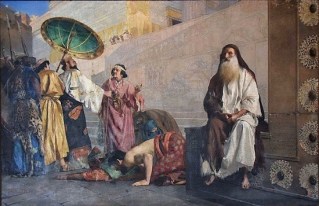
To learn more about why Mordecai did not bow before Haman, click on the image above or visit: http://thetorah.com/why-did-mordecai-not-bow-down-to-haman/
Cameron, Peter John, Rev., ed. “Mini-Reflection.” MAGNIFICAT. 25 December 2010. Print.
Adapted from a reflection written on December 25, 2010.
Much like the Book of Judith, the story of Esther is another that is full of danger and violence but this time counterpointed by trust in God . . . and great rejoicing. Today and tomorrow we discoverthat despite palace intrigue, envy and anger, joy is present. If today’s story calls you to search for more surprises, click on the word Joy in the categories cloud in the blog’s right hand sidebar and choose a reflection, or enter the word Joy in the blog search bar. You may also want to visit the Joy for the Journey blog atwww.joyforthee.blogspot.comto see how joy surprises you there. Today we find joy in times of massacre and war.
Chapter 9 of Esther’s story describes the origin of the Purimfestival, a celebration of the Jewish nation’s deliverance. We know that after a plot against these faithful was thwarted and as too often happens when power changes hands, wide-scale killing takes place. Old feuds rise and are settled. Grudges surface and are acted upon. Personal agendas take over.
Andrea del Castagna: Queen Esther (detail)
We humans have not moved much past these ancient rituals of slaughtering the conquered. Despite the fact that in many cultures leaders are elected by free and fair elections, too many peoples suffer at the hands of those who see instability as a time to take over, to amass power, and to use corruption as a governing tool rather than social justice or the rule of law. And we need not look to the evening news to find examples of how we repress one another in the hope of currying favor or gaining control. Our workplaces, neighborhoods and even our homes sometimes serve as microcosms of the problems we see on a more global scale.
Today we may be horrified at the acts of revenge we read in the Book of Esther. And today we might also be surprised at the elation that sweeps through these people who thought themselves dead. Today we remember that we witness many small killings too frequently in our lives, the killing of the spirit, the killing of the heart, mind and soul, the killing of ideas, hopes and dreams. The killing of innocence. And then . . . let us reflect on how we might find joy in times when insanity reigns and reason disappears.
Verses 9:17-23: This was on the thirteenth day of Adar. On the next day, the fourteenth, there was no more killing, and they made it a joyful day of feasting.The Jews of Susa, however, made the fifteenth a holiday, since they had slaughtered their enemies on the thirteenth and fourteenth and then stopped on the fifteenth.This is why Jews who live in small towns observe the fourteenth day of the month of Adar as a joyous holiday, a time for feasting and giving gifts of food to one another. Mordecai had these events written down and sent letters to all the Jews, near and far, throughout the Persian Empire,telling them to observe the fourteenth and fifteenth days of Adar as holidays every year.These were the days on which the Jews had rid themselves of their enemies; this was a month that had been turned from a time of grief and despair into a time of joy and happiness. They were told to observe these days with feasts and parties, giving gifts of food to one another and to the poor.So the Jews followed Mordecai’s instructions, and the celebration became an annual custom.
Let us pause and consider how we might refrain from seeking revenge when we have been wronged. Let us mediate on the meaning of interceding for our enemies. And let us celebrate deliverance from evil and killing we too often find in our own lives.
For more information about the feast of Purim, click on the image of Queen Esther above, or visit: http://www.chabad.org/holidays/purim/article_cdo/aid/645309/jewish/What-Is-Purim.htm and http://www.mythicmaps.net/Festival_calendar/March/Purim.htm
For more Noontime reflections about this woman’s story, enter the word Estherinto the blog search bar and explore.
Much like the Book of Judith, the story of Esther is another that is full of danger and violence but this time counterpointed by trust in God . . . and great rejoicing. Today and tomorrow we discoverthat despite palace intrigue, envy and anger, joy is present. If today’s story calls you to search for more surprises, click on the word Joy in the categories cloud in the blog’s right hand sidebar and choose a reflection, or enter the word Joy in the blog search bar. You may also want to visit the Joy for the Journey blog atwww.joyforthee.blogspot.comto see how joy surprises you there. Today we find joy in times of deceitful intrigue.
The opening chapters of Esther’s story describe how this young woman, despite her Jewish identity and fidelity to Yahweh, finds herself at the center of a major, political power struggle. Esther’s uncle Mordecaicounsels her; and the courtier Haman – full of hatred, envy and pride – plots to kill all Jews in the kingdom. Resenting the power and influence Mordecai and Estherhold with the king, Haman hatches a devilish plot; and Esther finds that the only way for her to survive is to rely on God’s providence and care. In the end, the tables turn on Hamanand he suffers the very punishment he had hoped to exact on the Jewish people, death on the gallows built at his own command.
Arent de Gelder: Esther and Mordecai Writing the Second Letter of Purim
Verses 8:15-17: Mordecai left the palace, wearing royal robes of blue and white, a cloak of fine purple linen, and a magnificent gold crown. Then the streets of Susa rang with cheers and joyful shouts. For the Jews there was joy and relief, happiness and a sense of victory. In every city and province, wherever the king’s proclamation was read, the Jews held a joyful holiday with feasting and happiness. In fact, many other people became Jews, because they were afraid of them now.
The story of Esther is one we will want to remember when we find ourselves looking for power and revenge. The story of Esther is one we will want to remember when we find ourselves plotting to preserve power or damage another another’s reputation. The story of Esther is one we will want to recall when we find ourselves thrilling to schemes of undoing . . . rather than planning to work in the kingdom of God.
For more about the painting by Arent de Gelder, click on the image above or go to: http://www.artbible.info/art/large/174.html
For more Noontime reflections about this woman’s story, enter the wordEstherinto the blog search bar and explore.
Read this story from the beginning at, Esther 1-8.
Millais: EstherWe have no way of knowing what plans are schemed against us. We have no method of seeing into the private places where the covetous lie on couches to weave their plots that entangle others. We can be certain, however, that when the faithful find themselves the victims of these plots – as the Jews do in the story of Esther – that God will redeem his people, will release them from oppression, and will decide how the connivers are to be judged.
In the story of Mordecai and Esther, Haman becomes jealous because Mordecai does not play the game of courtier as Haman would wish, yet has influence and prestige – which Haman covets. Rather than find union with Mordecai, Haman builds a gibbet on which to hang his perceived enemies . . . only to see his family executed . . . and himself led to the scaffold on which he had meant to exterminate the Jew he so hated.
For several weeks we have been reflecting on honesty versus deceit . . . and today we find another clear lesson of what is expected by God of his faithful. Earlier in Chapter 4 when Esther tells her uncle that she is afraid to go to the king to tell him of Haman’s plot, Mordecai reminds her that the faithful must do as God bids . . . for if they do not, God will find another willing to do the work. Then Mordecai reminds his niece of the fate she will suffer if she goes against God’s will (4:14).
So when we read these later chapters . . . and when we spend time praying, meditating and reflecting on God’s word to us . . . we know that we, too, hear the words of Mordecai, we also feel the tremors which Esther felt when she saw a task looming before her that was too great to bear. It will serve us well to read this story from beginning to end, including the later insertions, and to ponder God’s plan for us as we move through our days.
We need not worry about plots schemed against us; nor do we need to create a plan of reprisal. We only need to be constant to God each day, to maintain our covenant, to lay all problems at God’s feet for resolution. For this is the only way we will find peace amid the noise of the world. This is the only path to a serenity that lasts and sustains. This is the only true Way in which to live the gift of Life.
Written on June 15, 2008 and posted today as a Favorite.
Rembrandt: Ahauserus and Haman at Esther’s FeastWe cannot determine God’s timeline and when we watch how his plans unfold in our space and time we see that God has refined the shepherding of billions of souls to a mysterious art. And it is something that he practices well. Life is complicated. God knows that rewarding one creature stirs envy in another. This is the story of Satan and the fallen angels who succumb to their jealousy. God knows that giving his creatures the choice to opt for darkness or light means that some of them will fall; but God also knows that his loving compassion leaves many opportunities for reform and changes in outlooks, and so he leaves his plans open . . . in order to work with the creations he so loves.
God is fully aware that his show of mercy stirs jealousy in the hearts of others, and so he prepares plans for these contingences. We have seen and we have been told and we have experienced the fact that God will always turn harm to good. The extremity or numbers or layers in any given situation are never too much for God to handle. He is more than up to the challenge . . . for he is the creator of all we see and experience.
Today’s reading – another of my favorites – takes us to the beginning of another story of how a woman saves a nation. It takes us to the place in the narrative where we see how the seed of envy blooms into a fully-blown narcissistic tantrum which in the end brings down the initiator rather than the intended victim. Mordecai, a Jewish man living in the Persian court of King Xerxes(or Ahauserus), and his niece Esther, who is married to this King, have submitted their plea for justice. The King has responded and now we await the sentence he will deliver. As the king struggles with the plots that surround him and the information which has been brought to him, he goes back to a former event – a time when Mordecai saved his life by warning him of an assassination plot. When we read today, we see how the evil plotted against goodness has a way – in God’s plan and in God’s timeline – of returning to visit itself upon the perpetrator. What happens next to Haman is the very consequence he had wished to deliver to Mordecai and Esther – it is a punishment born out of the darkness of envy, and it goes home to exterminate its originator.
If you have time today, read this story through. Different Bibles have different methods of presenting the material that was later inserted to flesh out the story but it is worth the trouble of sorting through all of this. The story of Esther who would rather hide than confront evil with goodness and truth is its own reward. Today’s lesson that we cannot understand how things will unravel around us is a story to carry in our hearts. It both cautions us against entertaining ideas of revenge and it bolsters us in our hope that ultimately the light will overcome the darkness. All is revealed. All accounts are paid. In full. And this is what we have the opportunity to ponder today.
Reward often carries with it the fact that some human beings will covet the good fortune of others. Some human beings will wish destruction for those who receive gifts from the king. It remains with us to wait patiently for the ultimate outcome which the just king always delivers. Those who plot in the darkness are done in by the very mechanism they set into motion. This is divine justice at its best. It is for the follower of Christ to discern his or her place in God’s plan, to be patient as events unfold, and to pray for the redemption of those who delight in the darkness.







 The Noontimes
