For this is the message you have heard from the beginning: we should love one another . . .
For this is the message we carry into the world: we must love one another, even – or perhaps especially – our enemies.
Do not be amazed, then, if the world hates you . . .
We are not amazed, then, when the world condemns us.
Whoever does not love remains in death . . .
Whoever loves those who hate him remains in life eternally.
The way we came to know love was that he laid down his life for us; so we ought to lay down our lives for our brothers . . .
The way we come to know love is to enact it. The way we come to know hope is to give it.
Children, let us not love in word or speech but in deed and truth . . .
Sisters and brothers, let us not love in what we say but in what we do.
For this is the message you have heard from the beginning: we should love one another . . .
Spend some time today with the four selected versions of this citation in the scripture link above. Choose another version from the drop down menus and ponder what we have heard from the beginning, what we know, and how we enact God’s love in the world.
Today we hear some difficult words that we must not take too casually or too harshly. Today we are given the opportunity to heal rifts and bridge gaps in our relationships. Today we have the opportunity to turn away from judging one another and to turn toward loving one another . . . even our enemies.
It is of paramount importance to read these verses carefully lest we use them as a club against one another.
The Son of God was revealed to destroy the works of the devil.
It is imperative to enact these words with love lest we convince ourselves too quickly that it is our responsibility to see that no one breaks any rules.
No one who fails to act in righteousness belongs to God.
It is essential for our eternal well-being that we see these words as a license to forgive with deep compassion.
No one who fails to love his brother belongs to God.
It is vital for our own serenity that we allow these words to transform any small-mindedness we might harbor, so that we become passionate in our love for the universal Christ that lives in each of us.
In Jesus’ Parable of the Weeds(Matthew 13:24-30) we realize that each of God’s children is a field of wheat and weeds that God patiently tends as we grow, knowing that the weeds will be sifted from the wheat when the harvest time arrives. Therefore, rather than judge or condemn ourselves or our fellow pilgrims, let us do as John asks and love each of our sisters and brothers into goodness just as Christ loves each and every one of us into goodness.
While thinking of these verses, click on the scripture link above and study the four pre-select versions of this citation. Choose another version and read these words again and reflect on the opportunity to love that John brings to us.
See what love the father has bestowed on us that we might be called the children of God.
We need say nothing more about our relationship with God. We are God’s children.
The reason the world does not know us is that it did not know God.
We need write nothing but that God loves each of us dearly. We are God’s children.
Beloved, we are God’s children now; what we shall be has not yet been revealed.
We need not expend energy worrying or tears crying about what the creator may or may not think of us. We are God’s children.
Everyone who has this hope based on God makes himself pure, as God is pure.
Today, click on the scripture link above and study the four pre-select versions of this citation while thinking of these statements. Choose another version and read these simple yet hope-filled verses again and reflect on the amazing truth John brings to us . . .
See what love the father has bestowed on us that we might be called the children of God.
Perhaps because our circadian clockplays a quiet but powerful role in our lives we are subtly convinced that the universe is a mystery of black and white principles and forces. Perhaps because we see so much duality in others we are convinced that God punishes or saves depending on our behavior. Perhaps because we divide our lives between forces of good and evil, our perceptions between dark and light and our hours between day and night . . . we see God as something or someone we must seek. Perhaps because of all of this . . . we believe that seeking God means leaving what we know to journey toward what we do not.
St. Augustine of Hippo writes: Don’t go looking for any end beside God, in case by looking for an end beside God, you find yourself being consumed, not completed. (Cameron 277)
St. Augustinelived a life of dissipation in an era when the Greek and Judeo-Christian worlds were merging. He eventually changed his way of living and thinking to become an early leader in the Western Christian Church and to merge the worlds of day and night for himself and others.
In Chapter 14of his Gospel, St. John records Christ’s words at the Last Supper in which we hear the dialog between Jesus and his followers. Spend some time with it today and consider the world of black and white that we have constructed for ourselves. Consider what it is we would do well to change. And as the day comes to a close and begins to merge into night, join those in the Noontime Circle to pray.
Loving God, protect us from consuming ourselves as we fight against a world that struggles to reconcile darkness and light. Teach us to complete ourselves in you so that we might learn to live in a world that has both nights and days.
For those who convince themselves and others that creation divides itself into worlds of evil and good we pray: allow us to understand that God is every thing and every person.
For those who believe that God’s grace and blessing are earned and not given, we pray: allow us to learn that God’s compassion and love are gifts freely given.
For those who tell themselves and others that our task on earth is to find God while we live safely and comfortably without risking ourselves for others, we pray: allow us to see that we are complete in God when we allow ourselves to be consumed for and in God,
For those who understand Jesus’ words: I am the way and the truth and the life: inspire them to help others to see The Way of days and nights.
For those who live Jesus’ words: No one comes to the Father except through me: encourage them to bring the wisdom of a world of days and nights to others.
For those who enact Jesus’ words: If you know me then you will also know the Father: strengthen them as they bring Christ’s love to all who live in a divided world of days and nights. Amen.
Visit the scripture John Chapter 14 link above and read the versions that have been pre-selected. Choose another version and consider how we might live on a world where dark and light co-exist without consuming us, where the coming together of nights and days become a force in our transformation.
St. Augustine’s citation from SERMONS and cited Cameron, Peter John. “Meditation of the Day.” MAGNIFICAT. 18.5 (2014): 277. Print.
And the firmament shows forth the work of God’s hands.
Day unto day takes up the story
And night unto night makes know the message.
No speech, no word, no voice is heard
Yet their span extends through all the earth,
Their words to the utmost bounds of the world.
This spring we have reflected on the importance of preaching God’s Word with every small and great act in our lives. We have pondered the Lesson of the Fig Tree and the worth of even the smallest of sparrows. We have spent time examining our experience of Christ and we have compared the ideal with the real. Today we arrive at understanding that each day and each night are filled with God’s grace even when we cannot see or feel it. We have arrived at believing that just as the firmament extols God’s goodness . . . so must we. No speech is necessary. No word need be uttered. We have only to spend each waking moment doing God’s work. We have only to put our slumber into God’s trustworthy hands for it is in this way that we enter into God’s eternal goodness.
Is this what the Apostle John has seen and heard? Is this the goodness we seek? Is this the gift we have already been freely given?
Tomorrow, a prayer for our days and nights.
Visit the scripture link above and read the versions of this citation that have been pre-selected. Choose another version and ponder how the firmament speaks without words.
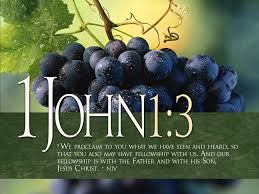
We are writing this so that your joy may be complete . . .
This is our anthem of love . . .
Sing it often . . .
Proclaim it aloud . . .
So that others may know this joy. Amen.
Spend some time today with the opening of John’s first letterof love to us by clicking on the scripture link above or here in this paragraph. Explore the four versions of these verses that have been selected. Choose another version by using the drop-down menus and examine the meaning of love in your life and where it is present in an unusual way. Say the prayer above or write your own prayer. Consider sending your Prayer to Love to another . . .
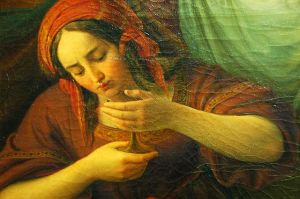
Friedrich Wilhelm Schadow: The Parable of the Ten Virgins
Watch!
We began our exploration of Mark 13 reminding ourselves that we preach the Gospel with each action we perform each minute of each day. What does our life say about our awareness of the importance of watchfulness? Where do our feet take us as we live out the Word? What do our hands do as we move through our days? How carefully do our ears listen to our friends and companions? How honestly do we look others in the eye? How truthfully do we live out our understanding that all temples to self will fall, all teachers and prophets are not authentic, and all tribulations bring us closer to God? Why is it essential to understand that Christ is among us now? What have we learned from the lesson of the fig tree?
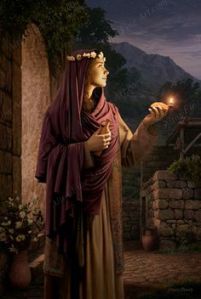
Jesus tells us the Parable of the Ten Virgins: Thenthe kingdom of heaven will be comparable to ten virgins, who took their lamps and went out to meet the bridegroom. Five of them were foolish, and five were prudent. For when the foolish took their lamps, they took no oil with them, but the prudent took oil in flasks along with their lamps. Now while the bridegroom was delaying, they all got drowsy andbegan to sleep. But at midnight there was a shout, “Behold, the bridegroom! Come out to meet him”. Then all those virgins rose and trimmed their lamps. The foolish said to the prudent, “Give us some of your oil, for our lamps are going out”. But theprudent answered, ‘No, there will not be enough for us and youtoo; go instead to the dealers and buysomefor yourselves”. And while they were going away to make the purchase, the bridegroom came, and those who wereready went in with him tothe wedding feast; andthe door was shut. Later the other virgins also came, saying, “Lord, lord, open up for us”. But he answered, “Truly I say to you, I do not knowyou”. Be on the alert then, for you do not know the day nor the hour. (Matthew 25:1-13)
We are presented with the choice to be foolish or prudent. We are free to decide if we will or will not carry a flask of oil to replenish the lamp of life we have been generously given. We have ears to hear and eyes to see; yet we do not know the hour and we do not know the day when we will be called to an accounting. What Gospel are we preaching with the days of our lives?
For a fresh perspective on this parable, click on the Bible link above and read another of the preselected versions of this story or choose one of your own . . . and discover how Jesus’ words speak to us in a new way about the old theme ofwatchfulness!
Caution. Patience. Readiness. Being watchful and diligent.
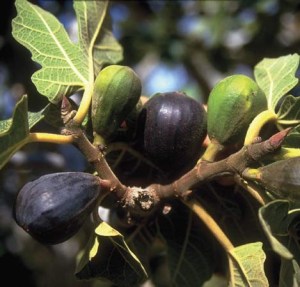
The fig tree blooms late and is unaffected by frost. It is patient and waits for the right weather until it flowers.
Many speculate about the meaning of these verses and many scholars simply say: Read Jesus’ words and take them in. They tell you all you need to know.
When we click on the biblical citation above we read four different versions of this story that are pre-selected. Choose another version of the Bible that is new to you and read the story through new eyes. Read it aloud to allow your ears to hear some new innuendo. Jot down one lesson that the fig tree might teach us personally. And let us remember that God says: Heaven and earth will pass away, but my words will not pass away.
Spend some time today with the story of the fig tree . . . and decide how it speaks its lesson to you.
 Trinity Sunday, May 30, 2021



 The Noontimes