This is how we feel many times when we are at our wits end – that we have no access to wisdom, no way of figuring out where we are, where we want to go and how we will get there. The clamor of the world quickly erases all of the serenity we stored up to carry us through the day. We feel as though wisdom is ephemeral and unpredictable when in truth it is solid and consistent. Wisdom – true wisdom – is always present and open to the moment. True wisdom is the voice of God within that calms the interior and exterior turmoil just as Jesus calms the storm on the sea. When our little boat is being swamped by gigantic waves, and when we feel that understanding is unreachable, it is time to consider how much silver, gold, copper, pearls and sapphires we have in the mine of our being.
No price can be paid for wisdom. There is nothing that is wisdom’s equal. Beasts have not trodden it. It is not in the abyss. Death does not know it. So where is it? And why are we enslaved by the fear of its inaccessibility? Perhaps we do not look for wisdom in the proper place. There is only one true place for true wisdom. God knows the way to it, it is God who is familiar with its place.
The faithful need not fight, they only need to witness, watch and wait, and to refuse to allow themselves to be separated from their God.
We see this truth with the patriarchs and the exodus. We hear it in the prophets and read it in the books of wisdom. We are called to it as the New Testament apostles of our age.
There is nothing else we need know. There is nothing else we need do. There is no other business at hand but this – to walk in humility with God.
God is awesome and terrible – in God’s love for us there are no restraints.
God roars – in God’s hope for us there are no limits.
God is renown – in God’s constancy with us there is no equal.
And so we pray . . .
May we make and keep our vows to the Lord our God. May we present all gifts to him who deserves our love. May we go to him in humility with our woe. May we celebrate with in him in all our joy. May we come to know God as the only defense we need. Amen.
How much longer will you put off taking steps to possess the land which the Lord, the God of your fathers, has given you?
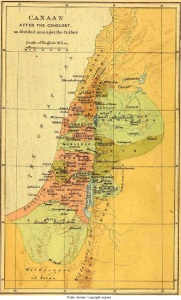
When the Hebrew people make their exodus from Egypt they are going back to the land that has been promised them by Yahweh. In today’s reading we arrive at the part in that story where several tribes have yet to realize their inheritance. Archaeologists have not found traces of the enormous migration described in scripture but what they dosee is evidence of cultures merging and reshaping as the peoples in the region struggle to survive through periods of famine and drought. The peoples sometimes unite against invaders. They sometimes strike out on their own to take over city-states and their surrounding territory.
Today we read about the precision and care the Israelites take in acquiring the land promised to them through the covenant established between Abraham and Yahweh. We also read about the care they take to include God’s influence and authority in their own plans. We might learn a good deal from this as we practice how to notput off taking steps to possess that which the Lord God has already given us.
We are given the gift of freedom; yet we sometimes allow ourselves to become trapped by the shackles we insist on acquiring.
We are given the gift of faith; yet we sometimes respond more to fear than reliance on God.
We are given the gift of hope; yet we sometimes sabotage our own possibilities of realizing potential.
We are given the gift of love; yet we sometimes hide this gift for fear of losing it.
We are given the gift of life everlasting; yet we sometimes cling more to life temporal in this world.
How much longer will you put off taking steps to possess the land which the Lord, the God of your fathers, has given you?
The Lord has promised us God’s care, God has assured us that we are the Lord’s, and God has already given us our inheritance. Do we abide with God in confident expectation? Do we take steps to explore and inhabit the land which God has promised? How much longer will we put off the taking of these steps?
The stakes:Taxes, coinage, control, weapons, debts, honor, the temple, the citadel, a gold shield weighing a thousand minas (a unit of money worth 60 shekels).
These are elements of today’s reading which took place just prior to the birth of Christ. We can unplug these names of ancient people and places to replace contemporary ones and yet the stakes and motivations have not changed in the millennia that have passed; human beings are, after all, creatures who struggle to survive and to maintain equilibrium and comfort levels. We never want to be off-balance or surprised. We want to be in control of our surroundings. We want to think that we have perfect understanding and skill in all we think, do and say. When this equilibrium is upset, we become anxious; and this anxiety leads to fear which has the potential to send us into devolution rather than evolution.
When mercenariesenter our lives we come undone in the sense that we begin to look for ways to solve our new and crushing problems from our own skill sets. In our urgency we forget to go to God and when this happens and our lives take on the characteristics we see in the activity we read about today.
When scoundrelsenter our lives they are so clever at hiding their manipulations that we begin to blame ourselves for all that seems wrong. In our confusion we forget that the one true measuring stick is Christ. When we doubt ourselves, we need only look to this word of God as a model.
When taxes or control or debt or temples or citadels become our idolswe fail ourselves and we allow these temporal entities to separate us from God.
When saving ourselves at all costs becomes our chief motivator we have lost our identity, for as children of God we need only have concern for our spiritual health. Once we tend to the life of our spirit, all else falls into place.
Let us be on the lookout for the scoundrels in our lives and when they appear, let us turn to the one true source that never fails us – the source that created us, sustains, protects and guides us. Let us turn to our God for only this one has the stamina, the capacity and the will to endure for eternity. All else vanishes into dust.
It is true that sometimes we are completely innocent of any wrongdoing and yet we suffer. One of the primary questions we ask as human beings is this: Why is it that things sometimes go so wrong for us and so right for others? We also ask: What have we done to deserve suffering and how do we cope without falling apart entirely? Some of us even ask: How long can I go on? Is life worth living?
Today we hear from Job, the man who suffers through no fault of his own. His fidelity attracts Satan’s notice and so he becomes an object of play in the devil’s evil game. Job describes with beautiful metaphors how quickly his friends abandon him, being undependable as a brook, as watercourses that run dry in wadies . . . [they are] caravans [that] turn aside from their routes [to] go into the desert and perish.
In today’s Gospel (Mark 7:31-37) we hear the story of how Jesus opens ears and a throat when he says words that he also says to us: Be open! In MAGNIFICAT, the mini-reflection for Morning Prayer reads: Jesus opened the ear of the deaf man that he might hear in a new startling way the word of salvation. What we hear as good news, we proclaim as good news: that is our task as disciples.
How we arrive at not hearing is not important; nor is the question about why we have become silent in our isolation. What is important is this: That one has come who releases all of us from our bondage – whether these chains have been acquired through our own action or inaction, or whether we are innocent slaves. One has come to call us to unity, and this one calls to each of us: Be open!
Be open to a surprising newness. Be open to pardoning and being pardoned. Be open to miracles in our lives. Be open to the amazing potential we possess. Be open to proclaiming the good news that we are free and need not toil futilely. Be open to the life of discipleship. Be open to union in Christ, with Christ himself. Be open.
This is easy to hear but difficult to do. We might turn again to Job who knows the pain of separation and also the joy of reunion.
Whether we suffer in innocence or through our own action or inaction, our reply to the one who created us can be the same. When we hear the voice that calls, let us all answer: We are open to the possibility that we might live again! This is our best human reply to the divine.
And this is the greatest miracle of all – that whether we suffer through guilt or whether we are innocent we can allbe open to God for we are all sought byGod for to each of us he says: Be open!
Cameron, Peter John. “Prayer for the Morning.” MAGNIFICAT. 6.9 (2009). Print.
The King of Aram cannot win against the God of Israel who speaks to the faithful through their prophet Elisha. As I read this story I too, wish that I had such a direct route to wisdom, and then I realize that I do. Today’s story of ambush is tempered with God’s pity for the Arameans, something we do not see often in the Old Testament. It is also a reminder that God abides with those who seek him in humility and trust, that when the faithful follow in fidelity, they too will benefit from a voice that advises them as if it has heard conversations in secret places that are meant to outwit God. Today we remember that God is everywhere, hearing everything, seeing everyone, knowing every thought. At first this can be unsettling – we realize that there is no part of us that we can hold separate from God. Later it is comforting – we realize that we do not want to be without this supreme intelligence and infinite mercy. We come to see that God’s presence – and our attentive ear tuned to God’s voice – is the only force which saves us from the ambushes plotted in secret places. We begin to comprehend the depth of God’s love for us.
When an ambush is sprung upon us, we might want to turn to Psalm 143 to intone its verses: My spirit faints within me; my heart within me is desolate.
When we feel as though all our own forces have been spent in enduring the onslaught, we say: I spread out my hands to you; my soul grasps to you like a thirsty land.
When we feel ourselves about to faint from the fear or anxiety which strangles us, we pray: O Lord, make haste to answer me; my spirit fails me; do not hide your face from me or I shall be like those who go down to the Pit.
We remember the times in the past when we have survived ambush by calling on God for help: I remember the time past; I muse upon your deeds; I consider the works of your hands.
We ask for God’s assistance: Revive me, O Lord, for your Name’s sake; for your righteousness’ sake, bring me out of trouble.
When we take ourselves away from panic and pain, we come to see that we too benefit from miracles brought to us through the words and actions of our own holy women and men. When we rely on the voice of God rather than the voices of society, we too become transformed by miracles that arrive as gifts from our loving God. And when we show mercy for those who have listened to their own advice rather than words from God, we too will see that no more raiders will come into our land.
God made a promise to Abraham to bring him descendants, renown and a land in which his progeny might be secure. In return, Abraham and his descendants were to obey God, worship him only, and keep to him always. Today we read about a time when the Promised Land is breaking into factions and falling into hostile hands. The covenant into which the chosen had entered has come undone; the descendants of Abraham have been taken into exile to be scattered by the four winds. All looks bleak and yet, God tells Jeremiah, redemption, healing, transformation and restoration are all possible. Indeed, all of this is at hand. This is how much God loves us.
Some few of us prefer the solitary life but most humans look for security in a landholding either individually or as part of a group. Private homes, rented and purchased apartments, communes, even tent cities of the homeless indicate this common yearning to have a place we call homeand in which we might be secure. Many of us go homefor a holiday. We look toward the end of a day when we might go home to kick off the worries of work to rejuvenate for the next morning. The people who had once known the protection and security of the pillar of fire and smoke in the desert now suffer the insecurity of not knowing where they will lay their head at night. They are vulnerable to the whims of capricious captors. The siege works have arrived at the city to breach it; the city will be handed over to the Chaldeans who are attacking it, amid sword, famine, and pestilence.
And what does God reply when his people ask to be rescued from these hopeless circumstances? Is anything impossible to me?
It is true that in the next portion of this story the people are handed over to their attackers as a consequence of their having abandoned the terms of their covenant with God. It is true that in this story God puts Israel out of sight for the incense they burned to Baal and the libations they poured to strange gods. It is also true that even as God promises to hand over the corrupt ones to the king of Babylon he also will gather the lost together from all lands to which they were banished. He will bring them back to the same place to settle them in safety. The Lord God says, they shall be my people and I will be their God. One heart and one way I will give them that they may hold me in awe always, to their own good and that of their children after them. I will make them an eternal covenant, never cease doing good to them; into their hearts I will put an overpowering love of me, that they may never depart from me. I will take delight in doing good to them: I will replant them firmly in this land, with all my heart and soul.
Perhaps the soul yearns for the security of a firm relationship with God just as the mind yearns for a pledge of land through which to be secure. Imagine what a world it might be if we sought the security of the pledge of the heart rather than a pledge of land.
We have spent a great deal of time with this portion of Sirach which deals with the value of constancy in relationships. Today we might focus on one verse: Happy is the one who finds a friend . . .
Too often we do not open ourselves to spiritual intimacy with one another; this assures momentary safety but ultimate loss. Being open to one another brings us more fully to the Holy Spirit and today’s MAGNIFICAT Meditationis about how this opening of self can be a two-edged sword: Let the word of God penetrate you as the division of soul and spirit, joints and marrow, to assay the thoughts and purposes of your heart. Then all secrets will lie open before you in a way you could never have dreamed. There is your inmost center the Spirit will scrutinize all, even the depths of God’s nature!
We are created to return home to God. We are created in a variety of looks, dreams, resources and gifts. When we open ourselves to God’s scrutiny we find our true depth, our true weaknesses and our true strengths. We fear knowing the worst and long to hear the best about ourselves and yet, in an odd way, when we hear the worst about ourselves we are able to rise to the best in ourselves. And this is what a true friendship can do – give us a safe harbor to reveal our inner self for loving scrutiny. This scrutiny brings us wisdom. This wisdom brings us peace. This peace is seen by many as we carry the voice of God into the world. This scrutiny is worth the price wrought by the two-edged sword which pierces to the joints and marrow, assaying the thoughts and purposes of our hearts.
Cameron, Peter John. “Meditation of the Day.” MAGNIFICAT. 22.9 (2009). Print.
Yesterday’s and today’s Noontimes are adapted from a reflection written on Armistice Day, November 11, 2008.
All the ends of the earth will worship the Lord; all the families of nations will bow down to you.
In this end which we see but whose time we cannot predict, God is all there is. The war of life will have been waged and won by God. Any influence of evil will disappear. This we have been promised.
I will live for the Lord; my descendants will serve you. The generation to come will be told of the Lord, that they may proclaim to a people yet unborn the deliverance you brought.
When miracles happen, we must proclaim them, thanking God. We must sing God’s praise continually for our blessings great and small because in spiritual warfare the fall of darkness and deceit is brought about in an accumulation of these small songs intone grand chorus. We also remember that the tiniest of miracles is significant for those to whom they have been granted, and these miracles are a sign of God’s continual presence in our lives.
In spiritual warfare we need not connive, we need not plot. We need only do what we know is right, understanding that we are graced by God. We need to avoid thinking that we are in control, knowing that God’s plan is always better than our own. We need to give over everything to God, believing that God turns all harm to good, even – and especially – the ultimateresolution of all conflict.
We are foot soldiers in spiritual warfare, and we know our orders. We must be patient in our perseverance as we grow to become God’s harvest in God’s time. We must speak, pray, study, witness, watch and wait. We must be ready. This is all that is required of us. We do not know the hour or time of this warfare’s end; but we know the outcome. This we have been promised. This we have been told. Let us pass the word along – that in the hour when we feel most abandoned, we are most accompanied. In the hour when we believe all is lost, all is truly found.
Tomorrow, a prayer for spiritual warfare.
For a Bible Study on Ephesians 6, click on the image above, or visit: http://www.biblestudytools.com/bible-study/topical-studies/spiritual-warfare-lesson-1-understanding-the-battle-11554631.html