Fear not. From the first day you made up your mind to acquire understanding and humble yourself before God, your prayer was heard.
The prophecy of Daniel is full of metaphor, symbolism and mystery and yet it is in this prophecy that we see the coming of the Son of Man predicted. (Daniel 7:13 and 8:17) Today we reprise the mysterious vision that presages so much fear and so much hope.
God says: I see that you are determined to follow me and this brings me joy. I also see the pitfalls and obstacles in your way and this brings me sorrow. I abide with you as always. I accompany you through fire, pain and death. I raise you up when you are fallen. I restore you when are spent. I rescue you when fire consumes you. Did I not save my servant Daniel? Are you not as important as he? Read this story of Daniel and humble yourself as Daniel does. Trust in me as this young man does. Acquire knowledge of me as this young prophet does for you are destined to be as significant as any prophet of mine in the days of old. Each of you is precious in my eyes. Each of you has the potential to prophesy for me. Each of you is welcome to take refuge in the limitless safety of my most sacred heart. When you shelter with me your smallness expands to the boundless horizons of my mind. When you remain in me your fears and anxieties become the sinews of my protective arms. When you act in me your tears and sorrows dissolve into mists that nourish the dry nights of the soul. Read about Daniel’s visions today, bring me requests, and give yourself hope for many tomorrows. Know that I hear every prayer you utter in the turmoil of the day, in the shadows of night, in the company for friends or in the solitary stillness of your heart.
To further explore the visions of Daniel, enter his name in the blog search bar and choose another reflection.
During Gottlieb Schumacher’s expedition of Megiddo, a rare seal was found with the inscription: “To Shema slave of Jeroboam”. This may be King Jeroboam II from 750BC.
Amos does not mince his words or couch them in easy metaphors; we can see why he was rejected. His message struck too quickly and too closely to the heart of those who by their actions did not live out the Mosaic Law of honoring the one true God. Amos lived during the reign of Jeroboam II (786-746 B.C.E.) and he pronounced his prophecy at the cult center of Bethel until the priest who was in charge of that royal sanctuary expelled him.
At this time, the northern kingdom of Israel had separated from the southern one of Judea and when we read closely we can see that the priests and the wealthy had succumbed to the lure of the power and control which their office as sacred ministers and leaders afforded them. Stated bluntly, they abused the gift and power given to them. They were more concerned about maintaining their control on the temple income derived from the people who brought their offerings as a part of their attempt to seek penance and union with God. The priests of Israel (the northern kingdom, also Samaria) had separated from Jerusalem (the southern seat of power and worship) and loved their position of wealth, plenty and power. Amos rebukes these fat, contented people just as Jesus did when he ejected the moneychangers from the temple.
Amos always understands that this perversion of the law is not permanent . . . as much as those in power may wish it to be. Amos knows that Yahweh will use this harm that the corrupt inflict on those over whom they have control . . . and he knows that Yahweh will turn this harm to good, just as he does with all things that are corrupting. Yahweh will use these stubborn acts of blindness and perversity to bring about restoration and ultimate union with God.
As with all prophets, Amos is reluctant to speak when called by God . . . yet speak he does . . . and oh, so beautifully. “His style is blunt and even offensive”. (Senior RG 362) He begins chapter 4 by calling the wealthy women cows, the wife of the priest, Amaziah, a harlot. “He is a prophet in the mold of Elijah, whose denunciations come close to cursing”. He saw himself as a poor shepherd and farmer with no influence and therefore saw no need to speak softly . . . as he did not expect to be heard. Amos pronounces doom on those who do not hear and those who are blind to their own actions, and then he goes back to his sheep and sycamores.
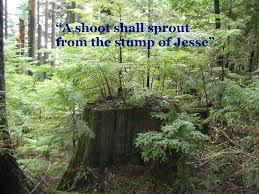
Amos’ offer of hope springs not from the idea that this doom and catastrophe for the controlling classes can be avoided, for it is clear that disaster is looming and in fact it does arrive in the form of the Assyrian invasion. No, the hope that Amos offers lies in the fallen hut of David, the Messiah who is to come . . . Jesus. Amos tells and foretells those who have ears to listen that we rebuke those who live in flagrant violation of the covenant and then we watch in hopeful waiting for the one who will come to deliver the justice that is so desperately needed. We wait in joyful expectation the kingdom where compassion and mercy merge with justice and righteousness, where we both rebuke and remain open to wonderful possibilities that can come only with tremendous hope.
I will bring about the restoration of my people Israel; they shall rebuild and inhabit their ruined cities, plant vineyards and drink the wine, set out gardens and eat the fruits. I will plant them upon their own ground; never again shall they be plucked from the land I have given them, say I, the Lord, your God.
Evidence and judgment, words and woes, threats and promises, visions of locusts, fire, the plummet, and the fruit basket, condemnation of priests and leaders, prophecy against greed and corruption, the final vision before the altar and then the winnowing sieve. This prophecy is too much to bear yet just as we are about to put aside forever its dark images and frightening premonition of doom . . . Amos leads us to the place he was always leading us. Amos brings us to the Christ, the Messiah.
God says: You most often find me in the dark valleys of your life for it is the failures, the betrayals, and corruption that bring you swiftly to my side. Just so does my prophet Amos warn you that my little ones must be shepherded. My lambs must be tended, my sheep must be led. Through the suffering, pain and sorrow I am with you. I have created you and you are mine. I have loved you and I will never leave you. I have already rescued you and placed you within the protective walls of my vineyard. You have been planted upon your own ground and you will never again be plucked from the place I have given you. Yours is the place of honor in my own sacred heart. This I have promised. This is the raising up you have been seeking. This is your raising up that is my gift to you this day.
How does the prophet Amos speak to us today? What foreshadowing does he share? What hope does he bring? What is his promise of raising up for you? When we consider our world today, many will say that we need the words of Amos more than ever. When we contemplate our surroundings, many will say that it is time to heed the prophecy that reminds us God is always raising us up.
Use your own commentary or one of the links below to learn a bit more about his prophecy.
This is what the Lord showed me: a basket of ripe fruit. “What do you see, Amos?” he asked. I answered, “A basket of ripe fruit”. Then the Lord said to me: The time is ripe to have done with my people Israel; I will forgive them no longer”.
Still the dreadful visions assault us – presenting a God who exacts punishment for acts of commission against the weak and vulnerable, for acts of omission for the times we have not answered God’s call. These images conjure up our worst fears. We do not like the ugliness of these scenes. We shrink from the exacting accountability that challenges us. We reject this God of terror and fear.
God says: My servant Amos was not an eager prophet – he preferred to tend his flocks of sheep and prune his orchards of sycamore trees – yet he answered my call. These visions are not meant to frighten you but they are a reality we must confront with honesty. My heart yearns to soften those hearts of stone that subjugate the vulnerable, those stiff necks that turn away from my lambs who suffer. My arms take up all those who run or fly to me. I mean to inspire love, awe and joy. These cruel visions are not my hope for you; rather, they are a genuine reflection of the viciousness that is always an option before you. They are the cruelness each of you may choose if you choose the evil road. Look into your own hearts. Turn away from this violence and come to me.
What is the ripe fruit we offer to God? How do we answer God’s call?
“Peter is the saint in the Gospels who is most like us, the closest to our humanity, and yet also very close to Christ. We can always follow Peter. He always leads us to Jesus, he unites us to Jesus, because he never permitted his own frailty to separate his heart from Christ, even when he denied him”.
Dom Mauro Giuseppe Lepori, O. Cist. (Cameron)
We have been exploring the prophecy of Amos, a difficult and sometimes abrasive lesson to hear; and an even more difficult message to enact. Yet this is precisely the example that Peter provides for us today. A man who leaves all to follow the one who is all. A man who at first disbelieves the words he hears who eventually becomes so close to that Word that he gives even his life to live in eternal union with Christ. In this canticle from Peter’s first letter we find convincing evidence that we need to take the words of Amos to heart. We find the consummate example of how to live authentically, how to witness and how to find the narrow yet sure path that leads to God.
Let us spend some time today with Peter’s words in the first of his letters. Let us consider how these words call us to dissect the prophecy of Amos. And let us turn all of our suffering over to Christ who best knows howand when and whywe suffer.
Enter the word Peterinto the blog search bar to find more reflections on how this simple man calls each of us to a greatness that lasts forever.
The Lord will roar from Zion, and from Jerusalem raise his voice: the pastures of the shepherds will languish, and the summit of the Carmel wither.
As the sacred high place of Carmelwithers and the simple shepherds suffer, God roars out a warning through the prophet Amos. What is it that we hear?
God says: You ask for my wisdom and I give it to you; yet you pause for my words do not always match your desire. You ask for my consolation and I bestow it on you; yet you mourn for what you do not have. You ask for redemption and I breathe new life into you; yet you hesitate . . . for you struggle to cast off your old complaints. They have become too familiar and too comfortable to you.
Amos challenges us today to listen for the roar of the lion, to tend to the altar on Carmel, to restore the shepherds to their flocks and fields. Where in our own lives do crops waste away and the sacred places fall silent?
If we have no commentary to explore the opening verses of Amos, we might use one the the following online.
What do we know about the prophet Amos? When we seek we will find that . . .
He described himself as a shepherd and farmer who tended to sycamore trees;
His strong verbal skills imply that he was more than an ignorant peasant;
He did not consider himself to be a professional prophet; he did not make a living proclaiming oracles to a patron who paid to hear what he wanted to hear;
He lived in Tekoa, a town about 11 miles south of Jerusalem;
He centered his ministry around Bethel, a major city in the north of Israel where many of the upper classes of the northern kingdom worshiped;
He lived during the reigns of Jeroboam IIof Israel and Uzziah of Judah, 760-750 B.C.E., an era of unusual prosperity;
He brought a message of warning to the wealthy and powerful that they must come to see that their wealth had lured them into spiritual complacency and ethical laxity;
He warned his audience that judgment would be exacted for the actions of the strong against the weak. (Zondervan 1444-1445)
There is heavy emphasis on social justice in this prophecy and those of us today who live in first-world cultures do well to spend time contemplating the words and thoughts of Amos. What do we who are comfortable do for those who are not? How do we have much enact God’s Word for those who have little? Who are the peasants among us who ask for our introspection, our witness, our voices, and our action? In the time of pandemic and social unrest, how do we reflect the God who created us?
If we spend time today with the words of Amos and a solid commentary or other resource, we will hear God speak to us in our innermost refuge where we go to forget the woes of the world. If we spend time with the poetry of Amos today, we will experience the message of healing and restoration this prophet still brings to the faithful who seek God’s wisdom, to the faithful who yearn to bear fruit.
Tomorrow, an exhortation to return to God.
Adapted from a post written on September 14, 2013.
“Amos was a shepherd ofTekoain Judah, who exercised his ministry during the prosperous reign ofJeroboam II(786-746 B.C.). He prophesied in Israel at the great cult center ofBethel, from which he was finally expelled by the priest in charge of this royal sanctuary. The poetry of Amos, who denounces the hollow prosperity of the northern kingdom, is filled with imagery and language taken from his own pastoral background. The book is an anthology of his oracles and was compiled either by the prophet or by some of his disciples”. (Senior 1126)
“Amos is the earliest of prophets who have books in their names. In fact, his oracles were transmitted orally, and only collected in book form much later . . . We know very little about the career of Amos . . . He was an independent agent. He was a shepherd and a dresser of sycamores (the fruit, resembling a fig, had to be tended in order to prevent insects from destroying it), and so had his own means. He did not depend on king or priest for support, and so was not beholden to them, and did not require their permission to prophesy. This independence left him free to speak the truth as he saw it, without political constraint”. (Senior RG 361-362)
The words and life of Amos charge us to speak without constraint. What do we do with and in our lives to live in this independence?
The oracles and visions of Amos show us the possibility of a world that delivers justice and mercy without constraint. How do we act and speak to live in this possibility?
The woes and joys of Amos guide us in the way that Jesus comes to lead us. How eager are we to follow in the witnessing we are called to perform without constraint?
False oaths, fake alliances, evil intrigues, any means to achieve an end: this is what Hosea sees in his community. The kingdom of David has been divided in two. Elijah, Elisha, and Amoshave warned the people; Isaiahand Micahwill add their prophetic words of warning. Hosea finds himself seeing clearly the devastation that awaits this false-hearted people. He is ignored.
Yet . . . Hosea persists, telling us that we are people meant to worship God, meant to take the yoke upon fair neck, to thresh, to be harnessed by the plow of the true God with a true heart. We are created to be workers in the vineyard, to sow justice and reap piety, we are meant to break new fields so that the rain of God’s justice might bring forth new fruit.
Hosea warns that those who have sown discord and wickedness will reap perversity and eat of the fruit of falsehood. Turmoil will break out among those who have trusted their warriors and chariots rather than trusting God. The fortresses carefully built against the needs of the world will be tumbled and ravaged; the false hearts who take advantage of the poor will be lost in the utter destruction. Hosea predicts all of this and does not succumb to the darkness of the world. He does not surrender to the pressures around him, he endures.
Like Hosea, we might want God’s justice to be clearly visible in the present; we may want all of Hosea’s predictions about false hearts to materialize in an instant. Those who seek a settling of scores may wish God’s integrity to rain down on those who sit on comfortable couches to contrive wicked plots. They will want to see a world of integrity replace the world of falsehood they experience. Yet this is the message of Christ: God has sent one of true heart and true words, one of promises kept and miracles revealed. God has sent Jesus to live among us. Lent tells us that the possibility of living a genuine life is here – now – this day. We need only turn to God and to open our eyes to see.
If we are dissatisfied with the speed of God’s coming or if we doubt that God is even here among us, we must look first to ourselves to begin kingdom-building. We must examine our own hearts to see if we remain in truth no matter the social consequence. We must cease the gossip, cease the controlling, and cease the lusting after outcomes, fame, possessions, power and people. We must amend our ability – and our willingness – to ignore reality. We must change our hearts so that we do not succumb to the social pressure to acquire goods, dominance or a sense of superiority. We must nurture our desire to share, our yearning to heal, and our aspiration for peace. We must ask God to transform the falsehood in our own hearts so that we might receive goodness from God. We must be open to the reality of the Lenten message that all are welcome. Welcome into Christ’s own, open heart.
With endurance, with fidelity, and with honesty the prophecy of Hosea will fully arrive. And thus the false hearts of the world will become the true heart of Christ.