Blessed are they who hunger and thirst for righteousness, for they will be satisfied. (Matthew’saccount of the Sermon on the Mount)
Blessed are you who are now hungry, for you will be satisfied. (Luke’s account of the Sermon on the Plain)
God says: Food and water are essential tosustain human life. It is for this reason that I sent manna to the desert and poured forth water from a rock in the dry and difficult journey my children made to the Promised Land. It is for this reason that I open human minds to possibility through scientific discoveries. It is for this reason that I call those of you who have plenty to be good stewards of my gifts and to share them. When have you seen me naked and alone, hungry and thirsty? When you have seen the least of my children you have seen me. When you satisfy these need, you discover my righteousness. When you share what you have . . . you receive far more that you give.
As we continue our Beatitudes thanksgiving, we might consider giving alms to an organization whose mission is to secure clean water for God’s miraculous creation. We might sponsor a child or her family in a third-world culture to assure she has enough to eat. We might also join our voices in solidarity with others to raise public awareness of food and water shortages on our planet. We might sign a petition, write to a legislative representative, or begin a blog. We might pray for both those who live on the margins of human society and those who marginalize the powerless. In any case, we will want to do as the Gospel encourages us to do, stand as one with those who hunger and thirst.
Tomorrow, rejoice and be glad!
Click on the images for local and global information and opportunities. For news about the United Nations Zero Hunger Challenge, click the image to the left or visit: http://www.un.org/en/zerohunger/#&panel1-1
We have reflected on some of the many names of Jesus; we have considered how we name ourselves as his followers and how we find Christ within. Through this Holy Week we will examine the inverted nature of the Kingdom that Jesus calls each of us to join.
Blessed are the poor in spirit, for theirs is the kingdom of heaven. (Matthew’s account of the Sermon on the Mount)
Blessed are you who are poor, for the kingdom of God is yours. (Luke’s account of the Sermon on the Plain)
God says: When you are at your lowest ebb, consider that you have your greatest strength – in me. Consider that when you have nothing, you have all – in me. Also consider this . . . when you have an abundance of joy and a surfeit of goods, you do well to consider sharing them intentionally, thoughtfully and prudently with those who do not. Such is the nature of my kingdom.
To see a Beatitudes video, click on the image above or visit: https://www.lds.org/bible-videos/videos/sermon-on-the-mount-the-beatitudes?lang=eng
Károly Ferenczy: The Sermon on the Mount
Then, explore options for improving the life of someone who is financially or spiritually poor, and offer God’s abundance as a healing, hope-filled action.
In today’s Gospel we hear that Jesus made a whip out of cords and then used it to drive moneychangers out of a sacred place of worship. As we read Jesus’ words, we might consider how we have cluttered our hearts with sacrifices that mean little or with the bargains we hope to exact from a loving God.
Take these [doves] out of here, and stop making my Father’s house a marketplace.
As we read Jesus’ words we might consider our willingness to give over the false temples we have constructed to the cleansing, healing hands of Christ.
Destroy this temple and in three days I will raise it up.
As we read John’s words we might consider God’s great generosity and mercy.
Many began to believe in [Jesus’] name when they saw the signs he was doing. But Jesus would not trust himself to them because he knew them all, and did not need anyone to testify about human nature. He himself understood it well.
As we read John’s words we might consider how we might begin to cleanse our hearts and minds, and how we might willingly offer them up for destruction.
Learn about Regina at the Women for Women site
Study El Greco’s rendering of Christ Cleansing the Temple above, then explore the sites below and determine if there is an appropriate action we might take toward removing the marketplace from our temples and releasing the captive doves.
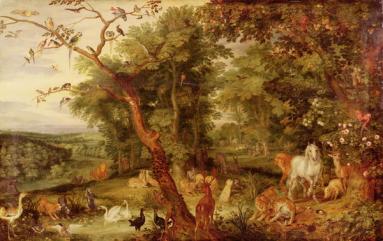
Jan Brueghel: The Temptation in the Garden of Eden
Friday, March 4, 2022
God created humans in God’ image; male and female God created them. God blessed them saying, “Be fertile and multiply; fill the earth and subdue it”.
On this first Friday in Lent, we contemplate the abundant gifts and mysteries of our planet. We ask for wisdom to use Mother Earth’s resources prudently. Today as we reflect we might read about or watch part of a Frontline episode and determine how we can improve the health of the Chesapeake Bay or the world’s rain forests.
When Jesus stills a sudden storm, his followers ask in amazement, “What kind of a man is this, that even the winds and the sea obey him?” Read this story in Matthew 8:23-27 or in Luke 8:22-25 and consider our complex relationship with the natural world and how we characterize our human dominion over earth’s resources.
In today’s Gospel we hear a clear call to rise to our own potential, to experience our own transfiguration. Since Ash Wednesday we have looked at the early books in the Old Testament to examine our earliest human ideas of the Living God and the special relationship we experience with this deity. This is a God who is not distant or removed; rather, the Lord accompanies us always in all places.
As we read the Gospel at the link above, we consider whether we live outside or inside the Lord’s camp, we consider where and how we find strength, and we examine our own sense of devotion to the Lord. As we reflect on both the Gospel and the ideas brought forward in our Lenten reflections, we consider how we might be transfigured in Christ, and how we might become – or continue to be – good and faithful servants to this Living God. And we determine to bring God to one another as we engage in social justice work.
As we scroll back through the last few weeks of The Noontimes, we linger with those that open the possibility of transfiguration to us in this Easter season.
Raphael’s painting of the transfiguration was comissioned by Cardinal Giulio de Medici who later became Pope Clement VII. To learn more about the painting and the painter, click on the image.
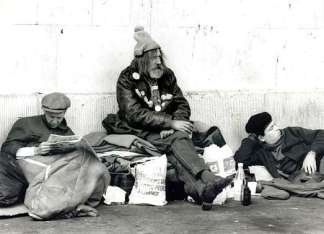
To learn how we might transfigure our own lives by helping the marginalized, we might learn about the homeless by following the link connected to the image to the left. We might also learn how we can change our lives to include the homeless in a positive way at: http://www.tillhecomes.org/how-to-help-homeless-people/
The Lord said to Samuel, “For I have witnessed their misery and accept their cry for help”.
Yahweh leads the Hebrew nation from slavery to freedom. The Lord guides Joshua as the tribes move into a promised land. God continues to abide with the faithful as they struggle through cycles in which they abandon God and return. We see God’s infinite capacity to heal and restore throughout the Old Testament. When Jesus arrives to incarnate God’s Word we are given a leader to follow, a brother to lean on, a vision of the world as it might be.
Matthew tells us in his Gospel: Seeing the people, Jesus felt compassion for them, because they were distressed and dispirited like sheep without a shepherd. (Matthew 9:36)
Mark tells us how Jesus feeds thousands from very little because of the compassion he feels for the faithful. In those days, when there was again a large crowd and they had nothing to eat,Jesus called His disciples and said to them,“I feel compassion for the people because they have remained with me now three days and have nothing to eat. If I send them away hungry to their homes, they will faint on the way; and some of them have come from a great distance.”(Mark 8:1-3. Read more of this story at Mark 8:1-13)
The message is clear. When we suffer distress, we must call on God. When we see others who suffer, we must do all that we can to relieve their plight. In this way we deepen our relationships with others and with God. In this way we prepare for the Easter promise. In this way we become Christ for one another.
If there is time today, read more of the story about how Samuel listens to God’s word. Or spend time with the Gospels looking for signs of God’s care for us today.
To learn more about the plight of the homeless and how we might feed them, click on the image above or visit: http://www.mohmsplace.org/2012/06/feeding-multitude.html
Psalm 13:1: Howlong, O Lord? Will you forget me forever? How long will you hide your face from me?
In yesterday’s Noontimewe gathered our prayers and petitions to carry them to the one who holds all the answers. Today we gather ourselves to listen to the Word of God.
Ephesians 2:13: In Christ Jesus you who once were far off have become near.
Paul answers our question of how long we must wait for God to appearwhen he reminds us that Christ answers our plea with unquestioning patience, indomitable mercy and limitless love. Jesus replies swiftly with his own presence, and with his invitation to join him in his union with the creator. Today we gather ourselves to hear the Word of God.
Luke 10:1-9: The Lord Jesus appointed seventy-two other disciples whom he sent ahead of him in pairs to every town and place he intended to visit. He said to them, “The harvest is abundant but the laborers few . . . Go on your way; behold, I am sending you like lambs among wolves. Carry no money bag, no sack, no sandals; and greet no one along the way”.
God answers our petition for help by asking us to trust in the plan laid out for our rescue. Today we gather to accept God’s invitation to join in the vital work of the harvest.
Psalm 94:3: How long shall the wicked, O Lord, how long shall the wicked exult?
We have asked how long our suffering will endure . . . and the response to this question is not a pat answer that tells us how many days or weeks or years or eons we must wait for God’s justice to prevail. A close reading of the Gospels tells us what we already know. In the person of Jesus we have all the answer we might need. In our finite world we look for finite solutions and well-defined answers that content us for today, but that have no place in God’s infinite world. In our apocalyptic view of the world we seek a justice that will measure out punishment and reward as if we were all small children, but God asks us to step into something much bigger than the little window we have on the God’s justice.
Psalm 13:1: Howlong, O Lord? Will you forget me forever? How long will you hide your face from me?
God does not hide from us. God is with us constantly and everywhere in the person of the rescuing Jesus. God does not forget us. God is within and around us in the person of the healing Spirit. God does not lose hope in us. God protects and guides, cajoles and upholds, saves and teaches, heals and loves us more than we can understand. Despite our faults and infidelities, God persists in waiting, calling, blessing, forgiving and loving.
Psalm 74:9: We do not see our signs; there is no longer any prophet, nor is there any among us who knows how long.
There is no need to ask how long; there is no need to despair for we already have God’s response . . . the surety that God dwells within us, asking for our trust and fidelity, forgiving our missteps and misgivings, calling us to great love and great mercy. In our darkest moment and in our deepest grief . . . God has not been distant or hiding. God has been quite near.
Let us move into the world around us . . . and act in a way that confirms our trust in God.
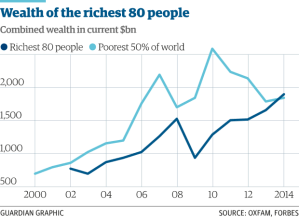
In 2015, Oxfam produced a study indicating that next year one percent of the world’s population will hold more than half of the world’s wealth. The hungry, the impoverished, the homeless may well ask How Long of God as they manage their daily survival. Read the two views at the links below, and reflect on how each of us might be the presence of God to the marginalized.
The prophets chronicle a people’s yearning for union with their creator and un uncanny understanding of their own vulnerabilities.Their words warn, threaten, exhort, and promise us that God is always present, even though we may not recognize this presence. The Old Testament prophecies foreshadow the good news of the New Testament, and they remind us that no matter our circumstance God’s joy rescues us from sure destruction, Christ’s joy redeems us from our recklessness, and the Spirit’s joy heals us despite the gravity of our wounds. Today Amos brings the past into focus with the present as he foretells the joy we might find even in the bitterness of our own indictment.
Amos was a shepherd “who exercised his ministry during the prosperous reign of Jeroboam II (786-746 B.C.). He prophesied in Israel at the great cult center of Bethel, from which he was finally expelled by the priest in charge of this royal sanctuary . . . In common with the other prophets Amos knew that divine punishment in never completely destructive; it is part of the hidden plan of God to bring salvation to men. The perversity of the human will may retard, but it cannot totally frustrate, this design of a loving God”. (Senior 1126)
Amos 8:10: And I will turn your parties into times of mourning, and your songs of joy will be turned to cries of despair. You will wear funeral clothes and shave your heads as signs of sorrow, as if your only son had died; bitter, bitter will be that day.
More than any other prophet, Amos “speaks directly to the issue of social justice, with a vigor unparalleled anywhere in the Bible . . . No prophet is more easily related to the modern world than Amos, for the social inequities that he denounced in the eighth-century B.C. Israel are still very much with us . . . The first lesson to be learned from Amos is that social justice is the business of religion. The test of piety is what happens in the marketplace rather than what happens in the church or temple”. (Senior RG 365-366)
Amos 5:18: You say, ‘If only the Day of the Lord were here, for then God would deliver us from all our foes.’ But you have no idea what you ask. For that day will not be light and prosperity, but darkness and doom! How terrible the darkness will be for you; not a ray of joy or hope will shine.
Amos witnesses to the corruption and hypocrisy he sees before him. He is expelled from the temple community and then returns to his orchards and flocks but before he goes back to his work, he warns his listeners of the bitter day they hope to avoid, knowing that ultimately – as is always true with God – the joy opportunity for salvation surprises us even as we hear our own bitter indictment.
Senior, Donald, ed. THE CATHOLIC STUDY BIBLE. New York, Oxford University Press, 1990. 1126, RG 365-366. Print.
If this week’s Noontimes call you to search for more ways to encounter Joy or urges you to investigate the New Testament, click on the word Joy in the categories cloud in the blog’s right hand sidebar and choose a reflection, or enter those words in the blog search bar.

 God says: Food and water are essential to sustain human life. It is for this reason that I sent manna to the desert and poured forth water from a rock in the dry and difficult journey my children made to the Promised Land. It is for this reason that I open human minds to possibility through scientific discoveries. It is for this reason that I call those of you who have plenty to be good stewards of my gifts and to share them. When have you seen me naked and alone, hungry and thirsty? When you have seen the least of my children you have seen me. When you satisfy these need, you discover my righteousness. When you share what you have . . . you receive far more that you give.
 As we continue our Beatitudes thanksgiving, we might consider giving alms to an organization whose mission is to secure clean water for God’s miraculous creation. We might sponsor a child or her family in a third-world culture to assure she has enough to eat. We might also join our voices in solidarity with others to raise public awareness of food and water shortages on our planet. We might sign a petition, write to a legislative representative, or begin a blog. We might pray for both those who live on the margins of human society and those who marginalize the powerless. In any case, we will want to do as the Gospel encourages us to do, stand as one with those who hunger and thirst.
 Click on the images for local and global information and opportunities. For news about the United Nations Zero Hunger Challenge, click the image to the left or visit: http://www.un.org/en/zerohunger/#&panel1-1










 The Noontimes