We reflect on the story of the early apostles (Acts 5) as they remain faithful to Christ while suffering and rejoicing with equal energy and passion. When we open ourselves to God’s generosity, we come away refreshed and encouraged with the news that when we respond to the call to do God’s work, we know that we quickly find God in the obstacles that surround us. We know that we are Rocks in company with Peter; we know that we can serve as foundations of the living temple; we see that we are able confront corrupt authority; we can rejoice in our suffering to bringing truth and light to the world.
When we reflect on this story, we understand that a small group of the faithful, through the power and love of the risen Christ, successfully challenges the old guard. We realize that the Sadducees are afraid to order a sentence of death on these Jesus-followers because they fear the people will revolt. They fear the power of the Spirit.
There is irony in this story. Those who inflict fear on others eventually experience fear themselves. This we see the power of the Spirit unfold, rising from fear to bring us peace. This,we begin to understand, is the gift of salvific suffering.
And so today we ask ourselves, what do we fear, and why?
Tomorrow, how do we suffer with Christ?
Adapted from a Favorite written in November 10, 2007.
When we spend time opening Acts 5, and when we watch and listen to Peter, we discover how we might apply The Word to our lives.
We watch the apostles slip unseen from their prison, moving through locked gates and past watchful guards.
Do we ask Christ to open doors and safeguard us? Do we trust the Spirit who calls us?
The apostles go immediately to the Temple to proclaim the wonderful news that they were able to heal in Jesus’ name, the name of the man whom they taunted a few short weeks before as he hung on the cross.
Do we share with others the Good News of Christ’s movement in our lives? Do we celebrate our small victories and rejoice in the Spirit’s healing?
We follow the apostles as they brilliantly and boldly – and in every way like Christ – reply to the Sadducees that they cannot still their tongues or cease healing. We hear them defy this wealthy group of men who collaborate with the Romans and supervise the rebuilding of the stone Temple.
Do we react with courage when others accuse us unjustly? Do we trust the Spirit to send us her wisdom and grace?
We hear the apostles as they witness to Christ when they say – as we all are called to say: Whether it is right in the sight of God, you be the judges. It is impossible for us not to speak about what we have seen and heard.
Do we speak as these apostles speak? Do we listen as these apostles listen? Do we act as these apostles act?
Today we spend time with The Word as we learn how to celebrate our mourning.
This is a beautiful idea that reminds us that we are called to be living stones in the living temple of Christ. The letters of Peter are full of wonderfully good advice about how to build a Christian community and this is no surprise. Peter is The Rock on whom Christ builds his church. Peter denied Christ three times during the Passion, as Christ himself predicted, but he bridges any gap he had created by following Christ so ardently. Today we examine Peter’s suffering to learn how we might also learn to suffer well.
Studying The Acts of the Apostles slowly is refreshing if we can give ourselves the space and time to reflect deliberately and carefully on the story of the passion with which the first Christians feel Christ’s presence after his death. When we believe ourselves to be in dire straits, we really only need turn to this story. It reveals so much about the hope we called to live joyfully.
In Chapter 5, Ananais and Sapphira are struck dead by the Lord for withholding the gifts given to them. We hear about the second trial and imprisonment of the apostles, their mystical release by the angel of God, and rabbi Gamaliel’s wise argument to let the apostles go with a flogging – rather than execution – because if their work comes from God, you will be able to destroy them; you may even find yourself fighting against God.
At the end of this chapter we see the apostles return to their community and we find them rejoicing that they had been found worthy to suffer dishonor for the sake of the name. And all day long, both at the temple and in their homes, they did not stop teaching and proclaiming the Messiah, Jesus – even though the authorities warn them to cease healing in Jesus’ name.
Today we reflect on our opportunities to suffer as early church members did. We examine the zeal with which we carry out our own story of Christ’s hope and resurrection. We explore the choices we see in Acts 5 as we consider the words of Peter. And we begin to understand that we are each free to choose if and how we will suffer well.
Peter and John heal a crippled beggar (Acts 3) and when the crowd erupts with wonder, they explain that the miracle takes place only throughthem, and not because of them. It is the Messiah, crucified earlier, who brings about this marvelous cure. (See yesterday’s Noontime.) The commotion brings attention from the authorities who arrest the pair. Peter and John find themselves in prison, and finally they stand before the Sanhedrin. The authorities ask, “By what power or by what name did you do this?”
Peter, filled with the Holy Spirit, said to them, “Rulers of the people and elders, let it be known that this man is standing before you in good health by the name of Jesus Christ of Nazareth, whom you crucified, whom God raised from the dead.
There is no doubt that these words shock his listeners, but Peter further explains, “There is salvation in no one else, for there is no other name under heaven given among mortals by which we must be saved.”
If we read more of this story, we find that this series of events brings more followers to this small community. If we reflect on this story, we discover the marvel of God’s love and the power of Christ’s authority. If we pray with this story, we discover that we too, are filled with the healing presence of the Holy Spirit. What miracles might we bring to others when we allow ourselves to be conduits of God’s love?
Tomorrow, Peter’s fourth sermon following Pentecost.
When we use the scripture link and drop-down menus to explore this sermon, we allow ourselves to be filled with the Holy Spirit.
In this Eastertide, we spend time with the Gospels of the Easter Octave, the eight days comprising the celebration of Easter. We hear Luke’s account of what takes place when the Emmaus disciples return to Jerusalem. Once again, when we reflect on a few details, the story becomes vital to our understanding the mystery and miracle of Easter.
First, we choose a translation that speaks to us most clearly. Then we reflect. If we want to hear an audio version of today’s verses, visit the USCCB site. We may find other versions by using the scripture link and drop-down menus.
In the MESSAGE translation, Cleopas and his companion went over everything that happened on the road and how they recognized him when he broke the bread.
Can we imagine ourselves listening to our colleagues as they tell us that they have witnessed a miracle? Can we envision our conversation with family and friends as we hear about their incredible interaction with the risen Christ?
While they were saying all this, Jesus appeared to them and said, “Peace be with you.” They thought they were seeing a ghost and were scared half to death.
Can we predict our reaction to the appearance of Christ among us? What do we say when we share a meal with him? Is our overwhelming emotion fear? Do suspicion and doubt take over? Do anxiety and disbelief crowd our hearts? And then we hear Jesus’ words.
“Don’t be upset, and don’t let all these doubting questions take over. Look at my hands; look at my feet—it’s really me. Touch me. Look me over from head to toe. A ghost doesn’t have muscle and bone like this.”
How do we reply?
They still couldn’t believe what they were seeing. It was too much; it seemed too good to be true.
We are startled to hear the Teacher ask: “Do you have any food here?” They gave him a piece of leftover fish they had cooked. He took it and ate it right before their eyes.
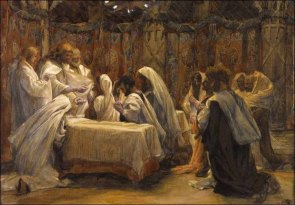
Duccio di Buoninsegna: Christ Appears to the Disciples at the Table
If we persist in a thick-headed and slow-hearted reaction, we look for ways to unravel the fraud we suspect. If we are reluctant and discouraged, we listen and watch warily, looking for reasons to doubt. If we remain hopeful and determined, we open our minds and hearts as we prepare to love and be loved. We listen to Christ’s words. We accept the joyful newness that asks to change our thinking.
Jesus says, “Everything I told you while I was with you comes to this: All the things written about me in the Law of Moses, in the Prophets, and in the Psalms have to be fulfilled. You’re the first to hear and see it. You’re the witnesses”.
We cannot do this, we are thinking. We do not have the courage or the tools. This newness is all too new, and too incredible for belief. Until Christ tells us . . . “What comes next is very important: I am sending what my Father promised to you, so stay here in the city until he arrives, until you’re equipped with power from on high”.
Christ predicts the arrival and in-dwelling of the Holy Spirit. Christ offers a gift too amazing to believe. Christ proposes a life too wonderful, too mystifying, too marvelous to believe. And yet . . .
Christ stands in the midst of us, sharing our meals, attending to our fears and doubts. Christ has fulfilled the promise of redemption made by the Living God for millennia. The choice is ours to make. Do we turn inward in our doubt? Or do we open in newness to accept the fulfillment of the promise we are offered?
For other posts on the story ofEmmaus, enter the word into the blog search bar and explore.
In this Eastertide, we spend time with the Gospels of the Easter Octave, the eight days comprising the celebration of Easter. We again hear Luke’s story of the road to Emmaus. Today we look again at a few details that bring this story into the present. First, we choose a translation that speaks to us most clearly. Then we reflect. If we want to hear an audio version of today’s verses, visit the USCCB site. We may find other versions by using the scripture link and drop-down menus.
In the MESSAGE translation, the story of Cleopas and his companion, and their astounding encounter with the risen Christ, carries the subtitle A Ghost Doesn’t Have Muscle and Bone. We want to remember this today as we face a world that is eager to distract us for the message we need to hear.
They were deep in conversation, going over all these things that had happened.
We can imagine ourselves moving through our day, walking side-by-side with friends and family, hashing out surprising events that have stunned our community. Too often we are so fully involved in our own story, we do not notice the stories of others.
They were not able to recognize who [Jesus] was.
We can see ourselves as lovers of Christ and believers in his promise; yet we are not always able to see the truth that stands before us.
Then he said to them, “So thick-headed! So slow-hearted! Why can’t you simply believe all that the prophets said? Don’t you see that these things had to happen, that the Messiah had to suffer and only then enter into his glory?”
We are thick-headed and slow-hearted, reluctant and discouraged; yet we remain hopeful and determined, prepared to be loved.
He acted as if he were going on but they pressed him: “Stay and have supper with us. It’s nearly evening; the day is done.”
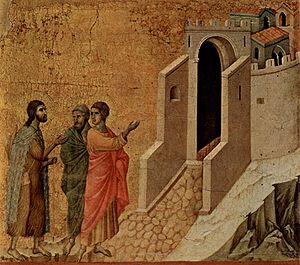
Duccio: Emmaus Detail
We are ready for the newness despite the lateness of the hour. We invite the prophets among us to share their experience of God. We remain open to the Holy Spirit and the gift of new and intense joy.
And here is what happened: He sat down at the table with them. Taking the bread, he blessed and broke and gave it to them. At that moment, open-eyed, wide-eyed, they recognized him.
This is how we must go into the world each day, open-eyed and wide-eyed. We must be willing to be amazed. We must be open to the promise. We must be ready to meet the Christ when we are downcast and least expecting to believe that this fact is true . . . A Ghost Doesn’t Have Muscle and Bone.
For other posts on the story of Emmaus, enter the word into the blog search bar and explore.
In the Torah, we find an early description of God, by God.
God said, “I am who I am. You must tell them: ‘The one who is called I AM has sent me to you.’” (GNT)
In the Torah, we find an early depiction of God as multiverse.
God said to Moses, “I-AM-WHO-I-AM. Tell the People of Israel, ‘I-AM sent me to you.’” (MSG)
In John’s Gospel of Christ’s story, we find Jesus’ own words tell us who he is. “I am the bread of life, the light of the world, the door through which all who yearn to be saved will enter. I am the good shepherd, the resurrection, the way, the truth and the life. I am the vine, you are the branches”.(John 6:35, 8:12, 10:9, 10:11, 11:25, 14:6, 15:5)
God says: The world around you tells you that you are small and that you have much to fear; but this is not so. Although the universe seems like a macrocosm to you, believe me when I say that is it in fact a microcosm in which you are central and essential. My life without you is a great void. My life with you is joy, and light and peace. I know that my essence to you is mystery and that is as it must be. I ask that you bring all that you are to me. Bring your sorrows along with your joys. Bring your anxiety along with your celebrations. Bring every molecule so that I might bring it into union with me and my multiverse. There is life eternal in me. Believe all that you have heard from my servant John. Believe all that your faith suggests, all that your hope proposes and all that your love intends. Bring all to me so you might live eternally with the beautiful mystery of my multiverse.
Paul and John have written letters to us so that we might believe. In this Eastertide, let us spend time with these verses so that we might truly believe.
The headwaters of the Yangtse River – a river that flows into the East China Sea
Wednesday, April 17, 2024
The earth is immense. Seven continents, five oceans, 165 major rivers, countless valleys.
I will make rivers flow among barren hills and springs of water run in the valleys.
I will turn the desert into pools of water and the dry land into flowing springs.(GNT)
Millennia ago early peoples knew the importance of rivers with their life-giving cycles of flood and recession.
I will open rivers on the bare heights, and fountains in the midst of the valleys;
I will make the wilderness a pool of water, and the dry land springs of water.(NRSV)
Modern humans have tried to harness the power of water in their search for sources of energy.
I will open up rivers on the barren hills
and wells down in the broad valleys.
I will turn the desert into a lake
and dry ground into springs. (CJB)
Ancient humans understood the potential for life found in life-giving rivers and the valleys through which they flowed.
Waipi’o Valley, Hawaii, USA
I’ll open up rivers for them on the barren hills, spout fountains in the valleys.
I’ll turn the baked-clay badlands into a cool pond, the waterless waste into splashing creeks.(MSG)
Today we reflect on the status of the world’s rivers and the valleys they nourish, and we pray for the courage to protect and defend this system of life-giving arteries that sustains God’s creation.
For a list of the oldest rivers on the planet, click on the image of the Yangtse headwaters.
For images of the some of the world’s beautiful valleys, click on the image of the Waipi’o Valley.
For more on the rivers of the world, visit these sites.
As we close our reflections on Jesus’ teaching with the Parable of the Tenants, we look at Luke 20, a chapter that describes for us how the people who followed Jesus loved him, and how the leaders of his day despised him.
Luke places this parable in a context that calls us to action. When we spend time with Luke 20 today, we have the opportunity to reflect on this progression of stories: Jesus’ Authority Questioned, the Parable of the Wicked Tenants, The Question About Paying Taxes, The Question About Resurrection, the Question About David’s Son, Jesus Denounces the Scribes. We have the opportunity to explore the meaning of The Rejected Cornerstone. And we have the invitation to take part in the conversion of the world.
We read Luke’s verses and know that it is for us to discover why the Pharisees and Herodians despised Jesus, and it is for us to determine how we will act to change a world that calls for newness. If we take a moment to watch the brief “The Pope Video” on YouTube or at www.thepopevideo.org, we will hear the same challenge the people in Jesus’ time heard. And we will have the same opportunity to decide what we will do.
For more about Pope Francis’ Worldwide Network of Prayer, click on the image below or visit: https://thepopevideo.org/