A Favorite from October 6, 2007. To read the epilogue (Esther F), consult the New American Bible (NABRE) using the scripture link above.
When we explore Esther’s story, we discover God’s gift of goodness.
How many times has this kind of rescue happened in small ways in our lives that we have given momentary thanksgiving and moved on to our next petition in our list of dreams? How many times have we quickly curtsied or bowed as we said a hasty “Thank you” before rushing on to out next request? We must always make the time to give full and abundant thanks to God. For has not God’s goodness been overflowing to us? We must pass along these stories to those who follow. For have not these stories been passed along to us? We must, like Mordecai who realizes that his highest hopes have been born out of God’s providence and mercy, gather together with joy and happiness before God that we may celebrate.We must rejoice in the goodness of God for only this gladness and joy will carry us forward to New Life in the fullest.
When we spend time with the story of Esther, Mordecai, Haman and Ahasuerus, we open our hearts to thanksgiving. We open ourselves to the Spirit.
In these opening days of a new year, we look for ways to better see God’s yardstick in our lives, and for ways to leave the world’s yardstick behind.
Queen Vashti refuses to obey an order from King Ahasuerus to come into his presence. From this single decision comes the opening for Mordecai and his niece Esther to come to the king’s attention; and it also opens the door for the courtier Haman to plot the end of all Jews living in the kingdom. This may or may not be a familiar story. It may or may not ring with a story we ourselves have lived.
Standing against evil is nothing new in human history; yet when the need to renounce wickedness comes into our lives we are tempted to hide or flee. When we experience the level of malice that Haman displays, it is natural to react as Esther does, wanting to hide or protect ourselves or, at the least, hoping to look out for our own interests first before tending to others.
But Esther hears the warning: Don’t think that just because you live in the king’s house you’re the one Jew who will get out of this alive.
Esther takes in the wider and deeper meaning: If you persist in staying silent at a time like this, help and deliverance will arrive for the Jews from someplace else; but you and your family will be wiped out.
Esther steps away the fear that holds her: Who knows? Maybe you were made queen for just such a time as this.
Esther steps into the challenge before her and asks for solidarity when she says to her uncle: Go and get all the Jews living in Susa together. Fast for me. Don’t eat or drink for three days, either day or night. I and my maids will fast with you.
Esther commits to measuring her life with God’s yardstick rather than her own: If you will do this, I’ll go to the king, even though it’s forbidden. If I die, I die.
Esther allows God’s providence and wisdom to transform her fear. Esther enacts a lesson for us today.
This week we spend time with Esther 3 (B) today and consider it as preamble to a new simplicity.
God’s sign is the baby in need of help and in poverty. Exactly the same sign has been given to us. God’s sign is simplicity. God’s sign is that he makes himself small for us. This is how God reigns. God does not come with power and outward splendor. God comes as a baby – defenseless and in need of our help. God does not want to overwhelm us with strength. God takes away our fear of God’s greatness. God asks for our love: so God becomes a child. God wants nothing other from us than our love, through which we spontaneously learn to enter into God’s feelings, God’s thoughts and God’s will – we learn to live with God and to practice with God that humility of renunciation that belongs to the very essence of love. God made of self so small that we could understand the enormity of God, welcome God and love God.
MAGNIFICAT MINI-REFLECTION December 25, 2010, Pope Benedict XVI Christmas Homily 2009
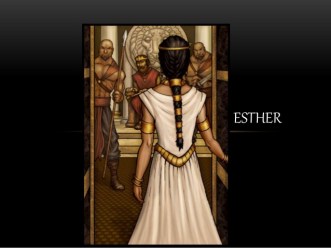
We might reflect on the life of Esther in a similar way. God sends a sign to God’s people through a woman who is considered an appendage of her husband, for the queen in this kingdom is not allowed to enter into the king’s presence without his permission. In this time and place, Esther’s intrusion on her husband’s time and person is punishable by death and so we see that God’s sign comes to his people through a woman who has been taken as part of the household of a pagan king and who fears for her life whether she remains silent or speaks. God comes to the LORD’s people through this defenseless woman who is in need of someone’s help. When we read her story, we might imagine ourselves as equally defenseless, equally frightened. If we allow ourselves to accompany Esther as she listens to her uncle Mordecai tell her that she has been chosen by God to speak on behalf of her people, we will watch as she opens herself to allow God into her life fully. If we watch what happens to the man, Haman, so filled with hatred that he plots the deaths of thousands in order to have his bruised pride assuaged, we will see Ahasuerus deliver to Haman the consequence of his own plots against God’s people.
Tomorrow, grace and blessing.
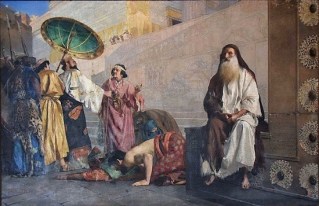
To learn more about why Mordecai did not bow before Haman, click on the image above or visit: http://thetorah.com/why-did-mordecai-not-bow-down-to-haman/
Cameron, Peter John, Rev., ed. “Mini-Reflection.” MAGNIFICAT. 25 December 2010. Print.
Adapted from a reflection written on December 25, 2010.
We have visited the story of Esther frequently in our Noontimejourney and this Christmas as pause to spend some time in Chapter 3. Because of various redactions, different Bibles have divided this story with both numbered and lettered parts but today we are looking at both Chapter 3 and B, the story about the letter of King Ahasuerus that decrees death to the Jewish people on the fourteenth day of the month of Adar. When we read the entire account, we know how the king finds out that Queen Esther is Jewish. We know how Esther and her uncle Mordecai intercede with God and king for the preservation of the Jewish people. And we know what becomes of the envious Haman and his family. This may be an unusual story to consider in the last week of Advent, but when we pause we see a connection with the Christmas Story: signs of God’s grace coming to a nation through people who are easily overlooked in a world that focuses on the supremacy and authority of powerful men. Today’s stories are about the surprising influence of the most vulnerable among us: a baby, and a woman.
While we are not in any way suggesting that Esther is the equivalent of the Christ child, we may want to consider the parallel these stories offer as analogous to our own feelings of defenselessness. And we may want to take direction from both Esther and Jesus as we watch them obey the Father who created them. These stories show us that the human life is best lived in search of and in preparation for our divinity. They show us that fidelity, simplicity, honesty and courage are essential to one who seeks to arrive at the potential God breathed into each of us at our creation.
Spend time with Esther 3 (B) today and consider it as preamble to a new coming.
What do we teach ourselves and others with our lives?
The triangle of Esther, Ahasuerus and Hamanis a delicate one. The young Queen has hidden her ethnic origin and fears discovery and death. The King has followed the advice of his trusted vizier Haman and now finds that he has been betrayed. Haman has allowed jealousy to consume him to the point of his own destruction. Where do we see these characters in our lives today . . . and who are we in the scenarios that play out around us?
In the workplace, a plot slowly brews until an awful truth comes forward to appall or disgust us. Betrayal, slander, back-stabbing, false accusations fly and we find that we have sudden choices to make. How do we determine where we stand? Where are we in this scenario? How do we react? What do we do? What do we learn? What message do we teach with our lives?
A family member or close friend has become depressive and negative and looks not for companions in grief but for compatriots in gossip. What do we do in this circumstance? Do we gently rebuke? Do we comply with this gentle slide into evil? What do we say? What do we learn? What do we represent with our lives?
We have recently been invited to join a group we have wanted to be a part of for some time yet now we discover the price of admittance is our unquestioning, fanatic loyalty. What role do we play in this picture? Do we quietly escape and think only of ourselves? Do we warn potential victims and look for an authentic, loving response? How do we decide? What do we learn? What do we embody with our lives?
As we allow this story to trickle through our thinking to reflect back to us little mirror images of who we are and what we do, is there some new idea that comes to us? Some thought we want to share with others? If so, enter your comment below.
Yesterday we reflected on how God foils perfect plots . . . today we examine the turning point in the story of Esther and look for clues about how we might expect the same reversal of evil when we place ourselves fully in God’s hands.
As humans we too often see or experience the hunting down and destroying of either an innocent or someone we believe “deserves what she gets”. Regardless of guilt or blamelessness, the brutal pack mentality of an attack on another human being is something to be avoided and we must work at turning others away from this ugly thinking. We may have been a peripheral or integral part of a plot to bring someone down and if this is the case then we must go to that victim to ask forgiveness. Association with those whose goal it is to establish an us against them mentality is dangerous for it sets us on a path that descends into darkness. Escape from these associations can be difficult and is always permeated with its own special fear; yet it is imperative that we escape because – as we see repeatedly in scripture and in life – God will always, later or sooner, reverse the plots that schemers have conjured in dark corners on their well-worn couches.
When the day arrived on which the order decreed by the king was to be carried out . . . on which the enemies of the Jews had expected to become masters of them, the situation was reversed: the Jews became masters of their enemies.
King Ahasuerus allows a great violence to erupt against Hamanand his family and this is not the sort of outcome that the New Testament faithful will want to see. What Christ-followers will ask for is that light penetrate the darkness, that hard hearts be softened, and that stiff necks begin to bend. And so we pray . . .
Just yet merciful God, you give us the opportunity to ask for our enemies’ conversion, grant us also the charity to intercede on their behalf.
Gentle and beautiful God, you make each one of us in your loving image, make also in each of us the patience to wait for reversal at your hand.
Strong yet gentle God, you bless us with the capacity to forgive, bless us always with your constant guidance and care for without you we are too easily led into the darkness.
Wonderful and awesome God, you surprise us constantly with your merciful justice, help us to see that in each of our calamities we might anticipate your sweet reversal.
We ask this in Jesus’ name. Amen.
Spend some time with these characters and the scripture citations and study the characters in this story. What more do we see in this story that we might apply to our own lives?





 The Noontimes