David, Amnon, Tamar, Absalom. Joab, the woman from Tekoa, Zadok the priest, Ziba, Ahithophel. What an amazing cast of characters to play the roles we find in this tale we have visited often – the story of a family fueled by envy, payback, and violence – the story of a family spiraling into self-destruction. Exile and Return, Forgiveness and Revenge. These are themes familiar to any people on any day in any generation. Today’s reading presents us with a window into the lives of several members of Jesus’ family tree as we see them plot and connive with tremendous skill; but eventually we see that gains born of deceit have no place in honest relationships; and this is a lesson we may want to carry into our own most intimate relationships, especially our relationship with God.
The first verse in chapter 15 stands out to us: After this Absalom provided himself with chariots, horses, and fifty henchmen.
Absalom returns home after having murdered his brother Amnon, and he is pardoned by his father, King David. Yet his first act is to begin to lay the ground work to continue his life of deception and connivance. Clearly he did not learn much during his years in exile in Geshur. Perhaps he spent them in denial of his own deeds, brooding about how he had been wronged and plotting to continue his revenge rather than spending time in introspection. Perhaps he nursed his anger, allowing hatred to bloom in his heart in the place where forgiveness rightly dwells.
This is a story we know well, and yet we might want to pause in order to spend time with a few details.
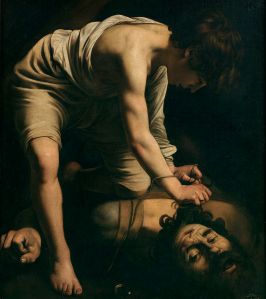
Battle armor and brave words do not protect Goliath from the truth of David’s one small stone. We might reflect that bluster, barricades and weapons do not serve us as we travel along The Way of Christ.
While David’s oldest brothers go off to fight against the Philistines with Saul, David tends his father’s sheep in Bethlehem. We might reflect that although our work may often seem insignificant, it is always on target when we obey God as we travel along The Way of Christ.
David leaves his flock with another shepherd when he takes roasted grain and cheeses to the battlefield for the troops. We might reflect that even in the midst of our work, we must remember to shepherd those who follow us as we travel along The Way of Christ.
David’s brothers are jealous not only of the bravery which stems from David’s special relationship with Yahweh but also because David comes to Saul’s attention for the question he repeatedly asks: “Who is this uncircumcised Philistine that he should insult the armies of the living king?”We might reflect that we are often the target of jealousy when we are faithful and courageous as we travel along The Way of Christ.
David says with confidence to Saul: “The Lord, who delivered me from the claws of the lion and the bear, will also keep me safe from the clutches of this Philistine”.We might reflect that we too, may place our hope in God’s promises as we travel along The Way of Christ.
David rejects Saul’s unwieldy warrior garments and tools so that he might take up and use the tools he knows best: smooth stones and his slingshot. We might reflect that rather than arms and physical strength, our petitions of intercession on behalf of our enemies are our most powerful weapons as we travel along The Way of Christ.
David answers the enemy’s challenge with these famous words: “You come against me with sword and spear and scimitar, but I come against you in the name of the Lord of hosts, the God of armies of Israel that you have insulted . . . All this multitude, too, shall learn that it is not by sword or spear that the Lord saves. For the battle is the Lord’s, and he shall deliver you into our hands”.We might reflect that when the crowd jeers and when we appear to be defeated, we too serve as an example of how God saves and restores as we travel along The Way of Christ. When we rise after apparent defeat, we are justified by God as we travel along The Way of Christ.
This is an old and familiar story against a backdrop of violence, yet it holds simple and valuable lessons for us today. They are,
we must believe the story we have heard,
we must hope in the promise we have been given, and
we must enact love in the world as a sign that,
we travel along The Way of Christ.
In so doing, the many false and boasting Goliaths who confront us will fall permanently as we journey along The Way of Christ.
When we examine the story of David and his son Absalom, and see that sometimes we cling to outmoded ideas or dangerous people. We humans seem to prefer the devil we know to the one we do not. We make a way to survive with the horror we experience rather than set boundaries against the craziness of the world. This is the fine line we walk between forgiving transgression and accepting abuse. This is the difference between pardon and leniency. It is the distinction we draw between recklessness and prudence.
Absalom is the favored child who does as he likes; he is coddled and feels entitled. We see many examples of this in our current world – men and women who take what they like from whomever they like, pitted against the innocent who are open and trusting. It is an uneven match and we wonder why God does not protect the naïve and unknowing more.
In today’s reading we see the dreadful end of Absalom, the favored child who abused his father who had given him so much. We also watch the mourning of the father who believes he has recently lost a child without understanding that he had lost him years before.
As Jesus reminds us, we cannot put new wine into old skins. (Matthew 9:14-17, Mark 2:21-22 and Luke 5:33-39) We cannot sew new patches on old sleeves. We are called by our maker to transform ourselves, to move beyond our old form and style, to become new in Christ. For just as the Old Testament is fulfilled in the New, as the old Covenant is re-written on the new heart, so are we called to make a place for a clean spirit, so are we called to sit at the city gate to indicate that we have returned – but in a new form.
In this season when we celebrate resurrection and new life, let us be determined that when we are fuddled by the line between compassion and acceptance of violence against one’s self, we will examine our lives in light of the Gospel to see if our suffering bears fruit or draws us down. In recent days at Mass we have been reminded that we are the fruit bearing branches of the vine that is Christ. We are nothing and do nothing except through the Creator. There is no secret thought; we keep no actions from the Spirit. We belong to God and our lives are transformed when we understand this.
From the mini-reflection in today’s MAGNIFICAT we read in reference to Acts 16:1-10: “Day after day the churches grew stronger in faith and increased in number”. This was due in large part to Paul and Timothy’s attentive docility and obedience to the Holy Spirit. They had been chosen “out of the world” by Jesus. When we act out of belonging, conscious that we do not “belong to the world”, we change the world”.
And this is how we address the recklessness and violence we see around us. We take on Christ, we go to the Creator, and we allow our transformation in the Spirit. In this way, we pray that we do not come to harm when the violence of the world threatens us. And we pray that when the violence of the world does invade our lives – as it surely will – we will have the courage, strength and clarity to witness with attentive docility and obedience to the Holy Spirit.We pray that we remind ourselves of our true belonging. And we pray for the lost souls of those who have been sucked into the cycle of danger and fear. In this way we change the world. Amen.
A Favorite from May 8, 2010.
Cameron, Peter John, Rev., ed. “Mini-Reflection.” MAGNIFICAT. 8 May 2010. Print.
As we continue to work and pray for peace in a world so full of turmoil, we reflect on this important story from Scripture.
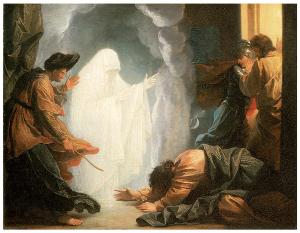
This is the portion of the Samuel story in which we watch Saul move away from God to begin his long slide into darkness. This downward movement happens because he presumes to know best. Saul takes action on his own without waiting for Samuel, who is designated by God as the judge/leader, to offer sacrifice before battle. Although his son Jonathan and the rest of Saul’s troops have immediate success, Saul himself is eventually lost. He becomes paranoid about his fear of David (1 Samuel 18) and forces David to flee the court (1 Samuel 19).H e allows his fears to overtake him as when he orders the priest of Nob to be slaughtered (1 Samuel 22) and continues his frenetic search for David in the wilderness (1 Samuel 23). In his panic he consults with a seer in Endor (1 Samuel 28); and finally he meets his dreadful end (1 Samuel 31) along with his beloved son Jonathon. This is a sad ending for a man who had shown such promise but who, in the end, did not trust God. Today we see the beginning of Saul’s long and terrible journey into the dark. Unwilling to admit his errors or to seek pardon, Saul gives himself over to the fantastical thinking that he knows better than God, that he can do without God. He sees his troops slithering away before the battle and, thinking that he will keep them from leaving, he steps in to intervene – countering God’s plan.
Today we reflect on Saul’s story and examine our motivations to see if the fire of self-knowledge threatens to consume us. Tomorrow, the fire of battle. Do our conflicts help us to know ourselves better? Or do they send us further into deception and denial?
Cornelis de Vos: King David handing the Scepter to Solomon
Thy kingdom come, thy will be done . . .
As we move from childhood to maturity, we take on commitments and we either fulfill or turn away from promises. As we seize control of as many facets of our lives as possible, we also strive for success as the world around us identifies it. And somewhere in the blur of activity and struggle, they is always the chance that we might move away from the core of who and what we are.
In the story of David and Solomon we find two men, and the women who surround them, scrabble to come out on top and in front, surrounded by security, relaxing into comfort. The details of David’s anointing and rise, his battles with both his enemies and King Saul he has pledged to serve, are all benchmarks in David’s life. So are his interactions with Michal and Bathsheba, and the prophet Nathan. David’s son Solomon must also struggle against heavy odds to survive into adulthood and to assume his father’s seat of power; but later he succumbs to the wishes of others and the lure of success and fame. Details of a temple are laid out and even include specifics about music, vessels and decorations. Life at court attracts both those who support and those who tear down what once was full of hope.
How do we arrive at the peak of power in our lives? What do we store up for the journey ahead and what do we jettison? What do we tend to and what do we ignore? Does our relationship with God grow or diminish? Have we found wisdom that nourishes and serenity that heals . . . and do these gifts from God even matter to us?
Today we take time to examine our lives to see how or if we have followed God’s lead in the living of our hours on earth, and to examine the kind of kingdom we have been building. We consider what we have set aside as having great value and what we have cast off as holding us down. And we discover, in the many relationships and encounters we have experienced, that both our storehouse and the debris we leave behind reveal a great deal about who and what we have become.
The two books of Chronicles have four major portions: a genealogy of our leaders beginning with Abraham (1 Chronicles 1-9), a description of the monarchy under David and Solomon (1 Chronicles 9 – 2 Chronicles 9), the divided kingdom (2 Chronicles 10-18), and the period from Hezekiah to the Babylonian exile (2 Chronicles 19-36). This story of divine promise interwoven with human commitment and infidelity tell a story that we might see reflected in our own personal sacred history. This story is worthy of our time over the next few days.
In this time of political tension around the world, Paul’s words are worthy of our reflection time.
Keep a sharp eye out for those who take bits and pieces of the teaching that you learned and then use them to make trouble. Give these people a wide berth. They have no intention of living for our Master Christ. They’re only in this for what they can get out of it, and aren’t above using pious sweet talk to dupe unsuspecting innocents.
Paul’s letter to the Romans holds this little paragraph: a warning to the brethren who cause dissention and scandal contrary to the doctrine they have learned. Commentary suggests that Paul’s intent is to inoculate the growing community against the formation of factions that might lead to the fragmentation of the church. In 1 Chronicles 28:20 David says to his son Solomon: Take charge! Take heart! Don’t be anxious or get discouraged. God, my God, is with you in this; God won’t walk off and leave you in the lurch. God’s at your side until every last detail is completed for conducting the worship of God.
And how do we worship the Lord? When do we gather to give thanks to God?
We hear that we must go about our work without fear of any kind.
We understand that our kingdom work is more important than any other.
We demonstrate our belief that God is with us always when we put aside the fear-mongering and scandal-peddling of troublemakers.
John shares Jesus’ words with us: These things I have spoken to you, so that in me you may have peace. In the world you have tribulation, but take courage; I have overcome the world. (John 16:33)
When we set ourselves to doing God’s work, we have no reason for apprehension or anxiety.
In both the Old and New Testaments, we see God’s yardstick in our world. Paul, David and Jesus offer us a clear image and method of measuring God’s presence and love in our lives.
The book of Judges is the part of the Bible saga where we see a fledgling nation forming. The twelve tribes have survived the rigors of their years of desert wanderings, following the pillar of fire and smoke which protects them. Joshua has led them into the land promised to them and they have secured a foothold where a kingdom will be established. A series of judges, or heroes, will rise up to gather the people to remind them that Yahweh has promised land, kingdom and blessing . . . and that they, God’s people, owe their creator fidelity, loyalty and obedience. This is the covenant they have entered into.
The context for these stories is “Holy War” and close reading of Judges, in which so much war is waged, tells us that we are called to cooperate with God’s plan and providence rather than serve our own small agendas. The whole point of this part of the story is to stay the course, but it must be God’s course and not our own. The forces of darkness cannot stand up to the perseverance, the innocence and the trust of the faithful. Deborah does this well.
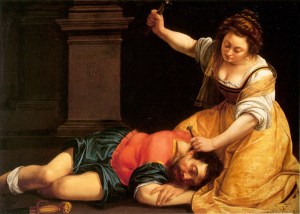
Artemisia Gentileschi: Jael and Sisera
In the preceding chapter we see this prophetess sitting under her palm tree delivering just decisions to the people. We also see Jael, wife of Heber, lure the enemy Sisera into her tent to kill him with a tent peg to the temple. Jael kills this enemy because Yahweh has ordained it as spoken through Deborah; and we find that these tribes fight off the pagan peoples any way they can; always consulting with Yahweh before going into battle. In these ancient times, the struggle to survive dominated all aspects of life and we see a good deal of brutal interaction. Yet is our interaction any less brutal today?
Deborah judges the tribes during the period of time which coincides with political unrest following the death of Ramses II in Egypt. The time of transition proves difficult for these people who struggle not only against the pagan nations that surround them, but also with conflict among the tribes. David will unite these people into a true political and spiritual kingdom, and whose son Solomon will erect a Temple which speaks to the fame of this people and their God.
Deborah leads well because she listens well when she speaks with God each day and it is against this voice, this measuring stick that she measures her own life. We will want to follow her example of fidelity as we struggle against the violence that surrounds us.
The most famous of the lament psalms, this prayer is said often during the Lenten season; it is also called Prayer of Repentance. It was written after David sinned with Bathsheba and their child was lost (2 Samuel 11 and 12).
“The first part (3-10) asks deliverance from sin, which is not just a past act but its emotional, physical, and social consequences. The second part (11-19) seeks something more profound than wiping the slate clean: nearness to God, living by the spirit of God (12-13), like the relation between God and people described in Jer. 21, 33-34. Nearness to God brings joy and the authority to teach sinners (15-16). Such proclamation is better than offering sacrifice (17-19). The last two verses ask for the rebuilding of Jerusalem (20-21) . . . Most scholars think that these verses were added to the psalm some time after the destruction of the temple in 587 B.C. The verses assume that the rebuilt temple will be the ideal site for national reconciliation”. (Senior 680-681)
The elements that help to bring us to reconciliation in this prayer are the call to be cleansed and purified with the sprinkling of the hyssop – a woody bush whose small branches were used in ceremonial sprinkling as prescribed by Mosaic Law – the acknowledgment that our wrongdoings effect every part of us – even our inmost heart – and the understanding that true reconciliation comes only through God’s healing hand. The writer of this psalm knows and expresses the idea that we of ourselves are nothing and can do nothing . . . other than act inand ofGod.
Let us offer up this prayer today as we continue to pray for the people of Ukraine.
Tomorrow, miserere.
Senior, Donald, ed. THE CATHOLIC STUDY BIBLE. New York, Oxford University Press, 1990.680-681. Print.
We continue our reflection on joy in the Books of Wisdom and today we see joy in the event of King Solomon’s marriage. When we read the full story of this man’s life we come to understand that although he demonstrated so much, and although much of God’s promise is fulfilled in him, this promise deteriorates, and at his death the kingdom that Solomon and his father pulled together begins to unravel.
If today’s Noontime calls you to search for more ways to encounter joy, click on the word Joy in the categories cloud in the blog’s right hand sidebar and choose a reflection.
It is so very easy to be joy-filled when all is going well; and yet . . . is it? A famous comedienne once commented that after honors were distributed for a unique award she had earned and the celebration ended, she went home and put a load of laundry in the clothes washer. She realized that the trappings of fame were not nearly as important to her as the simple joy of tending to her children and husband. Let us remember that when we have few hurdles to overcome and we find ourselves in the easy place of joy, we must weigh out accolades to put them in proper perspective. Perhaps this is what Solomon does today as he appears for his wedding procession as the beautiful Song of Songs describes.
Verses 3:10-11: Solomon made the columns of his litter of silver, its roof of gold,
Its seat of purple cloth, its interior lovingly fitted.
Daughters of Jerusalem, go out and look upon King Solomon
In the crown with which his mother has crowned him on the day of his marriage, on the day of the joy of his heart.
Select more of these beautiful verses and ponder them, considering your own marriage relationship with Christ. Compare the different versions of Songs at the scripture link above and reflect on how well God loves us, how much God guides us, and how much God heals and restores.