A Favorite from October 6, 2007. To read the epilogue (Esther F), consult the New American Bible (NABRE) using the scripture link above.
When we explore Esther’s story, we discover God’s gift of goodness.
How many times has this kind of rescue happened in small ways in our lives that we have given momentary thanksgiving and moved on to our next petition in our list of dreams? How many times have we quickly curtsied or bowed as we said a hasty “Thank you” before rushing on to out next request? We must always make the time to give full and abundant thanks to God. For has not God’s goodness been overflowing to us? We must pass along these stories to those who follow. For have not these stories been passed along to us? We must, like Mordecai who realizes that his highest hopes have been born out of God’s providence and mercy, gather together with joy and happiness before God that we may celebrate.We must rejoice in the goodness of God for only this gladness and joy will carry us forward to New Life in the fullest.
When we spend time with the story of Esther, Mordecai, Haman and Ahasuerus, we open our hearts to thanksgiving. We open ourselves to the Spirit.
God says: I watch over you while you sleep as a loving mother or father. I prepare each day for you so that you might live in me. Sing out your praise and abide in the comfort of my hands.
Ask God anything! Shout to the nations, tell them what God has done, spread the news of God’s great reputation!
God says: I plan the mornings, afternoons and evenings you journey through.I prepare saving pathways and abiding companions to accompany on your journey. Rejoice in my endless hope for you.
Let the whole earth know what he’s done! Raise the roof! Sing your hearts out, O Zion! The Greatest lives among you: The Holy of Israel.”
God says: When you share your joy with others, it multiplies the goodness I have showered on you. When you share your thanksgiving with others, it comes back to you ten-thousand fold. Rest in my deep and abiding love for you.
God speaks to us through the prophet Isaiah to bring us the good news that we are deeply and passionately loved. Let us rejoice today. Let us give thanks today.
Come aside to me, you untutored, and take up lodging in the house of instruction;
How long will you deprive yourself of wisdom’s food, how long endure such bitter thirst?
We remember the verses from Proverbs 9: Wisdom has set up her house and prepared her banquet.
I open my mouth and speak of her: gain wisdom for yourselves at no cost.
Take her yoke upon your neck; that your mind may receive her teaching.
Wisdom has sent her handmaidens to invite all who long for her consolation. (Proverbs 9)
For she is close to those who seek her, and the one who is in earnest finds her.
See for yourselves! I have labored only a little, but have found much.
Acquire but a little instruction, and you will win silver and gold through her.
Wisdom asks that we abandon our foolishness; she invites us to choose her path. (Proverbs 9)
May your soul rejoice in God’s mercy; do not be ashamed to give him praise.
Work at your tasks in due season, and in his own time God will give you your reward.
Wisdom knows that patience and openness to God bring us insight, understanding, strength and peace. Let us be faithful to the gift of God’s wisdom. Let us share in the hope of God’s Wisdom. And let us rest in the love and joy of Wisdom’s care.
Let us now sing the praises of famous men and women, our ancestors in their generation.
We have so much to be grateful for when we look to our past and remember the stories we have heard about the generations who preceded us. They laid the foundation for who and what we are today.
We have so much to give thanks for when we look at those young ones around us who will carry us into the future. They carry the dream we hope for who and what we will be in the years to come.
We have so much to sing joyously in the present for as we ponder the love our maker has for us. This creator wants nothing more than our welfare and success.
These words of St. John of the Cross appear in MAGNIFICAT today as the Meditation. When we read carefully and thoughtfully, they can bring us to an appreciation for the level of joy Hebrew ancestors felt when they worshiped Yahweh in the desert tent. They can bring us an understanding of the goodness of the Lord, our Bridegroom.
When one loves and doses good to another, he loves and does good to him in the measure of his own nature and properties. Thus your Bridegroom, dwelling within you, grants you favors according to his nature. Since he is omnipotent, he omnipotently loves and does good to you; since he is wise you feel that he does good to you with wisdom; since he is infinitely good, you feel that he loves you with goodness; since he is holy, you feel that with holiness he loves and favors you; since he is just, you feel that in justice he loves and favors you; since he is merciful, mild, and clement, you feel his mercy, mildness and clemency; since he is strong, sublime, and delicate being, you feel that his love for you is strong, sublime, and delicate; since he is pure and undefiled, you feel that he loves you in a pure and undefiled way; since he is truth, you feel that he loves you in truthfulness; since he is liberal, you feel that he liberally loves you, without any personal profit, only in order to do good to you; since he is the virtue of supreme humility, he loves you with supreme humility and esteem and makes you his equal, gladly revealing himself to you in these ways of knowledge, in this his countenance filled with graces, and telling you in this union, not without great rejoicing: “I am yours and for you and delighted to be what I am so as to be yours and give myself to you”.
This is what we humans try to avoid at all cost – suffering without end – and yet this is impossible for us. We will only experience true joy that lasts when we learn to allow suffering to transform us – and this is what I was thinking as I drove through Long Green Valley this morning on my way to work. The heavy mist curled through the vineyards at our local winery, nourishing the grapes that are promised for the fall. The vines are well tended, all reaching out to support one another – having been pruned back to little more than stumps last winter. Interlocked, these branches reinforce one another, anticipating the heavy crop to come. The workers go through their strict cycle of pruning and flourishing; the plants burgeon, wither and burgeon again, answering their maker’s call to yield fruit that will sustain. I was imagining myself as a branch of God’s vines just as Christ tells us in John 15: I am the true vine, and my Father is the true grower. He takes away every branch in me that does not bear fruit, and everyone that does he prunes so that it bears more fruit. You are already pruned because of the word that I spoke to you. Remain in me as I remain in you. Just as a branch cannot bear fruit on its own unless it remains on the vine, so neither can you unless you remain in me. I am the vine, you are the branches. Whosoever remains in me and I in him will bear much fruit, because without me you can do nothing.
This chapter in Job is followed by ones in which people who call themselves his friends urge him to confess his sins so that he might enjoy God’s grace once again. Job will repeat often in this story that he is innocent – and he is. His acquaintances will continue to berate him. He will continue to trust in God. And in the end, he will be restored.
We often feel as though we are suffering without end, and we are. Yet, this suffering brings about abundant fruit which we will not have to struggle to produce. This suffering carries within itself the seeds of restoration. This suffering is not to be avoided for when it is, we avoid the opportunity to be touched, and held and cured by the master grower’s hands. And this is something we do not want to miss.
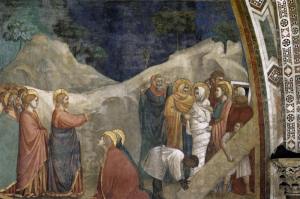
This is a bittersweet story if we believe in the resurrection. Each time I read it, I linger over verse 35: Jesus wept.As a child I believed that the Christ wept because his good friend had died. As I grew older I believed he mourned the fact that he knew he was calling this friend back from a beatific place. Now when I read this verse it seems to me that Christ cries out of his humanity; he cries at the tragedy of our human fragility. As I continue to grow I am guessing that I will have other perspectives, other reasons for Jesus’ tears. This is what is so wonderful about the message of the Messiah: each time we read it, we come away with something new, something surprising, something healing. This is why, I believe, God came to walk among us, so that we might number our sorrows with the Lord’s. When we cry out to God, God can honestly tell us that God experiences our pain.
There is another point which always intrigues me about this story. Hard on its heels arrives the story of the plot to kill Jesus. I am always struck with the vigor of the jealousy and venom of his enemies. Some of them went to the Pharisees and told them what he had done. So the chief priests and the Pharisees called a meeting of the council and said,“What are we to do? This man is performing miracles, many signs. If we let him go on like this, everyone will believe in him, and the Romans will come and destroy the holy place and our nation.” This narrative continues to verses 53 and 54: So from that day on they planned to put him to death. Jesus therefore no longer walked about openly among the Jews. And this chapter ends with . . .Now the chief priests and the Pharisees had given orders that anyone who knew where Jesus was should let them know, so that they might arrest him.
When I put myself into this story, I wonder where I would fall. Am I among the Pharisees, the priests, the followers who report Jesus? Am I one who succumbs to jealousy and revenge? Am I one who believes and follows? Do I understand that the “death” of Lazarus is really the initiation rite of his new life? Am I willing to enter into the hope God offers us when God frees us in the person of Jesus? Do I comprehend the joy I might experience when I unite with the Holy Spirit to carry the message of freedom to others? Am I willing to accept surprise in my life? Am I willing to hand myself over to a belief in something I cannot see? Am I ready to accept a new way of living?
There is much newness to think about as we read this old story. What appears to be death might actually be life. What seems to the end of a story, may actually be the beginning. What is apparently a handing over of self in obedience can be a surprising release into a full liberty of expression. We will only know when we choose to follow.
Chapter 40 of Job is sandwiched between the threat of Satan and the promise of restoration, bringing home to us the marvel of God’s immense love for us.
When we focus on 40:15 we see the Behemoth who sneezes, sending forth light flashes. Sparks fly from his mouth, his breath lights fires, his heart is hard as stone, the mighty fear him, nothing frightens him. This monster – who later appears in Revelation – is drawn so vividly that we tremble before him. What does he represent? Perhaps he signifies all the fear we have ever felt about all things, both little and large.
We know that we must fight back the fear but the task is daunting. When we spend time with Job we understand that when we allow God to be God, we enter into God’s love.
The Gospels tell us that when the Sea of Galilee is whipped by a storm, endangering the apostles in their tiny boat, we find Jesus walking on the water to calm both the turbulent waves and his followers. Take courage, it is I, do not be afraid! (Matthew 14:22-36, Mark 6:45-56, John 6:16-24) Just as the apostles follow Christ, so must we.
In the New Testament letters, John writes eloquently in his soaring verses to tell of the awesome enormity of the love God brings to us, the same love to which God calls us. We saw it, we heard it, and now we’re telling you so you can experience it along with us, this experience of communion with the Father and his Son, Jesus Christ. Our motive for writing is simply this: We want you to enjoy this, too. Your joy will double our joy! (1 John 1:1-4) Just as John encourages us to believe, so must we encourage one another.
When the behemoth of fear stalks us, waits at the next corner, rides home with us in the back seat of the car, springs from under the bed . . . we must turn to Christ and to his colossal, freely-given love.
So let us perfect this love which God plants in each of us. Let us revel in it. Let us share it, speak of it, spend time with it.
And let us pray: Let us put fear aside.
When loved ones betray or disappoint us . . . Let us put fear aside.
When we find the day too arduous and the night too long . . . Let us put fear aside.
When the behemoth springs from nowhere to instill us with foreboding . . . Let us put fear aside.
When we are anxious and tired and do not have the strength to summons the courage we so desperately seek . . . Let us put fear aside.
When we find ourselves separate from you . . . Let us put fear aside.
When we seek punishment instead of love . . .Let us put fear aside.
Amen.
I there is time today, spend time with John’s letters, and let God’s awesome love chase away the behemoth of fear.
In this reading we see images of a merciful and sometimes wrathful God woven through practical pieces of advice.
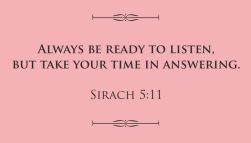
Do not say, “His mercy is great, he will forgive the multitude of my sins,” for both mercy and wrath are with him, and his anger will rest on sinners . . . Do not winnow in every wind, or follow every path. Stand firm for what you know, and let your speech be consistent. Be quick to hear, but deliberate in answering. If you know what to say, answer your neighbor; but if not, put your hand over your mouth.
Sirach reminds us that God is patient, forgiving, and understanding of our innermost thoughts and desires, and after reading the instruction from ben Sirach, we will want to explore not only our words and actions but our motivations as well. Why do we do and say what we do and say? When and why are we silent? When and how do we speak? When and where do we act? What do we value and how do we use the gifts we are given? Sirach tells gives us simple precepts for our complicated days.
Do not rely on your wealth, or say, “I have enough.” Do not follow your inclination and strength in pursuing the desires of your heart.
We live in a strange world of too many words and not enough clear information. In our search for clarity, we work to distill truth, measure honesty and reveal deceit. So often the advice of even the wisest among us is not enough so when we cannot see through the fog of abandoned promises, we must raise our eyes and hearts to the originator of our being. When we find ourselves on the knife’s edge of a demanding life, we place tired feet in the well-worn path of Jesus’ Way. And when we find ourselves falling into the depths of a dark and frightening well, we also find that we are falling not into nothingness but into the full and healing arms of the Spirit.
Sirach counsels us with his well-honed words. Jesus calls us with his proven Way. God leads us with a firm and guiding hand. And the Holy Spirit heals us as we move through wounding days. Despite all that frightens or wearies us, there is much to celebrate in our hearts and with others. Let us return to ancient advice that brings light to our darkness and joy to our hearts.
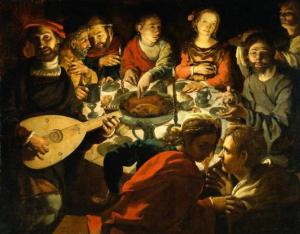
This brief but important story tells us a great deal about Jesus’ relationship with his mother and so it bears re-reading. When we begin to believe that we have lived beyond life’s rewards, we must remember the words of the wedding guest to the host: “You have kept the best wine until now!”
When we are too frightened or too confused to know what steps to next take when confronted by life, let us follow the advice of the Blessed Mother when she says, Do whatever he tells you.
Let us be prepared to experience more goodness and joy than we can imagine.
To suggest another images we might enjoy seeing, enter the painter and the name of the work as a comment to this post.
Over the next few weeks we will be away from easy internet access but we will be pausing to read scripture and to pray and reflect at noon, keeping those in The Noontime Circle in mid-day prayer. You may want to click on the Connecting at Noon page on this blog at: https://thenoontimes.com/connecting-at-noon/In these posts, we will have the opportunity to reflect on a scripture verse and an artist’s rendition of that event. Wishing you grace and love and peace in Christ Jesus.





 The Noontimes