Yesterday we spent time with John 6:16-21 in which the Beloved Apostle describes the appearance of Jesus on the water; we focused on how our lives pull us into so much activity that we easily forget to ponder the mystery through and by which we live. At that time we spent some moments meditating on a painting by Henry Tanner and with the words: It is I, do not be afraid. We thought again about how time is not truly linear, about how we miss so much by not being open to possibility, by thinking that all the work that lies before must be done quickly and well. And we also thought about the fear through which we operate rather than love: fear that work may not be accomplished, children may not be fed, laundry and lunches will go undone, papers will not be tended to. God not tended to. Today we reflect on the surprise Jesus invites us to enjoy, just when we least expect it. And we reflect on how we spend our time: time in kindness offering hospitality, time in joy believing in hope, time with self and others pondering the goodness of God, time in thanksgiving for gifts already given and yet to give.
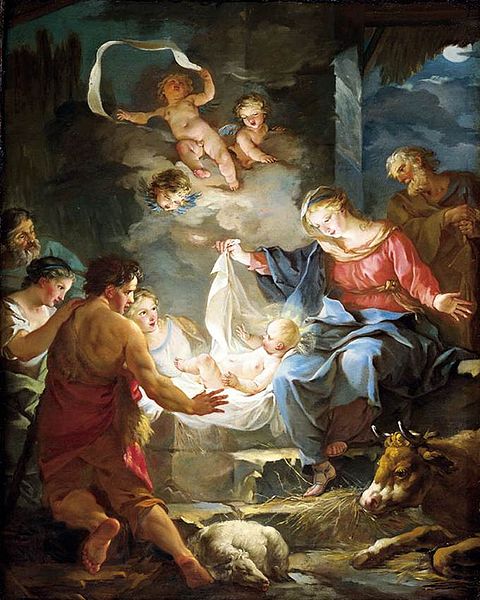
Advent is a time of waiting, hoping, renewing. Let us gather in Advent hope.
Advent is a time to put aside our cares in order to tend to the truly important. Let us gather in Advent love.
Advent is a time to have the courage to step out of the predictable order of our lives. Let us gather in Advent fidelity and prepare for Christ’s Advent of surprise.
Tomorrow, stepping into surprise . . .
Adapted from a reflection written on December 6, 2008.
When the fullness of time had come, God sent his Son, born of woman, born under the law, to ransom those under the law, so that we might receive adoption. As proof that you are children, God sent the spirit of his Son into your hearts crying out, “Abba, Father!” So you are no longer a slave but a child, and if a child than also an heir, through God.
We struggle to realize a kind of independence from any being – natural or supernatural. We strive to gain control of our own destiny – earthly or spiritual. We tussle with time and attempt to govern the passing of minutes, hours and years – looking back into the past and forward into the future while neglecting the precious present. We have need of none of these desires and indeed we expend our energy and creativity uselessly on these false battles . . . for we already have all that we could hope for. We are rescued from darkness. We are ransomed through the love of God. And we are already heirs of a kingdom and fortune too vast to be measured or counted. We have our proof in this small, tiny child.
On this eighth day of Christmas as we stand at the threshold of a new day that marks a new year, let us live in this prized gift of the present that the Father has given to us. Let us give thanks to the Father for all that we have and all that we are. On this day when we begin a new year that we so eagerly await, let us cease our search for the proof of God’s love and let us be convinced – as Christmas people – that what we seek we already possess.
Better one day in your courts than a thousand elsewhere.
In this brief last week of Advent we have little time to reflect on the coming nativity of one who is the keystone of our existence. Tomorrow is Christmas Eve, La Nochebuena or “The Good Night” as the Spanish name this holy day. This year, as we struggle with the stress and anxiety brought on by a pandemic, we can experience the quickness that is our lives in this last week that brings us to the celebration of Christmas.
Better one day in your courts than a thousand elsewhere.
One of the messages we hear continually in the Gospel parables is the need to be prepared. Jesus is forever reminding us of the importance of being good stewards of gifts God has given to us. We are repeatedly asked to be prepared for our own exodus. We are constantly told of the great value of the kingdom we are called to build with others. We are always asked to remain close to God no matter the circumstance. We might wonder why Jesus repeats this message so often and if so we need not look long for an answer.
As a sparrow finds a home and the swallow a nest to settle her young, my home is by your altars, Lord of hosts, my King and my God! Happy are those who dwell in your house! They never cease to praise you.
We have no way of knowing our future no matter how hard we work at knowing. We have no eyes to see images of our lives a generation forward. We can only rely on God and God’s goodness to preserve and protect those who flock to him.
As a sparrow finds a home and the swallow a nest to settle her young, my home is by your altars . . .
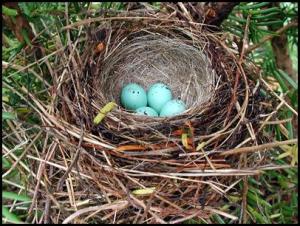
Chipping Sparrow Nest with Eggs
It is impossible to live the past again even if we want to right wrongs we have committed, even if we hope to heal wounds or change our crooked ways. We can only trust God and God’s mercy in forgiving all wrongs and transforming all transgressors.
As a sparrow finds a home and the swallow a nest to settle her young, my home is by your altars . . .
We do not control our own destiny; we only control our reaction to the world and the circumstances in which we find ourselves. We can only step forward as we answer the call we hear from God in our hearts. We can only prepare a place for God’s presence in our lives. We can only build our nest under the plinth of God’s altar and settle our young in the safe haven of God’s court.
Better one day in your courts than a thousand elsewhere.
As Advent draws so quickly to a close, we might feel the crush of time to complete hundreds of worldly tasks but rather than spend our time fussing with the details of a life that is fleeting, let us rather decide to build our permanent home in a place that is eternally protected. Let us choose to spend our time with The Living One who transcends all time and all wrongdoing. Let us fix on a site for our nest under God’s altar. Let us pledge to spend our last days of Advent preparing our minds and our hearts for the coming of The Christ Child. And let us spend our last days in God’s court, rather than a thousand elsewhere.
Past and future converging in the present. Attempting to establish a legacy from the past that extends into the future. Recording names in books that are passed down through generations. Looking for links to what was. Envisioning the future. Living an intentional present.
We humans concern ourselves so much with time and we hold to our belief that it is a strict, tight line even when mathematics and physics tell us that it is anything buta flat presence consisting of a series of moments. Time . . . God’s time . . . is eternal; yet we humans strive to pull it and push it until it snaps into an obedient straight plane, extending endlessly behind and in front of us. I do not believe that God sees us or time in such a superficial way.
There is value in tracing our roots and recording our deeds. These actions tell us who we are; they remind us of what we have done. With hopewe avoid the errors of this past.
There is value in laying plans, being stewards, husbanding resources, striding forward into an unknown future with confidence and a sense of mission. Our faith accompanies us as we step into the mystery.
There is value in living an authentic present, seeking to move through our days with integrity, looking at our faults without condemning ourselves or others, being honest about our successes with humility. In lovewe live each moment as it comes to us, pleading with God on behalf of our enemies, petitioning favors of God for all those we love, remembering all of God’s creation in our daily prayers.
Hubble Telescope: Two Galaxies Merging
I realize that when I pray I cannot help but think of time as linear when I remember with nostalgia my grandparents, aunts, uncles and cousins who wait for me on the other side of the veil that separates the body from that place we refer to as the world of the deceased. I also imagine the great-great-grandchildren I will never see in this life but whom I will know immediately when they rise to God. Resisting the idea that time is a strict line of seconds that march into minutes, hours and years, I see myself in the immense, slowly whirling, spiraling strands of human beings God has created in God’s image. I see us rising like incense in the night from the altar of our lives to bring a welcome aroma to the God who created us. I see the embrace with which we cling to one another as we dance beneath the arms of the Spirit while she is winging us home. I see us curling and binding with one another in an intimate union as we form the Mystical Body of this God-man walking among us.
Revelation tells us that there are many names written in the Book of Life. The names of the faithful. The names of the righteous. The names of the just. The names of the holy. The names of those who endured. The names of those who persevered. The names of those who have come to understand and return God’s love.
So as we consider God’s plan and God’s time, we pray . . . Let us call one another’s names in hope as we rise together in prayer. Let us call one another’s names in joy as we rise to meet our maker. Let us call one another’s names in love . . . and leave no one behind. Amen.
This week we will examine the Second Book of Kingsto see what this chronicler has to say to us . . . millennia after he first placed his words on papyrus.
“It is not for you to know the times or seasons that the Father has established by his own authority. But you will receive power when the Holy Spirit comes upon you, and you will be my witnesses in Jerusalem, throughout Judea and Samaria, and to the ends of the earth”.
These are some of the words spoken by Jesus to the eleven he left behind. The resurrected Christ returns, after having died, to gather his flock, to bless them, and to send them into the world. They are to be his hands and feet, eyes and ears . . . they are to build the new kingdom in all places of the earth.
After Jesus ascends into heaven and out of sight, the eleven and their companions are asked by two men dressed in white garments who are standing beside them, “Why are you standing there looking at the sky?”
We too, are sent into the world as the hands and feet, eyes and ears of Jesus. We also must wait for the events in our lives to unfold in God’s full season. We will want to linger in the places where we have felt Jesus’ presence as he has walked with us; but we must move on, knowing that although he may not be physically present to us . . . Christ walks with us still.
The eleven and their companions formed a tiny community of one hundred and twenty (verse 15), the number needed to form a new worship group in the Jewish tradition. They elect Matthias to replace Judas the Iscariot. The Mother of Christ remains with them, as do the other women who walked with Jesus. They come together to devote themselves in one accord to prayer. They are the nucleus which the Holy Spirit nurtures into a world-wide church.
When I think of the many obstacles that stood in the way of this small beginning . . . I see as miracle the fact that the story of Christ survived . . . but then it is Christ’s story . . . it is the only story worth telling . . . and it remains with us still . . . in God’s full season.
We will want to repeat this story often . . . both to those we know as we do old family stories . . . and to those we meet . . . as a story of welcome . . . as a story of wonder . . . as a story of praise . . . as we move through God’s seasons . . . in God’s time. We will want to stand staring at the sky . . . we will want to be certain that what we have witnessed is true . . . but we will not have time to linger . . . for we are called to God’s work . . . in God’s time . . . in God’s season.
Written on November 2, 2008 and posted today as a Favorite.


![Planting-a-Family-Tree-for-Parents-Day-–-iPhone-and-iPad-Genealogy-Apps[1]](https://thenoontimes.com/wp-content/uploads/2013/01/planting-a-family-tree-for-parents-day-e28093-iphone-and-ipad-genealogy-apps1.jpg?w=300&h=297)


 The Noontimes
