On this All Souls Day we remember those who have gone before us . . . as we listen and watch for the resurrection that we are promised.
On All Souls Day we celebrate those who are yet to come as we watch and wait for the resurrection that is freely given.
On All Souls Day we call forth the great cloud of witnesses as we wait and work in the resurrection kingdom.
On this All Souls Day we praise God’s goodness and mercy as we work and witness to the healing of the resurrection.
On this All Souls Day we rejoice with the faithful as we witness and we pray for the transformation of the resurrection, so that we may not be greatly mislead.
Amen.
In the northern hemisphere days shorten and nights lengthen. In less than a week we will move back to standard time and celebrate the feasts of All Saints and All Souls. As we watch, wait, work, and witness, we prepare for these feasts that anticipate the great feast of salvation that we will celebrate at Easter.
In this time of harvest when the northern hemisphere gives up her gifts of summer to prepare us for the cold darkness of winter, I cannot quite let go of the images and sounds of last week’s memorial Mass in which we celebrated the life of a young woman who died much too early. The gift of her life still rides with me as I journey back and forth to the school where she and I smiled at one another in the hallways and classroom. The wisdom of her youth still whispers to me as I greet and teach her grieving friends. The grace of her dying still accompanies me as I prepare lessons in the quiet evenings of the gathering autumn. Looking to meet the significance of this persistent presence, I go in search of a painting that soothes grief. As always, it reminds me of the wondrous sacrificial love that descends from the cross to offer itself when all else fails. And I come across this reflection written on September 25, 2008. I share it today with you.
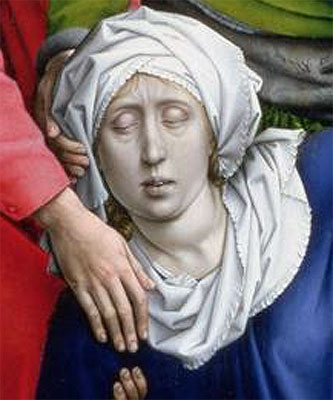
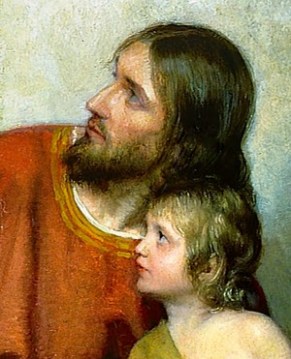
Detail from Roger van der Weyden: The Descent from the Cross
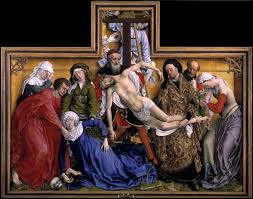
One of my favorite paintings is Van der Weyden’s “Descent from the Cross”. It lives in the Prado museum in Madrid, and when I travel there I like to spend as much time with it as possible. It hangs alone on a large, pale wall . . . where the downward movement from the cross moves through Jesus . . . through his fainting mother . . . past Nicodemus, Joseph of Arimathea and John, the Beloved Apostle to whom Jesus commends his mother . . . lingering with the brokenhearted women . . . hesitating with the grieving men . . . off of the canvas . . . and out of the room.
Detail from Roger van der Weyden: The Descent from the Cross
It is as if all of the sorrow of the world falls away from us and into the pale, dead body of the Christ. We can sense his downward journey into hell for the redemption of souls. We can anticipate his return.
St. Paul reminds us in 2 Corinthians 6:16: What agreement has the temple of God with idols? For we are the temple of the living God; as God said: “I will live with them and move among them, and I will be their God and they will be my people”.
St. John reminds us in 3:16: For God so loved the world that he gave his only son so that everyone who believes in him might not perish but might have eternal life.
Through this Descent from the Cross we feel an abiding compassion that persists through the most difficult of circumstances. We see an enduring passion that remains beyond all imaginings. We experience a love that knows only intimate union through mercy and justice. We sense that something will swing back through the red and blue and white of the canvas to leap out into us . . . to bring us in . . . to sweep us up into the arms now outstretched in death. We gaze upon the hope that tells us we are redeemable and worth fighting for.
Detail from Roger van der Weyden: The Descent from the Cross
And with faith . . . we know with certainty that this saver of souls lives. We know that he acts in us and through us. We know that he has returned to complete his mission of bringing fire and love to consume the world. We only need open our hearts . . . and trust him to act in our lives.
Amen.
Tomorrow . . . Resurrection
For more information about this masterpiece, visit: https://www.museodelprado.es/en/visit-the-museum/15-masterpieces/work-card/obra/descent-from-the-cross/ or http://hubpages.com/hub/Rogier-Van-Der-Weyden-Descent-From-The-Cross or http://hubpages.com/hub/Rogier-Van-Der-Weyden-Descent-From-The-Cross
This week we buried a young woman who was months away from her high school graduation. She was much too young to die. In our Noontime journey we have spent time with Jeremiah and today this reflection comes back to us. It was first written on September 26, 2008 and is adapted as a post today.
We just received word that the brother of one our ninth graders was killed in a car accident on his way to high school today. He is a junior. He is too young to go.
Looking for consolation we turn to scripture . . . the book opens to Jeremiah . . . and our eyes fall to see . . . I am too young.
We complain to God when he sends us or calls us that we are not the one to do this work with which he has tasked us. We believe that we are not the proper servants. We do not have the tools. We do not know what to say or to do. We are ill-equipped. We are a constant Jeremiah. And then events like today’s happen and all things come into perspective.
In a sense, each of us is too young. None of us has the answers to the many questions we hear. We search for ways to solve the mystery before us . . . and we feel too young.
When the darkest hours hover, when the rain does not end, when the pain feels as though it is taking over, we can do only one thing.
Be still and know that I am God.
In sorrow and in silence my heart waits for you, O Lord.
Truly we are wonderfully made, and you are our wondrous God.
We will call upon the Lord and we will be saved.
At dusk, dawn and noon we will complain.
And our prayer will be heard.
God in heaven be with us always.
And let perpetual light shine upon us.
Amen.
In light of the pandemic and natural disasters that leave us with too many deaths of those who leave us too soon, we re-post this reflection written on October 26,2014.
For a number of weeks we have spent our noontimes with the prophecy of Jeremiah examining the loss of the great temple, the destruction of Jerusalem, and the humbling experience of exile and deportation. We have also considered our own exile, we have reflected on the prophet’s foreshadowing of the Christ, and we have examined how we might be Jeremiah’s enemies or companions. Today we consider the final message from the prophet that holds so much importance for us. Despite accumulating deceits and betrayals, there is always hope . . . because God is always with us, moving us to live in a manner worthy of God’s call.
From Paul’s letter to the early Christians in Ephesus, and to each of us . . .
I, then, a prisoner for the Lord, urge you to live in a manner worthy of the call you have received . . .
In an ever-quicker world we may not pause often enough to hear God’s voice.
With all humility and gentleness . . .
In an always-competitive world we may not make room for those on the margins.
With patience, bearing with one another through love . . .
In an increasingly self-centric world we may not feel the need to advocate for those who have no voice.
Striving to preserve the unity of the spirit through the bond of peace . . .
In a world of crisis and emergency we may not restore the soul or rest in God.
One body and one Spirit . . .
In an always-dynamic world we may not see that we are one.
As you were also called to the one hope of your call . . .
In an always-problematic world we may not believe in a reason to hope.
One Lord, one faith, one baptism . . .
In an always-divergent world we may not want to listen to others.
One God and Father of all . . .
In a world that thinks there is no God we may not witness to injustice and corruption.
Who is over all and through all and in all . . .
In an always-vibrant world we must believe that we are worthy of the call that God has sent us.
Amen.
To learn more about Solomon’s Temple and the renovations made by Herod, visit The Archeology of the Bible site by clicking the temple image above or visiting: http://www.bible-archaeology.info/temple_of_jerusalem.htm
We humans have a desire to look at our world through a lens that separates right from wrong, black from white, right from left, up from down. This is likely due to our organic need to survive. Or perhaps we want easy shortcuts in our thinking that quickly label everyone with whom we come into contact. In this dual world where up is right and down is wrong, syllogisms pass as cogent argument; and all decision-making rests on our perception that we live in an “us and them” world in which we must separate and even isolate ourselves – at all cost – from “the other”. What we fail to recognize with this simplistic approach to life is that not only is we also they, but that with each of us these two apparently opposite worlds exist. The world is not as black and white as we believe. Our reality is, after all, rather more gray than black and white.
Today we read an oracle against the Philistines, an ancient people living along the shore of the Mediterranean Sea in the region of Philistia, whose territory the Hebrew tribes occupied in the Old Testament. In our modern world, the word philistineis defined as “a person who is guided by materialism and is usually disdainful of intellectual or artistic values, or one uninformed in a special area of knowledge”. (Merriman-Webster Online) Today we contemplate not the philistines from whom we separate ourselves, nor do we reflect on the philistine who lives next door. Today we consider the philistine who lives within each of us. We consider how well or how poorly we recognize the “other within”. And we consider our response to this force that disdains all that is foreign or unlikeable in philistine eyes.
Behold: waters are rising from the north, a torrent in flood; it shall flood the land and all that is in it, the cities and their people.
Good and generous God, help us to see our imperfections as places where we meet your healing hand rather than embarrassments to hide. Protect us from the flood of criticism from self and others.
Philistine Temple Carvings
All the people of the land set up a wailing cry.
Good and merciful God, remind us to see disasters as places where we act in your name rather than calamities to be avoided at all cost. Lead us away from fear and anxiety and toward you in love.
Fathers turn not to save their children; their hands fall helpless.
Good and wise God, guide us as we see the philistine in self and others with hope rather than with despair. Love us ever more as we place our helpless hands in yours.
Behold: waters rise, the people wail, our hands are helpless . . .
Good and redeeming God, save us from disdain, keep us from fear, and heal us in your love as we recognize the philistine in each of us.
Amen.
For a reflection on Recognizing the Messiah, enter the words into the blog search bar and explore.
Jerusalem is invaded and destroyed, the enemy chases down and captures the king, the princes are murdered before the father’s eyes, and the poor are left behind to tend the farms and vineyards. Jeremiah is released from the guard house where he had been detained for his words. He conveys the words of the Lord’ assurance to his Egyptian rescuer, Ebed-melech: Behold, I am now fulfilling the words I spoke against this city, for evil and not for good; and this before your very eyes. But on that day I will rescue you, says the Lord, you shall not be handed over to the men of whom you are afraid. I will make certain that you escape and do not fall by the sword. Your life shall be spared as booty, because you trusted in me, says the Lord.
From commentary: “Jeremiah’s behavior illustrates how to survive. By submitting to Babylon, he has escaped with his life as the prize of war and returned home. The Eded-melech sequel lends strength to this interpretation. Although the fate of the city is sealed, Ebed-melech will escape with his life as a prize of war because he trusted in YHWH. It is that confidence that most exiles emulate, and they too will gain a future. The many themes of these narratives unite in this rhetorical effort to persuade the exiles to submit to Babylon as the only avenue forward”. (Barton, and Muddiman 520)
All of this sets us to thinking about God’s justice.
From the mini-reflection in today’s MAGNIFICAT Evening Prayer: The concept of God’s justice can seem frightening. We are aware of our own sin and fear retribution. However, God’s justice is not about him getting back at those who offended him. God’s justice sets things aright . . . [so] we should not dread God’s justice. Rather we should rejoice in right order returned to his creation.
And so we pray . . .
Just, yet merciful God who sees and knows all, we return our lives to you. We, who are created by your hand, turn back to you all that we have managed to enact in our lives in your name. We, who have known the protection of your power, fly home to live in you. We, who have been saved by your love, gather all that we are as booty to be taken in by you. In your mercy, guide us. In your kindness, guard us. And in your great love, give us the hope, the grace and the endurance we will need to live in joyful hope for you. We ask this in Jesus’ name. Amen.
Barton, John, and John Muddiman. THE OXFORD BIBLE COMMENTARY. Oxford, UK: Oxford University Press, 2001. 520. Print.
Never again shall the city be rooted up or thrown down.
These are the reassuring words we finally hear as a prelude to the description of restoration we read today. The prophet Jeremiah buys a plot of land, “to testify that Judah will be restored and the life of the past will be rescued”. (Senior cf. 989) This might seem improbable after we have heard so many predictions of death and destruction but when we hear the Lord’s pledge, we know that all is well
Is anything impossible to me?
Let us take our worries and cares to the one for whom the impossible is possible.
They shall be my people and I shall be their God.
Let us rely on the one who is the creator of all life.
One heart and one way I shall give them.
Let us rest in the peace of God’s great and generous heart.
I will make with them an eternal covenant, never to cease doing good to them.
Let us trust in God’s fidelity and outrageous hope.
I will take delight in doing good to them.
Let us answer God’s call to celebrate the joy of the kingdom.
I will replant them firmly in this land, with all my heart and soul.
Let us share God’s goodness with open and loving hearts.
This confrontation between prophet and priests occurred in the year 609 B.C.E. at a time of tremendous political upheaval; the people in today’s reading were under tremendous political, spiritual, social and personal stress. Accusations of falsehood, of miss-reading and miss-interpreting the law are symptoms of a people and leaders who no longer trust one another or themselves. The message here, however, is as clear as the arguments: Judah’s fate has been sealed by her own actions.
When we read these verses we understand why and how such a great people fell into exile. The wayward priests and false prophets believe that if they silence Jeremiah, they will keep their secrets hidden, and they will be safe. Of course the opposite is actually the case and if those who are no longer faithful might only listen and heed this true prophet’s words they will be saved. This is not far from what also happened with Christ several hundred years later. This is also not far from what happens to the prophets among us today.
We live in a world with robots and sustain ourselves with pre-packaged food, starving for honest reality and intimacy, looking for genuine nourishment. We can manipulate images, dub sounds, pay surgeons to re-arrange our bodies, and pop psychologists to sooth our minds. We have created a false world for ourselves in which we control and are all. And, like the priests of Jeremiah’s world, we have things wrong.
Catherine of Siena recounts that God says to her: I am who am, you are she who is not. This is an idea which we must do more than merely believe, we must feel it, act it, live it. We, like Jeremiah, live in a world which is too clever, too complicated and too overcome by itself. But the faithful need not lament for there is always refuge, always a remedy. When false priests and false prophets rage against us, the faithful must turn away from all the trappings, the trinkets, the overblown, the super sizes, the arguments and the words. We must turn and return to God.
And so we pray . . . Good, gentle, all-encompassing Lord . . .
Remind us that our greatness is in our smallness.
Recount to us the infinite times you have shown us compassion.
Recall for us the immeasurable ways you have measured out justice on our behalf.
Revivify us with your presence.
Hold us away from the false light of the finite.
Draw us toward the life-giving light of the eternal.
Bring us home to you. Amen.
Adapted from a reflection written on May 11, 2008.