[The Jewish and Christian communities] preserved the most important innovation contained in the book of Daniel, the notion of resurrection in12:1-3: “and many of those who sleep in the dust of the earth shall awake, some to everlasting life, and some to shame and everlasting contempt”Isaiah 26:19may allude to the possibility of the resurrection of the dead, but if so, it is the only instance in the OT. “Those who are wise” (12:3) may well refer to thechasidimof which the writer Daniel is a part. Whether they pass over into the realm of the holy ones of God, the hosts of angels, is not entirely clear, though the notion that they will shine “like the stars forever and ever” might support the idea. In any case, the writer of Daniel has dared here to go further than anytheological predecessor in Israel, since he suggests that beyond the culmination of human history and God’s victory on behalf of righteousness is “a world populated by the saints themselves”. (Mays 633)
Prior to this point in Daniel’s prophecy, everything had taken place as predicted. Now the faithful are called to believe beyond their experience of today.
What do we – as the faithful remnant at the turn of the 21st Century – see as our own prophetic future? How do we anticipate moving into the days we have yet to live? Who will be our companions on The Way? And what do we do each day and each night that indicates to ourselves and the world that we are followers of Christ?
Mays, James L., ed. HARPERCOLLINS BIBLE COMMENTARY. New York, New York: HarperCollins Publishers, 1988. 633. Print.
In Daniel 3 we find the story of The Image of Gold and the Fiery Furnace in which Shadrach, Meshach, and Abednego endure their trial by fire and are accompanied by an angel of God. Later in Daniel 12:10 we are reminded that . . . Many shall be refined, purified, and tested, but the wicked shall be proven wicked, none of them shall have understanding, but the wise shall have it.
In 1 Peter 1:6-7 the Apostle tells us that . . . Now for a little while you may have to suffer through various trials, so that the genuineness of your faith, more precious than gold that is perishable even though tested by fire, may prove to be for praise, glory, and honor at the revelation of Jesus Christ.
The prophet Malachi reminds us that God will sitas a smelter and purifier of silver, to purify and refine us like gold and silver.(Malachi 3:3)
In the story of Exodus (3:2), the angel of the Lord appeared to Moses in a blazing fire from the midst of a bush; and he looked, and behold, the bush was burning with fire, yet the bush was not consumed.
With God as the refiner who watches over us, we need not fear. With Christ as our brother who defends us, we understand that we will not perish. With the Spirit who heals and comforts us, we are reborn to rise from the ash of our sorrow, refined by the fire that does not consume. This is a prophecy we might take as our own.
For more reflections on the words of this prophet, enter the word Danielinto the blog search bar and explore.
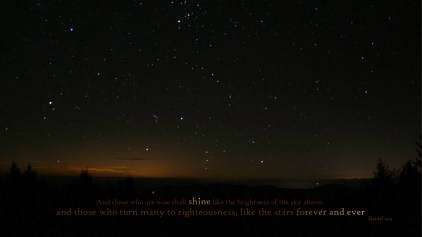
Daniel 12: 3: The wise shall shine brightly like the splendor of the firmament, and those who lead the many to justice shall be like the stars forever and ever.
“Daniel’s apocalyptic view of history is most fully laid out in Chapters 10-12, which make up one long vision. There an angel explains to Daniel that there is an ongoing battle in heaven between the archangels Michael and Gabriel on the one hand and the angelic “princes” of Persia and Greece on the other. This battle is reflected on earth in the wars of the Hellenistic age, which are described at length in Chapter 11 . . . At the end Michael will arise in victory and the resurrection will follow”. (Senior RG 349)
Apocalyptic writing was popular in the centuries before and after Jesus’ birth and although it is characterized by symbolism and descriptions of cataclysmic events, it is rooted in the teachings of the prophets. Dire circumstances and extreme conditions experienced by the Jewish people provided fertile ground for early writers as they warned, predicted and called the remnant people to fidelity. Living in times of hopelessness and desperation, the faithful took heart as they heard the stories of rescue, redemption and salvation. These images laid the groundwork for the genesis of Christianity, and Jesus’ introduction of the work of discipleship.
Many shall be refined, purified, and tested, but the wicked shall be proven wicked, none of them shall have understanding, but the wise shall have it. (Daniel 12:10)
Jesus describes the life of a disciple clearly in his Sermon on the Mount:Blessed are you when peopleinsult you and persecute you, and falsely say all kinds of evil against you because of me. Rejoice and be glad, for your reward in heaven is great; forin the same way they persecuted the prophets who were before you.(Matthew 5:11-12)
Daniel 12:12: Blessed is the one who has patience and perseveres . . .
Jesus tells a parable of the persistent widow who patiently returns to a corrupt judge, asking endlessly for justice. Now He was telling them a parable to show that at all times they ought to pray and not to lose heart . . .(Luke 18:1-8)
Daniel 12:13: Go, take your rest, you shall rise for your reward . . .
Jesus asks us that to give him our worries and anxieties that are too great for us to bear. Come to me, all who are weary and heavy-laden, and I will give you rest. Take my yoke upon you and learn from me, for I am gentle and humble in heart, and you will find rest for your souls. For my yoke is easy and my burden is light. (Matthew 11:28-30)
This portion of Daniel’s prophecy brings a new perspective of an old vision. Battle between good and evil are not new. But what Daniel brings us is the foreshadowing of a new and wonderful reason for hope and joy. Daniel opens up for us a new dimension. The world of joy born out of pain, of celebration rising from sorrow, and of new hope burgeoning from old wounds.
When we spend time with Daniel 12 today, we see new light leading us into a world of new dimension.
Senior, Donald, ed. THE CATHOLIC STUDY BIBLE. New York, Oxford University Press, 1990.RG 149. Print.
For more reflections on this prophecy, enter the word Danielinto the blog search bar and explore.
“The office of prophet was due to a direct call from God. It was not the result of heredity, just as it was not a permanent gift but a transient one, subject entirely to the divine will”. (Senior 877) Today joy comes upon us from the depths of fear experienced by a people lost and roaming . . . as we rejoice in the coming of the Messiah.
Baruch, the well-known secretary of the prophet Jeremiah, records beautiful verses in both poetry and prose that present a prayer for displaced people. Viewed in this way, the words help those who are lost or misplaced, those who suffer during this time of year when so many others celebrate. When contemplated in the silence of personal exile, these ancient words might set lost feet down on ground once thought unstable; they might give a new horizon and a clear path to those living abandoned or in pain. On this day awaiting the arrival of God in our midst, we take time with these words and rhymes . . . as we listen for God’s message of hope, healing and joy.
Take off your robe of mourning and misery . . .
God says: Your days of loss and suffering have come to an end.
Bear on your head the mitre that displays the glory of the eternal name . . .
God says: Decide to stand in the joy I shower on you . . .
God will show all the earth your splendor . . .
God says: I know that you believe I have abandoned you . . .
You will be named for God forever . . .
God says: Yet I have never left your side, I have never left your heart . . .
Look to the east and the west and see your children gathered at the word of the Holy One . . .
God says: Do not despair that all of your energy and work have been lost for in this you are incorrect . . .
Led away on foot by their enemies they left you . . .
God says: You have been apart and separate for a time but you have not been alone . . .
God will bring them back to you . . .
God says: All of your lost hopes are not, in fact, lost. They live on in all those whom you have touched as you have traveled your road of exile and sadness. Do you not see how many ripples you have sent out upon the waters?
For God has commanded that every lofty mountain be made low, and that the age old depths and gorges be filled to level ground . . .
God says: Have I not just done the impossible . . . arrived as God yet as a human babe?
For God is leading you in joy, by the light of holy glory, with mercy and justice for company.
God says: Remember that I have done all of this and more. I continue to hold you in my own heart and plans. You continue to be more important to me than you imagine. Each time you show mercy despite your painful circumstances you tell the world about my love for you. Each time you stand for justice despite your littleness you show the world the great love I have placed in you. Each time you live in me, my heart bursts with happiness in you. Remember all of this and know that I love you . . . and know that I always will.
Today we give thanks for God’s constant attendance on us . . . even in those times when we have felt alone. If the holiday season is a time of trial, spend time with Baruch today.
If this week’s Noontimes call you to search for more ways to encounter Joy or urges you to investigate the New Testament, click on the word Joy in the categories cloud in the blog’s right hand sidebar and choose a reflection, or enter those words in the blog search bar.
Senior, Donald, ed. THE CATHOLIC STUDY BIBLE. New York, Oxford University Press, 1990. RG 323. Print.
“The office of prophet was due to a direct call from God. It was not the result of heredity, just as it was not a permanent gift but a transient one, subject entirely to the divine will”. (Senior 877) Today joy surprises us from the depths of despair as a people lifts hope high . . . waiting for the coming of the Messiah.
The prophet Jeremiah responds to God’s call as a young man in the 13th year of King Josiah, approximately 612 B.C.E. He persists faithfully in conveying God’s word to a recalcitrant people “with enthusiasm and hope”. (Senior 949) He remains in the rubble of Jerusalem’s ruins but is forced into exile in Egypt by conspirators. Tradition tells us that he was murdered by these countrymen and that his prophecy was recorded shortly after his death. (Senior 949)
Jeremiah 15:16: When I found your words, I devoured them; your words were my joy, the happiness of my heart, because I bear your name, Lord, God of hosts.
God’s word sustains and upholds us; it nurtures the joy within. Jeremiah’s enthusiasm for his God and God’s word sustain us today.
Jeremiah 31:13: Then young women shall make merry and dance, young men and old as well. I will turn their mourning into joy, I will show them compassion and have them rejoice after their sorrows.
God’s love redeems and rescues us; it calls forth the joy within. Jeremiah’s fidelity to his God and God’s mercy liberates us today.
Jeremiah 33:9: Judah will be to me a name of joy, praise and glory before all the nations of the earth which will hear of all the good that I do for them, and they will fear and tremble because of all the good and all the peace that I make for it.
God’s goodness heals and transforms us; it celebrates the joy within. Jeremiah’s passion for his God and God’s power renews us today.
As we await the birth of the Christ who rescues, transforms, heals and makes new, let us reflect on God’s power to bring life out of ruin, healing out of destruction and hope out of death for a renewal of life.
If this week’s Noontimes call you to search for more ways to encounter Joy or urge you to investigate the New Testament, click on the word Joy in the categories cloud in the blog’s right hand sidebar and choose a reflection, or enter those words in the blog search bar.
Senior, Donald, ed. THE CATHOLIC STUDY BIBLE. New York, Oxford University Press, 1990. 877 & 949. Print.
“The office of prophet was due to a direct call from God. It was not the result of heredity, just as it was not a permanent gift but a transient one, subject entirely to the divine will”. (Senior 877) Today joy surprises us from the depths of despair as a people lifts hope high . . . waiting for the coming of the Messiah.
In the 8th Century B.C.E. the nations of Israel and Judah are threatened and then overcome by the Assyrians to the north and the Egyptians to the south. The prophecy of Isaiah, thought to be the combined work of several men, takes us on the rollercoaster ride of political, social and moral upheaval the faithful of Yahweh experience. But despite the dreadful events and circumstances that surround the faithful and strip away all they hold dear, the words of this prophecy bring hope.
Isaiah 24:14: They shall lift up their voice, they shall sing for joy in the majesty of the Lord, they shall shout from the western sea.
In a moment when we have no words, we allow the Spirit to give voice to our hope.
Isaiah 35:6: The lame shall leap like a stag, and the mute tongue sing for joy.
On a day when we find ourselves unwell or incapacitated, we allow Christ to heal our illness.
Isaiah 55:12: Yes, in joy you shall go forth, in peace you shall be brought home; mountains and hills shall break out in song before you, all trees of the field shall clap their hands.
In an hour when we see no reason to hope, we allow God to transform our fear.
Isaiah 65:18: Shout for joy and be glad forever in what I, the Lord, am creating.
If this week’s Noontimes call you to search for more ways to encounter Joy or urge you to investigate the New Testament, click on the word Joy in the categories cloud in the blog’s right hand sidebar and choose a reflection, or enter those words in the blog search bar.
Senior, Donald, ed. THE CATHOLIC STUDY BIBLE. New York, Oxford University Press, 1990. 877-879. Print.
“The office of prophet was due to a direct call from God. It was not the result of heredity, just as it was not a permanent gift but a transient one, subject entirely to the divine will”. (Senior 877) Today joy surprises us from the depths of despair as a people lifts hope high . . . waiting for the coming of the Messiah.
Isaiah 14:7:The whole earth is at rest and is quiet; they break forth into shouts of joy.
The world into which Jesus was born was not much different from our own when we consider that corruption, violence, turmoil and shame are countered by truth, love, healing and peace. Certainly in the twenty-first century a portion of us has access to instant global communication, the wonders of modern science and medicine, and the power to make choices about our individual and collective lives. Yet are we happier than the people of Jesus’ time? Are the poor less poor and the rich more compassionate? Do we care about and for one another more? Do we share the resources of God’s creation with one another?
Isaiah 14:7: The whole earth is at rest and is quiet; they break forth into shouts of joy.
If we have not already explored how each of us fits into a global picture, we might take time to do so today. We might choose a topic such as poverty, water, food, basic human rights, the status of refugees around the world. We can use a search engine to look for maps or charts; or we might find an organization whose data we trust and see this information as a prophetic call to heal the world. If God speaks to us in such a way that we want to set into motion a healing action, we can visit www.change.org and step into the call we have heard. God gives us the power to become modern-day prophets, the power to lend our own words to a universal call of love, the power to take up this universal invitation to shout for joy at the Messiah’s coming.
Isaiah 14:7:The whole earth is at rest and is quiet; they break forth into shouts of joy.
If God’s gift of prophecy is transient, its effects are infinite and everlasting. We step forward today in joyful acceptance and thanksgiving for this gift.
If this week’s Noontimes call you to search for more ways to encounter Joy or urge you to investigate the New Testament, click on the word Joy in the categories cloud in the blog’s right hand sidebar and choose a reflection, or enter those words in the blog search bar.
Thereupon the princes and all of the people said to the priests and the prophets, “This man does not deserve death, it is in the name of the Lord, our God, that he speaks to us”.
Each of us has likely experienced loss of friendship and perhaps even ridicule in either a private or public way. If we have not, it is likely that we know someone who has. Today we pause to reflect on the consequence of keeping silent when we know a lie is spoken as truth. Whistleblowers from all cultures and walks of life will recognize this story. Let us explore Jeremiah the man to see what his persistent, compelling love for God brings to us millennia after his words were recorded.
Jeremiah has been ridiculed, punished, mocked and finally condemned to death. Scholars tell us that we are uncertain as to his fate and you may want to visit one of the sites listed below to explore the mystery of this man.
The princes and the people versus the priests and the prophets. How do we see this drama played out today in our own families, in our own neighborhoods, in our own workplaces? Who are the factions and for what, of whom, do they stand? Take a bit of time and explore the story of Jeremiah. You may find that it is very like your own.
Click on the image above for a post entitled “Are We Too Negative?” by Dave Hunt, or go to: http://acrookedpath.com/2012/08/14/are-we-too-negative-by-dave-hunt-part-i/
Visit the sites below to explore the Jeremiah in each of us.
We began our study of Jeremiah looking at Chapter 11 of this prophecy and today we return again to examine if we have gained insight from the prophet’s words. Have our efforts to understand sacrifice and suffering, gift and giving been of no avail?
Jeremiah tells his community – and us – that persecution comes to all, even to the innocent. He examines false and true shepherds, insincere and sincere relationships, and how we might maintain a solid connection with our creator despite the corrupting influences of the world. In these opening chapters, Jeremiah’s basic attitude centers on “the tender love of God as manifested in the covenant in the days of Moses”. Sin brings consequence; yet punishment can be purifying and transformative, even for the innocent who suffer at the hands of corrupt leaders. Jeremiah counters a sense of hopelessness with words of encouragement. (Senior RG 311)
Then the Lord alerts the faithful servant . . . A conspiracy has been found, the Lord said to me, among the men of Judah and the citizens of Jerusalem. They have returned to the crimes of their forefathers who refused to obey my words. They have also followed and served strange new gods . . .
Jeremiah speaks aloud – and he suffers for this candor – words from the Creator: the leaders and the core of the Judaic society have turned away from the Living God who shepherded the Hebrew nation out of slavery and through the desert. It is no wonder that the prophet laments and yearns to remove himself from society to find refuge in a quiet desert lodge. And it is no wonder that the temple leadership begins to plot against this prophet.
What do we do when we find ourselves in a similar situation? We have seen corruption and named it. We have prayed and made sacrifice. We have remained part of the faithful remnant; and yet rather than experience reform instituted by leaders, we find ourselves struggling to survive ever-worsening circumstances. If we find ourselves besieged in this way, we do well to turn to this prophet.
We have begun our Jeremiah journey with reflections on how the innocent find strength, wisdom and patience to accompany the Living God whom their leaders have abandoned. In the coming weeks we continue our passage from transformative suffering to redemptive understanding. We accompany Jeremiah through his travail that culminates with the Babylonian capture of Jerusalem. We wend our way through difficult circumstances, anticipating the gift of hope in God’s plan for us, and looking to our Jeremiah Journey to bring us home.
Return to the Of No Avail or The Desert Lodge posts by entering the words into the bog search bar.
Senior, Donald, ed. THE CATHOLIC STUDY BIBLE. New York, Oxford University Press, 1990. RG 311. Print.
 Wednesday, January 26, 2022
 God’s victory on behalf of righteousness is “a world populated by the saints themselves”. (Mays 633)








 The Noontimes