I have been a fool and I have made a serious mistake.
David and Saul had at one time a close and personal relationship and David and Saul’s son, Jonathan, become hard and fast friends; yet Saul becomes envious of the admiration the people have for the young warrior-psalm-writer, David. Today we read a portion of the story in which we see the rupture between them – David and his followers have become fugitives; Saul rants and looks to take David’s life.
In today’s Noontime we watch as David creeps into Saul’s tent where the king sleeps surrounded by bodyguards. Most of us would expect David to take revenge for the treacherous way Saul has treated him but this does not happen. Instead, he takes Saul’s spear and water jar to demonstrate his presence and exits the tent. Admonishing his companion for thinking that they might do God a favor by eliminating Saul, David shows us that he understands his proper place in God’s plan. He is a servant. Later, Saul admits he has been wrong and he utters the words many of us need to say to others, or wish that others might say to us: I have been a fool and I have made a serious mistake.
We can spend our days waiting to hear these words from one who had wronged us. We can also spend our days weaving convoluted plots in order to avoid using these words, but in the end, the effect is the same: we become exhausted.
When offenses are committed and there is no apology, we must leave the unraveling of the consequences to God. When we offend others and find it difficult to ask for forgiveness, we must surrender our pride and ask God for the best way to repent and atone. In this way then, our exhaustion will be transformed into a new exuberance for life.
Written on May 21, 2010 and posted today as a Favorite.
We have been looking at this tiny prophecy which is packed with imagery and emotion. Today we continue our deeper look.
From the CATHOLIC STUDY BIBLE Reading Guide page 368: The oracle is really a testimony to the indomitable hope of a people who had been reduced to poverty and insignificance, and were at the mercy of their neighbors.
While most of us do not suffer from severe fiscal poverty, we certainly skate along the edges of financial crunches from time to time, but that is not what I think about when I think of poverty. The metaphor which comes to me as I read these lines of the people pleading for vengeance is one of a poverty of spirit, a state of broken-heartedness, a state of grief over the great loss of something we held near to us. All of us at some time have suffered at the hands of those who say they love us, and it is in this light that we can identify with the prophet Obadiah.
The territory of Edom (against whose people this oracle is written) was settled by the descendants of Esau, the brother of Jacob who allowed himself to be tricked into giving over his birthright to his brother with indifference. At the time of the exile and captivity, the Edomites raided Judah and pillaged what the northern invaders had left behind. This continued what had already been a bitter animosity between Jews and Edomites, their neighbors and near kinsmen, an animosity between peoples who ought to be linked closely in friendship and blood ties. Deception by friends and family is felt more intensely than any other, I believe; and it cuts deeply, swiftly. And surely. This kind of betrayal is the most difficult to overcome. But overcome we must, orf we are a Remnant People a destiny for conversion, for transformation, for kingdom.
From THE ARCHEOLOGICAL STUDY BIBLE article on Edom, page 1467 we find that Edom (located south of the Dead Sea and north of the Gulf of Aqaba) prospered from its control of north-south trade routes and its excavations of its copper and iron mines. Moses was unable to negotiate a peace with these people and so the Hebrews were forced to go around them on their way home to the Promised Land. David managed to control this tribe, many of whom lived in high caves cut out of the stony faces of the mountains, but other Jewish kings were not so fortunate. These people (later known as Idumeans) finally succumbed to Roman rule after the destruction of Jerusalem in 70 C.E. and “disappeared from history.”
We can easily identify with the prophet and people who suffer at the hands of their neighbor. We might as easily call for vengeance over the despicable acts of those who are near to us in body and in heart but if we are a Remnant People we must call for Hope. We must call for the Messiah.
Let us put aside our very human desire for revenge, and let us petition our Creator God for the same peace and compassion which we have been given. Let us ask intercession for those nearest to us who have hurt us. And let us ask forgiveness of those nearest to us whom we may have injured. Let us ask for restoration for all.
A re-post from September 10, 2012.
Senior, Donald, ed. THE CATHOLIC STUDY BIBLE. New York, Oxford University Press, 1990. RG368. Print.
“Edom.” ARCHAEOLOGICAL STUDY BIBLE (NIV). Grand Rapids, Michigan: Zondervan, 2005. Print.
Written on March 24, 2008 and posted today as a Favorite.
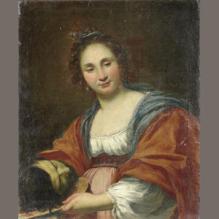
French School, 17th Century: SaloméMore thoughts on Saloméwho sought revenge, and who asked for the head of John the Baptist on a platter.
“We know nothing about Obadiah beyond his name, nor is the place of the book’s composition certain . . . Obadiah did not specify that his message came at the time of any specific king or event. On the other hand Obadiah 11-14 indicates that a major calamity had struck Judah and that the Edomiteshad capitalized on Judah’s troubles to their own advantage . . . common sense and a broad consensus suggest that the calamity was in fact the fall of Jerusalem in 586 B.C.”
“Obadiah was written to the people of Judah about the Edomites (descendants of Esau), condemning them for their treachery and violence toward the people of Judah, as well as for their arrogance and indifference toward God.” (Zondervan 1464)
This is the kind of prophecy which makes us cringe as we understand that revenge is not something we want as part of our value complex. Seeking vengeance is the kind of thinking my parents continually warned us against for it can never be good. We were often reminded in our growing years that when we dig a grave for our enemy we ought to dig two: one for them and one for us. “The truth will always come out in the end,” Dad would remind us. “Don’t worry about the other guy getting credit that is not due him, or the other guy getting away with things. It’ll all come out in the end. Just keep your eye on yourself and your God. And let God handle the other guy.” Dad warned us that human depravity was too crooked and too frightening for us to correct; he knew from personal experience that only God can deal effectively with deep evil. We humans – even when we are in the best of places and times – cannot conquer forces that have spent eons gathering strength in the dark. It is far better, according to Dad, to go to the light and stay there. “That way God can see you and pick you up on his way home.”
Mother always intoned her mantra of “Kill your enemies with kindness. Pray for them and you will never be alone; because you can bet on it that when people are that naughty lots of people will be praying along with you. Think of the message God will hear when all those voices join together,” she would remind us. “Yes, I know you want to get back at them but just pray for them. They will need your prayers. And besides, the results are better.”
These simple lessons were either never delivered or they were lost on Salomé who asked for and received John the Baptist’s head on a platter. Yesterday we spent time reflecting on her portrait and we saw her sultry stare and sullen posture, arms draped around the killing knife and the platter that would deliver the head of her enemy. Today we see a similar likeness; she looks out at us in apparent satisfaction yet we know that revenge is not sweet. It does not last and it does not satisfy. It only brings about our own destruction and doom. These are the truths spoken by Obadiah more than two millennia ago, and they are truths we can still use today. We must wipe revenge from our hearts and replace it with forgiveness for the measure that we measure with is measured out to us.
And so we pray . . .
When we are most hurt by others, we must not strike back, we must forgive.
When we are most neglected by others, we must not plot their downfall, we must forgive.
When we are most abused by others, we must ask for their redemption and we must forgive.
When we are most abandoned by others, we must not treat them in like fashion, we must forgive.
When we are most damaged by others, we must not in turn inflict damage, we must forgive.
God forgives. God restores. God repairs. God cures. We are each called to do the same. Amen.
Henri Regnault: SaloméConfident and startling, sulky and sultry, alluring and fear-inspiring, dappled with light and yet somehow dark, gifted with beauty and talent; yet, drawn to revenge and self-interest. As we read these verses that tell us of the death of John the Baptist, and as we look at this beautiful yet horrifying painting of Salomé we might ask ourselves where we stand in this story. We cannot take our eyes from the platter and knife. Has she already washed them clean or is she holding them in anticipation? Has she known that Herod is in the mood to grant wishes this evening or does she plant the seed of the idea somehow days in advance? Does she choreograph her dance to play on the king’s drunken frame of mind?
Plotters lie in wait for years if need be; those who seek vengeance have infinite patience and determination. They use any means and they go to any lengths to achieve their purpose.
What do we say to Salomé if anything? What do we do in this moment of terrible waiting? Do we speak or do we remain silent in fear? Are we distressed as is the king? Do we encourage Salomé as does Herodias? Do we gloat? Do we smile? Do we turn away? Do we cry?
Prompted by her mother . . .
How and what do we enact in peace?
Because of his oaths and the guests who were present . . .
Why do we allow society’s pressures to squeeze us into places of no return?
Give me here on a platter . . .
What terrible requests do we make of God in our moments of anger and fear? What petitions do we lay before him? Does our whispering instigate devious plans or do we speak and work for peace and reconciliation at all cost?
Let us spend some time today with Salomé and wonder who we are and where we stand. And let us consider what it is we might ask for on shinning bright platters.
A favorite from September 11, 2012. Let us consider again the measure of our lives . . .
The measure that you measure with is measured out to you.John the Evangelist speaks of the measure of God’s joy which we will know when we follow Jesus. All three synoptic Gospels (Matthew 7:2, Mark 4:24, Luke 6:38) remind us that we are measured by our own actions; this is the same message we hear from the prophet Obadiah today; yet, do we truly listen to these words?
Countless times in the Old Testament we hear stories of how people are done in by the plans they designed for their perceived enemies. The story of Esther is a wonderful example which I always recall because it illustrates this point in the person of Haman who is executed on the gallows he ordered constructed for Mordecai, the man he envied and wanted to eliminate.
Do we truly listen to these words?
Each time we find ourselves plotting to “teach someone a lesson”: Do we truly listen to these words?
When we worry about the schemes of others more than we place our petitions for change in God’s hands: Do we truly listen to these words?
If we engage in gossip or enable disrespectful or abusive behavior without saying a word: Do we truly listen to these words?
If there are times that we refuse to witness as God asks: Do we truly listen to these words?
When we have given up hope and cease asking God to intercede for those who harm us: Do we truly listen to these words?
When we allow our doubts and fears about God’s love for us and the goodness of his creation to overcome his love for us: Do we truly listen to these words?
When we examine the measure with which we measure others, will we want to be valued by this standard? Will we want to have others’ opinions rammed into our minds? Will we want others to lapse into mediocrity for fear of failure? Will we want others to give up entirely? Will we want others to speak in compassionate truth? Will we want to be measured with the norm we use when looking at others?
Do we truly listen to these words?
Notes from La Biblia de América: Can patience run dry? Does the capacity to lend support have a limit? Our Christian faith teaches us that the answer is, no. It is necessary to forgive seven times seven times – or infinitely. Love cannot have limits. Is this the only message Obadiah wants to communicate? Is he merely acting to break a cycle of violence in his own day, or does he speak to us as well? This briefest of prophecies has as a target the Edomites, a people in constant conflict with those in Judah, the descendants of Jacob’s brother, Esau. The abrasive conflict reaches a height when Edom backs the invading Nebuchadnezzar to destroy Jerusalem and carry the Jewish people off into exile. Obadiah speaks to the remnant left behind after the Assyrian holocaust. Obadiah speaks to us now.
Who are the Edomites in our own lives today? We know the land of Edom well. It is the place where our constant adversaries live. It is the hard heart which envies who we are and what we have. It is the stiff-necked place from where schemes and lies and plots all spring. And these are the places we are asked to measure with the same measure we wish ourselves to be measured. We are asked to measure in faith, with hope, and through love. Let us go to Edom with a full measure of love in our hearts.
LA BIBLIA DE LA AMÉRICA. 8th. Madrid: La Casa de la Biblia, 1994. Print.
If we can find the time this evening or this weekend, we will want to leaf through the first portions of the 13th chapter of Matthew and reflect. The Gospel writer is careful to record Christ’s words; he preserves them for us so many centuries after they were first spoken.
An essay in THE CATHOLIC STUDY BIBLE makes three points about this portion of Matthew’s Jesus Story. First, we must seek meaning in these verses and when we do, we will be rewarded with the wisdom and grace of Spirit’s presence. Second, we must always be confident in God’s promise and providence brought to us by Jesus. And third, leaders of all kinds will have to struggle with the gray world of often opposing forces. The past and present will be linked only when we seek and trust God.
“Parables are the trademark of Jesus . . . [T]hese pointed stories both reveal and veil the mystery of the Kingdom. Unless the listener is willing to probe beneath the surface of the parables, the true meaning of Jesus’ words will escape them . . . [T]rue followers of Jesus are to put aside everything and be fully committed to the compelling beauty of God’s reign.
“Many of the parables in Matthew’s Gospel have obvious moral messages . . . The parable of the weeds sown among the wheat explanation makes the point that the church, like the world itself, is a mix of good and evil. The disciples should not be discouraged by this but be confident that God’s grace will triumph at the end of time and evil will be punished.
“The conclusion of the parable discourse seems almost to be a signature of the Gospel writer . . . Bridging past and present in an open and respectful manner is one the greatest challenges of religious leadership.” (Senior RG 397)
And so we wait. We search. We question. We doubt. We struggle. We turn to and rely on God. We enter willingly into both the mystery and the revelation for the more we know the more we question.
The Parable Discourse is a lesson on how to meet difficulty. It is a graced interchange and dialog with our God. And it is an open door that invites us to enter the world of Jesus. May we be confident enough and bold enough to accept this invitation.
Senior, Donald, ed. THE CATHOLIC STUDY BIBLE. New York, Oxford University Press, 1990.RG 397. Print.
British Museum, London, England: Cuneiform tablet with part of the Babylonian ChronicleGod’s ways are just, and those who walk in pride will be brought low. Those who humble themselves for and in God will be rewarded. This is the lesson we read about today. The great and mighty Nebuchadnezzar realizes that the God of the Jewish nation is more powerful than anything known to humankind, and he wisely bows to the supremacy of this God.
Nebuchadnezzar ruled Babylon at the peak of its power, from 605 to 562 B.C.E. and he took pride in the building of temples and city fortifications. He is mentioned more than any other monarch in the Old Testament. He led several campaigns against Israel (in 604, in 597 and in 586) and succeeded in capturing Judah, ransacking the temple, and deporting thousands of the Jewish people. Nebuchadnezzar fought and won battles against the Middle Eastern powers in Egypt, Israel and Judah, and he consolidated this power to form a formidable empire; yet this powerful man bowed to the power of the God esteemed by Daniel, the bright young Jewish man whose God was stronger than any other power on earth. (http://www.biblehistory.net/Nebuchadnezzar.pdf)
Look for the video link labeled Babylon 612 B.C. How difficult it must have been to remain loyal to Yahweh and to not be drawn in by this grandeur and glory, and how difficult it must have been for the “madman” Nebuchadnezzar to bow to this unseen God when he controlled all he could see. This is truly a powerful God.
Written on April 12, 2009 and posted today as a Favorite.
Our lives seem full of words and in particular this recent election cycle seems to have the very air full of them. Words for, words against, words that describe, words that deceive, words that inflame, words that bring peace, empty words, words that fill, but so many words. At this point in his prophecy Jeremiah has spouted many life-saving words and yet the prophet is being ignored. He will eventually disappear from the world stage but his words will remain for they are God’s words. The words Jeremiah utters and writes down will prove him to be on target and in tune with God. We might wish to be so in accord with our creator. In the midst of so many words we stumble across this verse as we reflect on how we might make God’s words our very own.
Jeremiah 15:16:When your words came to me, I ate them; they were my joy and my heart’s delight, for I bear your name, O Lord God Almighty.
Jeremiah repeated the words the Lord gave him to say; we pray that we might be so ardent.
Jeremiah spoke faithfully in the name of God Almighty; we pray that we might be so persistent.
Jeremiah lived out the creator’s words; we pray that we might be so authentic.
Jeremiah sticks to the message the Lord gave him to deliver; he does not go off message nor does he incorporate his own agenda into the words he is given to speak. Jeremiah complains to God that he is cursed by many; he says that he ought never to have been born. He lives in pain as a consequence of his fidelity to God; yet Jeremiah does not give in.
Jeremiah delivers God’s words and in doing so he also delivers hope. Jeremiah speaks difficult words and in doing so he makes them his heart’s delight. Jeremiah makes God words his own, and in doing so he makes the invisible God visible.
Jestin Xavier: Journey in the DesertJoshua 24:17: It was the Lord our God himself who brought us and our fathers up out of Egypt, from that land of slavery, and performed those great signs before our eyes. He protected us on our entire journey and among all the nations through which we traveled.
There are many deserts in our lives and many places of captivity. They sap our strength.
There are many signs that God performs in his love for us. They bring us hope.
There are many protected journeys on which God shepherds us. We travel safely thorough enemy nations.
God says: I bring you out of the desert because I love you dearly. I perform great signs and wonders for you because I cherish you deeply. I make a way for you through dangerous places because I want to accompany you. I protect you in each day’s journey because I want to abide with you. I myself have brought you out of arid places to a fertile place where you will flourish. I have great plans in mind for you. I want to free you from that binds you and keeps you from celebrating your freedom in joy with me.
When we feel trapped in our lives, we must ask God for freedom.
When we face insurmountable obstacles in our daily journey, we must ask God to make a way for us.
When we fear for our safety and fret over the enemies who will take us captive, we must ask God for protection.
Enter the word Egyptinto the blog search box for more reflections on making a journey with God’s protection, or go to the Journeys of Transformation page and consider making a journey this coming week-end.