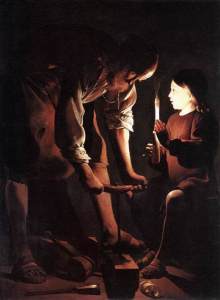
Joseph was a man who always did what was right, but he did not want to disgrace Mary publicly; so he made plans to break the engagement privately. While he was thinking about this, an angel of the Lord appeared to him in a dream. (Matthew 1:19-20)
There are many times in our own lives when we do not understand our circumstances. We might use Joseph as an example of how to move forward in the face of deep grief or fear. Rather than allow fear and doubt to paralyze us, we must turn to what we know, and we must turn to God.
When we live in the Creator, wisdom always arrives. When we live in Christ, courage always finds us. And when we live in the Spirit, peace takes over our lives . . . even on those days when they are filled with strife.
Over the few weeks we will be away from easy internet access, but we will be pausing to read scripture and to pray and reflect at noon, keeping those in The Noontime Circle in mid-day prayer. You may want to click on the Connecting at Noon page on this blog at: https://thenoontimes.com/connecting-at-noon/ In these posts, we will have the opportunity to reflect on a scripture verse and an artist’s rendition of that event. Wishing you grace and love and peace in Christ Jesus.
In days when we experience doubt and uncertainty, we return to a Favorite from October 17, 2010.
Teresa of Ávila and Catherine of Siena
I cannot understand what it is that makes people afraid of setting out on the road to perfection. May the Lord, because of who he is, give us understanding of how wretched is the security that lies in such manifest dangers as following the crowd and how true security lies in striving to make progress on the road of God. Let them turn their eyes to him and not fear the setting of this Sun of Justice, nor, if we don’t first abandon him, will he allow us to walk at night and go astray. Teresa of Ávila, MAGNIFICAT Meditation for October 15, 2010.
This past Friday was the feast day of Teresa of Ávila and on that day the readings focused on the fact that we are chosen by God, that God loves us more than we can imagine, and that nothing we think or say or do is secret from him. Today’s readings are about how we are to be persistent in prayer, just as were Teresa of Ávila and Catherine of Siena, two women who have been named Doctors of the Church, two women who did not let their fear of anything earthly keep them from doing as God asked them – even when it involved great risk to themselves and to all they struggled to do in God’s name.
Following is an excerpt from today’s MAGNIFICAT Day by Day reflection taken from one of Catherine of Siena’s letters.You know full well, most holy Father, that when you accepted holy Church as your bride you agreed also to work hard for her. You expected all these contrary winds of pain and difficulty to confront you in battle over her. So confront these dangerous winds like a brave man, with strength and patience and enduring perseverance. Never turn back because of pain or discouragement or slavish fear, but persevere, and rejoice in the storms and struggles. Let your heart rejoice, for in the many contrary things that have happened or will yet happen the deeds of God are surely being done, nor have they ever been done in any other way.
Catherine of Siena
Both of these women remind us that we are called to perfection and that perfection lies in our persistence to do God’s will despite the inconveniences and risks we meet along the way because God will never let God’s work go undone. In today’s Noontime we read that woe befalls those who plot iniquity, those who lie on ivory couches to lay schemes and plots, those who covet what others have and are, those who cheat others out of what they are due.
Today’s readings (Exodus 17:8-13, Psalm 121, 2 Timothy 3:14-4:2, and Luke 18:1-8) remind us that Moses and the Israelites, Paul, Timothy, the nameless Persistent Widow, and Jesus himself did not abandon the work given them by God – even in the face of great odds and overwhelming fear. All of this reminds us that when we are doing the work of the Gospel we will encounter unforgiving and dangerous head winds. We will experience great darkness and be tempted to undo our walk of perfection and persistence. All of this reminds us that in the midst of the greatest suffering and distress we do not find agony alone, there also do we find our God, and other who would do God’s will.
The eleven huddle in fear for their lives when the Emmaus disciples burst into the room telling of their resurrection experience with Jesus. We can imagine the juxtaposition of the Emmaus joy and the Calgary fear – these disciples are living two different aftermath experiences – and then Jesus appears to affirm the truth: that what they have hoped for has come to fulfillment. He is risen! Then the disciples hear the true call of the aftermath. This call is notthat troubles will fall away from Christ’s workers, but rather that these workers will bring the same hope to others that Jesus has brought to them. The light has come to the world in fullness just as they had expected.
And so it also with us. The aftermath that Jesus foretells is already surrounding us. Perhaps we just cannot see this duality yet that the light has come to the world in fullness just as we have expected.
Several times a year we visit the ending of Luke’s Gospel during our Noontimereflections. Perhaps we need this aftermath reminder that often. Just a few weeks ago we spent some time thinking about the Emmaus people on the road with Christ. Today we see them harbinger the news to the eleven that the Christ has risen. The light has come to the world in fullness just as they had expected.
We seem to always need reminding that the paradox of the Easter story is that we are free even though we do not always feel free; yet the very act of our doubt becomes an act of faith because the light has come to the world in fullness just as we have expected.
We seem to always need reminding that the hope of Easter is fulfilled in us; we bring that message to one another on dark days because the light has come to the world in fullness just as we have expected.
We seem to always need reminding that the love of Christ sustains us in all we do and think and say; we offer ourselves as victims each day in his love because the light has come to the world in fullness just as we have expected.
We are Easter People, yearning for the goodness of life and perfection in God; and we live that goodness and perfection because the light has come to the world in fullness just as we have expected.
Is this the aftermath we have expected from the Easter story? Yes it is, because the light has come to the world in fullness just as we have expected.
LA BIBLIA DE LA AMÉRICA. 8th. Madrid: La Casa de la Biblia, 1994. Print.
The expression “God’s Elect” seems contrary to the message of Jesus about universal access to God and salvation. We are all given the option to listen, seek, obey and serve. So the expression we see here today may put us out of our comfort zone. We need to think about this.
From the NAB: “This prophecy is rich in imagery and strongly eschatological in tone. . . Its prevailing theme is the day of the Lord.”
From today’s MAGNIFCAT: “Jesus said: ‘I am the gate. Whoever enters me will be saved, and will come in and go out and find pasture’.” John 10:9 The gate to the Lord’s sheepfold is narrow and cut in the shape of a cross. Yet Christ leads the flock safely through to the place of pasture he has prepared for us. . . Two distinct groups follow Jesus as he goes up to Jerusalem. Those who walked with him who ‘were amazed’ are the ones who live the prayer, ‘Look upon us, show us the light of your mercies. Give new signs and work new wonders.’ However, those who walked behind him ‘were afraid.’ Joining with Jesus who gives his life as a ransom for many changes our fear into amazement.”
With God and prayer, fearturns to amazement. We must remember this.
When we turn to God through our suffering, our wonder and awe are increased many-fold. When we see how God provides for us, our faith is increased many-fold. When we dream of prayers God might answer for us, our petitions are answered many-fold. When we love as God loves us, our love is increased many-fold. And so we pray.
Good and gracious God, grant us the patience, the wisdom, and the perseverance to seek the narrow gate and to enter it. May our fear turn to awe, and may we be continually amazed by your goodness. Amen.
Adapted from a Favorite from May 30, 2007.
Cameron, Peter John. “Meditation of the Day.” MAGNIFICAT. 30.5 (2007). Print.
As we prepare for the celebration of Easter, we return to some Christmastide meditations from 2011 and we reflect on how the Passion and Easter stories begin in a stable in Bethlehem.
This is the perfect time of year to think about our relationship with God – this God who comes into our lives as one of us in such a humble way that his family must beg for shelter, and within days of the child’s delivery they must flee into exile. The Messiah’s family life is one of constant dichotomy and this is fitting for it reflects our own lives of surprises, disappointments, and promises both fulfilled and unfulfilled. Our days are a series of hills and valleys, of ups and downs that make us anxious and fearful – we wish everything to be settled and determined. These highs and lows show us our mortality and make us uncomfortable – we prefer a life in which we are in total control.
From the very beginning of Jesus’ story, we see his family’s split reality; they are welcomed and gifted by both shepherds and magi, and they are hunted by Herod’s soldiers. (Matthew 2:1-18) In today’s Noontimewe go back to the time when the people of Israel have come home to Jerusalem after exile. They too, live lives of dichotomy, lives full of fear and hope for they know that the nation’s disobedience and errant ways have separated them from God; yet they hope for a return to their special status before God.
Tomorrow, the Israelites, Ezra, flight, and return.
In these opening days of a new year, we have looked at women in scripture who see and use God’s yardstick in their lives. Over the next few days we explore how we find God’s yardstick in both Old and New Scripture.
We have spent a number of reflections with this psalm, the longest of the 150 songs of sorrow, praise, joy, petition and lament. Two winters ago we spent several weeks examining each of the poem’s stanzas that begin with the letters of the Hebrew alphabet. As we concluded we decided that this psalm was an intense love letter from God to us. When we look at all the psalms, and this one in particular, we discover a yardstick that can only come from God, a yardstick that measures both the highs and lows of our days. A yardstick that offers forgiveness, healing, redemption and joy.
I’m feeling terrible—I couldn’t feel worse! Get me on my feet again. You promised, remember? On the days when we feel we can go no further, we must remember to take our woes to God.
When I told my story, you responded; train me well in your deep wisdom. On the days when we find it difficult to gather strength, we remember to ask God for help.
Help me understand these things inside and out so I can ponder your miracle-wonders. On the days when we forget the wisdom God has shared with us, we remember to ask again.
My sad life’s dilapidated, a falling-down barn; build me up again by your Word. On the days when we see no way past the heavy obstacle before us, we remember to rest in God.
Barricade the road that goes Nowhere; grace me with your clear revelation. During the nights when doubts and fears return, we remember that with God all things are possible.
I choose the true road to Somewhere, I post your road signs at every curve and corner. During the nights when we are restless and alone, we remember that Christ is constantly within.
I grasp and cling to whatever you tell me; God, don’t let me down! During the nights when we are desperate for peace, we remember that the Spirit heals and comforts.
I’ll run the course you lay out for me if you’ll just show me how. During the days and nights when we struggle with the world, we read and re-read God’s love letter to us, and remember that we are made by God for and with and in love alone.
Enter the words God’s Love Letter into the blog search bar for other reflections about Psalm 119. This ancient prayer from ancient scripture continues to serve us today as God’s yardstick. Tomorrow, we find God’s measure of love in the person of Jesus.
In this time of Advent, as we expect the coming of light and truth, we reflect on our relationship with Gad and the intimacy we give and receive.
As a community, the ancient Hebrews in their relationship with Yahweh were continually looking for something to excite or interest them while at the same time walking away from a profound intimacy with a God who loves them more than they can imagine. As believers today, we are in relationship with God and frequently we look for something we already have, the presence within that keeps us from harm and that draws us continually to our own divine origin. For some reason, we humans struggle with relationships that bring us to the truth of ourselves, relationships that ask us to grow, relationships that fulfill through their constancy.
There is no lack of stories – either about famous celebrities or the people in our own circles of friends and families – of men and women who cannot maintain fidelity. What is it we fear? Seeing ourselves in the mirror of the beloved’s eyes? Finding that we prefer the instant, superficial image that others have of us rather than the enduring truth of who we are?
We need not succumb to the fear of who we might be. We need not do as we think best but rather, let us do as God thinks best and as God asks of us as we hear in today’s first reading at Mass from Isaiah 30: Thus says the Lord God, the Holy One of Israel: O people . . . no more will you weep; he will be gracious to you when you cry out, as soon as he hears you he will answer you. The Lord will give you the bread you need and the water for which you thirst. No longer will your Teacher hide himself, but with your own eyes you shall see your Teacher, while from behind, a voice shall sound in your ears: “This is the way; walk it in”, when you would turn to the right or to the left.
We have an interior guide who is ever faithful to us. Let us put aside our fears of who we think we might be to open our eyes and ears to who we really are. And let us return this gift of self to the God who made us. For in this one small action we find a self that is waiting to be revealed. In this one small way we remain truly faithful to the one who knows and loves us . . . precisely as we are.
Notes from the NAB, page 1328: Rather than allow the slow to become content in their slowness, Paul exhorts them to even higher levels of spirituality. He is not lenient. And as for those who have fallen away completely, he does not even address these apostates. If all we need is energy to progress in our spiritual journey, we can turn to Christ for he tells us through Matthew (10:28-30), my yoke is easy, my burden light.Christ himself exhorts us, Come to me, all you who are weary and burdened, and I will give you rest.
Sometimes we are not so much sluggish as afraid. We know that the task lying before us is laden with tricky passages, dark corners, deceitful paving stones that look firm and yet sink into quicksand. On these occasions we must also turn to Christ, trusting him when he says take my yoke upon you and learn from me, for I am gentle and humble in heart. Disobedience is not an option for an apostle.
Paul tells us that Christ’s promise is immutable, and he uses the long story of the covenant promise between Yahweh and Abraham as ample proof. Did not the elderly couple – Sarah and Abraham – begin a kingdom of millions? Did this new way of seeking God not travel to allpeoples of allnations? Do we not know even today the story of this Abraham, Sarah, and the high priest Melchizedek? Paul reminds us that it is impossible for God to lie; God’s very goodness and honesty force God to keep God’s covenant with God’s people.
So when we feel weary or afraid, we might turn to Paul for a reminder of the words we can never hear too often. This we have as an anchor of the soul, sure and firm, which reaches into the interior behind the veil [into the Holy of Holies], where Jesus has entered as forerunner . . .
We must rest in this promise that when all is dark, when all appears to be lost, when all is more difficult or more terrifying than we can bear, we must be still so that we might hear again . . .
Come to me . . . and you will find rest for your souls . . .
Our talents are gifts from God and they are meant to be shared with the community – not hidden and kept away for ourselves. The last verse sounds so harsh, perhaps silly. Its true meaning is that once we begin to share what we have, we will be given the further gift of wanting to share. We will increase, we will convert, and we will find intimate union with God.
If our great fear is fear to commit, then once we begin to commit to others, the action becomes easier. If we do not take those steps toward others, if we build walls, then we will end up with less than we had when we arrived here. We will be alone in our tower – a tower built with our own hands.
Using another example, if we have a fear of paying attentionto others because we want all the attention for ourselves, we will never be fulfilled. If, on the other hand, we practice stepping out of ourselves and giving to others, we will receive further gifts which will enable us to truly forget ourselves and do for others. If we do not take these steps, we will end by being alone – separated from humans and from God – and again, all by our own hand.
Fill in the italicized words above with any human fear and Jesus’ message is this: Once we take the steps to convert ourselves in the area where we know we need improvement, we will receive more and more gifts which will empower us to continue our conversion. If we refuse to enter into this difficult process of conversion, we will lack more and more – until we have and are nothing. We will have diminished rather than increased. We will have separated ourselves from God. We will have descended the ladder of Beatitude into a lonely place – rather than ascended it to intimate union with God.
Mark’s Gospel is the most brief and succinct. His descriptions are precise. Jesus’ actions are seen in a clean, clear trajectory of purpose. His words are unadorned and plain, but strong and resolute. Mark’s story of Jesus is powerful.
May the power of these words be with each of you today.