We must always be prepared for the surprise of God’s goodness when tragedy encircles us. We must always be open to God’s gift of healing when trauma haunts us. We must always be willing to accept God’s gift of mercy when anxiety overtakes us. We must always be seeking a more intimate relationship with God, for this is what God seeks in us.
Yesterday we reflected On John 6 with Henry Tanner’s painting The Disciples See Christ Walking on the Water. Today we reflect on the verses that follow that story, and we watch as those who seek Jesus use any available means to pursue the healing, prophetic presence of God among them. We explore the depth of our relationship with God, the breadth of our love for God, and the infinity of peace that comes with our seeking.
On this day when we acknowledge that we each return to the cosmic dust that God called into being, let us consider the story we read today.
Salome, the mother of James and John, the Zebedee brothers, asks Jesus to give her sons places of honor in the new kingdom; yet she does not fully understand . . . and so Jesus explains the terrible and beautiful importance of this special cup of blessing.
What can I give back toGod for the blessings the LORD poured out on me?
We are accustomed to asking God for favors. Do we think about giving thanks for our cup of salvation?
I’ll lift high the cup of salvation—a toast toGod!
We are accustomed to thanking God quietly and privately. Do we think to join our voices with others in praise of God’s goodness?
I’ll pray in the name ofGod;
I’ll complete what I promised God I’d do, and I’ll do it together with God’s people.
We are accustomed to joining in Sabbath prayer and song. Do we think about giving testimony to a broader circle about God’s mercy?
When they arrive at the gates of death, Godwelcomes those who love the LORD.
Oh, God, here I am, your servant, your faithful servant: set me free for your service!
We are accustomed to approaching each day’s obstacles. Do we think about serving God by tending to the barriers we meet as Jesus does? Do we think about the cup we have asked to take as curse or blessing? Are we prepared to accept the cup that passes before us?
As we think about God’s beautiful and challenging cup of salvation, let us begin our Lenten practice. Rather than thinking: “Let us make three tents to contain the joy of God’s wisdom,” let us think instead, “Let us share the joy of God’s great gift of love”.
As we have explored God’s yardstick in the measure of our lives, we have discovered that God’s love and mercy are infinite, healing and present to each of us. Today we respond to Christ’s loving call to join him in this Spirit of love. We ask to live in God’s presence.
As the deer longs for streams of water, so my soul longs for you, O God.
Like the doe seeking water to sustain her young, we move through our days in search of God’s presence.
Wait for God, whom I shall praise again, my savior and my God.
We are pilgrim people, wandering the deserts of our lives on our way to the land promised us by God. We are a people in exile, waiting to return to the temple, living out our hope in Babylon.
Send your light and fidelity, that they may be my guide.
There is no other source of light or life worth pursuing.
And bring me to your holy mountain, the place of your dwelling.
There is no other place worth seeking except God’s holy presence. As adopted sisters and brothers of Christ, we now hold that temple within our hearts and God has written the great promise of love on our hearts. Touched with the mark of Tau as God’s faithful, we are called back to God’s holy place.
Then I will praise you with the harp, O God, my God.
There is no other song worth singing except the song which praises God’s bounty to us. There is no other grace so blessed. No other gift worth receiving.
Wait for God, whom I shall praise again, my savior and my God.
We wait, we watch, we witness. We are a people of hope. We are a people of justice. We are a faithful and faith-filled people. We are a people of love.
As the deer longs for streams of water, so my soul longs for you, O God.
Amen.
The Revised Grail Psalter
Many of the Psalms were written during the forty years that Israel wandered in the desert. Many more were written by David when he spent years evading King Saul when he sought David’s death. Still other Psalms were written during the Babylonian captivity. Today, the Hebrew Psalter (differing slightly in numbering from the Greek translation) contains 150 beautiful hymns of lament, praise, thanksgiving and petition. These songs describe our own journey of life. Psalm 42 is the cry of one longing to be in God’s presence.
Baruch 2: The Road to Destruction or Redemption – Part I
Wednesday, November 23, 2022
The apocryphal book of Baruch tells us how to live in exile; and in particular Chapter 2 gives us an important, two-fold message. It reminds us that God alwaysfulfills promises, and it also gives us an outline of how we might make our way back to the covenant we have chosen to abandon.
In Chapters 16 to 18 of Revelation we come upon something that reminds us of the infinite forgiveness and mercy of God. We see once again that in God all things are possible. We have understood the importance of being faithful in small ways to God. We have understood that closed, exclusive groups which stultify possibility and potential, darknesswhich hides and subsumes potential, and silencewhich conceals and enables deceit. . . will never conquer opennesswhich spawns universal communion, light which calls forth authentic life lead in integrity, and praise of Godwhich magnifies truth and joy.
In the end, God’s will of universal openness and light leads to jubilation. The dark world which opposes this truth germinates in envy and ends in destruction. And those who work so hard at building up a closed empire of selfrather than an open kingdom of all, bring about their own destruction at their own hands. We see this countless times. What is the allure of the darkness and deceit that is so tempting? It is the same siren call of Satan to Adam and Eve in Eden, You will be like gods . . .
There is something about the road to perdition that answers our human need to control. There is something about this broad highway leading to the wide gate that brings comfort to those who travel it in their closed special groups. The aching longing to be the bride who is rescued and loved by the steadfast, powerful groom is universal. Yet we insist on filling this yearning with superficial, finite relationships which ironically do not satisfy, and which ultimately destroy. We must respond to the summons of the road and choose redemption rather than perdition.
If we learn nothing more about ourselves in this Lenten journey, let us pray that we understand how much easier life when we learn the simple lesson Jesus teaches us daily: Where your treasure lies, there also will your heart be.
Where do we place our priorities each morning? Do we jump into our day or do we pause to spend time orienting ourselves to God’s agenda rather than our own?
Where do we place all our energies each afternoon? Do we make plans for vacations, parties, and reunions as frequently as we plan to spend time in prayer and fellowship with others?
Where do we place our petitions each evening as we tumble into sleep? Do we give thanks for the good we have received as much as we worry about all that did not go well?
Jesus is quite clear. Where we focus our attention and anxiety, this is the place we are storing up the essence of ourselves. Where we spend our time in kingdom building, this is the place we are calling our home for all eternity.
Where do we choose to deposit all that we do and are? In our wealth and power? In our influence and possessions? How much better it is to place all we are and all we do in the ample heart of God.
Spend some time with Luke 12:22-34 today and compare biblical texts. How will we change our hearts as we move toward the closing days of Lent?
Visit http://www.farming4hunger.com/, or click on the image to the left, to see how one man’s determination to store up goodness has changed his life and his world. Consider sending some of your Lenten alms to a kingdom-building organization that gives its all to enact God’s goodness and mercy.
Special thanks to a Noontime friend for sharing the good news about Farming 4 Hunger.
In the next days of our Lenten pilgrimage as we near the celebration of the Easter miracle, we will focus on the New Testament with its words of joy that call us to newness. Today we take time to compare varying versions of verses as we listen for the voice that speaks within. If possible, we will look for a quiet place and time in which we can look at the opening verses of each Gospel. And we will listen for God’s wisdom, ask for God’s grace, and rest in God’s mercy.
Matthew 1 begins with: The book of the genealogy of Jesus Christ, the son of David, the son of Abraham.When we consider why Matthew was calling his largely Jewish audience to Jesus’ lineage, we may begin to understand the importance of our own heritage, the influence of our tribe and its traditions, and the opportunities for division that unity in Christ might bridge.
Mark 1 begins in this way. The beginning of the Gospel of Jesus Christ, the Son of God. Thinking about this story that was written quite close to the resurrection event, we may begin to comprehend the fear and awe that gripped these first followers of Christ, the same fear and awe that take hold of us today, and the prospect that Christ heals all wounds when we open ourselves to his care.
Luke 1 begins in another manner: Since many have undertaken to compile a narrative of the vents that have been fulfilled among us, just as those who were eyewitnesses from the beginning and ministers of the word handed down to them to us, I too have decided after investigating everything accurately anew, to write it down in an orderly sequence for you, most excellent Theophilus, so you may realize the certainty of the teachings you have received. Contemplating these words, we might also consider how our own story of our life in Christ might begin, how it might play out, and how it might conclude. We might also consider how we live out Christ’s message each day as we play and work and pray.
John 1 begins with its soaring, beautiful language that carries us on a journey we cannot forget or put aside: In the beginning was the Word, and the Word was with God, and the Word was God. Meditating on these concepts, we might allow ourselves to be called into newness, to be open to restoration and to forgive others as we are forgiven.
Today we think, we contemplate, we consider and we meditate on the story of Jesus. Let us also act in Christ’s name to heal a world that longs for peace and mercy. When we click on the scripture links we open a world of hope where before there was no possibility. We enter into a world of fidelity where before there was only betrayal. And we allow Christ to create goodness and light out of harm where before there was only darkness and evil. Let us, like Theophilus, enter into our relationship as a beloved friend of God. And let us allow God to bring us the Easter promise in a full and meaningful way so that we might realize the certainty of the teachings we have received, so that we might pass on the goodness that God has in store for each of us.
In today’s Gospel we hear that Jesus made a whip out of cords and then used it to drive moneychangers out of a sacred place of worship. As we read Jesus’ words, we might consider how we have cluttered our hearts with sacrifices that mean little or with the bargains we hope to exact from a loving God.
Take these [doves] out of here, and stop making my Father’s house a marketplace.
As we read Jesus’ words we might consider our willingness to give over the false temples we have constructed to the cleansing, healing hands of Christ.
Destroy this temple and in three days I will raise it up.
As we read John’s words we might consider God’s great generosity and mercy.
Many began to believe in [Jesus’] name when they saw the signs he was doing. But Jesus would not trust himself to them because he knew them all, and did not need anyone to testify about human nature. He himself understood it well.
As we read John’s words we might consider how we might begin to cleanse our hearts and minds, and how we might willingly offer them up for destruction.
Learn about Regina at the Women for Women site
Study El Greco’s rendering of Christ Cleansing the Temple above, then explore the sites below and determine if there is an appropriate action we might take toward removing the marketplace from our temples and releasing the captive doves.
We move further into scripture looking for stories of joy that continue to surprise us. To explore other stories, click on the word Joy in the categories cloud in the blog’s right hand sidebar and choose a reflection, or enter the word Joy in the blog search bar. You may also want to visit the Joy for the Journey blogat www.joyforthee.blogspot.comto see how joy surprises you there. Today we pause to pray in gratitude for Joy.
We most often associate joy with positive feelings of happiness; yet God dwells most fully with the broken-hearted. Today, whether we are content or sad, we open our hearts to God’s mercy and goodness.
Blessed are the poor in spirit, for theirs is the kingdom of heaven. Blessed are those who mourn, for they will be comforted. Blessed are the meek, for they will inherit the earth. Blessed are those who hunger and thirst for righteousness, for they will be filled.
We frequently ask for joy in the darkest of moments; and Christ walks with us most passionately when we are lost or abandoned. Today, whether we are alone or with loved ones, we open our hearts to Christ’s power and transformation.
Blessed are the merciful, for they will receive mercy. Blessed are the pure in heart, for they will see God. Blessed are the peacemakers, for they will be called children of God. Blessed are those who are persecuted for righteousness’ sake, for theirs is the kingdom of heaven.
We regularly forget joy when we are suffering or in pain; yet the Spirit dwells within us most completely when we experience sorrow and loss. Today, whether we feel God’s presence or not, we open our hearts to the Spirit’s consolation and peace.
Blessed are you when people revile you and persecute you and utter all kinds of evil against you falsely on my account. Rejoice and be glad, for your reward is great in heaven, for in the same way they persecuted the prophets who were before you.
Joy is present in our lives even when the horizon is dark and our circumstances grime. Although we sometimes feel as though our woe outweighs our joy, we find that God surprises us in the most unusual of times, places and ways.
Loving God, we thank you for your gift of surprise today.
Healing Christ, we thank you for the gift of your presence today.
Healing Spirit, we thank you for your gift of hope today. Amen.
To reflect further on Jesus’ Sermon on the Mount, visit Matthew 5. Or visit Luke 6 for Jesus’s Sermon on the Plain. Spend time with these verses today. Consider the blessings and woes we find each day and how we find God in all of these experiences.
If there is time, enter the word joyinto a Bible online concordance and allow God to surprise you. Explore www.biblegateway.com or use your web browser to find a concordance that appeals to you . . . and prepare for the gifts of joy and surprise.

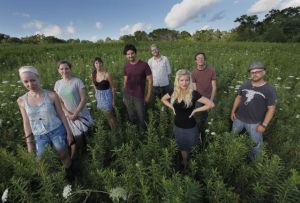 A Krista Tippet interview with Craig Minowa and the band Cloud Cult explores how we seek, what we seek, and how this seeking affects us. To listen to the podcast, visit the On Being site: https://onbeing.org/programs/craig-minowa-cloud-cult-music-as-medicine/








 The Noontimes