Jesus cried out and said, “Whoever believes in me believes not only in me but also in the one who sent me. I came into the world as light, so that everyone who believes in me might not remain in darkness”.
We often hear the question: Where was God when this tragedy happened? Today we hear an answer.
God says: I hear you when you ask, “Where are you, God?” And when I hear this I hear it I know that you are frightened. I walk among you every day and most of the time I am invisible to you. Perhaps you are looking for a powerful leader, a doctor, a wise one who has all the answers to your questions. If this is the one you seek, you seek me. But I do not look powerful. My healing of your wounds and ills is often taken for granted. And my advice to you is regularly ignored. But this does not anger me for I am patient and my love for you is wider, deeper and more intense than you have imagined. I walk with you each day in the darkest of places to bring you light. I carry you through the night to set you in the sunshine. I bind up your injuries and restore your body, mind and soul. I am The One who created you and I am The One who tends to you. Even when you cry out against me I am there.
We seek God and look past his presence because God often comes to us as the battered, the homeless and the bereft. God speaks to us through inversion and hears our cries. Rather than shun the light of truth, we must be open to it. Rather than close the door to uncomfortable information, we must welcome it. Rather than deny growth and transformation, we must embrace it. For this is how God comes to us each hour of each day.
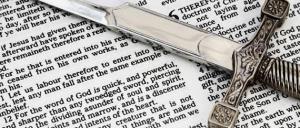
In his right hand [the son of man] held seven stars. A sharp, two-edged sword came out of his mouth, and his face shone like the sun at its brightest.
Commentary tells us that the seven stars represent the pagan authority over the world in which the writer, John of Patmos, lived. The sword refers to the Word of God. The shining face represents the divine mystery of Christ. (Senior cf. 401)
God says: Like the vineyard owner who sends his son to gather the rent, I have sent my own son among you for your acceptance of rejection. This son is My Word to you. His actions are mine. His love is mine. All that he is and all that he does speak My Word and in this he is constant and faithful. Sometimes he brings you fire. Sometimes he brings you tranquility. Always he brings you justice tempered with mercy, mercy enacted through justice yet it is not always easy to hear this word. My son always brings you healing. Always brings you transformation. Always brings prudence and persistence. This double edge may be difficult for some to understand yet it describes my son’s nature and thus my nature. t both divides and unites. It harvests where it can. Live by the word brought to you on this double edge. Imitate this two-edged sword as best you can for it is in this fusion of two worlds that you find me. It is in the inversion of your world that you best feel my presence.
In Ephesians 6:17 Paul writes of this sword of the spirit, the word of God, that sings as it completes the armor of the steadfast servant. As we arm ourselves today and all days to go into the world, let us remember that God’s word cleaves the faithful – it both divides and unites. Let us spend time with God today to determine how we react to the fire and restoration brought to us by the two-edged sword of God’s Word.
Senior, Donald, ed. THE CATHOLIC STUDY BIBLE. New York, Oxford University Press, 1990. 401. Print.
With the praise of God in their mouths, and a two-edged sword in their hands . . .
With mercy and justice, compassion and integrity, love and honesty the double-edged sword of God sings in the hands of God’s people. Let us praise God.
God says: I understand how difficult it is for you to wield this special sword when you see only a small part of the broad landscape of the time and place that I see. Yet you are my special and dear children and for that reason I cannot refuse you this sword of redeeming life. When you are discouraged from struggling with the world, take up the sword and grasp it firmly. When you feel that you are bullied because of me, lift the sword and allow it to sing. When you find that you are weighed down with my justice, raise the sword and join your voice in the song of the double-edged sword.
We humans tend to be dualistic; we find life easier to live when we look through a single lens that filters out opposing views. We have difficulty balancing opposites yet we lose our way when we see events and people through the lens of our own singular thinking. God is always showing us a world of inversion: the poor are wealthy, the wealthy poor; what is lost is found, what is found is lost; we are born to die, we die in order to be born anew.This two-edged sword that separates and yet joins is a living sign of God’s presence in our lives. Let us celebrate our struggles and take up our burden with joy. And let us learn a lesson of great value as we ponder God’s double-edged sword.
For thus says he who is high and exalted, living eternally, whose name is the Holy One: On high I dwell, and in holiness, and with the crushed and dejected in spirit, to revive the spirits of the dejected, to revive the hearts of the crushed.
We are accustomed to thinking of the high and exalted as above all who are weary and disheartened from the stress of their labor. We usually think of rulers as those who set themselves apart from the common masses. Our societies today reflect this thinking. Isaiah conveys comforting words from the One who is Lord of all to those who are afflicted.
God says: Isaiah tells you that I live on high and this is true; yet I dwell with you. I raise you up to live in me. Isaiah also tells you that I live with you who are crushed and weary; and this is also true. My favorite dwelling is with those who have no hope. Do you see the inversion that I bring to you? I live with those who are rejected and lowly, and raise them up. I revive those who have a darkened spirit. I live through those with a tired heart. My shoulders are broad and my spirit willing; my heart encompasses the universe; I am eternal. And it is to this eternity, this holiness, this revival that I carry you. Allow me to heal all that weighs you down.
This is no false promise. God always reverses what we humans see as the natural order and God wants to transform weary hearts into hearts afire with eternal love.
Enter the words inversion or God’s heart into the blog search bar and continue to explore.
Once more God will fill your mouth with laughter, and your lips with rejoicing.
In a world that yearns for the best, the most, the highest, the tallest, the greatest in all things, we lose sight of the tiny and what appears to be unimportant. God’s plan always works through inversion; God transforms our suffering and brings forth joy; God calls the smallest of us for the greatest of tasks. We have the choice to choose the false life of bigness or the eternal life of the seemingly insignificant.
God says: Do you not see the many little miracles in which you take part with me each day? I know. The same blindness overcame the first apostles until I sent them out in twos to heal and cure. They, like you, are still surprised when I invite them to join me in my Way of Love. But you see that I must send you into the world so that you will fully experience my presence in the healing you do each day. My loyal servant Job was seen as a sinner by his friends. They erred in their thinking. Job’s loyalty and unwavering fidelity kept him bound to me. His family, friends and foes saw only pain where Job saw possibility. Job remained in the world and allowed me to bring him to his fullness. My goodness calls forth laughter from your tears. Your constancy calls forth rejoicing from your sorrow. You must go out as I have asked. And you must trust me.
This is a difficult lesson to learn and it requires much trust. When we have the time to read Job’s entire story we see that God does indeed abide with the little and the small. We will see that God cares for the marginalized and the dispossessed. God brings laughter and rejoicing to those who experience anxiety and pain. What appears at first glance to be insignificant is – in the scope of eternity – the greatest of all.
For more reflections, enter the word inversion in the blog search bar and explore.
Footnotes tell us a great deal about Paul’s words here: “The dialectic of Jesus’ experience, expressed earlier in terms of life and death (5, 15), sin and righteousness (5, 21) is now rephrased in terms of poverty and wealth. Many scholars think that this is a reference to Jesus’ preexistence with God (his ‘wealth’) and to his incarnation and death (his ‘poverty’) and they point to the similarity between this verse and Phil 2, 6-8. Others interpret the wealth and poverty as succeeding phases of Jesus’ earthly existence, e.g. his sense of intimacy with God and then the desolation and the feeling of abandonment by God in his death (Mark 15, 34)”.
Once after Mass, a friend and I were discussing the homily and my friend offered his thinking on eternity. He said that he never has a problem imagining that time goes on into infinity before us, but that he stumbles when he tries to think of how time yawns back into our past. We concluded that this is one of the many mysteries we will never understand.
Today when we read these words of Paul, when we puzzle through the footnotes, when we think of how Christ always speaks to us through inversion, we believe that we are all looking for the intimacy with God we know exists. We all are looking for that comfort which is total union with God, with one another. We all are looking for the one person in whom we can place our total trust, the one person who always has our best interests in mind and heart.
That person is God whom we meet in Christ – the Christ we see in one another and the Christ we encounter in Scripture. We are comforted in Christ by the Holy Spirit. This is a mystery which we cannot unlock, yet it hovers always in our consciousness, tantalizes us with its fleeting clarity and its constant, enduring, encompassing emotion of love.
We so long to love. We so long to be loved. We so often forget . . . that we arelove.
This is our wealth. This is what we ought to hold dear. For it is in forgetting this that we suffer poverty. It is in remembering this, and thanking God for this gift of love and of self, that we know we are rich. It is this marvelous God we are called to trust.
Adapted from a reflection written on June 13, 2008.
Senior, Donald, ed. THE CATHOLIC STUDY BIBLE. New York, Oxford University Press, 1990. cf 285. Print.
“A series of seven rhetorically effective antitheses, contrasting negative external impressions with positive inner reality. Paul perceives his existence as a reflection of Jesus’ own and affirms an inner reversal that escapes outward observation. The final two members illustrate two distinct kinds of paradox or apparent contradiction that are characteristic of apostolic experience”. (Senior cf. 283)
We are treated as deceivers and yet are truthful . . . and so as disciples of Christ we must become accustomed to the world’s unbelief.
As unrecognized and yet acknowledged . . .and so as followers of Christ we must become comfortable with rejection.
As dying and behold we live . . .and so as members of the remnant we find that dying so that we might live a normal daily act.
As chastised and yet not put to death . . .and so as apostles of the Living God we become accustomed to the scorn of others.
As sorrowful yet always rejoicing . . .and so as sisters and brothers of Christ who take up our cross daily we are assured that our mourning is turned into dancing.
As poor yet enriching many . . .and so as disciples sent into the world in twos we know that we need not take a purse or sandals for the journey.
As having nothing and yet possessing all things . . .and so as children of God we are gladdened by the knowledge that we lack for nothing when we hold only Christ, that we rise in new life when we forfeit the old, and that we are loved beyond imagining by the One who rescues us in an acceptable time.
But as for me, my prayer is to you, O Lord. At an acceptable time, O God, in the abundance of your steadfast love answer me in your saving faithfulness. (Psalm 69:13)
For this and for all God’s goodness we give thanks as we sing of God’s loving fidelity, justice and mercy. Amen.
Senior, Donald, ed. THE CATHOLIC STUDY BIBLE. New York, Oxford University Press, 1990.283. Print.
I am always fascinated by the questions posed to Jesus . . . and the manner in which he answers these questions. The Pharisees and scribes whom he condemns as vipers are anxious to depose this man. They are jealous of his authenticity and his authority. They want him gone.
Last week we examined how to react and pray for the plotters and schemers who want to undermine us and even eradicate us. Today we watch Jesus as he combats his foes with the simplest of techniques . . . with questions.
Jesus so often answers his inquisitors’ demands with questions of his own. He also uses the parables with which we are familiar, stories with simple images like putting new wine into old skins. His words are plain and simple enough for the people of his day to understand . . . and they are also eternal so that we might understand his meaning two thousand years later. Jesus’ words are also universal. They create pictures that humans will comprehend. He invites. He calls. He brings the Old Testament scriptures to life as he describes the desperation of David’s plight when he and his men eat the bread of offeringin 1 Samuel 21. Jesus makes a connection between himself and David by using a simple rabbinic method of mentioning a well-known scripture story to pertain to a present situation. Jesus was, in fact, a wonderful teacher.
The questioners described by Luke in today’s reading do not understand that God has come to live among us in human form. They do not see that Jesus fulfills their hopes and prophecies. Jesus is the Sabbath . . . and they do not revere him . . . they trump up charges against him . . . they became enraged and together discussed what they might do to Jesus.
Yesterday’s MAGNIFICAT reflection was from St. John of the Cross and it concerned why we undergo trial. He writes: The reason trials are necessary . . . is that highest union cannot be wrought in a soul that is not fortified by tribulations, darknesses, and distress, just as a superior quality liqueur is poured only into a sturdy flask which is prepared and purified . . . A man should hold in esteem the interior and exterior trials God sends him, realizing that there are few who merit to be brought to perfection through suffering and to undergo trials for the sake of so high a state. For God repays the interior and exterior trials very well with divine goods for the soul and body, so that there is not a trial which does not have a corresponding and considerable reward.
In today’s story we can feel the resentment building among Jesus’ enemies and, of course, we know the end of the story. We know that they win . . . but they lose. We know that they are in power . . . but have no power. We know that they are full of themselves . . . and empty of God. We see their opposite in Jesus who stands quietly to answer their questions . . . who calls them to unity, to hope and to love . . . who waits patiently, who replies calmly, who endures endlessly.
In today’s story, who are we? The Pharisees . . . or the expression of God among us? And how have we decided to question our own inquisitors?
Over and over again we read frightening lines like this one: The chief priests and the scribes were looking for a way to put Jesus to death, for they were afraid of the people. The leaders see that they will lose influence and power because to Jesus offers compassion and healing to those who suffer. The leaders also worry that Jesus’ actions might attract the attention of the overlord Romans, and they do not want to encourage another Jewish rebellion. They search for a way to do away with this troublesome rabbi who asks piercing questions. Jesus – who presents a way of finding timeless peace and healing restoration – is eliminated by those who offer far less. The paradox is that this cornerstone that is rejected becomes a salvific force which redeems not only friends but enemies – if only these adversaries might put down their weapons and return to the goodness to which they are called.
Today we continue with our theme of dark schemes and wicked conspirators, and we look at how events around Jesus’ last hours unwind . . .
While Jesus and his followers prepare for Passover, the shadowy plot of murder unwinds; these two activities coil around one another in a twisting dance of darkness and light. This serves to remind us that in this world goodness and evil often walk side by side unremarked . . . almost accepted. We fool ourselves into believing that all around us must be perfect. Who is the reaper who knows to sort the grain from the chaff?
A foreshadowing of Peter’s denial sends a frisson of consciousness through us . . . we too have denied Christ when we are under pressure. Jesus reminds us that we need nothing for our journey save his protection and guidance. We fool ourselves into believing that we make our own way and earn our own bread. Who is the source of our talents?
Jesus prays. Judas betrays. The faithful scatter. The powerful take over. The odd dance of inversion continues as those with arms believe themselves to be the strongest. We fool ourselves into believing that we can exert pressure to win arguments by overwhelming knowledge when overwhelming goodness is the true strength. Who allows himself to be made weak so that he might be strong in the creator?
Arrest, denial, rejection. Jesus stands innocent before Pilate and Herod. He is beaten and sentenced to death. He carries his cross, he is crucified and dies . . . and he awaits the resurrection he has been promised by the Father. We fool ourselves into believing that this story was lived once by a man two thousand years ago. Who suffers each day with each of his billions of sisters and brother?
There is no plot Jesus does not comprehend. There is no darkness he has not experienced. There is no pain he has not suffered. There is no mockery, no betrayal, no rebuffing, no murder he has not survived. Jesus experiences all, and Jesus wants to save and restore all . . . if we only rely on him.
When the situation is bleakest, when the plot is thickest, when the hour is darkest . . . this is where Christ stands. This is where he waits . . . for he knows that we will need him because we take nothing else with us on this journey – no purse, no bag, no sword. We take only Christ, for he is all we need against any evil, against any plot . . . against even murder.
Adapted from a Noontime written on November 18, 2009.