Jesus proposes that we forego power and wealth, pleasure and honor. Today we consider the quality of meekness that Jesus so willingly exhibits as he walks among us.
Blessed are the meek, for they will inherit the earth. (NSRV)
This vision of the world sees gentleness as a quality of those who are close to God.
Happy are those who are humble; they will receive what God has promised!(GNT)
This picture of the world sees kindness as an essential trait of those who live by God’s design.
Those who are humble are happy. The earth will belong to them. (ICB)
Giotto: Christ Washing the Disciples’ Feet
This view of the world sees humility as crucial to the living of God’s plan.
You’re blessed when you’re content with just who you are—no more, no less. That’s the moment you find yourselves proud owners of everything that can’t be bought. (MSG)
This picture of the world sees physical possessions as stumbling blocks to intimacy with God.
The Gospels show us how God’s Word teaches us that meekness as authentic strength. They show us that Jesus returns anger with kindness, and responds to provocation with piercing questions. They show us that the Spirit nurtures sacrifice rather than acquisition.
How do we find strength in our meekness, and courage in our kindness? How willing are we to wash the tired feet of others?
Michal Splho: Jesus washing the Feet of his Disciples
When we compare varying versions of this verse, we better understand how humility provides us with far more peace than our possessions do.
For more reflections on meeknessas enacted by Jesus, enter the word in to the blog search bar and explore.
To read a reflection about meekness as strength, click on the first image above, or visit: http://blog.newadvent.org/2013/05/meekness-is-not-weakness-meekness-is.html
Say to those who prophesy their own thought: hear the word of the Lord . . . I am coming to you, says the Lord God.
Yesterday we reflected on evil leaders. Today we spend time praying and thinking about false prophets. Who are they in our lives? How have we been false prophets ourselves?
Say to those who prophesy their own thought: hear the word of the Lord . . . I am coming to you, says the Lord God.
Yesterday we reflected on how evil leaders operate, how they appear to working for good and may even use the vocabulary we come to expect from those who walk in the light. Today we meditate on how we might be lured into following the broad road rather than the narrow path.
Say to those who prophesy their own thought: hear the word of the Lord . . . I am coming to you, says the Lord God.
Yesterday we reflected on those who surround evil leaders to enable them in their dark work. Today we think and pray about those whose gestures and actions appear to have divine inspiration but do not.
Say to those who prophesy their own thought: hear the word of the Lord . . . I am coming to you, says the Lord God.
We notice that God does not remain silent when evil operates. We see that God speaks to darkness. We understand that even the dark ones are offered the opportunity to allow their pain to transform them.
Say to those who prophesy their own thought: hear the word of the Lord . . . I am coming to you, says the Lord God.
When we are doubtful about false and true leaders and prophets, we might remember that our courage, strength and perseverance lie in and with God. When we read scripture, when we join in liturgy, when we try to do as Jesus does, when we open ourselves to the Holy Spirit, this is how we will know what to think, what to say, and how to act. And so we pray.
When silence is more attractive than fidelity to the truth: Our God, remember us.
When approval is more desirable than perseverance in good: Our strength, abide with us.
When safety is more appealing than suffering for righteousness’ sake: Our Lord, transform and heal us.
When we celebrate and commemorate the gift of the Holy Spirit, we remember that it is impossible for us to discern false and true leaders and prophets on our own. We can only maneuver life’s treacherous waters when we rely on the Spirit who will tell us where to go and what to say. If we want to live with less fear, if we want to transform the lives of our enemies and even our own lives, we might remember: Say to those who prophesy their own thought: hear the word of the Lord . . . I am coming to you, says the Lord God.
God’s trust in humanity is so enduring that the Creator takes the dare from Satan. How might we return this amazing trust? God the parent guides and protects us every waking moment and every sleeping hour. We need not eradicate all of the evil in the world; we need only keep our eyes on Christ and do as he asks; we need only open ourselves to the miracles of the Spirit and follow.
God’s hope in us is so strong that Christ returns for us. How might we learn from this strength? Christ reconciles and guides us. And so must we heal and shepherd others. We need only bloom where we are planted, reap the harvest that God has sown.
God’s love for us is so infinite that the Spirit resides eternally in us. How might we return this love? By tending to the marginalized, the broken-hearted and the bereft, by entering into transformation, and inviting others to join us.
In the marvelous story of Job, his friend Bildad cannot believe that Job suffers innocently. He cannot fathom why God allows misfortune to befall one of the ardent faithful. “Does God mess up?” he asks. “Does God Almighty ever get things backward?” He encourages Job not to hang his life from one thin thread, not to hitch his fate to a spider web. Bildad sees Job’s misfortune as punishment, and so might we if we do not read closely. After consideration we understand that Job suffers precisely because God trusts him, believes in him, and loves him. God restores all that Job loses and more, and this is a gesture that Satan cannot understand in his narrow, stingy world. God trusts that Job will not turn away in desperation or fatigue, and this is an attitude that Satan cannot countenance from his pathetic, narrow perspective. God allows Job to choose between hope and desperation, and this is a love that Satan cannot comprehend with his tragic, empty heart.
If God is so willing to take Satan’s dare, so willing to trust humanity with the enormity of God’s infinite goodness and mercy, might we then be willing to follow Jesus? Might we be willing to open ourselves fully to the Spirit?
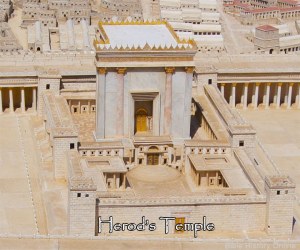
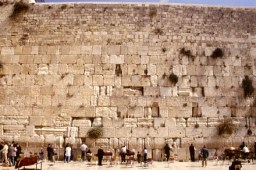
The followers of Yahweh erected a tent to house the ark they created to hold their tangible remnants of their relationship with the Lord: stone tablets holding God’s ten pronouncements of the Mosaic Law, manna provided by the Lord during the Hebrews’ desert wanderings, and the staff that Aaron used to mystify Pharaoh, the ruler of Egypt whom the enslaved people of God escaped. The Israelites replaced the tent with a glorious Temple to house the ark, sacred scrolls of God’s word to them. More than once this Temple was overrun, brought down, and reduced to rubble and a single, solemn wall of prayer. Today followers of Christ carry this tent, this Temple within; and it is in this sacred interior space that we find courage, hope, strength, faith, persistence, peace and joy. As we move through Eastertide, we bolster ourselves for the journey ahead as we continue our pilgrimage.
The New American Bible gives a wonderful title to these verses: A Psalm of Fearless Trust in God. We might benefit from the grace of this special prayer if we reflect carefully on its words as we pray them.
A depiction of the Moses Tent
When we are anxious or troubled, we recall . . .
TheLordis my light and my salvation; I will fear no one.
The Lord protects me from all danger; I will never be afraid.
When we are overwhelmed and distraught, we remind one another . . .
Even if a whole army surrounds me, I will not be afraid;
even if enemies attack me, I will still trust God.
When we are lost or abandoned, we remember . . .
I have asked the Lordfor one thing; one thing only do I want:
to live in the Lord’s house all my life, to marvel there at his goodness, and to ask for his guidance.
When all seems lost and dark, we remind one another . . .
In times of trouble God will shelter me; God will keep me safe in the Lord’s Temple and make me secure on a high rock.
When we are alone or bereft, we call out . . .
So I will triumph over my enemies around me.
With shouts of joy I will offer sacrifices in his Temple; I will sing, I will praise theLord.
Hear me,Lord, when I call to you! Be merciful and answer me!
When we falter, we encourage one another . . .
When you said, “Come worship me,”
I answered, “I will come, Lord.”
The Western Wall of the Temple in Jerusalem today (The Wailing Wall)
When the world closes in and we find no exit from sorrow, we pray . . .
Teach me,Lord, what you want me to do, and lead me along a safe path, because I have many enemies.
Don’t abandon me to my enemies, who attack me with lies and threats.
When we are rescued, we rejoice . . .
I know that I will live to see
theLord‘s goodness in this present life.
Trust in the Lord. Have faith, do not despair.
Trust in the Lord.
When this present life seems as though there is no evidence of God’s presence, let us remember Christ’s temple of light and peace that we carry within.
If there is time in the next several hours, enter the word TEMPLE into the blog search bar and consider how God’s plan has brought us from enslavement through the desert to a solid place where we rejoice and yet remains with us when great loss or great sorrow overtake us. It is God’s abiding love that brings us this fearless trust in the temple of God that remains within. When we reflect on these images or listen to these or other audios as we pray, we allow this fearless trust in God to rest in us today. Wishing all of you peace and joy on this day and all days.
We continue to see God’s yardstick in the Old and New Testaments.
Mattathias laments that he lives in an age when centuries of fidelity fade into corruption: Woe is me! Why was I born to see the ruin of my people, the ruin of the holy city?We might well ask this question in any age and in any place. It seems that the human condition is to succumb to the temptation of the call of false teaching and self-promotion. Fraud replaces fidelity; dishonesty becomes truth; disgrace and honor trade places. But Mattathias calls on his sons to remember their lineage as beloved children of Yahweh. Falling back on their relationship with God, this ancestry is characterized by strong men who consistently rely on qualities that nourish truth and light. These forbears trust God alone, and they serve as a measuring stick for our own behavior in turbulent times.
Remember the deeds that our ancestors did in their times, and you shall win great honor and an everlasting name.
Abraham, faithful in trial, fills with righteousness. Joseph keeps the commandment, despite distress, to become master of Egypt. Phinehas, for his burning zeal, receives the covenant of an everlasting priesthood. Joshua executes his commission to become a judge in Israel. Caleb bears witness before the assembly and receives an inheritance in the land. David, known for his loyalty, receives as heritage a throne of eternal kingship. Elijah, full of burning zeal for the law, is taken into heaven. For their faith, Hananiah, Azariah and Mishael are saved from the fire. Innocent Daniel is delivered from the mouths of lions. (verses 51-60)
We might pause with these verses 61-63 in particular.
And so, consider this from generation to generation, that none who hope in Heaven shall fail in strength.
Do not fear the words of sinners, for their glory ends in corruption and worms.
Today exalted, tomorrow not to be found, they have returned to dust, their schemes have perished.
When we spend time reflecting on these verses today, we see how this pedigree inspired Mattathias and his sons to defend the kingdom whose loss they lament. Like Mattathias, we might also allow ourselves to see the measure of God’s love in our own spiritual family tree. Let us place our hope in heaven so that whatever our circumstances require of us . . . we do not fail in strength.
In these opening days of a new year, we have looked at women in scripture who see and use God’s yardstick in their lives. Over the next few days we explore how we find God’s yardstick in both Old and New Scripture.
We have spent a number of reflections with this psalm, the longest of the 150 songs of sorrow, praise, joy, petition and lament. Two winters ago we spent several weeks examining each of the poem’s stanzas that begin with the letters of the Hebrew alphabet. As we concluded we decided that this psalm was an intense love letter from God to us. When we look at all the psalms, and this one in particular, we discover a yardstick that can only come from God, a yardstick that measures both the highs and lows of our days. A yardstick that offers forgiveness, healing, redemption and joy.
I’m feeling terrible—I couldn’t feel worse! Get me on my feet again. You promised, remember? On the days when we feel we can go no further, we must remember to take our woes to God.
When I told my story, you responded; train me well in your deep wisdom. On the days when we find it difficult to gather strength, we remember to ask God for help.
Help me understand these things inside and out so I can ponder your miracle-wonders. On the days when we forget the wisdom God has shared with us, we remember to ask again.
My sad life’s dilapidated, a falling-down barn; build me up again by your Word. On the days when we see no way past the heavy obstacle before us, we remember to rest in God.
Barricade the road that goes Nowhere; grace me with your clear revelation. During the nights when doubts and fears return, we remember that with God all things are possible.
I choose the true road to Somewhere, I post your road signs at every curve and corner. During the nights when we are restless and alone, we remember that Christ is constantly within.
I grasp and cling to whatever you tell me; God, don’t let me down! During the nights when we are desperate for peace, we remember that the Spirit heals and comforts.
I’ll run the course you lay out for me if you’ll just show me how. During the days and nights when we struggle with the world, we read and re-read God’s love letter to us, and remember that we are made by God for and with and in love alone.
Enter the words God’s Love Letter into the blog search bar for other reflections about Psalm 119. This ancient prayer from ancient scripture continues to serve us today as God’s yardstick. Tomorrow, we find God’s measure of love in the person of Jesus.
In these opening days of a new year, we look for ways to better see God’s yardstick in our lives, and for ways to leave the world’s yardstick behind.
Two women named Sarah figure in scriptures and today as we remember their stories we better understand that God’s promise is so often delivered through surprise. Choose one of these stories – or both if there is time – and look for God’s yardstick.
Genesis Chapters 12-23 tell us the story of Sarah, wife of Abraham and mother of Isaac. Although we know this story well, it is likely that we have not spent time beyond the basic facts that are obvious to us. She traveled with her husband and his family from Urto Haran and was barren for much of her married life. She was so beautiful that her husband asked her to pose as his sister to avoid creating jealousy among Egyptian leaders and endangering his life. She suggested that her husband take her slave Hagarto his bed so that he might engender an heir with her; then later asked him to banish the slave and child when the younger woman took on a disparaging attitude. Sarah prepared a meal for strangers and then laughed when they told her that she would conceive at the age of 90. She was buried in Machpelah Cave near Hebron. When we focus on even a portion of her story, we find that Sarah shows humor, resiliency, and openness to God’s presence in her life.
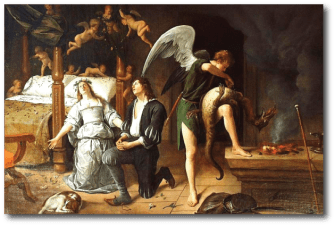
Jan Steen: Tobias and Sarah on their Wedding Night
Tobit 3 introduces us to Sarah who prays for death to come to her quickly. In Chapters 6-12we follow Tobiasand Sarahas the angel Raphaelushers them through danger. We may know this about the Sarah who marries Tobias: she is married to seven men who die on their wedding night, she and Tobitpray for death at the same moment and God hears them both, she travels from Ecbatanato Ninevehand back to Ecbatana with Tobias who – with help from the angel Raphael – routs the demon who has plagued her. When we explore her story, we find that Sarah withstands false accusations that mount against her by relying on God to solve problems that appear to have no solution.
Strength that flows from reliance on God and belief that with God all things are possible. This is the yardstick with which these two women measure their lives.
Perhaps James spent time with Psalm 62 as he learned scripture. We can see clear connections between this hymn and his letter. James knows that when wars and quarrels break out our most effective and most sensible refuge is God alone.
God, the one and only. I’ll wait as long as he says.Everything I need comes from him, so why not? He’s solid rock under my feet, breathing room for my soul, an impregnable castle: I’m set for life.
James knows that when we struggle with temptation and giving in to easy promises and quick bribes, we have no enduring strength.
How long will you gang up on me? How long will you run with the bullies?There’s nothing to you, any of you – rotten floorboards, worm-eaten rafters, anthills plotting to bring down mountains, far gone in make-believe. You talk a good line, but every “blessing” breathes a curse.
James knows that the world offers a foundation of shifting sand but that God offers us solid ground.
My help and glory are in God – granite-strength and safe-harbor-God – so trust him absolutely, people; lay your lives on the line for him. God is a safe place to be. Man as such is smoke, woman as such, a mirage. Put them together, they’re nothing; two times nothing is nothing.
James knows that with God we receive a just wage for our hard-earned works.
And a windfall, if it comes – don’t make too much of it. God said this once and for all; how many times have I heard it repeated? “Strength comes straight from God.” Love to you, Lord God! You pay a fair wage for a good day’s work!
James knows something that he wants to share with us. Today we reflect on his letter in light of Psalm 62 while considering the good works we offer up as we build the kingdom. We are grateful for God’s great generosity, tender compassion and healing love.
Compare varying versions of Psalm 62. Consider the good works we offer each day to God and consider our response.
Ezekiel 37: From Dry Bones to Restoration – Part V
Sunday, September 18, 2022
If we cannot believe in restoration after the desert, let us at least begin by asking God to strengthen our gift of faith. Just as a mariner trusts that the lighthouse will guide ships past rocky shores, let us trust the Gospel story of Jesus. The writer of the letter to Hebrews shows us the way. From Hebrews 11.
Faith is the confidence that what we hope for will actually happen; it gives us assurance about things we cannot see.
If we do not have confidence, let us ask God for this gift of sureness.
By faith we understand that the entire universe was formed at God’s command, that what we now see did not come from anything that can be seen.
If we do not have understanding, let us ask God for the gift of wisdom.
It was by this faith that Abraham obeyed when God called him to leave home and go to another land that God would give him as his inheritance. He went without knowing where he was going.
If we do not have fidelity, let us ask God for the gift of certainty.
And even when Abraham reached the land God promised him, he lived there by faith – for he was like a foreigner, living in tents. And so did Isaac and Jacob, who inherited the same promise.
If we do not see or believe in God’s promise in our lives, let us ask God for the gift of hope.
For Abraham was looking for a city with eternal foundations, a city whose architect and builder was God.
If we do not feel or comprehend God’s power in our lives, let us ask God for the gift of fortitude. And let us pray.
Good and loving God, your fidelity lives in us although we may not perceive it. Being your creatures we are made of love for love; yet we might not believe this. Breathe new life into those who are discouraged or unbelieving. Bring new strength to those who falter. And shower us with your hope and encouragement so that we might come to fully know, and feel and understand that your only wish for us is our restoration in and for you. We ask this in Jesus’ name, in unity with the Holy Spirit. Amen.
Tomorrow, laying a foundation for restoration . . .