The human character seems determined to bring about evil. No epoch escapes the lust for power. No era is exempt from the pursuit of wealth or the competition for survival. The chase for fame is a goal that exacts a lethal price; but dark consequences deter few. Many of us are bent on building a life of celebrity, affluence and supremacy and this quest destroys both individuals and whole societies.
In ancient days, and in our own, we long for a serenity that comes with the cessation of conflict. We look for ways to de-stress our lives, to slow down the headlong pace of our digital interface with the rest of humanity. We complain about the divisions we experience and yet feel powerless to bring our world together; yet somewhere deep within we know that we must change our circumstances. And so we turn to the eternal wisdom of the Spirit. We follow the model Christ gives us. And we ask for God’s intervention and help.
Today, as we look for transformation, we search various translations of this holy prayer. We place our trust in God’s plan and love. We remember the promises God keeps. We consider the furnace of evil times that we survive while the silversmith of life watches over us. And we ask for help in evil times.
When we use the scripture link and the drop-down menus, we consider God’s hope for humankind, and how we might make a plea for God’s help in evil days.
Bacchiacca: Joseph receives his brothersJust when we think we have reached a plateau in our journey where we might walk along the flatland rather than clamber up and skitter down the mountain sides, we find that we have to go back to repeat a leg of our passage. Just when we have begun to relax at the oasis where we have filled our water sacks and rested in the shade from the heat of the day, we are told that we must move on. Just when we are beginning to become comfortable in the little fortress where we are hiding from our foes, we hear the voice that calls us to make a second journey.
Today we find ourselves in the Joseph story at the point where the brothers have returned home to Jacob to tell him that they must go back to Egypt, and this time they must take the favored son Benjamin with them. Just when Jacob thought his problem of famine had been resolved, he is told that he must relinquish the last person who brings him comfort. Despite his age and the litany of difficulties he has undergone, Jacob must trust God and allow himself to suffer again. The brothers who had sold Joseph into slavery know that they must make a return trip to Egypt. Little do they know that well-hidden secrets are about to be revealed, questions will be asked and answered, truths will be spoken. They plan to go to Egypt to purchase food for their families. They do notplan to encounter the brother they have delivered to slavery and death. They do not know they are about to make a further journey. We do not hear from Benjamin, the young boy whose full brother wields power second only to Pharaoh, but we can imagine that he feels both anxiety and excitement. Everyone in this story will suffer. Everyone in this story will be rewarded beyond their wildest imaginings.
I am reading a book by Richard Rohr which a friend gave to me. In FALLING UPWARD, Rohr posits that in life each of us is given the gift of a second or further journey. “[I]n my opinion, this first-half of life task is no more than finding the starting gate. It is merely the warm-up act, not the full journey. It is the raft but not the shore . . . There is much evidence on several levels that there are at least two major tasks to human life. The first task is to build a strong ‘container’ or identity; the second is to find the contents that the container was meant to hold. The first task we take for granted as the very purpose of life, which does not mean that we do it well. The second task, I am told, is more encountered than sought; few arrive at it with much preplanning, purpose, or passion.” (Rohr viii and xiii)
Rohr cites W. H. Auden: We would rather be ruined than changed. We would rather die in our dread than climb the cross of the present and let our illusions die. (Rohr 65) And on page 73 we find this from Matthew 16:25-26: Anyone who wants to save his life must lose it. Anyone who loses her life will find it. What gain is there if you win the whole world and lose your very self? What can you offer in exchange for your one life?”
Jacob believed that his sons were going to Egypt to purchase food that would save the family. He did not know that his lost son Joseph would be their savior. Joseph’s brothers thought they were purchasing food to save their lives. They did not know that they would also redeem their souls.
Just when we believe that we have convinced everyone of the reality of our illusions, we are given the opportunity to leave our comfort zone and enter the second half of our lives. We are blessed with the gift of seeing clearly that we are created to love honestly and suffer well. We are created to take the second journey of our lives, the journey that promises far more than suffering, the further journey that brings us more reward than we can ever imagine.
Rohr, Richard. FALLING UPWARD: A SPIRITUALITY FOR THE TWO HALVES OF LIFE. San Francisco: Jossey-Bass, 2011. Print.
The painting above is housed at the UK National Gallery. To see more detail, click on the image and follow the link. A spy glass on the museum site will allow you to see detail by zeroing in. You will also find a link to other scenes from the life of Joseph which may interest you. Image from: http://www.nationalgallery.org.uk/paintings/bacchiacca-joseph-receives-his-brothers
Written on January 8 and posted today as a Favorite . . .
The house is to be rebuilt . . .
Habitat for Humanity Volunteers rebuild after a disaster in Nepal
We are so often exhausted by life’s demands that we cannot experience joy when we hear good news . . . the house is to be rebuilt.
In today’s Noontime, King Darius reiterates the original command given by King Cyrus . . . the house is to be rebuilt.Nehemiah, the administrator, and Ezra, the priest, set about restoring the city and temple in Jerusalem. They travel through dangerous territory and carry with them a letter of safe-passage from their former enemy. They arrive in Jerusalem to find a pile of rubble so dense that horses cannot find a pathway – they must pick their way on foot through toppled stone. They return from exile most likely drained of energy, but there is hope and even joy because . . . the house is to be rebuilt.
I am struck by the concordance of the instructions in the decree we read today with the original description of the temple that Solomon built which we read in 1 Kings 7. God does not forget his promise to the Jewish nation that . . . the house is to be rebuilt.
Nor does God forget all that God has promised us, his daughters and his sons. Just like the destroyed temple, we too will be rebuilt and in fact are being rebuilt each day. We are the temple in which the Spirit dwells, and as the cares of the world tear at its pillars and nibble at is foundation, Jesus becomes the master planner who constantly offers to help us reconstruct. His constant attention and love remind us that . . . the house is to be rebuilt.
I am thinking of Psalms 126 and 127. Those who go out weeping return singing . . . we labor in vain unless the Lord is the master builder of our house.
Whatever our flaws, whatever our sorrows, all will be converted to joy for we are promised that . . . the house is to be rebuilt.
Whatever our obstacles, whatever our fears, they become our stepping stones to serenity once we remember that . . . the house is to be rebuilt.
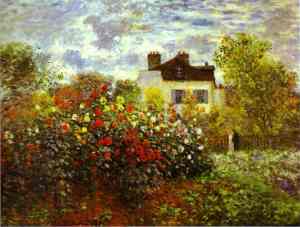
Monet: Monet’s Garden at ArgentueilJesus ben Sirach reminds us that life’s prime needs are water, bread, and clothing, a house, too, for decent privacy.This simple axiom can be so difficult to remember, especially in our competitive society which regards appearances as more important than substance. Be it little or be it much, be content with what you have, and pay no heed to him who would disparage your home . . .
Frugality has earned the unhappy reputation of stinginess; and yet in its purest sense frugality means prudence in the avoidance of waste. Each time we throw out food because we do not like leftovers, each time we buy a pair of shoes we really do not need, each time we hoard something away so that we will have it when others do not, we use something that someone else might have used better. This is an extravagance that the faithful cannot afford. It is an excessiveness that makes it impossible for us to find serenity. It is an injustice that works against kingdom-building.
When I become impatient with God’s timing – wanting results to arrive more rapidly, wishing events would move more swiftly – I am reminded by God’s pace and stamina that God is teaching us to practice prudence in the avoidance of waste.God is showing us a productive and generous kind of frugality; and in his infinite wisdom God knows that when we have something before we can fully appreciate it, we will likely waste the benefit.
Healthy contests that pit equals against one another are good for all of us, individually and collectively. Creativity, critical thinking, and industrious behavior are essential if society is to move ahead; but in all of the bustle of the marketplace we must keep in mind that in the end . . . life’s prime needs are water, bread, and clothing, a house, too . . . and that frugality is prudence in the avoidance of waste.
There are many ismsin our world: capitalism, communism, socialism, favoritism, entrepreneurialism, dominionism, fascism, patriotism, and on and on. Each of these attitudes has something to bring to a discussion – and the practice – of how we humans co-exist. Each has advantages and disadvantages, each has pitfalls and pluses. Some of these isms teach us stinginess; none will teach us frugality. None can bring us stability, dependability, or union with others we trust implicitly. None can bring us what we really seek – peacefulness, reliability, contentment with ourselves and the world.
And so we pray . . .
Generous and caring God, we need your constant guidance to remind us to share the essentials of life.
When we work over-long hours to the neglect of our family to finance an extravagant lifestyle, we have moved off the path that leads to serenity. Tell us to wrap up the work and go home.
When we hoard goods and refuse to share with those who have less than we, we have somehow been lured away from the light and into the darkness. Remind us that the world has enough resources for all if we share.
When we begin to think that five bathrooms and four vehicles are a necessity, we have slipped away from reality. Ask us to share the planet’s storehouse prudently.
When we have become stingy in the name of frugality, we have ceased listening to your voice. Call to us again in a way we cannot miss.
Life’s prime needs are water, bread, and clothing, a house, too. Let us share what we have prudently, let us avoid wasting the bounty your creation unfolds for us, and let us practice the same generosity you so lovingly pour out on us. Amen.
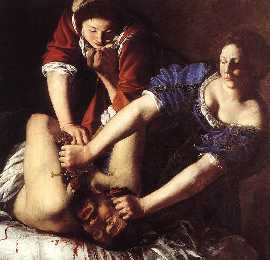
Gentileschi: Judith Beheading HolofernesWe have visited the story of Judith frequently this year and there is much to be learned from the narrative as she enacts sublime fidelity and heroic love. A favorite Noontime reflection on the Book of Judith may interest you. It is linked to the Favorites page above, or through the Pages tab in this blog.
Just yesterday we reflected on the concept of fasting. Today we see Judith set aside her sackcloth and ashes to break her mourning; she goes out to face the enemy, armed with her woman’s weapons of beauty and speech. Judith will save a nation – and she will do this by first seeking and then living inGod. She will receive God’s favor – and she will become the vehicle of a people’s salvation.
We notice that God is central in every decision Judith makes and in every act she performs. Judith is able to escape the enemy’s revenge by walking past the sentries with her maid – and with the head of Holofernes hidden in their food pouch – precisely because she and her companion have walked out each night to pray at the ravine of Bethulia. The guards are accustomed to seeing this regular ritual and so do not intercept the two women; they do not even search the food pouch. After bathing each evening, Judith seeks God’s help – and she receives it.
We watch Judith as she leaves the city of Bethulia – a city which has provided her people safety and is now threatened by the Assyrian enemy: Order the gate of the city opened for me, that I might go to carry out the business we discussed” . . . Judith and her maid went out . . .
When we are called to go out of our comfort zone we are frightened. We tell God that he has chosen the wrong emissary. We say that we are too consumed with all the many other tasks he has assigned to us. We find reasoning and excuses for not doing God’s will and yet, when we pray as Judith does, when we develop steadfastness as Judith has, when we trust God and take each step as it comes to us rather than worry about the distant future, we are able to rejoice – as Judith does – in the favor God bestows on her.
And so we pray . . .
Good and holy God, we are both fear-filled and awestruck at your power. We watch as Judith goes into the very heart of the enemy camp – for this is where you need her – and we worry that we will not be able to slay the enemy in your name as Judith does. We watch Holofernes and his soldiers set Judith in a place of honor – knowing that these acts come from lust – and we worry that we may not be as clever as Judith is. Give us the courage to remain faithful to you. Give us the endurance to wait on your plan. Give us the prudence and patience to allow you to unfold before us, through us, and in us so that we, like Judith, may rejoice in you. Amen.
Many religions and cults include the practice of fasting as a form of worship; and in most cases the act of abstaining from food, drink or activities is meant to indicate one’s belief in or attitude toward some higher power. In the case of Christians, fasting is prescribed on certain days in the liturgical calendar; the practice of denying one’s self food and drink is meant not as an outward sign or status but as an expression of interior penance. The Catholic catechism states the following: “Fasting: Refraining from food and drink as an expression of interior penance, in imitation of the fast of Jesus for forty days in the desert. Fasting is an ascetical practice recommended in Scripture and the writings of the Church Fathers; it is sometimes prescribed by a precept of the Church, especially during the liturgical season of Lent”. (“Glossary” 879) Prayer and almsgiving are other forms of this interior penance described in paragraph 1434 of the catechism.
None of this should be a surprise to those who are familiar with the prophecy of Isaiah in which we hear today that this, rather, is the fasting that I [the Lord] wish: releasing those bound unjustly, untying the thongs of the yoke; setting free the oppressed, breaking every yoke; sharing your bead with the hungry, sheltering the oppressed and the homeless; clothing the naked when you see them, and not turning your back on your own. These words are echoed beautifully in the Beatitudes spoken by Jesus in Matthew 5, yet we persist in thinking that the poor are without resources because they are lazy or ignorant, victims have somehow brought their circumstances upon themselves, and the hungry and homeless just have not planned their lives well. We continue to believe that refugees have gotten themselves in their sorry state; and immigrants need to “go back home.” It seems that many of us prefer to believe that life’s circumstances can be controlled yet there but for the grace of God are we.
I am wondering if we might feel better about ourselves as a society if once a month, we prepared casseroles of food and took them along with gently used clothing to shelters for women, children and men who find themselves in circumstances they do not deserve and have not asked for. Of course, we would want to do this without judging how or why some of us need such help from others. I am imagining how the world might be different if we stood up to corruption and the abuse of power. I am visualizing our communities if we were to come together in small or large groups to exert all our efforts to the improvement of life for all of us and not just some of us. I am thinking that we would be happy with the results and that we might even enjoy ourselves in the process.
There are worthy organizations that build homes for the marginalized and take on legal cases for victims who cannot afford decent advocacy; there are medical and legal professionals who quietly give of themselves in pro bono work for the disadvantaged. The least we can do is to support these groups with our own resources of time, treasure, talent and prayer. We always receive far more than we give once we find time in our busy lives to exert ourselves and to expend our energy in true kingdom-building.
The psalmist reminds us in Psalm 40:7-8: Sacrifice and offering you do not want; but ears open to obedience you gave me. Holocausts and sin-offeringsyou do not require; so I said, “Here I am . . .”
And so, we pray . . .
Here I am . . . to do your will, Lord . . . here I am.
Here I am . . . to answer your call, Lord . . . here I am.
Here I am . . . to do offer my gifts, Lord . . . here I am.
Here I am . . . to love your sheep, Lord . . . here I am. Amen.
A re-post from Friday, August 12, 2011.
“Glossary.” CATECHISM OF THE CATHOLIC CHURCH. 2nd ed. Vatican: Libreria Editice Vaticana, 2997. Print.
Written on January 11 and posted today as a favorite . . .
The January 10 Noontimestruck a chord with a number of people; today the theme continues: We look at how we must give ourselves time to adjust to the newness of something. Before we leap into action, clutching our new gift of sight, we must first allow Jesus to verify that what we are seeing is what is actually before us to be seen.We must calibrate our vision with God’s reality.
I love to watch Jesus heal; and I try to learn from his gentle, three-part triptych of interchange. Jesus moves us forward through a process of deep and significant change, if we remain open to possibility.
Jesus often enters into dialog with us by asking, “What is it you want from me?” He is humble enough to give us think-time and to genuinely ask about our own perception of who we are and what we believe we need from him.
He regularly makes certain that the newness of his healing is not overwhelming, that it does not throw us out of balance. He is loving enough to know that we are easily knocked off center and confused when there is a change in our surroundings or in our method of interacting with the world.
And finally, Jesus makes certain that we know where to go and what to do next with our newness. He is wise enough to know that we are most vulnerable when we are taking our first steps at anything. Sometimes he warns us to say nothing to anyone. At other times he recommends a visit to the priests for a final blessing. Most often, there is the request that we allow the newness in us to change our lives and the lives around us for the better.
Today we see Jesus heal a blind man. Being God, he knows that the miracle has taken place yet – he asks for the man’s impression: Do you see anything?When the man replies that people look like trees walking, Jesus lays his hands on him again. This time the sight is true. He could see everything distinctly.
I am thinking about all of the times Jesus has brought me through a kind of blindness to see what is obvious. What was once walking trees becomes people. A fuzzy uncertainty becomes crystalline reality – God’s reality. I must remember to always allow God to adjust my vision – for I do not want to mistake people for trees.
Because she was afraid, Sarah dissembled, saying, “I didn’t laugh”. But he said, “Yes you did.” It seems that when we are afraid, or even uncomfortable, we hide. Perhaps we want to protect ourselves from unwanted criticism at a time when we feel vulnerable. Society would benefit from our willingness to put aside fear in order to practice honesty. Our families would flourish if we might find a way to establish trust in order that we become less defensive. Our work and play communities would prosper if we were free of ridicule. Putting aside fear so that we might live a life of authenticity is what God asks us to do. We all fail at this constantly – and this is something that God knows well.
Fear has been with us since our genesis as humans; it is not an aberration that arises after eons of human evolution. Nor is it a modern phenomenon brought on by rapid change or sudden advances in technology. Fear must have been with the first humans who hunted and gathered food and sought shelter. Dissembling was likely a defense against isolation or separation from the tribe, a strategy for survival. Is it a tool we want to use today? Do we need to shave edges from truth? Do we need to shape the opinion of those around us? Are we willing to go to God and ask that we begin again – in total honesty – without dissembling?
It is good to remind ourselves that God is quick to pardon when we ask forgiveness, and that God has infinite mercy for us. We know that all God asks is our gratitude and our willingness to do as he asks. God constantly assures us that we are loved – and God asks for our love in return. We need not fear. We need not dissemble. And we need not nurture this dissembling in ourselves or others. When we are fearful, we know what we must do.
From today’s MAGNIFICAT Morning Prayer (Cameron 129-130)
Jonah 2:3: Out of my distress I called to the Lord, and he answered me.
Isaiah 43:12: Fear not, for I have redeemed you; I have called you by name: you are mine. When you pass through the water, I will be with you; in the rivers you shall not drown. When you walk through fire, you shall not be burned; the flames shall not consume you.
And so we pray . . .
When we feel fear begin to consume us, rather than dissemble and begin to weave a complicated web, we must call on God to bolster us in the truth.
When we are tempted to mislead others, rather than add to the illusion, we must ask God to help us to be honest and authentic.
When we come upon a rat’s nest of lies and deceit, rather than turn away with blank face and trembling heart, we must rely on God to help us witness to what we know to be truth.
Good and honest God, you have allowed us to choose if and how we are to follow you. Guide us to see through the clever tricks of the expert weavers of lies and lead us to be merciful with those who dissemble out of fear. Protect us as we mark a straight path to you with the signs of our little and big sufferings. Lead us out of the maze of confusing dissembled responses others give to us. Give us the courage to speak candidly, to act compassionately, and to love into goodness those who would harm us with their dissembling words. We ask this of you who has created us, you who has shown us the way of authenticity, and you who abides within us always. Amen.
Cameron, Peter John. “Prayer for the Morning.” MAGNIFICAT. 13.6 (2011): 129-130. Print.
Written on January 9 and posted today as a favorite . . .
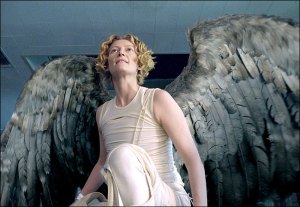
Tilda Swinton as Gabriel in “Constantine”What we see today is Daniel’s interaction with God’s messenger Gabriel who is mentioned here for the first time in scripture. We know that scripture is not history – it is not an accurate telling of events in a sequential manner in order to set facts in place; rather, it is an inspired record of our interactions with God over thousands of years. This is the gift of the Torah, prophets, and wisdom literature. It is the gift of the accounts of Jesus, the Apostles and the Holy Spirit as a manifestation of God among us.
In today’s Noontime, footnotes tell us that the Darius the Mede whom we see in this prophecy is “unknown in profane history. The Median kingdom had already been conquered by Cyrus the Persian, and it was Cyrus who captured Babylon. Evidently the author of Daniel has deliberately adopted an apocalyptic view of history, derived from prophecy . . . according to which the Medes form the second of four world kingdoms preceding the messianic times . . . The character of Darius the Mede has probably been modeled on that of the Persian King Darius the Great (522-486 B.C.), the second successor of Cyrus.” (Senior 1096)
Further commentary tells us that “the prophet Jeremiah (25,11; 29,10) prophesied a Babylonian captivity of seventy years, a round number signifying the complete passing away of the existing generation, Jeremiah’s prophesy was fulfilled in the capture of Babylon by Cyrus and the subsequent return of the Jews to Palestine. However, the author of Daniel, living during the persecution of Antiochus, sees the conditions of the exile still existing; therefore in his mediation he extends Jeremiah’s number to seventy weeks of years (v 24), i.e., seven times seventy years, to characterize the Jewish victory over the Seleucids as the ultimate fulfillment of the prophecy.” (Senior 1100-1101)
What we see today is not a story about people or places we know in history. Nor is it a story about a particular time in our human record that has little to do with us in 2011. What we have before us is the story of how we– like Daniel – might interact with God’s messenger and with God himself. It is the story about the ultimate fulfillment of prophecy.It is the story of how God visits us constantly, how God interacts with us, and how God always keeps his promises.
When we flag or lose faith, when we are exhausted from the effort of our journey, when we are at the point of feeling that our exile will never end, we might – like Daniel – turn to God, acknowledge our humanity, and enter into a dialog with the divine. For it is through our trials, when we drop our defenses against God’s presence in our lives, that we are most intimate with God. And it is through our anguish and suffering that we encounter our divinity within. This is the ultimate fulfillment of God’s promises to us – to live freely and wholly in the Spirit.





 The Noontimes