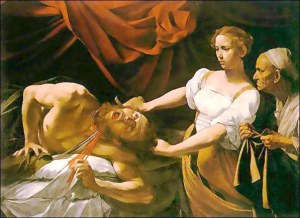
Caravaggio’s JudithCommentary will tell us that Judith is an apt symbol for Israel in this story as she is a childless widow, a defenseless figure in society and one who is to be protected rather than stalked and raped. What we read today is Judith’sPrayer, and through it we have a view of Judith’s plan to act as God’s agent. In some way – she does not tell us exactly – Judith will use her words and her guile against the enemy. Many wonderful lessons come from this story and one of them is that despite any action she takes herself, Judith continues to see God as the author of all events. Judith’s ego does not claim success as her own other than her willingness to be God’s instrument. She further identifies God through a beautiful litany as theGod of the lowly, the helper of the oppressed, the supporter of the weak, the protector of the forsaken, and the savior of those without hope. If we ever wanted a description of God, Judith gives it to us with simplicity and power.
Judith is so faithful to God and knows God so well that after she calls upon the Lord she petitions this God of the humble who authors all events to allow her to act on God’s behalf – and to do so in a subtle and beguiling way. The entire story is well worth our reading and if you have time in these hot and hazy days of summer, sit with Judith for awhile. You will be rewarded.
Caravaggio: Judith Beheading HolofernesTHE CATHOLIC STUDY BIBLE tells us on page 520 that although we do not know the identity of the author of this story, and although we cannot determine the reasons for its origin, we do know that it was written to strengthen the faithful in the belief that God truly lives among them. “The book of Judith is a tract for difficult times; the reader, it was hoped, would take to heart the lesson that God was the Master of history, who could save Israel from her enemies. Note the parallel with the time of Exodus: as God had delivered his people by the hand of Moses, so he could deliver them by the hand of the pious widow Judith . . . Any attempt to read the book directly against the backdrop of Jewish history in relation to the empires of the ancient world is bound to fail. The story was written as a pious reflection on the meaning of the yearly Passover observance.” Clearly Judith’s story is one that we will want to read when we feel that we stand alone before an imposing enemy; it is one we will want to read when we have lost the feeling that God is with us. Perhaps as we read Judith’s prayer today, we will want to pray along with her . . .
All merciful and ever-tender God, take us up to cradle us away from danger. You care for the abandoned, the betrayed and the forsaken. Gather us up into your safety, bring us into your fold today and every day.
All good and ever-compassionate God, you shepherd the lowly, the meek and the humble. You defend the oppressed, the beaten, and the weak. You allow the oppressor to succumb to their own plots. Rescue us, heal us and restore us today and every day.
All loving and passionate God, you care for the vulnerable, the powerless and the marginalized. You bring goodness out of all that is wicked and evil. You turn harm back on its author. Cure us, mend us, and renew us today and every day.
Almighty and ever-powerful God, you know all things before they come to pass. You see and hear all things that are beyond our comprehension. You accomplish all things that are beyond our ability. Remain with us, protect us and guide us today and every day.
You who are the author of all events and lover of the lowly, hear our cry and come to our aid. Remain with us today and every day. Amen.
A re-post from August 8, 2011.
Senior, Donald, ed. THE CATHOLIC STUDY BIBLE. New York, Oxford University Press, 1990.520. Print.
The Gospel writers tell us that Jesus feeds thousands from a few fish and several loaves of bread; yet we store up food and goods against the fear that we will one day be without. Famine grips the horn of Africa and war zones while the people who live in these places of death wait on the generosity of others. And despite the abundance in which others live, these images stir some to sharing and others to hoarding. In either case, we fear that we will one day be without. Today’s Mass readings deal with the intense fear that seizes us when cataclysm strikes and we fear the worst. The homily we heard at Mass today was moving. Father reminded us that although we seek physical signs of God’s presence, we do not see the markers God constantly posts along the route of our journey. Fear has the effect of eliminating sight and reason.
In 1 Kings 19:9a-13a, Elijah hides in a cave, fearing that Queen Jezebel’s men will find him and execute him in the same way she has put to death other prophets. God calls to Elijah that it is time for him to come out of his hiding place. Go and stand on the mountain in the presence of the Lord, for the Lord is about to pass by. And Elijah hears the Lord not in the tumult of the storm or the crashing of the earthquake, but in the whisper of the gentle wind.
In Romans 9:1-5, Paul bears witness to God’s presence even though he suffers great anguish. Rather than succumb to fear, Paul continues to tell the good news story that Christ is risen and present. He persists in responding to God who first called him in the bolt of blinding light in Acts 9 when he says to him: Get up and go into the city, you will be told what you must do.Paul finds God in the blinding light.
In Matthew 14:22-23, the apostles become frightened during a storm that threatens to swamp their boat. Jesus walks toward them over the water and says: Take courage, it is I; do not be afraid.Peter gets out of the boat to walk toward Jesus but doubt overtakes him and he begins to sink. Immediately Jesus reaches to pull him to the water’s surface. Peter finds God in his willingness to risk the dangers of the storm-tossed waters.
God is constantly telling us that we need not be afraid . . . yet we cannot hear the voice for the cacophony of the world.
God is constantly showing us that God is with us . . . yet we cannot see God for the blinding confusion of the world.
God is constantly proving to us that God wants to heal and rescue us . . . yet we cannot feel God’s presence for the fears that we harbor.
Our daily experiences frighten us and so we ask God to give us a sign that God is present . . . forgetting that God already is. God feeds us daily.
We allow the details of living to stir up so much fear that we can no longer hear or see or touch the goodness and providence of God . . . and still God says to us: Take courage, it is I; do not be afraid.
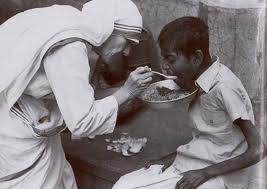
Mother Teresa of CalcuttaWe fret over minutiae, we become anxious about events that are too overwhelming for us to handle, anxiety overtakes us . . . and still God says to us: My heart is moved with pity for you have been with me many days now and have come a long distance. Do not be afraid for I am always with you. I will sustain you. You are mine. There is nothing to fear.
“Jeremiah sends a ‘book’ of oracles against Babylon to Babylon with Baruch’s brother in about 594. These are to be read publicly and then tied to a stone and cast into the Euphrates, symbolizing Babylon’s fate. It has been suggested that the original intention of Jeremiah’s action was to rebut the prophecies of Ahab and Zedekiah to the effect that the exile would be short (see 29:4-9, 20-23). On this interpretation, reading and then destroying a set of anti-Babylonian prophecies would have the effect of stressing Jeremiah’s rejection of this optimistic view.” (Mays 576)
Jeremiah knows that the exile will be long and harsh, yet no one believes him because it does not coincide with the false view many find easier to hold. It seems that nothing much has changed in the intervening millennia since this story; we humans would rather cling to the falsehood that matches our view rather than change our thinking to the truth. Today’s citation tells us that it is better to adjust ourselves to reality because no amount of manipulation or coercion will hide the obvious. My dad liked to say: The truth comes out in the end so we might as well get used to it as soon as we can.
In today’s case, Jeremiah accurately predicts that even the conquerors will themselves be conquered and he predicts an unpleasant winnowing. The imagery is brutal, the devastation complete. There is no escaping the consequences that result from greed, corruption, and mollification. The prophet Jeremiah sees collusion between his own leaders and those who of Israel’s pagan neighbors and while the “optimistic view” cited above may be popular, it is not honest. And so Jeremiah outs the lies. He does as God asks and sends his prophecies to Babylon via the brother of his secretary, Baruch.
It is difficult to speak truth with respect, to express candor gently; and it may, in fact, even place us in danger. When we see that everyone around us chooses to believe a myth created by the powerful and wealthy, we must speak honestly but with mercy no matter the cost to us. It is in this way that we adjust ourselves to reality rather than follow the fashionable fairy story. It is in this way that we honor ourselves and others who speak truth. It is in this way that we praise and honor our God.
From today’s first reading at Mass, The Feast of Jesus’ Transfiguration, 2 Peter 1:16-19: Beloved: We did not follow cleverly devised myths when we made known to you the power and coming of our Lord Jesus Christ, but we have been eyewitnesses of his majesty. For he received honor and glory from God the Father when that unique declaration came to him from majestic glory, “This is my Son, my beloved with whom I am well pleased.” We ourselves heard this voice . . . Moreover, we possess the prophetic message that is altogether reliable. You will do well to be attentive to it, as to a lamp shining in a dark place until day dawns and the morning star rises in your hearts”.
Peter knows that he cannot remain silent about the story he has witnessed and, like Jeremiah, he knows that he must speak so that others might adjust to the amazing reality that what seems impossible is real, that we are created and loved by God and that God wants nothing but goodness for us and from us. We are called to seek truth, to cling to it and to celebrate it with others who are willing to adjust their vision to be in line with God’s.
Once we cease nodding in idiotic agreement with the myths woven by those who are vested in them, we will see and know God’s truth, and we will not be silenced. We too, will write out the prophecy that God commands, and we will adjust ourselves to God’s vision.
Mays, James L., ed. HARPERCOLLINS BIBLE COMMENTARY. New York, New York: HarperCollins Publishers, 1988. 576. Print.
Francisco Goya: Las pinturas negras“The anguish of death has rarely found expression in such touching images as those of the present psalm: prison, shipwreck, solitude, and darkness. The suppliant has experienced the depths of misfortune. Has God abandoned him? Despite the depths of the distress, the believer refuses to admit such a thing; he puts down all thought of rebellion within himself. For although no expressions of hopeful expectation (as in most psalms) are present and the last word speaks of darkness as ‘my closet friend,’ the psalmist firmly believes that the Lord is ‘the God of [his] salvation.
“This psalm illustrates the hazy ideas that the ancients harbored about life after death before they arrived at faith in the resurrection: in the netherworld (‘Sheol’), in the subterranean pit, the dead have no more communication with God; they are no more than dull shadows of themselves in the land of no recall. It is a prayer of a man who experiences the depths of human misery, a prayer of Israel at the edge of collapse, but also a prayer of everyone on the brink of hopelessness.” (“THE PSALMS, NEW CATHOLIC VERSION” 229)
It is suggested by some that this psalm may have been written by someone who at one time had taken an active part in liturgies but who is now isolated from the community by a disease such as leprosy that would exclude him from human contact. No matter the cause for separation, the plaint in this psalm is almost too difficult to read; and it is for this reason that it is so important. I have a friend who says: Everyone takes a turn, and by this she means that no matter life circumstances, each of us will suffer deeply at one time or another.
Several of my friends experience depression and the words of this psalm express their feeling aptly. A sense of being the shadow of whom we are meant to be, the feeling of intensely dark isolation, the state of deepest despair where there is not even a spark of hope – these are all conditions described by my friends. The psalmist here touches the unfathomable sensations of grief, sorrow, and despair that depression brings on and yet, in this psalm the suppliant continues to reach for God despite the fact that he cries out from a place that has no recall, no memory, and no expectation of anything other than misery. We might wonder how this petitioner is able to pray at all for we are left at the end of this psalm with nothing but silence. This is the world we want to avoid; yet it is the world in which many live. From Job 19:13-16: My brethren have withdrawn from me, and my friends are wholly estranged. My kinsfolk and companions neglect me, and my guests have forgotten me. Even my handmaids treat me as a stranger; I am an alien in their sight. I call my servant but he gives no answer, though in my speech I plead with him . . .
Platitudes offer nothing to those whose existence is so bleak that what they once knew as commonplace no longer exists; they are well beyond comprehension of well-meaning words such as, there is never a cross too heavy to bear, another door opens when one is shut, every cloud has a silver lining.When living in the murky depths we encounter today only real contact, genuine assurance, and honest encouragement will begin to penetrate this darkness; words and ideas do not serve.
And so as always, we pray . . .
For those who feel as though they drift in oblivion, for those for whom it is impossible to experience anything but pain, for those who are blinded and deafened by the darkness . . . we ask your intercession, Lord.
For those who cannot help themselves out of the abyss, for those who are the caregivers of the deeply depressed, for those who accompany loved ones in their journey of anguish . . . we ask you mercy, Lord.
For those who are convinced that there is no hope, for those who are incapable of experiencing joy, for those who cannot find you even with help . . . we ask you compassion, Lord.
Oh, loving and ever tender Lord, keep all of us, we pray, from the darkness of Sheol. Oh good and gentle Lord, do not let us slip into the land of no recall . . . for you are our only salvation. Amen.
THE PSALMS, NEW CATHOLIC VERSION. Saint Joseph Edition. New Jersey: Catholic Book Publishing Company, 2004. 229. Print.
Senior, Donald, ed. THE CATHOLIC STUDY BIBLE. New York, Oxford University Press, 1990.318. Print.
To learn more about the work and life of Francisco Goya, visit: https://www.theartstory.org/artist-goya-francisco.htm
We have tackled this theme before: The importance of knowing our appropriate limits. We have reflected on the subtle ways in which vanity creeps into our lives, allowing us to believe that we do not need God or worse – that God does not exist at all. We already know that if we are not prudent, humble and watchful, arrogance will make a stealthy entrance into our lives. We preen a bit too much when we are complemented. We allow ourselves to forget that it is God who creates us and fills us with the talents we so easily take for granted. When we know our limits – and when we know God’s beneficence – we keep well away from the subtle snares of pride.
We may puzzle a bit over why the Lord is so particular about dividing the tribes into designated territories, and if so then we will want to recall that the land from the Wadi of Egypt to the Great River Euphrates is part of God’s covenant promise to Abraham in Genesis 15:18. The Lord understands that unless demarcations are made we humans will constantly squabble over control. The Lord also knows that once we relinquish ourselves to God’s boundaries, we learn to rely on God rather than ourselves.
We may object to this laying out of lines and the designation of supervisors. We may believe that God does not really understand what it feels like to be in our shoes. We may think that our burdens are too heavy, our challenges to great. We may even think that God does not understand us, and in this we would be incorrect.
For the lovely paradox is this . . .
When we learn to rely on God alone for everything we are and do, we will find it easier to remain within the human limits that define us.
When we learn to thank God for all that we have and all that we are, we will find it easier to empty ourselves so that God might enter.
When we learn to ask God for help in everything we do, we will find it easier to overcome the obstacles in our path.
In doing all of this, we hand ourselves over to God.
In doing all of this, we find our own divinity. And this is the lovely paradox.
If we want to live in relationship with others, we will find it necessary to change our plans; sometimes this is quite easy to do and at other times we suffer change at great cost. Events occur not as we would wish them. They often take on a life of their own. In today’s reading we have the opportunity to examine a model for authentic accommodation in relationship with others. When we make room for God in every connection we make with others, we have the guarantee of God’s simplicity, sincerity, and grace. We can be confident that no matter the change required of us, we will flourish and thrive.
When we read Paul’s two letters to the church in Corinth, we see the importance of flexibility and constancy in all relationships. While it is important to remain authentic and faithful, it is also essential to allow for some give and take as circumstances require. As we read through these epistles, it is clear that there are some disagreements and differences of opinion that have the potential to create permanent rifts. Important connections have been established and nurtured; breaches must be bridged. Cleverly, or perhaps by God’s grace, Paul begins with himself. “Since Paul’s own conduct will be under discussion here, he prefaces this section with a statement about his habitual behavior and attitude toward the community. He protests his openness, single-mindedness, and conformity to God’s grace; he hopes that his relationship with them will be marked by mutual understanding and pride, which will constantly increase until it reaches its climax at the judgment.” (Senior 277) As we read the opening chapter of 2 Corinthians we understand that a change of plans has caused anxiety and upset. Paul addresses the problem by beginning with himself – and by falling back on God.
Simplicity, sincerity, and the grace of God: These qualities are given to us by God the Father; these traits are modeled for us by Jesus; these virtues are renewed in us by the Spirit.
When we must change plans we must keep things simple. Adding more jumble to an already stressed schedule does us and those we work and live with nothing but harm.
When we must change plans we must be honest. It is important to take the time to examine motives and look for hidden agendas. Any plan that is not genuine is not needed. Any plan that comes from deceit brings ruin.
When we must change plans we must do so with good will, considering the common benefit. When a community must alter plans to please only one or two of its members, morale plummets and cooperation disappears.
Simplicity, sincerity, and the grace of God. Paul outlines for us the opening step in bridging a rift between colleagues, friends or loved ones. We begin with ourselves. And we look for God’s plainness. We look for God’s straightforwardness. We look for God’s beauty. We look for God’s blessing in all we say and do.
A re-post from August 2, 2011.
Senior, Donald, ed. THE CATHOLIC STUDY BIBLE. New York, Oxford University Press, 1990. 277. Print.
We will need to look at notes in order to understand the references in today’s Noontimeand the following information is from THE CATHOLIC STUDY BIBLE. Ephraim(note verse 17) was the tribal area that remained in the northern kingdom of Israel after the Assyrian invasion. The woodand wand(note verse 12) refer to any carved idol or utensil used in the practice of divination. Ritual prostitutionpracticed in Canaanite shrines was introduced into sanctuaries dedicated to Yahweh (note verse 14). Gilgalhere (note verse 15) is in reference to a sanctuary in the north in Bethel where there was an association of cult prophets (2 Kings 2 and 4:38); it is not a reference to Gilgal in the south where Joshua sets up memorial standing stones (Joshua 4). Finally, the priestsare in for heavy criticism because they are seen as the ones who lead the people away from God as they set up a schism between genuine and cult prophets. All of this information helps to clarify the link between the prophet Hosea’s deep sorrow over his wife Gomer’s prostitution of herself and the descent of the nation of Israel into this same harlotry. Hosea sees the individual and collective return to idolatry as a seal of the fate of the nation and its people. They are all caught up in the coming whirlwind of disaster. (Senior 1112-1113)
The psalmist reminds us that: The idols of the nations are silver and gold, the work of human hands. They have mouths but speak not; they have ears but see not; they have ears but hear not; no breath is in their mouths. Those who make them will be like them, and so will all those who trust in them.(Psalm 135:15-18) If only we humans might remember that in the end these little gods cannot forgive us, save us, redeem us or love us as God does.
We have reflected during our Noontimesthat little gods creep into our lives without notice and it is in this way that we become unwitting collaborators in the creation of an illusion; today we look at how a nation of people who have been blessed by God turn away from God’s goodness. The children’s story of The Emperor’s New Clothes from the Hans Christian Anderson collection is an apt allegory not only for Hosea’s society but for our society today. We have only to determine if we number among the adults who have ceased to think for themselves or if we are the astonished child who announces: The emperor is naked! Like the child, Hosea cries out to the people of Israel. And like the child, our prophets of today cry out against the obtuse among us.
When we become frustrated with a herd mentality that drives idiotically toward the precipice or when we give up all hope that the small voice of truth might be heard above the clamor of a self-deceiving crowd, we must turn away from our little gods of anxiety and desperation and turn to God, for it is God who best understands what is to be disbelieved and dispossessed. And it is God who knows well how to convert the darkness of despair into the beauty of joy, for it is in the darkness that God plants the seeds of new life.
And so we pray . . . Good and forgiving God, remind us that we have only to be open to a newness that you will bring out of the ignorance and despair we witness today. Show us the newness born of the dark that is your compassionate healing and eternal transformation.Amen.
Senior, Donald, ed. THE CATHOLIC STUDY BIBLE. New York, Oxford University Press, 1990.1112-1113. Print.
When we reflect on national, local and international news reports, we might believe that our world is falling apart. When we do, we might want to revisit this post from July 17, 2011. And for more reflections on the books of the Bible, visit the Book of Our Life page on this blog.
“The sixth century B.C. was an age of crisis, a turning point in the history of Israel. With the destruction of the temple and the interruption of its ritual, the exile of the leaders and loss of national sovereignty, an era came to an end. Not long after the fall of Jerusalem (587) an eyewitness of the national humiliation of Zion, submission to merited chastisement, and strong faith in the constancy of Yahweh’s love and power to restore. The union of poignant grief and unquenchable hope reflects the constant prophetic vision of the weakness of man and the strength of God’s love; it also shows how Israel’s faith in Yahweh could survive the shattering experience of national ruin”. (Senior 1017)
We might not want to reflect on a time of crisis in our personal lives when all we knew had been destroyed or lost, when a time of happiness and prosperity ended. We may want to avoid thinking about any humiliation or chastisement we have experienced. The memories of our personal shattering may be too difficult to handle, too painful to live with. The Book of Lamentations written by Baruch, the prophet Jeremiah’s secretary, is a small one and may be easily overlooked; yet it holds so much that is vital to living happily. In Lamentations we find the important lesson that while we do not want to center our lives on suffering, neither do we want to circumvent its message. Focusing a life on the avoidance of pain only leads to more obstacles, more grief, more distress and, eventually, even more pain. Learning how to pass through pain patiently, placing our trust in God as we navigate the grief also allows the transforming touch of God to bring us the serenity we yearn to experience – despite the sorrow we feel. When we allow God to alter our attitude about the losses we suffer, we also consent to God’s transformation. We enter into life’s shattering experiences, and then exit with a new view of the world, a renewed sense of compassion, and a serenity that cannot be shaken. Lamentations gives us an opportunity to examine our attitude toward pain and God’s deep and abiding love for us.
Today’s Mass readings provide a road map for healing through pain: Wisdom 12:13, 16-19, Psalm 86, Romans 8:26-27 and Matthew 13:24-43 all outline the same lesson: God has infinite patience, compassion, mercy and love – enough to heal any breach or restore any loss. From today’s MAGNIFICAT mini-reflection: “God in his providence will use even the apparent evil that attends us in life to some perfecting purpose; out of our littleness, our emptiness, our nothingness Gods greatness will flower in an astonishing way.” (Cameron, 251) Rather than curse our loss as punishment or the end of an era, when we rely on God we learn to celebrate each shattering experience as the beginning of something new. And so we pray . . .
Good and patient God,
For all the times we forget to call on you when we suffer and for those times we lose patience with ourselves and others . . . continue to be patient with us.
For all the times we show anger instead of compassion and for those times we commit acts of vengeance rather than love . . . continue to be merciful with us.
For all those times we are anxious about evil in the world and for those times we forget that you always pull goodness out of wickedness . . . continue to abide in us.
For all those times we grow weary of the daily struggles and for those times we waver in our trust . . . continue to be with us. Amen.
Senior, Donald, ed. THE CATHOLIC STUDY BIBLE. New York, Oxford University Press, 1990.1017. Print.
Cameron, Peter John, Rev., ed. “Mini-Reflection.” MAGNIFICAT. 17 July 2011: 251. Print.
In today’s Gospel from Mark 6:53-56 we hear the message that we recognize Jesus’ goodness immediately when we are suffering or in need. [P]eople immediately recognized him. They scurried about the surrounding country and began to bring in the sick on mats to wherever he was. Jesus, moved by compassion, acts out of his love for humanity; he turns no one away. We must remember to invite Jesus to heal our wounds each day. We must ask God to guide us as we try to solve our small and big problems. And we must turn over our fears and anxieties to the Holy Spirit constantly.
Erasmo Leiva-Merikakis, a Cistercian monk, writes in today’s MAGNIFICAT Meditation (108-109): We have to invite Jesus continually to become Lord of our life. He never imposes himself by force because, being Love, he wants to be loved in return, and love is born only from freedom and never from force or obligation. What is true of the natural level is also true of the supernatural. God cannot force us to love him. Yet instead of loving God unconditionally, we spend most of our time piously trying to manipulate his power to suit our own desires: we want to have God at our beck and call . . . we have to place ourselves, voluntarily and gratefully, in the hands of the Physician of the bodies and souls, confidently manifesting to him our every illness and complaint.
In this portion of Joel’s prophecy we are reminded just how much God wants to care for us that even after we have turned away and have done things that would erase any human relationship, God is still waiting patiently to heal.
From the MAGNIFICAT Morning Prayer Mini-Reflection (102): God in his power is refuge and strength; God in his mercy is the river that refreshes the soul; God in his beauty stills all our useless struggles and gather us into his peace.
The Milky Way
The Lord himself will fight for you; you have only to keep still. (Exodus 14:14)
We already have all that we need . . . we may not feel it.
We already have all that we want . . . we may be blind to it.
We already have all the love we require . . . God is allowing us to come to this understanding.
God never imposes God’s self by force because, being Love, God wants to be loved in return, and love is born only from freedom and never from force or obligation.
Let us live our lives in total trust of the saving power of God’s love for us.
Let us free ourselves of all doubt, all coercion, and all lusting after control for all of these are alien to God’s love.
Let us instead allow ourselves to be born of God’s endless compassion and love.
Cameron, Peter John, Rev., ed. “Mini-Reflection.” MAGNIFICAT. 21 July 2011. Print.










 The Noontimes