Adapted from a reflection written on January 20, 2008, and explored last September. Today we explore again how scripture’s wisdom might help us discern the difference between true and false shepherds.
Yesterday we explored the concept of the shepherd in Old Testament scriptures. Today we look at the books of wisdom to see what wisdom they hold for us as we look for a way to discern the difference between true and false shepherds.
In the Book of Psalms, the Holy Spirit brings us beautiful words of the comforting, guiding, protecting shepherd.
In the sapiential book of Ecclesiastes, Chapter 12, we hear that the words of wisdom are like the shepherd’s staff.
Tomorrow, prophets who shepherd us . . .
When we compare translations of these verses, we discover the qualities of the good shepherd. In hope we cleave to the shepherd who guides, who calms our fears, who gathers us in.
For more beautiful images of shepherds and their flocks, click on the image or visit the “Tending the Flock” post on the “Herding on the Web” blog.
Ezekiel 34: Shepherds and the Old Testament – A Reprise
Friday, January 10, 2024
Adapted from a reflection written on January 20, 2008, and explored last September. Today we re-visit our experiences with shepherds both true and false.
Today’s reading is a familiar allegory that we read in scripture. It is a metaphor we hear read out to us when we participate in liturgies of The Word.
In Genesis 48, Jacob/Israel reminds his sons that God has been his shepherd.
In Numbers 27, Moses tells Yahweh that he ought not to leave his sheep without a shepherd.
In 1 Kings 22 (and 2 Chronicles 18), the prophet Micah predicts that the false shepherd kings of Israel will lead the flock astray.
Through this early Old Testament history, we see the image of the watchful shepherd, guiding and guarding his flocks; but another shepherd steals sheep from the owner. Shepherds wander great distances with their flocks in search of grazing and water to sustain them, and by the nature of their work, there are out of touch with the master and with society. False and true shepherds come and go with their herds; they roam hillsides and rest by watering holes. However, these shepherds are not all to be trusted. The false shepherd leads his sheep astray – with no one knowing where they were, or what is happening to them. The good shepherd always thinks of his sheep before self; he struggles to gather his sheep in, to tend to their wounds, to save them from harm or danger. The outcast shepherd lives on the margins of society, and does not feel community or solidarity with anyone. Out of touch with society in general, shepherds are free to deceive us or to protect us. We need to acquire the skill of discernment. Today, Ezekiel juxtaposes the good and the false shepherds, the sustainers versus the ravagers. And we do well to pay close attention to his words.
Tomorrow, shepherds in Wisdom . . .
When we use varying translations to explore Ezekiel’s words, we develop new eyes better able to discern the difference between true and false shepherds.
Why does God allow me to feel so alone, exasperated, angry or sad?
If we hear ourselves asking these questions frequently, we may need to think of them as inversions.
What do I expect of God?
Where have I put God in my life?
Why do I ask so little of God?
Why do I forget God or turn away from God’s love when I am alone, exasperated, angry or sad?
Today we re-read the prophecy of Hosea, the man who married an adulterous wife and we focus on Chapter 2 to find a description of Gomer, the unfaithful wife. Metaphorically, Gomer is each of us when we reject the conditions in which we find ourselves. As difficult as our problems may be, they are our stepping stones to self-discovery . . . and to serenity. Once we learn to turn everything over to God, the sorrow and anger slip away. And we are at peace with the circumstances surrounding us.
Today’s Gospel is John’s story of the feeding of thousands (6:1-15) and we might look at how Jesus asks the disciples how they want to feed so many – John writes: He said this to test them.This does not mean that Jesus wants to throw his friends into turmoil; rather, he wants to see how they hope to solve the problem before them. Do they resort to their own resources, or do they rely on God in any way?
We must remember to ask for miracles, because God wants to grant them.
We must remember to take our woes to God, because God welcomes them and erases them.
We must remember to leave our sadness in God’s hands, because God heals all mourning with deep and abiding love.
Hosea laments his unfaithful wife. God misses us when we stray. Why do we try to solve everything on our own? And why do we expect so little from a generous, loving God?
William Brassey Hole: David Fleeing Jerusalem is Cursed by Shimei
Wednesday, January 8, 2025
We have journeyed through Christmastide. We have spent time with the magi and their gifts of wisdom, mystery and grace. Today we reflect on one of Jesus’ major messages: Loving our enemies.
Various translations present today’s story with varying titles; yet despite the words, the story of David’s patience, wisdom and forgiveness remains the same. David – who seeks forgiveness from Yahweh himself – understands the importance of mercy. David says that we need to allow our foes to curse us if that is the will of God, for who are we to stand in the way of God’s design? When Shimei curses him, David says, Let him alone and let him curse, for the Lord has told him to. Later, in Chapter 19, Shimei returns to David and repents his cursing. David forgives him.
What do we learn today? We never know when someone is on his or her conversion path, and to allow someone conversion of heart is correct, just, and God-like.
As we move forward into this new year, we will want to give thought to the benefit, the beauty and the grace we might find in allowing our adversaries to curse us.
When we use the scripture link and the drop-down menus to explore various versions of these verses, we discover the many gifts that come to us when we love our enemies.
As commentary explains the issue of genealogy, the purpose of Matthew’s inclusion of this long list of who begat whom serves to describe the fourteen generations in this listing, 14 being the numerical value of the letters in the name David. I once heard an entire lecture on numerology and the Hebrew alphabet, concepts important to Matthew’s audience, the Jewish people at the time of Christ. The salient point here is that Matthew was making the case that the man Jesus was indeed the long-awaited Messiah who springs from David’s line.
Yet, despite this affirmation that emanated from their way of thinking, despite the many signs and fulfillments of Old Testament scriptures and the prophets, the people refused to accept the evidence before them. We might ask why; and the answer is – because they wanted to.
When Jesus came into his family, his town, his country, his culture, he upended many of the long-held tenets. He came to set the world on fire, to cause discussion, to move the people out of their comfort zone. He did this in his own time and he continues to do this with us today. He does this with an inversion that startles and even frightens us, but that also transforms us.
We might turn to Paul to better understand the genealogy we share with Jesus. Paul explains to the Galatians, and he explains to us . . . When the fullness of time had come, God sent his Son, born of a woman, born under the law, in order to redeem those who were under the law, so that we might receive adoption as children. And because you are children, God has sent the Spirit of his Son into our hearts, crying, “Abba! Father!” So you are no longer a slave but a child, and if a child then also an heir, through God. (Galatians 4:4-7)
Family was important to my parents – both the generations before us and the generations to come. These cohorts formed a foundation on which Mother and Dad stood and from which they drew strength as they met the daily challenges of life. We need to practice standing and stretching. We need to practice patience and forgiveness.
Today we read of Jesus’ legitimacy. Let us reflect on our own legitimacy as his adopted sisters and brothers. Do we share his patience? Do we share his love for those who curse us? Do we share his love for doing God’s will? Are we legitimate heirs of the redemption Jesus has gifted to us?
With Christmastide ending, we find ourselves observing the official feast of Epiphany. What significance does this feast hold for us? To further explore, we return to a Noontime reflection on the wisdom of the Magi. We reflect on the wisdom they reveal, the wisdom of patience, willingness, and openness as they listen to God’s voice that speaks within.
I love this portion of the Christmas story. The wise men are sowise that they are able to read Herod’s secret intent. Nothing can be hidden from the wise because they are so connected to the creator that they seem to have special insight. What they really have is patience, serenity, and a finely tuned ear for God’s word. And so the wise men left for their own country by another road.
I am thinking about the number of times I have averted disaster because that calm, strong voice within indicated that I was to stay put. We notice that an attitude of patience and a willingness to obey always accompany the wise. They do not appear to be brash or excitable. They do not speak harshly, nor are they silenced. Like the Persistent Widow, they know when to persevere in speaking God’s word. And like the Three Magi, they know when to stand down and melt away into God’s protecting presence.
The wise know when to stand and witness – and when to leave quietly by another road.
On the tenth day of Christmas, my true love gives to me ten lords a-leaping.
Many of us are familiar with The Ten Commandments that Yahweh gives to Moses, but how often do we pause to think of the fact the God, through Moses, not only gives us a simple set of rules to follow, but that he explains the effect these rules will have on our lives. God sees our authenticity by the way we live, and by the way we do or do not say, “Yes,” in response to God’s call. Today the old Christmas carol poses these questions to us: do we see the Gospel stories as a fulfillment of God’s hope in the covenant God establishes with us in the promise of the Ten Commandments?
This part of the Exodus story is bracketed by two convergent episodes: the provision of quail, manna and water by God to the Israelites, and the planning and building of a desert temple-tent for Yahweh by the Israelites. We see actions by both God and the Chosen People that speak of their desire to live in a covenant relationship. And the actual agreement, along with its explanations and implications, lies between these two actions in chapters 20 to 24.
The Holy Spirit
God takes the Israelites out of bondage – just as Jesus later does for all when he comes to live among us and to institute the Kingdom (in Luke 4:14-30). With the giving of the commandments, God foresees the struggle of the people in the desert. God’s preservation and protection of these people bring to God not only fame, glory and praise, but also an arrogant, contemptuous rejection by us. So too does Jesus arrive among God’s people to fulfill the Mosaic Law, to provide and protect us, and then to suffer at our hands; yet ultimately, God the Father and God the Son both offer their compassion and mercy to us when we are wayward. All that is required of us is that we repent of our past transgressions and then respond to the call. Just as God sent an angel to guard the Israelites and bring them to the place God had in mind for them (23: 20-33), so too does Jesus send the Holy Spirit to dwell with us after Jesus’ resurrection – to guide and protect, and to lead us to the holy place he has prepared for us. Of course, later in Chapter 32 of Exodus, the people tire of waiting for Moses to descend Mt. Sinai, so they create and worship the Golden Calf. Moses returns, breaks the tablets and loses his patience. The people repent, agree to do as Yahweh asks and Yahweh restores the tablets. A familiar story that we repeat today – we only need to read and compare history and current events. And it is no wonder that we stray – no wonder that the Israelites strayed. When we look at chapters 20 to 24 of Exodus, we see the social implications of the Mosaic Law. We might pay special attention to some of the verses that hold ideas difficult to take, verses that call for us to respect ourselves and one another: 22:15, 23:1, 22: 1-3, 22: 20, 21:35-36.
So on this day when we continue our celebration of God’s truest gift of love, we take a few moments to recollect our experiences in covenant relationships with others. We might mediate for a bit on how we might remain faithful to the one central covenant in our lives. And we might decide how best to renew that covenant each day with our Creator.
Adapted from a reflection on The Ten Commandments written February 14, 2007.
Being a teacher, Jesus asks his listeners a question to see if they have fully understood the enormity of his message; and when it is clear they have not, he calls forth the very principal on which they stand to show them where they err. He truly is a master. He uses what we say and do to mirror back to us the echo of what we declare.
From today’s MAGNIFICAT: From the beginning of time, God has acted to reverse the loneliness which represents the consummate curse to the human race – an experience analogous to hell. Even this master defers to his creator, God, in all the important decisions of his life. He responds to the call of love which washes away the fears of loneliness, anxiety, betrayal, failure and abandonment. This master obeys the voice within that calls him to act in and for love. If Christ does this, if this is what it means to be Messiah, then how can we believe that we know a better way to exist? How do we dare to defy God?
From today’s MAGNIFICAT reflection by Mother Elvira Petrozzi: If you are able to be an instrumentin the hands of God, if you have trust, love, and the patience to accept His plans for you, He restores to you what you have given, one hundred times over . . . Those who trust in him will not remain imprisoned in their little plans. I have seen young people who built a cage with their own hands and then fell into desperation because of it.
Christ built no cages; he opened doors and windows. Christ did not succumb to the siren song of Satan to be like gods.Christ obeyed the voice of his vocation.
I am reminded of a favorite verse from Jeremiah: For I know well the plans I have in mind for you, says the Lord, plans for your welfare, not for your woe! (29:11)
This is what it means to be Messiah. Obeying God for love of God rather than out of fear or laziness. Loving God for the passion we feel for God rather than from a sense of duty or response to a whim. Committing ourselves to the Messiah even as the Messiah commits himself to God, this is what we believe. This is what we follow. Enormous plans for our joy, rather than little plans for woe. Awesome plans for a serenity that comes from doing what is good and right and beautiful even though there may be pain in the interim. For . . .
It is in the doing that we redeem and are redeemed.
It is in the acting that we declare and are declared.
It is in the obeying that we love and are loved.
This we know. This we believe.
Let us rise up and follow the Messiah born to us this night.
Cameron, Peter John. “Meditation of the Day.” MAGNIFICAT. 12.2 (2009). Print.
Adapted from a Favorite written on February 12, 2009, posted on Christmas Day 2017.
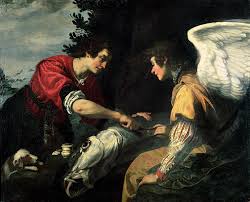
God hears the pleas of two desperate people in two distant places, and he sends his special messenger Raphael to guide Tobiah in the healing of Sarah and Tobit. Tobiah is first the faithful son and later the courageous and abiding spouse. Sarah sees no reason for her existence based on a series of marriages that fail because a demon has become enamored of her. She becomes separate from everyone in her intense and desperate grief. Tobit, a good main who is faithful to his Jewish beliefs, has also become separate his blindness. Yearning for the light, he seeks death rather than continue in the darkness. He, like Sarah, feels alone; they both search for the reason that God has visited punishment upon them when they know themselves to be innocent of doing wrong. They stand judged by others because Old Testament thinking saw misfortune as a punishment for sin. Some of us may from time to time feel like this man and woman.
Yesterday in chapter three, we read that Tobit and Sarah’s desperation has reached such depths that each, in distant privacy, prays for release from this world. As they pray for death, their prayers rise to God intertwining like spirals of incense. God hears these petitions and sends Raphael to accompany the faithful Tobiah in his journey to knit together these wounded souls. God intervenes when we sometimes least expect it . . . and in very surprising and confounding ways.
Rembrandt: The Angel Rafael Leaving Tobit and his Family
The journey that Tobiah takes is a long and complicated one. Yet he accepts his father’s request, finds a traveling companion (Raphael in disguise) and perseveres faithfully without fully understanding how his actions will result in anything good. He continues, he obeys, he listens for and answers the call. This is how we must live. It is how we must act. This is how we find consolation and healing. It is how we encounter God. This is how we become wounded healers. This is God’s plan.
So after reflection with the story of Tobit, we pray.
Sometimes we must reach the point of desperation in order to know what we truly hold sacred . . . and that we are sacred healers.
Sometimes we must fall into the abyss in order to find God’s abiding presence . . . and our own divinity.
Sometimes we must cry out from our aloneness in order to understand that true and deep hope is also bold and outrageous . . . and that God’s best hope lies in us.
Sometimes we must be victim to our darkest fears in order to lay aside our anxieties . . . for then we see them as prison bars that separate us from God.
Sometimes we must be blind in order to see.
Sometimes we must feel unloved in order to be loved and to love truly and deeply.
Sometimes we must reach the point of desperation in order to know what we truly hold sacred. And in that spot, in that distant place that is actually dep within, we will find our consolation, our birth in Christ. Amen.