Then they opened their treasures and offered him gifts of gold, frankincense and myrrh.
Gold for the king of kings. Frankincense for the priest of priests. Myrrh for the death that is life, for the child who brings life eternal. This is our proof of God’s love. Knowing this truth, we live confidently now and forever. Living this truth, we become radiant in Christ.
This is the gift of being Christmas people.
Then you shall be radiant at what you see, your heart shall throb and overflow, for the riches of the sea shall be emptied out before you, the wealth of nations shall be brought to you. Caravans of camels shall fill you, dromedaries from Midian and Ephah; all from Sheba shall come bearing gold and frankincense, and proclaiming the praises of the Lord. (Isaiah 60:5-6)
Click on Midian, Ephahand Sheba to learn more about these places.
For this is the message you have heard from the beginning: we should love one another . . .
The ancient Shematells us how we are to live as children of God. The Apostle John reminds us that we already have the answers we seek. The Gospels describe how God has come to live among us, entering the world as a vulnerable child. The message is always the same . . . we are to love one another, even those whom we do not wish to love.
On this eleventh day of Christmas, enter the words Love One Another into the blog search bar and consider what this message means for us as Christmas people.
Notes from the NAB, page 1328: Rather than allow the slow to become content in their slowness, Paul exhorts them to even higher levels of spirituality. He is not lenient. And as for those who have fallen away completely, he does not even address these apostates. If all we need is energy to progress in our spiritual journey, we can turn to Christ for he tells us through Matthew (10:28-30), my yoke is easy, my burden light. Christ himself exhorts us Come to me, all you who are weary and burdened, and I will give you rest.
Sometimes we are not so much sluggish as afraid. We know that the task lying before us is laden with tricky passages, dark corners, deceitful paving stones that look firm and yet sink into quicksand. On these occasions we must also turn to Christ, trusting him when he says take my yoke upon you and learn from me, for I am gentle and humble in heart.Disobedience is not an option for an apostle.
Paul tells us that Christ’s promise is immutable, and he uses the long story of the covenant promise between Yahweh and Abraham as ample proof. Did not the elderly couple – Sarah and Abraham – begin a kingdom of millions? Did this new way of seeking God not travel to allpeoples of allnations? Do we not know even today the story of this Abraham, Sarah, and the high priest Melchizedek? Paul reminds us that it is impossible for God to lie; his very goodness and honesty force him to keep his covenant with his people.
So when we feel weary or afraid, we might turn to Paul for a reminder of the words of hope we can never hear too often. This we have as an anchor of the soul, sure and firm, which reaches into the interior behind the veil [into the Holy of Holies], where Jesus has entered as forerunner . . .
In this Advent season when we anticipate the arrival of Emmanuel, God among us, let us rest in this promise. Let us acknowledge that when all is dark and appears to be lost, when all is more difficult or more terrifying than we can bear we must be still . . . so that we might hear again . . .
Come to me . . . and you will find rest for your souls . . .
Rembrandt van Rijn: The Presentation of Jesus in the Temple
Simeon
Now there was a man in Jerusalem called Simeon, who was righteous and devout. He was waiting for the consolation of Israel, and the Holy Spirit was upon him. It had been revealed to him by the Holy Spirit that he would not die before he had seen the Lord’s Christ.
Righteous, devout, awaiting the consolation of Israel . . . Simeonfocuses all of his spiritual, mental and physical energy on God. We imagine what sort of award awaits us when we determine to live as Simeon lives.
He came in the Spirit into the temple . . . Not only does Simeon live in the Spirit but he carries this Spirit with him wherever he goes. We imagine what effect we might have on the world if we are as faithful as Simeon.
“A second Lucan theme lies in the setting: Jerusalem and the Temple. For Luke the ministry of Jesus moves toward Jerusalem and the mission of the church moves out from Jerusalem. As for the Temple, Luke is alone among NT writers in is favorable view. His Gospel begins with Zechariah in the Temple and it will close with Jesus’ disciples in the Temple”. (Mays 932)
In this Advent time of year when all the world awaits relief from a pandemic, and when we await Christ’s coming into the world, let us consider the many directions in which we feel ourselves pulled, the many losses we feel, and let us determine to await Christ in the temple of our hearts. Let us decide to take the story of our salvation to the world.
Today is Gaudete, or “Rejoice” Sunday and it is a pause in our watchfulness as we await the coming of Light to a world longing for hope. As we continue our journey into a season of darkness in the northern hemisphere, we reflect on the plundering of the Jerusalem Temple, and our transformation that grows form the ashes of despair. When we listen to the ancient carol Gaudete, we have a sense of the joy we might find amid the sadness of dark days. Click on the image above or visit: https://www.youtube.com/watch?v=vUbcHfnx0pY
Simonlusts after control and so lies and connives to gain his end. He appears to succeed, yet we all know from our perspective in the second millennium that a new temple brings down the Jerusalem temple and rebuilds it in three days. This happens in the person of Christ.
The faithful who follow the good and compassionate priest Oniasimmediately take to the streets, the priests prostrate themselves in petition, and Yahweh answers their prayer in a surprising way.
Gérard de Lairesse: The Expulsion of Heliodorus from_the Temple
It should not surprise us that the men in this story who grasp for control of the treasury resort to any means to achieve their ends; nor should it surprise us that God answers the pleas of these holy and faithful people.
It should not surprise us that even those enveloped in the power, money and control can have their eyes opened.
And it should not surprise us that this conversion will often happen as the result of a cataclysmic event. We must constantly prepare ourselves for these experiences and these people. And so we pray . . .
Dearest God, Creator, Savior and Consoler,
Lead us away from the ways of Simon and keep our eyes open for the times we want to take control. Show us how easily we may be tempted to resort to any means to achieve our own ends. Remind us to make a new temple of ourselves as Christ has asked. Remind us that we are called to be holy disciples.
Lead us to you as your faithful. Keep our ears open for your word, your message and your rescuing messengers. Remind us to intervene and intercede for those who wish us harm. Remind us to act when we see injustice.
Lead us to the Christ who dwells within us. Keep our hearts open to our own conversion. Remind us to witness for you in the marketplace. Remind us to stand and to proclaim your goodness.
We ask this of you our Loving Protector. We petition you our Loving Redeemer. We entreat you our Loving In-dweller. Amen.
Tomorrow, we move forward with the nativity story . . .
Adapted from a reflection written on January 5, 2008.
We continue our journey through troubled days of pandemic that teach us the lesson of waiting. These days also teach us that temples are not always the safe places we imagine. They teach us that physical temples are always plundered. They teach us that the temple of Mary’s waiting is a sacred lesson we will want to learn.
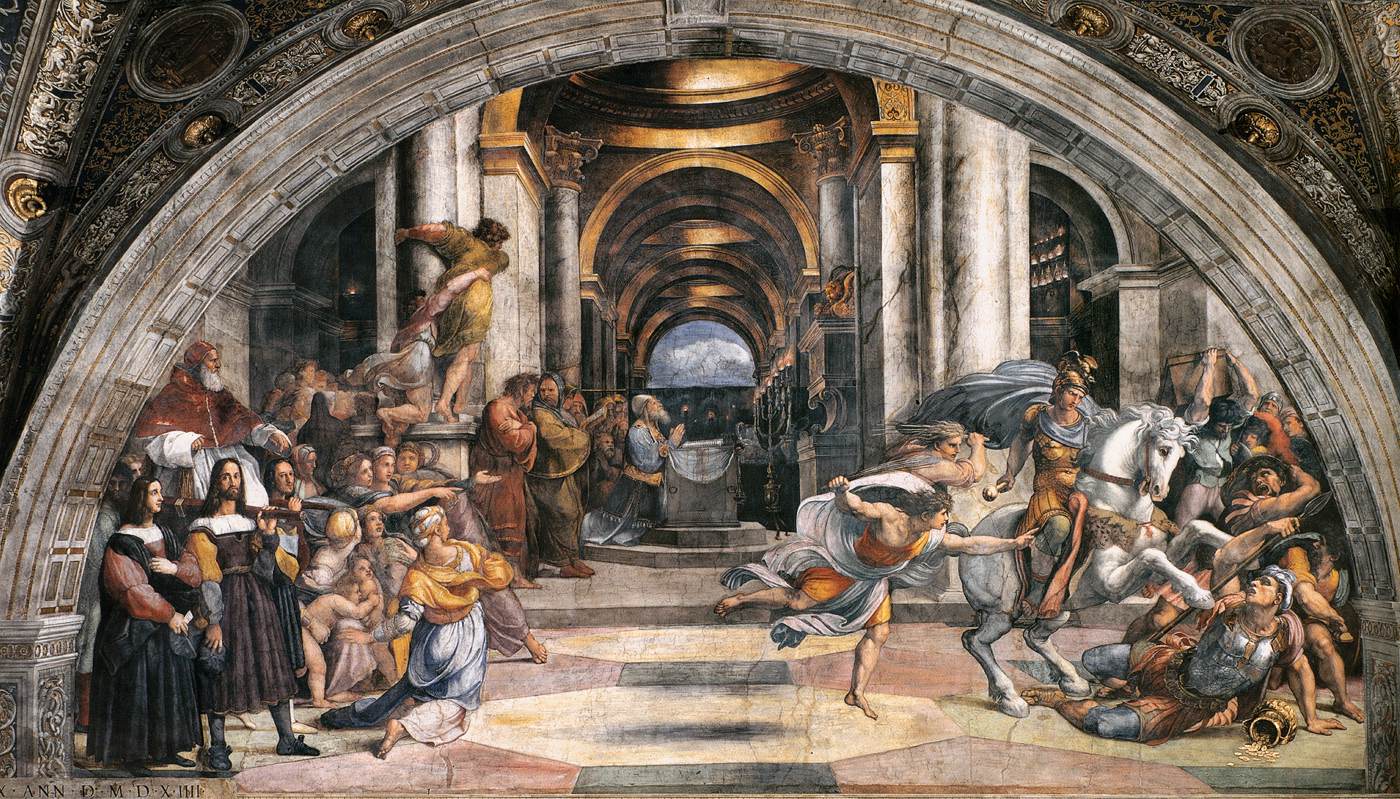
Raphael: The Expulsion of Heliodorus from the Temple2 Maccabees 3
An Attempt to Plunder the Temple
Today’s reading is a story about a man named Heliodorus, treasurer to King Seleucus IVof the Hellenistic Seleucid Empire from 187 to 175 B.C.E. It is also the story of a man named Simon, superintendent of the Jerusalem temple, who argued with the high priest Onias. . . and decided to exact revenge.
There are some important points to consider when we read this chapter.
Footnotes tell us that this book of the Bible is likely a condensation of a many-tome collection of events which occurred just before the Romans took control of the Middle East.
Looking ahead, we can see the story of Simon and his deception does not end. Simon escapes unscathed from this deceitful confrontation but when we move into the Gospels, we know that the corruption we see in this story eventually brings about the fall of the temple. History tells us that this happened about 40 years following Jesus’ death . . . and the rest of the Good News which we know so well unfolds.
The Jewish community was exempt from paying Greeks taxes on all temple sacrifices, and this practice was re-negotiated later with the Romans.
The Jewish community took care of widows and orphans from this temple fund; and wealthy Jews “hid” their money from taxation in this temple fund which was administered well and poorly, depending upon who was in control at the time.
The messages that run through this chapter are important for us today: 1) where we find money, power and fame we will also find treachery, jealousy and corruption, 2) the anguish of the faithful is heard and answered by God, and 3) even those who come to attack us may experience a change of heart.
As we continue our Advent journey, how does all of this speak to us today?
Tomorrow . . . A Prayer for the Plundered
Adapted from a reflection written on January 5, 2008.
In the artist Raphael’s depiction of these angels of God who intervene for the faithful on God’s behalf, we see the mysterious mounted man with his two compatriots on the right as they strike Heliodorus down. http://www.abcgallery.com/R/raphael/raphael37.html
And Mary kept all these things, reflecting on them in her heart.
Pain and happiness. Amazement and worry. Wonder and joy. A gamut of emotions in such a short few days.
Joseph and the child. Shepherds and angels. Innkeepers and oxen. Extraordinary companions for such a new mother.
God says: Mary is wise to ponder all things in the heart. It is from this pondering that she gains wisdom and fortitude. It is in this abiding with me that she discovers courage and patience. It is from her love of me that she finds persistence and hope. When Mary keeps these things in her heart she hides from no one; rather, she gathers a new strength for the journey before her, a fresh perspective of the past that lies behind, and a deep reverence for the holy present. Each moment of each life is as precious as the moment you read about today. Each moment of your lives holds more love from me than you can imagine. Ponder these things in your heart. Reflect on these things in your heart. And remember me.
Mary knows that the road she travels with this special child will be as fraught with problems as her journey to Bethlehem has been. She also knows that the shepherds who arrive in the quiet darkness have sought and found her small family by knocking on many doors in their determined search. Faith, persistence, endurance and courage. As Mary greets her son’s first visitors, she ponders these things in her heart.
A universal enrollment of those living in the Roman Empire is unknown outside the New Testament, and there are further difficulties in pegging the year of Christ’s birth to a specific year; yet this lack of tidy detail has not hampered the story of the Christ Child. Scholars tell us that “It is not by chance that Luke relates the birth of Jesus to the time of Caesar Augustus: the real savior (11) and peace-bearer (14; see also 19, 38) is the child born in Bethlehem. The great emperor is simply God’s agent (like the Persian king Cyrus in Is 44, 28-45, 1) who provides the occasion for God’s purpose to be accomplished”. (Senior 101) The story of this child born in obscure beginnings still reverberates throughout the world today.
God says: Why do you struggle to pin Jesus’ birth to a specific point in your calculation of time when he is eternal in my own time? These are details you need not chase but I understand that there are those among you who crave the feeling of comfort this exactness brings to you. Expand your horizon beyond your small place and strike out to enroll yourselves in your own town which is my own heart. As you journey, remember that the greatest among you are the least, and the least among you are the greatest. Has my own presence among you in the person of Jesus not told you so? Has my own Spirit not abided with you to comfort you and to remind you of my constant presence in your lives? Each of you is precious to me for each of you is my own sweet child. Always remember . . .
The detail of life obscures and fogs our thinking. The big picture draws us away from the many tiny indicators of God’s presence. Somewhere between the large and small is where truth lies and the truth is this: Each of us is a child of God; each of us is precious to God; and each of us makes a pilgrimage to the place we hold as our own. Let us pray that this place is God’s own heart.
We know the story of Samsonand Delilah well. He the child whose birth an angel announces to a barren woman and who is reared with devotion. She a Philistinewoman with the power to bewitch and who uses any means to achieve her goal. When we read this familiar story slowly, we will find many twists and turns left out of the abbreviated version we usually hear, and these turnings will give us the opportunity to reflect on the parts of our own lives that might mirror the fortunes and failures of this complicated story.
We see Samson as the clever solver of riddles who visits harlots, a warrior of incredible strength who wishes to marry outside of his tribe. We see him rise to fame and power and we also see him stumble and fall into a mockery of his former self.
We watch Delilah enter into Samson’s confidence to exact his secret for a price, using any trick or deception to gain the tightly held information. In her campaign to learn about his power, Delilah says to Samson, How can you say that you love me when you do not confide in me?She chooses her words well because Samson took her completely into his confidence and told her.
There is a part in each of us that identifies with both Samson and Delilah. There is betrayal, deception, anger and revenge. And there is also a strength and light that persists despite the darkness.
As we approach the Advent season, a time of year when we celebrate the arrival of a new light into a world of darkness, we will want to prepare ourselves for the gift of truth and openness that Christ brings. With the dawning of this great awakening, let us examine our way of living and resolve to put away any darkness that leads us away from God, and let us welcome the light that is Christ.
Let us petition God for greater fidelity to our covenant promise to walk with Christ.
Let us petition God for deeper courage to remain steadfast inChrist.
Let us petition God for Samson-like strength to choose life that unites and enlightensrather than death that divides and scatters.
Let us petition God for the light that we know will overcome all darkness, no matter how deep, no matter how intense.
And let us remain in this light of Christ always, for it is the only power that overcomes the dark.
Adapted from a reflection written on November 25, 2009.

![the-magi[1]](https://thenoontimes.com/wp-content/uploads/2014/01/the-magi1.jpg?w=300) Click on Midian, Ephah and Sheba to learn more about these places.
Click on Midian, Ephah and Sheba to learn more about these places. 
![Hebrews-6-19[1]](https://thenoontimes.com/wp-content/uploads/2013/12/hebrews-6-191.png?w=300)


![nativity-story-gathering[1]](https://thenoontimes.com/wp-content/uploads/2013/12/nativity-story-gathering1.jpg?w=300)
![images[1]](https://thenoontimes.com/wp-content/uploads/2013/12/images11.jpg)
![I-give-you-my-heart-e1297118791257[1]](https://thenoontimes.com/wp-content/uploads/2013/12/i-give-you-my-heart-e12971187912571.jpg?w=300)

 The Noontimes
