She wrapped him in swaddling clothes and laid him in a manger, because there was no room for them in the inn.
Scowling as we read these words we easily say that we would have offered this small family a room if we had we lived in that place and that time. Yet each day we are offered the opportunity to welcome this small child of hope into a place of rest and refuge that we take time to prepare. Each day we are given the opportunity to offer Christ a place in our hearts and homes.
God says: You prepare for an important sports event, bringing food and party decorations into your home; yet many of my children go hungry. Will you open your hearts and homes to them? You buy and wrap presents, make travel and work plans when a holiday approaches; yet many of my children have no roof under which to shelter. Will you open your hearts and homes to them? You lay down deposits, call family and friends to coordinate a vacation in the mountains, at the beach or in a far-off city; yet many of my children have no families or friends to protect them and no place to shelter from danger? Will you open your hearts and homes to them?
A solitary person can make change in the world when listening to and acting in God.
The Rev. David Buck sits next to the Jesus the Homeless statue that was installed in front of his church, St. Alban’s Episcopal, in Davidson, N.C.
Just one of us can offer a moment of respite, a meal and a place of safety to one who is lost.
The Christ Child and his family call at our door each day.
Do we open our hearts and homes to them? Do we offer this child a room?
A universal enrollment of those living in the Roman Empire is unknown outside the New Testament, and there are further difficulties in pegging the year of Christ’s birth to a specific year; yet this lack of tidy detail has not hampered the story of the Christ Child. Scholars tell us that “It is not by chance that Luke relates the birth of Jesus to the time of Caesar Augustus: the real savior (11) and peace-bearer (14; see also 19, 38) is the child born in Bethlehem. The great emperor is simply God’s agent (like the Persian king Cyrus in Is 44, 28-45, 1) who provides the occasion for God’s purpose to be accomplished”. (Senior 101) The story of this child born in obscure beginnings still reverberates throughout the world today.
God says: Why do you struggle to pin Jesus’ birth to a specific point in your calculation of time when he is eternal in my own time? These are details you need not chase but I understand that there are those among you who crave the feeling of comfort this exactness brings to you. Expand your horizon beyond your small place and strike out to enroll yourselves in your own town which is my own heart. As you journey, remember that the greatest among you are the least, and the least among you are the greatest. Has my own presence among you in the person of Jesus not told you so? Has my own Spirit not abided with you to comfort you and to remind you of my constant presence in your lives? Each of you is precious to me for each of you is my own sweet child. Always remember . . .
The detail of life obscures and fogs our thinking. The big picture draws us away from the many tiny indicators of God’s presence. Somewhere between the large and small is where truth lies and the truth is this: Each of us is a child of God; each of us is precious to God; and each of us makes a pilgrimage to the place we hold as our own. Let us pray that this place is God’s own heart.
Not by appearance shall he judge, nor by hearsay shall he decide, but he shall judge the poor with justice, and decide aright by the land’s afflicted.
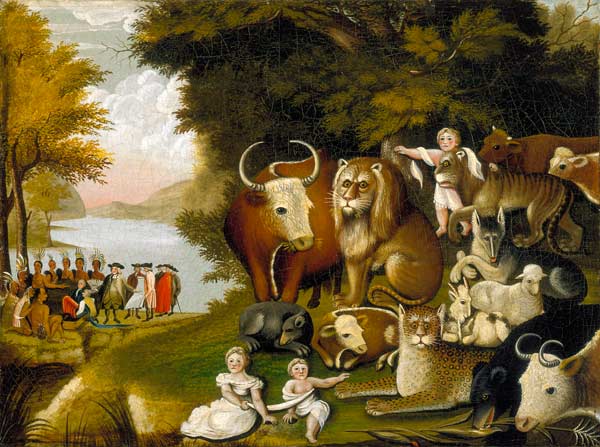
Isaiah shows us a vision of God’s Kingdom and of the world as it might be. We are welcome to paint our own images upon this enormous canvas of hope. The prophet describes a dominion the hunters live peacefully with their prey. A child plays near a venomous serpent; division, harm and ruin have come to an end. Our superficial system of judging and choosing no long functions. God’s justice sees what is in the heart and mind. Our empty gestures are seen for what they are, hollow hope, false hospitality and silly pandering. We forget that those who live on the margins are the closest to God’s heart. When we exclude the poorest among us we exclude Christ.
What might we do to welcome this vision of the kingdom in honesty? How might we welcome Christ as generously as he has welcomed us?
Edward Hicks: The Peaceable Kingdom
Welcome one another, then, as Christ welcomed you, for the glory of God.
Paul speaks to an audience in conflict; his listeners and readers have allowed petty differences to divide them and they have openly ignored the beauty and wealth of God’s offer of this peaceable Kingdom. With clear reason Paul presents his cogent argument: God’s Kingdom is not a club with rules; rather, it is a state of being in which everyone speaks the Language of Love.
How might we examine our own actions and thoughts to root out our pettiness? How might we nurture our growth in God’s Law of Love?
Produce good fruit as evidence of your repentance.
In the end there is one sure way to know if we are hearing, speaking and acting in God’s love: our personal yardstick is the fruit our labor bears. If we call on candor and patient waiting, we will quickly see how much we welcome the Christ in others and how much we exclude.
Do we invite everyoneto learn about Jesus by the way we live? Do we chase away lions and bears assuming that they do not belong in the Kingdom? Do we exclude adders and vipers because we cannot see their potential for change? Do we welcome only those who look and act and believe as we do?
On this Second Sunday of Advent we are welcomed by Christ – along with countless billions – to prepare for his arrival. Let us ready our hearts and our minds to receive the greatest gift of all time and space – the gift of an amazing Kingdom, the gift of unbelievable peace, the gift of Christ’s universal welcome.
When we pray the Liturgy of the Hours we participate in the rhythmic repetition of the morning and evening canticles that we find here in Luke. They – along with the presentation of petition, glorification and thanksgiving through the psalms – give our days and nights a deep sense of tranquility. These times of meditation and contemplation create the pathways through which God speaks. The heart, in this way, willingly readies the soul in hospitality for the reception of the Holy Spirit and the presence of Christ. Prayer cleanses the mind, prepares the spirit and animates the heart for the reception of God’s revelation to us. Nothing can be more important for it is our intentional and incidental prayers that bring us sanity and serenity. These canticles of praise help us to travel through our days, our years, our lives.
No one experiences life without feeling distress and anxiety, and it is when we turn to God – the source of all that is good – that we are healed, lifted up, salvaged and restored. When we allow harm to transform us through our grieving and our trust in God, we find the joy expressed in the canticles we read today. We also find reason to celebrate God’s salvific love.
Champaigne: Visitation The Canticle of Mary or the Magnificat
These canticles sung by Zechariah who finds his voice after the loss of speech, and by Mary, who anticipated greatest joy and greatest sorrow, are meant to carry us from sun up to sun down continually. The canticle of Simeon, which the Liturgy of the Hours designates as part of the Night Prayer, is an anthem of gratitude, and together these songs can bracket our goings and our comings, they can guide our days and nights, they can fill us with hope and trust in God.
When we sit with Jeremiah 20:10-13, Psalm 18, and John 10:31-42we can see how we too might sing canticles of praise for God’s providence as we move from dread to joy.
I hear the whisperings of many: “Terror on every side! Denounce! let us denounce him!” All those who were my friends are on the watch for any misstep of mine . . . In my time of distress I called upon the Lord, and he heard my voice . . . From his temple he heard my voice, and my cry to him reached his ears . . . The Jews picked up rocks to stone Jesus. Jesus answered them . . . “If I do not perform my Father’s works, do not believe me; but if I perform them, even if you do not believe me, believe the works, so you may realize and understand that the Father is in me and I am in the Father”. Then they tried again to arrest him; but he escaped from their power.
The Prophets Simeon and Anna with the Christ Child
And so we pray . . .
God is in his temple and he hears my voice, it reaches his ears . . . we are the temple in which God resides, Father, Son and Holy Spirit.
They tried again to arrest him; but he escaped from their power . . .we have nothing to fear when we walk in the way which is lighted by the light of Christ.
Sing to the Lord, praise the Lord! For He has delivered the soul of the needy one . . .we have everything to gain when we live in God.
As we begin our Advent journey, let us sing these canticles at dawn, at the setting of the sun, and when we lie down to rest. And as we escape from the power of terror’s grip and watch it melt away, let us turn to God in all things, in all ways, at all times . . . and let us sing our canticle of joy. Amen.
Adapted from a reflection written on April 3, 2009.
To explore these songs of praise and what they can mean to us, click on the images above or go to The Liturgy of the Hourspage on this blog.
Once again we have a familiar story which we might take time to read quite slowly, verse by verse. It is the encounter between two waiting mothers, Mary and Elizabeth. Both are astonished at the presence of the child growing within. Mary because she has yet to sleep with a man and all she has to believe is the word of an angel who appeared to her suddenly. Elizabeth because of her advanced years and the words of her husband Zechariah who became mute after an encounter in the Temple. Both women have been irrevocably changed forever and they recognize something new in the other. Both women are open to receive the significance and the full impact of their great encounter. We wonder . . . do they know that for millennia so many of us will read the day of their encounter?
God says: You are constantly meeting important people and yet you do not see that this is so. You are too often expecting to see someone who is famous or wise in the eyes of the world and so you miss the encounters with those who are famous to me. The lonely co-worker who eats lunch alone, the quiet relative who never makes “interesting” conversation, the endless string of people who wait on you in this holiday season. Once you allow your eyes to rest on them, once you smile and pause in the rush of your day . . . perhaps you will see why these people are so special to me. Perhaps you will experience an encounter that will change your life forever.
If we move through our days in happy anonymity, content to let others speak rather than extend and share our own good ideas, we might consider the importance of the encounter we read about today. What salvific news might we be missing when we become part of the background? Do we not carry with us the presence of God? Are we not as important as others? Take time today to consider the power of speaking up and stepping out.
If we take all the space and the air in any room we enter, happy to take over, take charge and take control, we might consider the importance of pausing in our extroverted rush to be known. What salvific news might we be missing when we brush people aside? Do we think that our words speak more loudly than our gestures and actions? Are not the other people in the room as important as or even more important than we? Take some time today to consider the power of listening and observing.
For another Noontime reflection on Luke 1, enter the words The Encounter into the blog search bar and explore.
Hail, favored one! The Lord is with you. Do not be afraid, for you have found favor with God.
We know little about Mary, the mother of the Christ, and yet we know all that we need to know. Mary was reared as a faithful child of God. Mary remained faithful to God throughout the turmoil of her life. Mary remains faithful still as she continues to visit the children of God.
God says: Many of you strive to find favor with friends, loved ones and those with whom you work; yet you only once in a while think of me or think of finding favor with me. I do not ask that you spend an unreasonable amount of your time away from your favorite pursuits or companions but I do ask this – remember me each day for I am the one who has given you time. Bring your sorrows to me each day for I am the one who brings you hope. Rejoice and sing with me each day for I am the one who gives you life.
To find favor with God we might follow the example shown to us by Mary. Let us remain faithful children of God despite the tumult in our lives. Let us bring our fears and sorrows to God who created us. And let us celebrate with God who brings us life.
But now you will be speechless and unable to talk until the days these things take place.
We cavil against God’s plan; we complain about God’s time; we fuss with the details of God’s space and time. And this despite the evidence of God’s love and care that stand boldly and honestly before us. We persist in worrying and hoping to control.
God says: The story of Zechariah may seem a harsh one but when you look more closely you will see another layer. In all those days that Zechariah could not speak he drew nearer to me than he had at any other time in his life. And out of this great restraint and learning comes the beautiful fruit of his knowing my love.
We too frequently see the details of God’s plan as stumbling blocks rather than stepping stones. We too seldom trust that God’s infinite plan brings compassion to all.
The Lord God will wipe away the tears from all faces; the reproach of God’s people the Lord will remove from the whole earth. (Isaiah 25:8)
Listen to the words of the song Speechless by Steven Curtis Chapmanand imagine what we might learn when we cease talking and begin to listen. Imagine the strength of God’s love that leaves us speechless.
Visit the Benedictus page on this blog to reflect on Zechariah’s response to God when his speech returns.
I am Gabriel who stands before God. I was sent to speak to you and to announce to you this good news.
Gabriel appears to Daniel (Daniel 9:21), Zechariah (Luke 1:19) and Mary (Luke 1:26) to announce good news from God. We too want to hear words that lift our hearts as we manage the complexities and challenges of living.
God says: My angels bring you constant messages although they struggle to be heard amid the cacophony of your lives. If you are able to find a regular quiet time – even if for only a few moments each day – when you will draw apart to open the door of your heart to me, you will feel the presence of my angels. You will also feel my own presence within you. How shall you know this? Only come to me . . . and you will know.
The words of Psalm 138 remind us: I thank you, Lord, with all my heart, you have heard the words of my mouth. In the presence of the angels I will bless you . . . I thank you for your faithfulness and love . . . You increased the strength of my soul . . . All earth’s kings shall thank you . . . They shall sing of the Lord’s ways.
How shall we know that God is great?
St. Paul reminds the Colossians: Be thankful. Let the word of Christ dwell in you richly, as in all wisdom you teach and admonish one another, singing psalms, hymns, and spiritual songs with gratitude in your hearts to God.
How shall we know? When we create time for God in our hectic lives, we will come to know.
Enter the word angelsinto the blog search bar and explore.
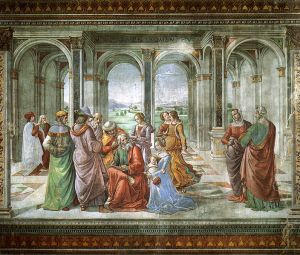
There was a priest named Zechariah who had a wife, Elizabeth. Both were righteous in the eyes of God, but they had no child because Elizabeth was barren and they were both advanced in years. An angel of God came to Zechariah and announced: “Do not be afraid, your prayer has been answered. Your wife Elizabeth will bear you a son, and you shall name him John. And you will have joy and gladness and many will rejoice at his birth, for he will be great in the sight of the Lord. He will turn many of the children of Israel to the Lord their God”.
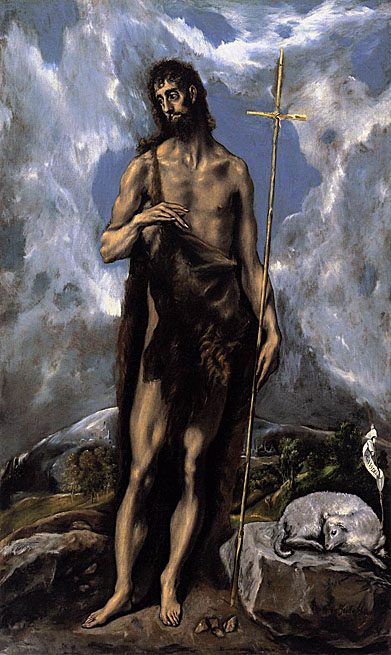
John the Baptist turns many to God. Might we say the same of ourselves?
God says: Each of you is my witness. Each of you has the capacity to call others to my side. The work of witnessing does not require great works. On the contrary, it only requires simple and honest living. Your actions speak far more eloquently than your words so do not worry about what you might say on my behalf. Live your life in fidelity to me. Live your life with integrity in the Spirit. Live your life openly and honestly as Jesus does . . . and this will be witness enough. In this way, your life will be the turning of many to me.
We too often depend on our own resources to do God’s will when all God asks is that we serve as a faithful conduit. We must learn to let God do the heavy lifting, quick thinking, and clever speaking . . . through the authentic living of our lives.
To learn more about John the Baptist, enter his name in the blog search bar and explore.
![3b-adoration-of-the-shepherds-el-greco[1]](https://thenoontimes.com/wp-content/uploads/2013/12/3b-adoration-of-the-shepherds-el-greco1.jpg?w=215&h=300)

![images[1]](https://thenoontimes.com/wp-content/uploads/2013/12/images11.jpg?w=378&h=206)
![I-give-you-my-heart-e1297118791257[1]](https://thenoontimes.com/wp-content/uploads/2013/12/i-give-you-my-heart-e12971187912571.jpg?w=300&h=204)
![jwelcom[1]](https://thenoontimes.com/wp-content/uploads/2013/12/jwelcom1.gif?w=150&h=150)




![images[1]](https://thenoontimes.com/wp-content/uploads/2013/12/images1.jpg?w=329&h=285)