Woe to you, scribes and Pharisees, you hypocrites.
It is too easy to judge others and forget to look in the mirror.
You pay tithes of mint and dill and cumin, and have neglected the weightier things of the law; judgment and mercy and fidelity.
The words come to us quickly: I am too busy. I already know that. This is just the way I am. We cringe when we think we might have to change our perception of self.
Blind guides, who strain out the gnat and swallow the camel!
We fuss with details and avoid authentic conversion.
You cleanse the inside of the cup and dish, but inside they are full of plunder and self-indulgence.
We recognize our sense of entitlement but refuse to move forward in transformation.
Cleanse first the inside of the cup, so that the outside also may be clean.
Jesus is clear. There are steps to be taken. Christ leads the way. There are changes to be made. Do we persist with a lifestyle that is comfortable and known but lacking in judgment, mercy and fidelity? Or do we choose a life of honesty and understanding?
Christ speaks to each of us today of gnats and camels. Christ speaks to us today of honesty and hypocrisy. Christ speaks to us of an opportunity to change. Let us spend some time today with Matthew 23and look for the occasions we have wanted to strain gnats and swallow camels.
For a humorous post on How to Swallow a Camel with No Gnats, click on the image above or go to: http://www.waynestiles.com/how-to-swallow-a-camel-with-no-gnats/
For information on the town of Topheth, the priest Pashur, the gods Baal and Molech, and how Jeremiah’s predictions play out, enter the words The Potter’s Flask into the blog search bar and explore.
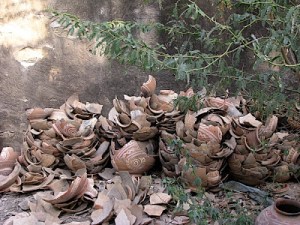
Broken Pottery
Ancient society can be traced through its pottery. Ceramic pots were ubiquitous. They were designed, created and decorated by artisans to hold or carry everything from water and food to medicines and even funeral offerings. For more on this ancient craft, visit: http://www.ancient.eu/pottery/
Today, we spend time with Jeremiah and image of the broken jug.
The Dust of Topheth
The name of Topheth we utter no longer, its singular offering is shame and amazement.
The potter’s flask floats before us; yet we convince ourselves that our walls are exempt.
Our circumstance is special; our creation unique.
So well loved, we cannot stray.
So well nourished, we cannot fall.
The Valley of Slaughter is distant; yet Baal and Molech await first-born offerings with leery eye and eager lip.
Status and wealth build narrow walls against approaching truths.
So well tended, we cannot falter.
So well equipped, we cannot fail.
Prophets raise shadow arms to pronounce sacred words with parched throats while Pashur gathers warm beds against the arriving storm.
Deaf ears and silent hands cast down the potter’s flask where it lies broken with the bones of those who grapple with falling city walls.
So well guided, we cannot lose our way.
So well protected, we cannot perish.
And yet Adonai is near.
In the still of destruction the house of Jerusalem lives in the hearts of the remnant.
Israel breathes yet in the faithful who bore Topheth on exhausted backs and empty bellies.
Stiff necks and hard hearts vanish with the grime of rubble . . .
Leaving the hearts of the faithful to rise in the dust of Topheth.
Why does the way of the godless prosper, why live all the treacherous in contentment? You planted them; they have taken root. They keep on growing and bearing fruit. You are upon their lips, but far from their inmost thoughts.
These questions are raised by each of us as we strive to do what we know to be merciful and right and good while we see the wicked prosper. Jeremiah records God’s Complaint: My beloved has turned on me like a lion in the jungle; because she roared against me . . . many shepherds have trodden my heritage underfoot; the portion that delighted me they have turned into a desert waste, desolate it lies before me . . . they have sown wheat and reaped thorns.
And so we too, question and wait for an answer that makes sense.
God says: This word of “why” is the one you raise to me most often; I know that injustice and darkness pain you as they pain me. If I were to focus on all that is wrong with the world I would have brought it to an end long ago and so I look for the faithful, the good, the merciful and patient. I wait for the persistent, the loving, and the hope-filled. And my watching and waiting is always rewarded. You who gather goodness into my great harvesting barn also gather joy into my immense heart. You who sow compassion and praise in the vineyards where you struggle also sow the tears of my goodness that salve and heal souls. You who wait patiently and keep me constantly in mind abide in my all-knowing mind and rest in my powerful arms. You are never without me. You need never be afraid. You need never wonder why.
We are accustomed to instant news feeds and immediate search results. With the Lord we must be patient. In the Lord we must remain. For the Lord we must persist. Because the Lord is present . . . we need not wonder why.
Reform your ways and your deeds that I might remain with you in this place . . .
Put not your trust in deceitful words . . .
If each of you deals justly with your neighbor . . .
If you no longer oppress the resident alien, the orphan, and the widow . . .
If you no longer shed innocent blood, or follow false gods to your own harm . . .
These are words we hear from God through the prophet Jeremiah sent to us over the millennia. What might we reform? How might we speak less deceitful words? When have we oppressed those living in life’s margins? Who are our false gods? Let us take notice of ourselves, our actions and our surroundings as we pray.
Gentle and Gracious God, you visit us in this place today. We thank you for your presence.
Faithful and Loyal God, you abide with us in this time today. We thank you for your mercy.
Just and Powerful God, you strengthen us when we falter. We thank you for your fidelity.
Compassionate and Generous God, you forgive us when we stray. We thank you for your understanding.
Healing and Loving God, you restore us when we fail. We thank you for your stillness.
Constant and All-knowing God, you bind up what we tear down. We thank you for your wisdom.
We praise you for abiding. We thank you for enduring. We thank you for remaining. Amen.
For more on Jeremiah 7 and words from the mystic Adrienne von Speyron fidelity, enter the word Remaininginto the post search bar and explore.
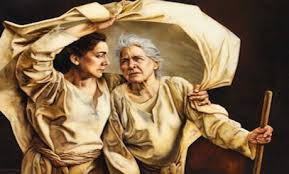
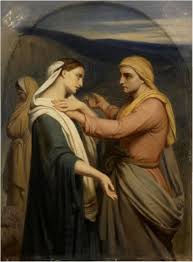
The story of Ruth is a story with characters who “are presented as models who live faithful to the spirit of the covenant even in the difficult situations of life”. (Senior RG 141) It is believed to be a true story and is best read with notes in order to understand the plight of Naomi and her daughter-in-law, the customs of land ownership, the Levirate marriage contract, the tradition of allowing widows to glean food from a harvested field, the remarkable strength of Ruth’s fidelity to her mother-in-law, and the noble loyalty of Boaz who is drawn to Ruth’s kindness and piety. As we have investigated this story, we have thought about how God moves and works through people, is ever faithful and always at hand. Today we can focus on the last verse of chapter 3 when Naomi says to Ruth, “Wait here, my daughter, for the man will not rest, but will settle the matter today”. These words describe true integrity, true honesty, true clarity, and true holiness. This man will not rest until he settles a matter of honor – and he will do this before the sun sets. This man will not let anything stand in the way of doing what he knows he is called to do. This man sets aside his own humanity to do the will of the divine. Again from the Readers’ Guide page RG 145: “The double meaning [of the word for feet or genitals in Hebrew] may be intended to rouse the interest of the audience, ‘to raise a few eyebrows,’ only to show that the unusual steps taken by Ruth [and recommended by Naomi] do not end up in an illicit sexual union, but reveal the honorable character of Boaz. He does not take advantage of Ruth, but agrees to take the necessary steps to marry her. He ensures her reputation is not ruined and sends her away with six measures of barley”.
The marriage of these two honorable people results in the birth of a child, Obed, the father of Jesse, the father of David, the ancestor of Jesus. It is the beautiful story of how people who respond to God’s call can transform tragedy into something blessed and holy. It is also the story of God’s constant presence in our lives as we accompany one another, share our grief, and move toward the light of truth. The action begins with emptiness which is reversed by the end of the tale. “The emptiness of the land (famine) causes Naomi to leave the land. The emptiness of the land gives way to the emptiness of Naomi in the loss first of husband and then sons. Naomi dismisses her daughters-in-law because her ‘emptiness’ cannot be cured . . .” And so she returns home so that she will not be a widow in a foreign place, but not alone. Ruth follows her. Back in Bethlehem, Naomi who finds herself empty of everything that previously had meaning, says the words in 3:18. She recognizes the goodness in Boaz and Ruth and she supports the young woman who waits for the man of integrity to do what he must do to claim her as his wife. Blessings and graces follow.
And so we pray . . .
Good and generous God, make us instruments of your work as were Naomi, Ruth and Boaz. Send us the words to say, the acts to perform, the prayers to raise as we enter the difficult situations of life and the pockets of emptiness around us. Send us your word that we may do your work to bring joy out of mourning. We ask this as always in Jesus’ name. Amen.
This is a beautiful story about women, a happy story about what marriage is meant to be. It is also a story about constancy, fidelity, perseverance, family, ancestry, and a deep abiding love which puts the other before self. It is an image of how we might be with, and in and through Christ. It is a metaphor for the relationship we have already been gifted by our creator.
This is not a long book and still it is saturated with imagery and peopled by characters worthy of any Jane Austen novel or Shakespearean play. “The book of Ruth . . . is one of the most beautiful pieces of literature in the Bible. The plot revolves around family relationships . . . and the role each member plays in fulfilling the needs of other members and hence the family as a whole”. (Meeks 408)
Some of us have families we might turn to; others of us do not. Some of us are born into clans that suffocate us and so we strike out on our own to build community; others find themselves in a large caring tribe that lets no one fall behind during the trek. All of us are born into the family of God and in this family there will be Naomis, and Ruths and Boazes: people who know the value of “loyalty of faithfulness arising from commitment” which in the Hebrew community is known as chesed. Naomi guides her widowed daughters-in-law (women without men were less than human in this era). Ruth abides with Naomi to share whatever destiny comes to them. Boaz preserves both the family inheritance and individual family members in a respectful and considerate way. All three understand the importance to continuity and to the fulfillment of a pledge at cost to self. (Meeks 408) All three listen for and to God. All three find a way to follow God, to preserve legacy, and to further a lineage that produces the Messiah of the human race. And all of this without accepting abuse or losing self.
We might spend some time today with this story and with our own reflection on how we embody chesedas we weave our lives. Do we respect the traditions of the clan? Do we provide for and abide with those who are marginalized? Do we do what is just and merciful even when this may be painful? Do we gather in the harvest at the expense of others? Do we leave the gleanings for those who have none and protect them as they forage? Do we listen for the voice that calls us to strange lands and yet abides? Do we intentionally commit our own acts of chesed? And if so . . . what are they?
The story of Ruth, Naomi and Boaz is a tale about family, integrity, honor, honesty and fidelity. It is also about God’s providence and love; and it is about returning to the covenant relationship we have with God that is marked by “loyalty of faithfulness arising from commitment” which in the Hebrew community is known as chesed. (Meeks 408) If there is time this weekend, read this story from beginning to end. It will warm your heart.
“The book contains a beautiful example of filial piety . . . Its aim is to demonstrate the divine reward for such piety even when practiced by a stranger . . . [Ruth] became the ancestress of David and of Christ. In this, the universality of the messianic salvation is foreshadowed”. (Senior 278)
Today we enter the drama at the point where Ruth, the stranger in this land of the one living God, goes for the first time to glean what she can so that she and her mother-in-law might survive. It is when she is in the field gathering the leftovers that she meets Boaz for the first time. Keeping in mind that a widow in ancient society was considered a burden rather than an asset, we see how well Boaz treats her. He does not take advantage of her diminished status; rather, he seeks to support and protect her from the impure, unwanted – yet legal – advances of others. He cautions her to glean only in hisfields, and he warns off the men who work for him, making certain – as much as he is able – that Ruth might gather enough to support herself and her mother-in-law. He even allows her to glean among the sheaves themselves rather than just the edges of the field. It is clear that he is taken by Ruth yet he does not take advantage of her. In subsequent chapters Boaz fulfills all honor obligations so that he might marry Ruth according to the law and tradition of the time. So we see that “Ruth’s piety . . . her spirit of self-sacrifice, and her moral integrity were favored by God with the gift of faith and an illustrious marriage”. (Senior 278) But first she was widowed, followed her widowed mother-in-law to a new land, and set about doing what she might so that they both might survive.
Ruth does what she must, given what she is given. Ruth gleans where God sends her and in so doing, she harvests more than the ephahs of barley that she takes home to Naomi; she becomes the mother of Obed, the father of Jesse, the father of David, king of the Jews. Ruth appears in Jesus’ genealogy: Boaz became the father of Obed, whose mother was Ruth. (Matthew 1:5).
In the times when we feel widowed, abandoned or alone . . .
In the times when we feel the overpowering burden of providing for self or others . . .
In the times when we feel that we have arrived in a foreign land with new traditions and customs . . .
In the times that we feel exhausted from the gleaning we have done for endless days . . .
Let us remember the goodness and wisdom of Naomi . . .
Let us remember the integrity and protection of Boaz . . .
Let us remember the piety and self-sacrifice of Ruth . . .
And let us remember the merciful justice, the guidance, and the love of the Lord. For these are the things that save.
Meeks, Wayne A., Gen. Ed. HARPERCOLLINS STUDY BIBLE (NRSV). New York, New York: HarperCollins Publishers, 1989. 404. Print.
Senior, Donald, ed. THE CATHOLIC STUDY BIBLE. New York, Oxford University Press, 1990.278. Print.
Adapted from a reflection written on May 18, 2010.
When we consider the factors that move us to risk something of ourselves to act as God asks of us, fear and discouragement might well be reasons that we do not act when called by God. And yet for millennia God has assured us that trust in God’s plan and hope in God’s presence are the hallmarks of the faithful. Over the last few weeks we have contemplated John’s first letter to the faithful. This week we look for the many times that we have been supported and guided as God’s precious children.
Be firm and steadfast; go to work without fear or discouragement, for the Lord God, my God, is with you. God will not fail you or abandon you before you have completed all the work for the service of the house of the Lord. (Verse 28:20)
David reminds the Israelites of God’s fidelity and power; but we can turn to the Torah and the first sacred verses recorded centuries ago.
In Genesis 26:1-3 we hear God speak to Isaac at the time of a famine: Do not go down to Egypt, but continue to camp wherever in this land I tell you. Stay in this land, and I will be with you and bless you.We might remember this and act bravely and hopefully when we believe that making a geographical change will somehow bring us serenity.
In Deuteronomy 31:6 the Hebrew people are about to enter the land they have been promised when Moses reminds his flock: Be brave and steadfast; have no fear or dread of them, for it is the Lord, your God, who marches with you; God will never fail you or forsake you. We might remember this and act compassionately and justly when we believe that remaining with what is familiar is better than moving into what is new.
Tomorrow, the prophets combat fear and discouragement.
Click on the scripture links above and read other versions of these verses; and let us consider how God speaks to us about our fear and discouragement.
Through a series of visions Amos leads us to his central message: we must respond to God’s call to correct the social injustice we see around us. In Chapter 7 we see the core of Amos’ message through a series of visions but it is perhaps his personality that moves us more than the images he describes. Amos displays characteristics we see in Jesus, and these are the same tools we must nurture so that we might be faithful servants of God’s Word: frankness, brevity, an insistence to stay “on message” despite the chastisement and threats received from a corrupt civil, social or religious structure.
Amos refuses to hire himself out, as other prophets do. He resists the urge to say more than Yahweh has told him. He speaks, takes no credit or blame, remains faithful and tenacious, then stands down when his work of prophecy is complete, returning to the productive life he had lived before he stepped into history.
We are each called to be Amos. We are each called to speak in witness to what we know to be truth and light. We each live in the providential care of God. We each have the power of speech and spirit. We each must intercede for our family, friends and enemies – just as Amos does. And then we may return to our work, living the Gospel we know to be true until we are called again by God.
Life lived in this manner becomes less complicated, less frightening, more fulfilling, and more peaceful. Life lived in this manner – even in the midst of painful abuse and dire extremes – is seen as beautiful and serene. Life lived as Amos shows us is life in its proper alignment – we become good and faithful servants doing the work of God. As humble and honest workers, we demonstrate our understanding that God is in charge, that God’s plan will not be thwarted, that God can be trusted to turn all acts of malicious damage into acts of saving love.
This then is the lesson of Amos: Speak when we know we must, listen for the Word always, step forward when called and back when the time for speaking has ended. Act always in God and through God. Remain always God’s willing servant who brings a full and open heart to each day. Trust God . . . and stay out of God’s way.
Tomorrow, a Prayer for Faithful Servants.
Adapted from a reflection written on May 18, 2008.





 The Noontimes