But who can endure the day of the coming? Who can stand firm when he appears?
We humans have a knack for postponing the difficult work needed to more fully integrate ourselves. We see the cautionary road signs, yet continue on our narrow journey without expanding horizons. We ask how long we must wait for rescue. We ask how long we must endure. And God might ask us . . . how long we will delay in rising to the potential God has placed in us.
But who can endure the day of the coming? Who can stand firm when he appears?
The day of reckoning is not some distant past in which we conquer all our anxieties, fears and disasters. The day of reckoning is here in our midst and our God dwells within us to bring joy from our mourning.
But who can endure the day of the coming? Who can stand firm when he appears?
The day of reckoning is not some distant future in which the sheep and goats will divide to the right and the left. The day of reckoning is already upon us and we are asked to put aside animosity and open our hearts to our enemies.
But who can endure the day of the coming? Who can stand firm when he appears?
How do we stand firm when we are overcome with life? We rely on the firmness and healing power of God’s love.
How do we keep our feet on the foundation of God’s fidelity and our dreams in God’s hope? We rely on the authenticity and eternity of God’s love.
But who can endure the day of the coming? Who can stand firm when he appears?
We need not fear a judgment that condemns and destroys. We need only look for God’s presence within . . . and take that presence into the world. This is the life the prophet Malachi calls us to experience.
But who can endure the day of the coming? Who can stand firm when he appears?
We are invited into a disciple’s intimacy with Christ. Jesus offers friendship that is personal, immediate and joyful. Today we remember that Christ is the groom and that we are his bride. And we consider how God’s incredible love calls and binds us together.
John the Baptizer recognizes that his joy increases when he finds union with others in and through Christ.
The Bride and Groom– John 3:25-30: There arose a discussion on the part of John’s disciples with a Jew aboutpurification.And they came to John and said to him, “Rabbi, He who was with youbeyond the Jordan, to whom youhave testified, behold, He is baptizing and all are coming to Him.”John answered and said, “A man can receive nothing unless ithas been given him from heaven.You yourselves are my witnesses that I said, ‘I am not theChrist,’ but, ‘I have been sent ahead of Him.’He who has the bride isthe bridegroom; but the friend of the bridegroom, who stands and hears him, rejoices greatly because of the bridegroom’s voice. So thisjoy of mine has been made full.He must increase, but I must decrease.
Jesus tells us that the union we seek with him – the union we already have if we might recognize it – is the sole source of lasting and satisfying joy.
The Vine and the Branches –John 15:11: These things I have spoken to you so that my joy may be in you, and that your joy may be made full.
Jesus reminds us that his joy is complete in us and that as we turn over the cares of the world to him our joy will increase. Jesus is the vine and we are the branches; he sustains and we celebrate and bear fruit. Our pruning strengthens us and brings us closer to God. Our fidelity and persistence bring us the reward of God’s genuine and enduring joy.
This is the Good News John brings us. Today we might consider how we will share this joy with others.
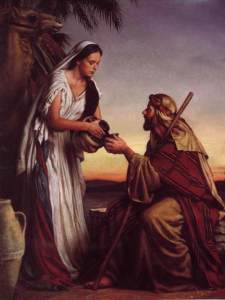
Click on the image of the bride above to learn more about women in ancient times, or visit: http://www.womeninthebible.net/3.2.Major_Events.htm
If this week’s Noontimes call you to search for more ways to encounter Joy or urges you to investigate the New Testament, click on the word Joy in the categories cloud in the blog’s right hand sidebar and choose a reflection, or enter those words in the blog search bar.
Psalm 13:1: Howlong, O Lord? Will you forget me forever? How long will you hide your face from me?
In yesterday’s Noontimewe gathered our prayers and petitions to carry them to the one who holds all the answers. Today we gather ourselves to listen to the Word of God.
Ephesians 2:13: In Christ Jesus you who once were far off have become near.
Paul answers our question of how long we must wait for God to appearwhen he reminds us that Christ answers our plea with unquestioning patience, indomitable mercy and limitless love. Jesus replies swiftly with his own presence, and with his invitation to join him in his union with the creator. Today we gather ourselves to hear the Word of God.
Luke 10:1-9: The Lord Jesus appointed seventy-two other disciples whom he sent ahead of him in pairs to every town and place he intended to visit. He said to them, “The harvest is abundant but the laborers few . . . Go on your way; behold, I am sending you like lambs among wolves. Carry no money bag, no sack, no sandals; and greet no one along the way”.
God answers our petition for help by asking us to trust in the plan laid out for our rescue. Today we gather to accept God’s invitation to join in the vital work of the harvest.
Psalm 94:3: How long shall the wicked, O Lord, how long shall the wicked exult?
We have asked how long our suffering will endure . . . and the response to this question is not a pat answer that tells us how many days or weeks or years or eons we must wait for God’s justice to prevail. A close reading of the Gospels tells us what we already know. In the person of Jesus we have all the answer we might need. In our finite world we look for finite solutions and well-defined answers that content us for today, but that have no place in God’s infinite world. In our apocalyptic view of the world we seek a justice that will measure out punishment and reward as if we were all small children, but God asks us to step into something much bigger than the little window we have on the God’s justice.
Psalm 13:1: Howlong, O Lord? Will you forget me forever? How long will you hide your face from me?
God does not hide from us. God is with us constantly and everywhere in the person of the rescuing Jesus. God does not forget us. God is within and around us in the person of the healing Spirit. God does not lose hope in us. God protects and guides, cajoles and upholds, saves and teaches, heals and loves us more than we can understand. Despite our faults and infidelities, God persists in waiting, calling, blessing, forgiving and loving.
Psalm 74:9: We do not see our signs; there is no longer any prophet, nor is there any among us who knows how long.
There is no need to ask how long; there is no need to despair for we already have God’s response . . . the surety that God dwells within us, asking for our trust and fidelity, forgiving our missteps and misgivings, calling us to great love and great mercy. In our darkest moment and in our deepest grief . . . God has not been distant or hiding. God has been quite near.
Let us move into the world around us . . . and act in a way that confirms our trust in God.
In 2015, Oxfam produced a study indicating that next year one percent of the world’s population will hold more than half of the world’s wealth. The hungry, the impoverished, the homeless may well ask How Long of God as they manage their daily survival. Read the two views at the links below, and reflect on how each of us might be the presence of God to the marginalized.
The Book of Psalms calls us to praise God and during this first week of Advent we will focus on the power of the psalms in a number of ways: to connect us with God as sisters and brothers in Christ, to give us a healing pathway on which to carry our lament to the Spirit, to call us together as we praise and honor the creator God, and to offer us more examples of how God’s joy calls forth a great shout.
Click on the scripture links and explore other versions of these verses. Share an idea about the surprise of joy in the dark places and times in our lives with a loved one, a neighbor or friend. And allow the surprise of joy to brighten each day as we move forward in the season of hope-filled waiting for the arrival of the Christ.
Psalm 51verse 8: Let me hear the sounds of joy and gladness; and though you have crushed me and broken me, I will be happy once again. Do we acknowledge that God’s joy calls goodness out of harm?
Psalm 65verses 8-13: You have always been my help, Lord. In the shadow of your wings I sing for joy. You show your care for the land by sending rain; you make it rich and fertile. You fill the streams with water; you provide the earth with crops. The pastures are filled with flocks; the hillsides are full of joy. Everything shouts and sings for joy. Are we willing to see all of creation as God’s shouts of joy?
Psalm 66 verse 1: Praise God with shouts of joy, all people! Do we share the good news of God’s fidelity, hope, love and joy?
Psalm 68verse 3: But the righteous are glad and rejoice in his presence; they are happy and shout for joy. Do we willingly come together as community to share the news of God’s goodness?
The story of Judith is full of danger and violence counterpointed by fidelity and great rejoicing. Today we discover that despite grave danger, joy is present. If today’s story calls you to search formore surprises, click on the word Joy in the categories cloud in the blog’s right hand sidebar and choose a reflection, or enter the word Joy in the blog search bar. You may also want to visit the Joy for the Journey blog atwww.joyforthee.blogspot.comto see how joy surprises you there. Today we find joy in miraculous deliverance.
Judith’s story is not included in all versions of the Bible because it is regarded by some to be an historical novel rather than sacred word. Others see is as a kind of allegory in that the name Judithis the feminine form of the word Judah. Still others point to anachronisms and decline to regard these words as inspired. In any case, the story holds is one of consequence, and one in which we see God’s deliverance of the faithful from the most extreme of circumstances. It is a story to which we will want to attend.
Artemisia Gentilischi: Judith and the Maid-servant with the head of Holofernes
If you did not have time to read the introductory chapters, move through them today – if even only quickly. The opening pages of the book prepare us for the dreadful middle and the joyful end. They put us in a time and place we will recognize as much like our own. They will give us a firmer footing from which to view this story, a stronger reason to hope as Judith does, and a clearer image of the desperation and joy she experiences.
Verse 14:9: When she had finished her story, the people cheered so loudly that the whole town echoed with sounds of joy.
Is there a Judith among us who quietly moves forward through God’s plan and surprises us with an outrageous act of hope? Are we the unobtrusive Judith or almost unseen handmaiden who turns history on its head in a surprising way? And when God intervenes withand inus in such startling ways, do we recognize the presence of the Spirit in our hour of desperation?
Verse 15:9: When they arrived, they all praised her, “You are Jerusalem’s crowning glory, the heroine of Israel, the pride and joy of our people!”
Do we recognize the Judiths among us and if so, do we value their quiet persistence and determination? Do we perhaps see ourselves in the gritty and resolute actions of these women? And when God intervenes with and in us in such surprising ways, do we give thanks and honor to the Living God who is in and with all who find joy in great peril and outrageous deliverance?
For more details and insights about the encounters between Judith and Holofernes, visit other Noontime reflections by entering the wordJudithinto the blog search bar.
The story of Judith is full of danger and violence counterpointed by fidelity and great rejoicing. Today and tomorrow we discover that despite grave danger, joy is present. If today’s story calls you to search for more surprises, click on the word Joy in the categories cloud in the blog’s right hand sidebar and choose a reflection, or enter the word Joy in the blog search bar. You may also want to visit the Joy for the Journey blog at www.joyforthee.blogspot.comto see how joy surprises you there. Today we find joy in great peril.
The opening chapters of Judith’s story set a scene of violence, intrigue and power. War begins. An ultimate is delivered. An enemy is defeated and a council takes place to assess plans and possibilities. Ninevehand Ecbatana are now at the center of this drama, but Nebuchadnezzarrages against more than Persia. He lays out a secret plan to take revenge on the entire world, and once these plans are complete he sends for his general Holofernes. These events bring forth images from our daily newscasts that we might recognize in our modern world. Who would suspect that the town of Bethuliaand the little-known widow, Judith, would turn the Assyrian power structure on its head? How might each of us, in our own infinitesimal way, have an effect upon the wider world? How might each of us find joy amid the peril that surrounds us?
Artemisia Gentileschi: Judith and her Maidservant
Verse 10:3: She took off the sackcloth and her widow’s clothes . . .Judith turns away from her inner grief and turns outward to the world. So might we.
She took a bath, and put on rich perfumes . . . Judith enters into an intentional plan brought forward through prayer. So might we.
She brushed her hair, tied a ribbon around it . . .Judith prepares herself as herself and not as another entity with grandiose ideas. So might we.
She dressed herself in the fine clothes she used to wear on joyful occasions when her husband Manasseh was still alive . . . Judith moves forward in the only way she knows how. In fidelity. In trust. In faith. In hope. So might we.
In Chapter 9 we find The Prayer of Judith, beautiful, honest verses of petition from one who is so small against gargantuan obstacles. If we spend some time with these words today, we might better understand how Judith calls forth the joy she had once known to find joy in great peril.
For more Noontime reflections about this woman’s story, enter the word Judithinto the blog search bar and explore.
Today we continue to visit with scripture to look for stories about joy that will surprise us in a variety of ways. If you want to explore other stories in which joy astounds us, click on the word Joy in the categories cloud in the blog’s right hand sidebar and choose a reflection, or enter the word Joy in the blog search bar. You may also want to visit the Joy for the Journey blog atwww.joyforthee.blogspot.comto see how joy surprises you there. Today our story is from the Book of Samuel.
Too often the high points in our lives are followed by turmoil and darkness brought on by jealousy. My dad always warned us that as we move up the ladder of life to become more proficient in the workplace we may also become targets for office gossip and suspicion. But, he added, we cannot allow this to affect either our work or our relationships. Rather than frighten us, Dad meant to arm us with the knowledge that joy is accompanied by suspicion, and we see truth play out with David today when he returns from slaying the giant Goliath to be greeted with both great joy and deep suspicion. If we spend time with these verses, we see that success may breed its own kind of darkness. It is up to us to decide how we will react. It is in our power to look for joy hidden in the dark recesses of suspicion.
Verses 6-9: It happened as they were coming, when David returned from killing the Philistine, that the women came out of all the cities of Israel, singing and dancing, to meet King Saul, with tambourines, with joy and with musical instruments. The womensang as they played, and said, “Saul has slain his thousands, and David his ten thousands.” Then Saul became very angry, for this sayingdispleased him; and he said, “They have ascribed to David ten thousands, but to me they have ascribed thousands. Now what more can he have but the kingdom?”Saul looked at David with suspicion from that day on.
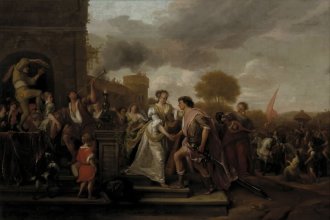
Jan Havicksz, Steen: David’s Triumphant Return
Suspicion, gossip, jealousy, envy. These are the slippery steps that David navigates with God’s help. Later in his story, David succumbs to temptation that ruins the lives of many, but his actions bring us hope when we understand that even God’s anointed will err.
Fidelity, trust, hope, love. These are the footholds we look for in the face of the mountain we climb. We find joy even in the darkest of places when we rely on God’s providence, God’s wisdom and God’s love.
Visit 1 and 2 Samuel if you have time over the next few hours to put today’s Noontime into context.
Enter the words, Saul, David, envyor jealousy into the blog search bar and explore. Discover ways in which God’s quiet joy is always with us, even when we lest expect to feel its presence.
Click on the Steen image above for more information about this story of triumph, suspicion and ultimately joy.
For more about anxiety and joy, click on the image above or visit: http://riselikeair.wordpress.com/2014/01/09/anxiety-joy-a-journey/
In today’s citation Jesus attempts to instruct the Sadducees about resurrected life, telling them that they have missed the Mosaic message and promise. The Sadducees were members of a priestly family descended from one of David’s high priests, Zadok. King Solomon gave this group supreme control over the Temple and they came to form one of the ruling parties of Judaism from the time of the Hasmonean Dynasty around 146 BCE to the destruction of the Temple in 70 ACE. They stood on the religious authority presented in the first five books of the Bible, The Torah, and were highly conservative; yet despite this leaning, the Sadducees were open to the Greek culture and may have been willing to sacrifice their beliefs for wealth and power. They took special exception to the belief in the existence of angels, resurrection, and life after death, beliefs held by the Pharisees, a religious reform movement that began in the century before Christ’s birth emphasizing fidelity to Jewish law through an elaborate system of oral laws that bolster the written Mosaic Law. This movement found its base in the local synagogue where scriptures and traditions were studied, and a strong sense of piety was nurtured. It is into this world of closely held ideas and tightly fought intellectual battles that Jesus comes to the poor and disenfranchised to turn the world order on its head.
St. Paul was a Pharisee who zealously defended the Jewish faith before becoming the feet of Christ to take the message of spiritual freedom into the world. Both the Pharisees and Sadducees jealously guarded the influence they had with the occupiers of their land; but we see without much effort the dichotomy between priestly sect and lay people, between temple and synagogue, between strict conservatism that sees the path to God through the temple sacrifice conducted by priests and the lay movement seeking to invigorate faith through instruction and fidelity to the Law. Both groups saw Jesus as a threat . . . for he came to set the faithful free from narrow constraints and corrupt hierarchies. Jesus reminds us repeatedly that there is indeed, a true path to God, but it is open to all. It charges no Temple tax and it requires only that its followers work in God’s vineyard to build God’s kingdom. The Temple is now Christ who lives in each of us. The Law of Moses is now fulfilled by the Law of Love that Jesus brings. The only tax we need pay is our allegiance to a loving God who welcomes all to the feast. And we will miss all of this if we are not watching for the resurrection that lives with and for and in us each day. When we focus on self, we become protective of all that we have built up like the Sadducees who question Jesus. We miss the truth that God uses each of us in God’s way to build The Kingdom that heals and saves. We miss the truth that Christ reveal to and in each of us . . . and we find that we have become easily and greatly misled.
Tomorrow, waiting for the resurrection . . .
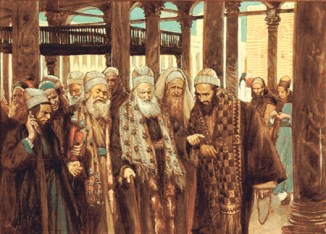
For insights into Luke’s story of how Jesus interacted with his accusers, click on the image above or go to: https://www.lds.org/manual/print/new-testament-student-manual/introduction-to-the-gospel-according-to-st-luke/chapter-20-luke-23-24?lang=eng
Senior, Donald, ed. THE CATHOLIC STUDY BIBLE. New York, Oxford University Press, 1990.Glossary 433 and 436. Print.
Adapted from a reflection written on November 22, 2008.
We become so occupied with news of the day and the obstacles we see in our lives that we struggle to find a half hour to be still with God. Sometimes we look for little pockets of silence in the tumult of schedules and appointments. When we arrive at the end of our day, we may sleep more easily if we set time aside to commune with the Lord. The book of Jeremiah still lies open before us. If we turn to Chapter 23 we see the gift of promise almost hidden in this prophecy of doom; we find hope in the darkest of places. Destructive pastors and restorative pastors. Which are we?
Each of us is called as “pastors over God’s sheep that they shall feed them,” and to the extent that we are able, we hope to shepherd those placed in our care with integrity, authenticity, truth, wisdom, fidelity, mercy and compassion. As much as we are able, we are likewise called to bring comfort to the troubled stranger, to offer peace to the enemy, to bring God’s presence everywhere we go and to all whom we meet.
In this way, may we all move toward forward in restoration in Christ. In this way . . . we become an integral part of the Messiah promise.
Enter the word promise into the blog search bar and explore ways in which we might bring hope to our troubled world.

 We need not fear a judgment that condemns and destroys. We need only look for God’s presence within . . . and take that presence into the world. This is the life the prophet Malachi calls us to experience.










 The Noontimes