Psalm 17:6 – I call upon you, O God, for you will answer me; incline your ear to me and hear my words.
It is so difficult to hear God’s voice above the clamor of the world. It is so easy to forget that for God all things are possible. We must be persistent in telling God our woes, insistent in letting God know how we feel and what we seek. We must continue to call on God . . . for God is our only hope.
God says: I see how frustrated you become with the big and little worries of your life; I see how your burdens wear you down. You have called on me and I hear you. I am responding to your plea but you are so worried that you cannot hear my words of peace. You are so anxious that you cannot feel my healing touch. I incline my ear to you . . . I touch your heart . . . just as you touch mine.
God listens to us more than we believe. God speaks to us more than we think. God loves us more than we imagine.
Psalm 30:13 – My heart sings to you without ceasing; O Lord my God, I will give you thanks for ever.
In all circumstances, either sorrowful or joyful, give thanks to the Lord. He has done great things for me; he keeps his promises and fulfills his word.
God says: I do not let you down, I am with you always. I do not change my mind; I am constant love. I do not bully or neglect you; I wait until you move toward me . . . and then I run to greet you with an overflowing heart and open arms. My love takes you in, washes away anxiety, allays fears and sends away all that threatens you. If you rest in me you need nothing else. Trust me and sing with me.
Hoping that God’s lullabies take away all that terrifies you.
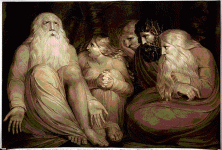
Commentary from La Biblia de América:Job continues in his search for a personal encounter with God, both seeking and fearing him; but the judgment of his companions does not speak to his condition. Job finds himself bereft not because he has broken God’s law in any way. His sins do not bring him to this spot of desperation; he suffers innocently from circumstances beyond his control. Yet amid all of this hurt, Job refuses to reject God; indeed, he seeks God all the more with each new wave of pain. Job actually takes refuge in his suffering, frightened and even terrified, waiting for his end. He describes an impotence which we ourselves may feel at a time when we are abandoned and have no recourse. We suffer while the wicked experience success. A victim of bad luck and injustice, Job experiences a reality too awful to be concealed. Further footnotes tell us that verses 18 through 25 have appeared here rather than where they may rightly belong – in a previous chapter – perhaps the copyist could not bear the pain and so thought to bring consolation from another place.
This lament of Job guides any and each of us through a wave of pain so intense that it nearly takes one’s breath away. This level of suffering can only be healed by God . . . and it is upon God that Job calls.
Today’s reading asks us to think about our desire to see and know God . . . face to face. Job’s unquenched yearning is void of any wish to exact punishment or revenge on anyone or anything. Job questions. Job fears. Yet Job does not leave God perhaps because he knows that God has not left him.
The imagery today describes a dichotomy of longing accompanied by fear. Job needs to experience God’s presence in his life . . . and he fears that perhaps he will never escape this place of emptiness where the wicked have full sway. He survives in a twilight world where day and night co-exist, and he fears that the darkness will win out.
As we have observed, perhaps it is for this reason that a later copyist has inserted the words which we know Job believes because they hold truth and because they describe what Job does . . . he refuses to give up, he holds on to hope and he waits.
To him who rises without assurance of his life he gives safety and support.
When we find ourselves in the pit of misery described by Job, we must remember that the force of our yearning will be met, matched, and exceeded by God’s love . . . for he is life itself.
To him who rises without assurance of his life he gives safety and support.
A re-post from May 9, 2012.
LA BIBLIA DE LA AMÉRICA. 8th. Madrid: La Casa de la Biblia, 1994. Print.
Keeping each of you in prayer while I am away from electronics. Holding you in prayer at noon each day.
We gather our worn flesh and our broken bones. We take one last look around us at the weariness, poverty and darkness in which we find ourselves . . . and we prepare for restoration.
Just when we believe that we escape all that terrifies us, we learn again that life holds no guarantee. Just when we believe that we escape our worries and anxieties, we learn again that eternal life is a promise on which we can rely.
When we use the scripture link and commentary to explore this book, we discover that there is no guarantee that we will not suffer; but there is a guarantee that the light of God’s love will overcome the darkness to bring us new life.
We know that Judges is the book in the Old Testament that takes us from the time following the death of Joshua through several hundred years of leaders, or judges, who include Gideon, Deborah and Samson, to the time of Jesse, father of David. It delineates the story of a people struggling to understand themselves and one another, a people who constantly cycle through a loop of straying, repenting, returning, and forgetting. The last verse of the book speaks about the attitude of the people regarding not only their civic relationship with one another, but also their spiritual relationship with God. In those days there was no king in Israel; everyone did what he thought best.We reflected on this idea several days ago, saying that this is a sentiment we might apply to our contemporary times as we watch events unfold over which we have little and no control. It seems that in all ages we humans . . . do what we think best. We also see God’s reaction to human waywardness: God allows the weeds to grow up with the wheat.
A number of years ago I came across a painting in the National Gallery’s Pompeii exhibit. It showed maenads, those who stir themselves to frenzy with wine and orgy, and who sink so low that they tear apart their own children. They are the famous Bacchae of Dionysus, the distraught female followers of this god of wine who exacts revenge on any woman who will not submit to his will. This Dionysus is the antithesis of the God of Israel. This pagan god takes what he wants for his own satisfaction, and his followers are too exhausted to see the truth of his and their existence.
We are constantly faced with a choice in our lives because God grants us the freedom to either follow in The Way or to strike out on our own, to enact love or to deaden our senses with the wine of self-pleasure and self-gratification.
The painting by Sir Lawrence Alma-Tadea entitled The Women of Amphissa shows the exhausted maenads as they awaken the morning after a night of mad running through the hillsides in rapacious, orgiastic delight. We can see their numbness to the light and to life. The local townswomen protect them and arrange for them to be returned home unharmed; but the damage has already been done, and they remain powerless, forever in the grip of Dionysus. They cannot escape from his cruel delight in watching them destroy others. They have no God who loves them enough to sacrifice himself in redemption of their souls. There is no Christ who refuses to leave his faithful to do what they think best.
Our God, the God of the Twelve Tribes, the one God of all of us here is not a God who holds us bound by the secrets or the dark debauchery that surround us. Our God does not destroy with threats, but rather calls us to grow amid the weeds through faith in God’s own hope and love. Ours is the God who forgives many times and constantly. Our God welcomes those who witness and turn to goodness. Our God does not chain us, does not bind us, does not force us into relationships, and does not take revenge. Our God brings light, and truth and redemption. And this God asks us to behave in like manner. God sets us free to search for God’s goodness with our whole heart and our whole soul, to love or to turn away. Our God is always hoping that when we dowhat we think best, we will respond in joyful hope to the call of light and truth and authentic, unencumbered love.
Adapted from a reflection written at the close of 2008.
The story of Ruth is a tale of fidelity, self-sacrifice, moral integrity, faith, and divine reward for piety. The people we read about today are in Jesus’ family tree and as always, with God, the message is clear when we look and listen: If something is bound to happen, no one can intervene, and if something is not going to happen, no one can cause it to happen . . . except God. God is in charge.
This story shows the proper covenant relationship between the Creator and the created. God is always present – yet in the background. We who are made in God’s image are called to act as God does, with fidelity, compassion and persistence. We see God take action through people who respond to his call and in this way God’s actions are mediated by his people.
This story shows how tragedy can be transformed when we allow ourselves to serve as conduits for God’s love to a waiting world. It also shows how God is actualized in the lives of the faithful. Scholars point out that the story of Ruth is very much a story of Judges in reverse. She is a woman from a pagan nation whose people battled against Israel but Ruth forsakes her little gods of Moabto faithfully serve the Living God, Yahweh. Matthew includes Ruth in Jesus’ genealogy to remind us that God’s ultimate plan is to include diverse nations in his family tree. Ruth is in many ways what Israel was called to be. And she is also what we are called to be. Faithful, trusting, persistent, loving, and always returning home.
Ruth and Naomi return to Bethlehem at the start of the barley harvest – a harvest that plays an important part in the story that is unfolding – and the town celebrates this return. Recalling that women without men were less valuable than animals in these ancient times, we can only be in awe of their courage in the face of tragedy, their obedience in the face of impossibility, and their trust in the face of overwhelming odds. Ruth and Naomi return to Bethlehem, and in so doing they return to God. As we pause in our Jeremiah journey, let us consider the value of this homecoming.
Adapted from a reflection written on August 14, 2007.
 Psalm 17:6 – I call upon you, O God, for you will answer me; incline your ear to me and hear my words.



 The Noontimes