Isaiah 55:10-11: Just as from the heavens the rain and snow come down and do not return there till they have watered the earth, making it fertile and fruitful, giving seed to him who sows and bread to him who eats, so shall my word be that goes forth from my mouth; it shall not return to me void, but shall do my will, achieving the end for which I sent it.
God gives us great gifts – and asks that we use them well.
Jesus tells us parables of unfaithful and faithful stewards who abuse or use well the office with which the master entrusts them – and we see ourselves somewhere in these stories.
The Spirit moves us to act on the word we hear – and we are free to deny or respond to God’s call.
God creates us in God’s image – and asks that we go forth to represent God in the world.
Jesus models God among us – and calls us to follow him.
The Spirit lives within each of us – and manifests God’s word to the world.
We receive great gifts – and are asked to do much with them.
We aregreat gifts – and we are asked to share.
What nourishment do we bring to others? What sustenance do we provide to others? What action do we take as we achieve the end for which we are sent?
Jesus has spoken to his own generation and he speaks to ours.
I urge you, by the mercies of God, to offer your bodies as a living sacrifice, holy and pleasing to God, your spiritual worship. Do not conform yourselves to this age but be transformed by the renewal of your mind, that you may discern what is the will of God, what is good and pleasing and perfect. (NAB)
Paul reminds us that our own generation lures us to sleep if we are not watchful.
So here’s what I want you to do. Take your everyday, ordinary life—your sleeping, eating, going-to-work, and walking-around life—and place it before God as an offering. Embracing what God does for you is the best thing you can do for him. Don’t become so well-adjusted to your culture that you fit into it without even thinking. Instead, fix your attention on God. You’ll be changed from the inside out. Readily recognize what he wants from you, and quickly respond to it. Unlike the culture around you, always dragging you down to its level of immaturity, God brings the best out of you, develops well-formed maturity in you. (THE MESSAGE)
We might call one another to holiness, to newness of the heart, to openness of the mind.
I beseech you therefore, brethren, by the mercy of God, that you present your bodies a living sacrifice, holy, pleasing unto God, your reasonable service. And be not conformed to this world; but be reformed in the newness of your mind, that you may prove what is the good, and the acceptable, and the perfect will of God. (DOUAY-RHEIMS AMERICAN)
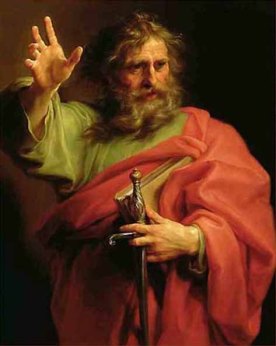
A 17th Century depiction of Paul writing his epistles
We step outside of that familiar place where we begin as children, come to age as adolescents and form our conscience as adults. We examine our fears, our motives, our addictions and our loves. We take stock of our resources. We rest in God. When we examine our own generation, what do we have to say for ourselves? What do we have to say about this age?
When we use the scripture link and drop-down menus to examine other translations of these verses, we begin to see humanity’s march toward union in Christ.
I have stumbled upon this reflection written after a summertime visit to the beach. It seems appropriate again in this springtime when so many hearts grow weary from the news of a troubled world, to return to the basic truth that we will continue to struggle to live together until we agree to live in harmony with God.
After spending a number of days with children and grandchildren who love to vacation at the ocean together in a jumble of towels, wet bathing suits, games, snacks, sleeping bags and favorite toys, I marvel again at how these families can come together to find a common way of approaching life’s small and big obstacles. They do not do my will or their own; they return to what has brought them together in the first place and they act in accord with the values they hold in common. They know their origin and they know their worth. They know that when they live in harmony with something greater than themselves that sees only good, they cannot fail to enjoy one another’s company. As I open scripture today, I am grateful for this gift we hold in common and I am thankful for an opportunity to reflect on how we bloom as humans when we try to live a life of harmony with God.
John 7 is “a discrete literary unit, with a clear beginning point at 7:1 where the locus of Jesus’ activity is discussed. The episode reaches a culmination with the appearance of Nicodemus and the official rejection of Jesus in Jerusalem. Unlike chap. 6, chap. 7 has few points of contact with the Synoptics [Gospels of Matthew, Mark and Luke] . . . Chapter 7 is a carefully constructed narrative containing dialogue”. In this chapter we see the “deadly intent” of Jesus’ enemies. “The Jews who are there seeking Jesus (v.11) are apparently hostile and to be distinguished from the crowds of people who are divided but for fear of the Jews keep quiet (vv. 12-13); on the motif of the fear of the Jews see 9:22; 12:42; cf. 20:19)”. (Mays 969)
In verses 14 through 31 we see “the characteristic attempt to explain Jesus on the basis of inadequate knowledge of his origin (cf. 1:46; 6:42). Jesus immediately sets matters straight (7:16). That Jesus’ will is in complete harmony with God’s has already been stated (6:38); now the very recognition of the fact is said to depend upon the intention to do God’s will. As Jesus’ unity with God is a unity of will, unity with Jesus depends on a similar unity with God’s will”. (Mays 970)
We see the official response in verses 31 through 52. The authorities, believing that they are the chosen people who have entered into a covenant with God mediated by Moses, do not believe Jesus to be the Messiah. Jesus’ acts and words are viewed as divisive, in this sense, because they do not coincide with the acts and words of the leadership and so . . . “The division over Jesus among the Jewish people falls more or less along the lines between officialdom and general populace”. (Mays 971)
We know how this story ends, with Jesus praying in the garden that his task might pass him by, but with Jesus’ will in complete harmony with God’s.
We know how this story ends, with Jesus suffering as the sacrificial lamb, yet with Jesus’ will in complete harmony with God’s.
We know how this story ends, with Jesus rising from death to live again, and with Jesus’ will in complete harmony with God’s.
We know how this story ends, with Jesus sharing his transformation with those who have eyes to see and ears to listen, with those who hope to live as Jesus does, striving to bring their will into harmony with God’s.
Mays, James L., ed. HARPERCOLLINS BIBLE COMMENTARY. New York, New York: HarperCollins Publishers, 1988. 969-971. Print.
The New Testament brings us the good news that God has come to live among us, has died as one of us and has risen from the dead as one of us. Paul tells us that with Christ there is always hope when we sink into doubt, light when we walk in darkness, and joy when we suffer sorrow.
Paul speaks to the Romans two thousand years ago, and he also speaks to us today. His life as a disciple was difficult and yet Paul shares with us the great joy he experiences in his travail.
The apostle Paul says: For the kingdom of God is not a matter of food and drink, but of righteousness, peace, and joy in the holy Spirit. (Romans 14:17)
God says: Theworld of corruption, greed and warfare is the kingdom as you have constructed for yourselves. When you live in me this world becomes one of righteousness, peace and joy. I know that this is difficult for you to believe but just one of you can make a difference; and if two or more of you come together in my name, your light will pierce the darkness.
The follower of Christ, Paul says: May the God of hope fill you with all joy and peace in believing, so that you may abound in hope by the power of the holy Spirit. (Romans 15:13)
God says: The life of sadness, pain and sorrow is the life you have fashioned for yourself. When you place your days and years in my hands you live the potential I have dreamed for you. If you are overcome, seek help. If you are overwhelmed, find others who are determined to live in peace rather than revenge. If two or more of you gather in my name, your prayer converts harm to good.
The sharer of Christ’s work and work, Paul says: I urge you, by our Lord Jesus Christ and by the love of the Spirit, to join me in the struggle by your prayers to God on my behalf,that I may be delivered from the disobedient, and that my ministry may be acceptable so that I may come to you with joy by the will of God and be refreshed together with you. The God of peace be with all of you. Amen.(Romans 15:30-32)
God says: The struggles you experience are opportunities to discover new strength in one another and in my Spirit. The ministry you live is a new opening to life in Christ. The prayer you offer is reliance on my strength and fidelity. When you bring me your sorrows and your fears you step into the depths of my love . . . you become one in your brother Christ, and you rise to live again in the Spirit, converting the pain of the world to celebration. Come, and follow me . . .
Today Paul speaks to us to bring us the hope and joy and word of God. Let us set aside a bit of time tonight before the close of this first day of the new year to decide how we will respond. How will we share with others the good news that the depths and heights and breadth of darkness will always be overcome by the light of Christ’s joy? How will we strengthen ourselves and others in Christ?
If this week’s Noontimes call you to search for more ways to encounter Joy or urges you to investigate the New Testament, click on the word Joy in the categories cloud in the blog’s right-hand sidebar and choose a reflection, or enter those words in the blog search bar.
It is human nature to avoid or reject anything which challenges us to move out of our comfort zone. We may want to eliminate from our lives anything which makes us re-think an idea, an issue, or a long-held perception of a person. We may want to circumvent any conflict or idea that challenges the status quo or asks us to open our minds to a new concept. Peter tells us clearly that suffering can actually be good for us when we suffer according to God’s will – not according to some trial we create for ourselves out of our own stubbornness, pride or envy.
In our prayer time this weekend we might want to examine our desire to remain comfortable to determine if our trials are truly in line with Peter’s idea in verse 19: those who suffer in accord with God’s will hand their souls over to a faithful creator as they do good.
From this morning’s Liturgy of the Hours in MAGNIFICAT: God’s faithful constancy is an anchor in an ever-shifting world, where love declared today is spurned tomorrow, and all other certainties are blown away by the wind.In the end, God is all there is and all there need be.
May we find fidelity as the keystone of our relationship with our faithful creator.
May we remain constant even as we learn to shift ourselves out of our comfort zones.
May we do good today and every day as we hand our souls over to the will of God in accordance with the covenant we hold together.
Cameron, Peter John. “Prayer for the Morning.” MAGNIFICAT.14.3 (2007). Print.
A re-post from October 5, 2013 and adapted from a reflection written on March 14, 2007.
Enter the word suffering into the blog search bar and spend some time with the concept of suffering.
The quote in the image above is credited to Neale Donald Walsch, the author of the “Conversations with God” series. The image is from Breathe Out.com at: http://www.breathe-out.com/?p=306
Commentary tells us about Micah 5:4: “This passage, expressing confidence inJudah’sability to deliver itself fromAssyria, is in contrast with the preceding messianic oracle, which ascribes deliverance to the Lord and his agent. Some believe that here the prophet is quoting the words of the defiant men of Judah. The shepherds and men of royal rank are one and the same: warriors capable of routing Assyria”. (Senior 1144)
If this is the case, we might take this opportunity to reflect today on the importance of doing God’s will rather than our own. Easily said, possibly done . . . and done only when we give ourselves over in humility.
Last evening I again had a conversation with a friend about the simplicity of God’s plan: Step 1 – We acknowledge our complete dependence on God. Step 2 – We establish regular communication times with God. Step 3 – We listen. Step 4 – We do what God asks of us.
We know the un-fussiness of this kind of relationship with God when we hear about it in the words of others who always have words of wisdom when cataclysm strikes.
We know the cleanness of this kind of relationship with God when we see it in the actions of others who roll easily into serenity when thrown against an obstacle.
We know the clarity of this kind of relationship with God when we begin to fold ourselves into God’s plan rather than our own.
We know the peace of this kind of relationship with God when we put aside all else to spend our regularly appointed time with God.
There are no short cuts. There is no bravura. There are no quick answers. There is no magic bullet. There are no secrets. There is no club, no group, no party, no onewho satisfies, protects and sustains as does our simple relationship with God.
Micah calls us to this today when he throws our words back at us: I can do anything. I can tough this out. I can go it alone. I can gather my sympathetic friends. I can get away with this. I do not have time for prayer right now. I will think about God later, just now I have my hands full.
Our hands are full because we do not take this fullness to God. Our time is clipped and things are urgent because we believe that we must raise up an army of royal shepherds against the invasion of our plans.
When we believe that our confidence comes from ourselves and not from God, we can make a sure prediction – as does Micah regarding Judah. All of our plans and all of our desires will be abolished as surely as the craven images and sacred poles we read about today. When we come to the end of a road and there is no apparent way to go, it is time to take the confidence in self that we have so carefully nurtured, place it in God’s hands, listen, and then act as directed.
Senior, Donald, ed. THE CATHOLIC STUDY BIBLE. New York, Oxford University Press, 1990.1144. Print.
Written on March 20, 2010 and posted today as a Favorite.