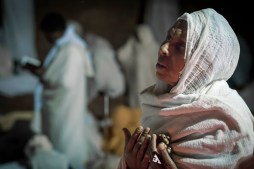
Today we reflect on the message God gives to Moses through the medium of the burning bush that never burns; and over the next days, we will spend time reflecting on how God communicates with us the enormity and the mystery that is God’s love for us.
God said, “I am who I am. You must tell them: ‘The one who is called I Am has sent me to you.’ Tell the Israelites that I, the Lord, the God of their ancestors, the God of Abraham, Isaac, and Jacob, have sent you to them. This is my name forever; this is what all future generations are to call me”.
“I am who am”.
What does this simplest of phrases mean for us? That all of creation announces God. That all of humanity comes from this source.
“I am who am”.
What might this simplest of phrases hold for us? God’s promise that we are never alone, and never abandoned.
“I am who am”.
What might this simplest of phrases portend for us? That we have nothing to fear and everything to expect.
“I am who am”.
Today as we contemplate God’s gift of self to each of us, we spend time with this simplest of phases as we reflect on its meaning and promise.
In Chapter 12 of Genesis, we hear God’s call to Abram: Leave your country, your relatives, and your father’s home, and go to a land that I am going to show you. I will give you many descendants, and they will become a great nation. I will bless you and make your name famous, so that you will be a blessing.
Today we ask ourselves if we are willing to leave all that we know in order to move toward an unseen promise. Do we have faith that God truly calls us as God called Abram? Do we believe in the hope of God’s covenant? Do we share God’s Spirit with open and giving hearts? In today’s Noontime reading, we move further into Abram’s story and we rest in the verses that tell us how and why Abram becomes Abraham. We hear the familiar words describing how and why Sarai becomes Sarah. And we ask . . .
Are we willing to step forward into the unknown as we follow God’s call? Do we anticipate the joy of the journey as we discover new places, times and peoples? Do we act with Christ’s mercy? Do we live in Christ’s joy? And like Sarah and Abraham, are we willing to leave the comfort of Ur?
We move toward the Easter promise, standing on the rejected cornerstone, stretching forward in hope. The story of Jesus’ transfiguration reminds us that the promise is real and tangible. Hope is justified.
We have not depended on made-up stories in making known to you the mighty coming of our Lord Jesus Christ. With our own eyes we saw his greatness.
As he witnesses the transfiguration, Peter says to Jesus, Rabbi, it is good that we are here! Let us make three tents: one for you, one for Moses, and one for Elijah.Jesus asks his followers to hold their mountaintop experience in their hearts until he has risen from the dead. Mark records these words:[Peter] hardly knew what to say, they were so terrified. Although at first they kept the matter to themselves, questioning what rising from the dead meant, the disciples later recounted the encounter. Today we benefit from Peter’s witness.
We were there when he was given honor and glory by God the Father, when the voice came to him from the Supreme Glory, saying, “This is my own dear Son, with whom I am pleased!”
Jesus climbs the mountain to examine his coming exodus. (Matthew 17:1-13, Mark 9:2-10, Luke 9:28-36). We journey through Lent in expectation of our own encounter. Peter witnesses to the event of Jesus’ transformation. We witness our own makeover in the possibility that Easter opens for us so that we too may say . . .
We ourselves heard this voice coming from heaven, when we were with him on the holy mountain.
Peter witnesses boldly for us. Are we willing to witness for others today?
These verses are the GOOD NEWS TRANSLATION BIBLE. When we compare other versions of these words, we – like Peter – do not rely on made-up stories. And we discover ways to share our own story of faith and conversion with others.
Over the last month we have sung a hymn in time of national struggle, we have argued with the Almighty, gone beyond human limits, reflected on narcissism and considered what we might learn from the story of Esther. Today we settle into these verses from Paul’s letter to the Corinthians.
Even though on the outside it often looks like things are falling apart on us, on the inside, where God is making new life, not a day goes by without God’s unfolding grace.
In the midst of turmoil, there is the promise of renewal.
These hard times are small potatoes compared to the coming good times, the lavish celebration prepared for us. There’s far more here than meets the eye.
Despite the pain that feels eternal, hope rises with the promise of restoration.
The things we see now are here today, gone tomorrow. But the things we can’t see now will last forever.
Although our fears bring us insurmountable anxiety, we have the assurance of transformation.
God puts a little of heaven in our hearts so that we’ll never settle for less.
In all times and in all places, in all sorrows and in all joys, God’s grace remains. Once we recognize this, we never settle for less.
When we compare this translation of today’s reading with others, and when we weigh our troubles with the promise of the covenant, we know that each day God’s grace brings us more than meets the eye.
Yesterday we assessed the narcissism we might discover in ourselves and how unilateral listening governs our world circumstances. Today we reflect on how Esther and Mordecai operate in their world – and what we might learn from them.
It is clear that Haman is consumed by envy of Mordecai and while we cannot analyze this character from a Biblical story, we can certainly learn from his actions. It is also clear that Esther – as a woman but especially as a Jewish woman in a non-Jewish court – fears for her life, and the life of her nation. The kingdom of Xerxes is an ancient one in which individual rights are denied to most. We might believe that we as a species have evolved and it is true that in general, we have. However, many peoples in our modern society have no benefit of personal rights. When this happens, we might speculate, it is often the result of someone, or some group, behaving in a narcissistic manner. Navigating these troubling conditions is difficult at best. What does the story of Esther have to tell us?
Queen Esther answered, “If it please Your Majesty to grant my humble request, my wish is that I may live and that my people may live”.
Humility is usually an ineffective tool against brutality; it seems to encourage even more violence. Yet, here we see that despite her humble behavior and words, Esther acts in order to save a people.
“If you keep quiet at a time like this, help will come from heaven to the Jews, and they will be saved, but you will die and your father’s family will come to an end. Yet who knows—maybe it was for a time like this that you were made queen!” (Esther 4:14)
On Wednesday when we explored Chapter 4, we considered Martin Neimöller’s advice that if we do not speak against evil and injustice, we guarantee not our safety, but our sure demise. Despite their fear, Esther and Mordecai form a solidarity of two as they begin a quiet, patient assertion of justice and truth.
An article from Psychology Today gives us guidelines to manage the effects of narcissism. These experts advise that we evaluate both our surroundings and the narcissist to look for context, that we maintain a firm sense of purpose along with a sense of humor, and that we remain realistic about how much we can accomplish when working with the self-centered. If we are in dangerous surroundings, controlled by a persecutor as Esther and Mordecai are, we begin by turning to God and finding others with whom to form solidarity. We move forward with patience, reliance on the Creator, persisting in hope, and acting in mercy.
Tomorrow, fighting back.
When we read varying translations of this story by using the scripture link and the drop-down menus, we find an opportunity to transform a world beset by narcissism.
Today we hear a portion of Esther’s story that resonates with humans in every age. Mordecai puts on sackcloth and ashes as he mourns an impending holocaust. He warns Esther that her future is in danger whether she takes action or not. He reminds her that her thinking that there is safety for her in the palace is a false one. And he suggests that perhaps she is queen for precisely this moment in history. His words force her into action once she realizes that inertia only invites evil. Apathy or disinterest are no protection against malicious intent.
Do not think that in the king’s palace you will escape any more than all the other Jews. For if you keep silence at such a time as this, relief and deliverance will rise for the Jews from another quarter, but you and your father’s family will perish. Who knows? Perhaps you have come to royal dignity for just such a time as this.
We will celebrate Ash Wednesday in a few weeks when we will wear ashen crosses on our foreheads at the beginning of the season of Lent. As we move toward that day and time, we will explore our own role in human history, and we will examine our own fears and hopes. We pause in our journey through Esther to reflect on words from the 20th Century.
From the Holocaust Encyclopedia site: “Martin Niemöller (1892–1984) was a prominent Protestant pastor who emerged as an outspoken public foe of Adolf Hitler and spent the last seven years of Nazi rule in concentration camps”.
First they came for the Socialists, and I did not speak out—
Because I was not a Socialist.
Then they came for the Trade Unionists, and I did not speak out— Because I was not a Trade Unionist.
Then they came for the Jews, and I did not speak out— Because I was not a Jew.
Then they came for me—and there was no one left to speak for me.
A Catholic nun uses ash to mark a cross on the forehead of a child in observance of Ash Wednesday at The Redemptorist Church at suburban Paranaque city south of Manila, Philippines Wednesday, Feb. 18, 2015. Ash Wednesday marks the start of the Lent, a season of prayer and fasting before Easter. (AP Photo/Bullit Marquez)
Both Mordecai and Niemöller invite us to examine our hearts. Esther invites us to consider our response to God’s call.
Tomorrow, an invitation.
Who celebrates Ash Wednesday? Click on the image of the woman and child receiving ashes to learn more.
Visit the United States Holocaust Memorial Museum to learn how Niemöller dealt with his own anti-semitism: https://www.ushmm.org/
At Christmas time several years ago, we reflected on Esther 3 as a preamble to the Jesus story. The coming of light. A voice asking for mercy. Justice amidst corruption. The presence of simplicity in a complicated world. Plots and schemes returning to haunt their authors.
As the story unfolds, we see our own modern headlines in the verses. Millennia later, what have we learned?
Bulletins were sent out by couriers to all the king’s provinces with orders to massacre, kill, and eliminate all the Jews—youngsters and old men, women and babies—on a single day, the thirteenth day of the twelfth month, the month Adar, and to plunder their goods.
We sift into groups that exclude. We gather words and weapons to assault “the other”. Millenia later, where do we invest our resources?
There is an odd set of people scattered through the provinces of your kingdom who don’t fit in. Their customs and ways are different from those of everybody else. Worse, they disregard the king’s laws. They’re an affront; the king shouldn’t put up with them. If it please the king, let orders be given that they be destroyed. I’ll pay for it myself. I’ll deposit 375 tons of silver in the royal bank to finance the operation.
We shrink from corruption. We turn away because we believe we have no power. Millennia later, how many Hamans stalk the innocent?
At the king’s command, the couriers took off; the order was also posted in the palace complex of Susa. The king and Haman sat back and had a drink while the city of Susa reeled from the news.
We gather in solidarity. We welcome and heal. Millennia later, what is our story?
Tomorrow, one small woman.
When we compare varying versions of these verses, we open ourselves to seeing “the other”.
To read three posts on Esther 3, enter the word Preamble into the search bar and explore.
We cannot leave this book of wisdom without pausing to confront the evil that sets this story into motion. If we have time today, we will want to listen to an On Being conversation hosted by Krista Tippet with Rabbi Sarah Bassin, and Imam Abdullah Antepli. The discussion is entitled Holy Envy, and it opens a method for confronting evil in our world.
Once again the sons of God came to present themselves before the Lord, and Satan also came with them.
The image of evil hiding among faithful servants is an unsettling thought. We go about our work or we rest in fallow time, trusting that all will be well, hoping to be children of light rather than the dark. The image of Satan lurking among the holy ones might unnerve us enough to re-examine the opening chapters of this story so that we might see a few details we have previously ignored. Satan reports that he has been patrolling his domain – – – the earth; yet God expresses confidence in the faithful, patient Job.
We do not like to think about evil, and we too often turn away when it enters the comfort zone we have carefully set up for ourselves. Usually we believe that we must avoid evil at all costs, or we believe it is a force that only God can handle. Because we feel powerless, we may not spend much time thinking about what evil is or where it comes from. Yet we must take it seriously while at the same time not allowing it to paralyze us.
Several summers ago, I read a fascinating novel about how the devil takes up residence in our hearts almost without our noticing. The Angels’ Gameis a remarkable story and well worth reading. The author, Carlos Luis Zafón, deftly weaves a tale that at once terrifies and holds us in dreadful yet delicious anticipation of what we know the end to be when we align with malignancy. The story is terrifying in that the reader does not feel God’s presence specifically; rather the reader finds goodness in individual people and from literature itself. In Zafón’s tale, God is found in books and stories, and there is a spell-binding quality to the plot. As I closed the last page, I gave thanks for being in a well-loved vacation place with well-loved and loving people. The force of goodness and God-ness through them put my mind at ease. And it is this goodness and God-ness that Job brings to us today. Job’s fidelity and faith not only make him a target of the envious devil, they also save him. And so we are left to reflect . . .
Once again the sons of God came to present themselves before the Lord, and Satan also came with them.
God is so good that God does not banish Satan from his presence.
God is so good that God does not allow Satan to have the last word.
God is so good that God rescues, saves, heals and restores.
Job puts all of his trust in this God.
Job refuses to bow to social pressure and to pretend that he is guilty of something he has not done.
Job speaks directly to God, and argues with God, asking for answers.
Once again the sons of God came to present themselves before the Lord, and Satan also came with them.
We must not fret about evil, yet we must not forget its presence. When we find ourselves up against one who is a fallen angel, we cannot think that we, on our own, can win against the overwhelming power of Satan. We must place all of our faith, all of our hope, and all of our trust in the Lord. Only this one has the power to convert the aftermath of evil into the goodness of love. Only this one has the compassion to love us beyond the arguing.
Adapted from a reflection written on July 22, 2009.
I once heard a homily on Job 1:6 in which we discover that Satan/Lucifer has to “cover himself” with light. He sneaks into the midst of the holy people in order to be in God’s presence. Yet, God sees him there and asks him where he has been and what he has been doing. Satan replies that he has been on earth, roaming and patrolling. The homilist pointed out that we, God’s adopted children, can come freely into God’s presence but that Lucifer, also known as the Morning Star, has to sneak in when the holy people enter. In other words, the homilist tells us, Satan is going to hang out with people who are clearly doing God’s work and who have free and ample access to the Lord.
Satan brings woes upon Job and for a while, Job is stunned because he does not understand this punishment. His wife tells him to curse God and die; his friends advise him to confess his wrongdoing so that the evil will leave him. Still puzzled, Job feels alone, and these beautiful words in 23:10 describe how we might also feel as we struggle with unwarranted suffering. “I would learn the words with which [God] would answer and understand what [God] would reply to me . . . yet [God] knows my way; if [God] proved me I would come forth gold.”
Still, Satan does not give up and he tries to dupe Job into cursing God. Job thinks that he is no longer in God’s presence; but God has never left him, just as God never abandons us. Satan, in his arrogance and conceit, finally leaves Job alone and goes off to bother someone else. Job continues to worship God from his lonely place, and he continues to make the case with his friends that he is innocent – which he is.
Job is finally rewarded for his argument with the Almighty when God speaks. And like Jesus, The Word Among Us, God replies to our cry for help with questions rather than answers. “Where you there when I created the earth? Are you going to be my critic?”We might think this a cruel response to one in deep pain; but on reflection, we see God’s goodness. It is impossible for Job – or for us – to comprehend creation’s enormous plan. It is alarming for Job – or for us – to see the enormity of our complex universe. It is a colossal challenge for Job – or for us – to react to evil as God does, with an open, forgiving heart.
When we argue with the Almighty as Job does, we – like Job – will want to reply to our living God, “I know that you can do all things, and that no purpose of yours can be hindered.” (42:2) God rewards Job – and us – mightily for being the good and faithful servant who asks questions and argues from a clean heart. With this reward comes fresh hope, new wisdom, and the courage to come forth gold. This a story we will want to ponder, a story we will want to share, a story we will want to argue once again with the Almighty.
Adapted from a reflection written on February 6, 2007.