We lament the world’s injustice. We search for wisdom in the prophets. We struggle to live the Word of the Gospel. We await a Messiah.
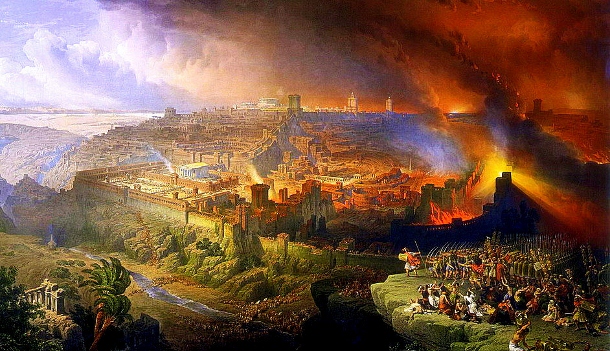
As Jesus drew near Jerusalem, he saw the city and wept over it, saying, “If this day you only knew what makes for peace – but now it is hidden from your eyes”.
Jerusalem is the celebrated site of God’s presence among the Jewish people – yet Jesus laments her blindness.
“For the days are coming upon you when your enemies will raise a palisade against you; they will encircle you and hem you in on all sides”.
The holy Temple contains the Ark of the Covenant – yet Jesus predicts the day when all will be lost.
“They will smash you to the ground and your children within you, and they will not leave one stone upon another within you because you did not recognize the time of your visitation”.
The people of God cried out for a king. God answered their prayer. Yet they did not recognize that God already lived among them.
Let us decide to address the world’s injustice. Let us listen to the wisdom in the prophets. Let us determine to live out the truths of the Gospel. And let us choose to recognize the Messiah who dwells within.
On this Easter Sunday that holds so much promise after a year of pandemic fear and social unease, we acknowledge that although the Temple of Jerusalem fell, it rose again in the body of Christ. We recognize the wisdom of the prophecy of Amos. We celebrate the limitless mercy of the Messiah.
The child grew and became strong, filled with wisdom; and the favor of God was upon him.
Last week we spent time with Luke’s telling of the Nativity Story and in our reflections we explored four Lucan themes: the rearing of Jesus in the Mosaic Law and traditions, the importance of Jerusalem and the Temple in Jesus’ family life, the presence of God’s Spirit in the Jesus story, and Jesus as the presence of truth and light that will effect decision and judgment. (Mays 932)
God says:When you experience my son in this story you too will be filled with wisdom and light. When you live in my Spirit you too will find your decisions come to you more easily for they will be made in and through me. I do not want to control you and that is why I have given you full free will. I want to love you, and I want you to love me. Jesus lives by the old law in order to bring about the new. This is not easy and it involves misery and disappointment; yet this sadness is transformed just as a butterfly arises from the cocoon spun by a caterpillar; new life springs from the decaying seeds of the old tree, and eternal life arrives through the fidelity and integrity of your relationships. Remain in me as I remain in you. Allow yourself to be filled with my wisdom and light. And allow my favor to bring you out of all suffering and pain.
As the child grows strong and becomes filled with wisdom, so too do we grow in strength and understanding when we grow in God. As God’s favor rests upon the Child of Wisdom and Light, so too does God’s favor rest on each of us when we live and work in the Spirit. As we move through this holiest of weeks, let us open our hearts and minds to the gift of endless light and life.
Mays, James L., ed. HARPERCOLLINS BIBLE COMMENTARY. New York, New York: HarperCollins Publishers, 1988. 932. Print.
Rembrandt van Rijn: The Presentation of Jesus in the Temple
Simeon
Now there was a man in Jerusalem called Simeon, who was righteous and devout. He was waiting for the consolation of Israel, and the Holy Spirit was upon him. It had been revealed to him by the Holy Spirit that he would not die before he had seen the Lord’s Christ.
Righteous, devout, awaiting the consolation of Israel . . . Simeonfocuses all of his spiritual, mental and physical energy on God. We imagine what sort of award awaits us when we determine to live as Simeon lives.
He came in the Spirit into the temple . . . Not only does Simeon live in the Spirit but he carries this Spirit with him wherever he goes. We imagine what effect we might have on the world if we are as faithful as Simeon.
“A second Lucan theme lies in the setting: Jerusalem and the Temple. For Luke the ministry of Jesus moves toward Jerusalem and the mission of the church moves out from Jerusalem. As for the Temple, Luke is alone among NT writers in is favorable view. His Gospel begins with Zechariah in the Temple and it will close with Jesus’ disciples in the Temple”. (Mays 932)
In this Advent time of year when all the world awaits relief from a pandemic, and when we await Christ’s coming into the world, let us consider the many directions in which we feel ourselves pulled, the many losses we feel, and let us determine to await Christ in the temple of our hearts. Let us decide to take the story of our salvation to the world.
We visit the book of Jeremiah often in our Noontimereflections; it is a rich and complex prophecy. Jeremiah is so frank, honest, and open about his suffering. Chapter 33 is particularly lovely and holds much promise about healing after punishment.
This prophecy might prove difficult for those among us who are addicted to turmoil and conflict or to the control of others and our surroundings. Jeremiah speaks of reliance on God who loves dearly and intensely, tenderly and passionately. Through Jeremiah, God announces a desire for our own personal freedom so that we might freely choose to be in relationship with God. Whether we suffer or celebrate, God wants to dance in intimacy with us.
Call to me and I will answer you, and will tell you great and hidden things that you have not known.This quiet instruction from God speaks of the closeness and confidence of our relationship. We have only to ask. God will answer. Like the faithful spouse.
Verse 9: Then Jerusalem shall be my joy, my praise, my glory, before all the nations of the earth, as they hear of all the good I will do among them. They shall be in fear and trembling over all the peaceful benefits I will give her.The prophecy of Jeremiah is not only a faithful prediction of what will happen to King Zedekiah, to the city of Jerusalem and the kingdom of Israel, it is a foretelling of the Christ story and it is the story of our own ransom and redemption.
God wants only freedom for us so that we might have the option to choose to love and follow. Christ arrives to bring us this freedom from slavery and darkness. The Holy Spirit abides with us constantly, whispering this promise to us repeatedly.
When we seek freedom from all that haunts us, we only need turn to a forgiving and loving God. This is where real and lasting love lies. This is where eternal sustenance and strength lie. And this is where the undying and sure promise of God’s presence and movement in our lives will always lie. This is the freedom God willingly gives. God’s promise to us is this great. God’s love for us is this persistent and ever-lasting.
Adapted from reflections written on January 1, 2007 and April 28, 2010.
The nameless woman returns to her city and as her foot touches the threshold . . .This is a story which tells of the two kings of the split kingdom of David – Israel with her king Jeroboam in the north and Judah with her king Rehoboamin the south. Notes, websites and histories can give us a visual of the lineages and a few are listed below.
What we miss when we read history without scripture is the detail, and we have it in abundance in this short chapter. There is the child, Abijah, the two kings, the wife who is not named and Naamah, the mother who is. There are other ancillary characters. http://bible.cc/1_kings/14-1.htm
We can put ourselves in the timeline and in the space to try to see, hear, smell and hear these sights and these people . . . but what strikes me is this . . . this is a story which might happen to any one of us. And who am I?
Am I the nameless wife and mother who fears the death of her child? Am I married to the son of Solomon who finds his kingdom split? Am I the besieged king or the aggressor, the shield maker, the guard, the prophet, the chronicler? Do I have a loyalty to the north or south? Do I believe Jeroboam to be maligned or do I know him to worship idols? Do I follow Rehoboam blindly or do I question? In this vivid picture . . . Where am I? Who am I? What am I doing?
We know that Jeroboam feared re-unification of these split kingdoms because he would no longer collect the temple worship taxes which he now did since setting up his own capital. We know that Rehoboam, son of Solomon, scrambled to keep these two territories united, fearing invasion from Assyria, Persia, Egypt and others. We know that one king was buried with honor and the other was not. And we know why.
I have such empathy for the nameless woman in this story. She dies as she is bidden yet she is powerless before these men and apparently before her God. She moves like a shadow.
I also have empathy for the woman Naamah whose son leads Judah to do evil in the sight of the Lord. What does she think of the cult prostitutes the leadership has encouraged? Does she agree that they are a means to worshiping God? Does she dare to speak if she disagrees?
What do these women think? What do they say? What do they hold dear?
Today’s story calls us to think of our journey . . . do we travel light . . . do we travel alone . . . where do we stop along the way . . . what waters and feeds us?
The nameless woman in today’s story is told that her child will pass away as she returns home . . . so in that moment she knows that she will not see him again. What does she feel?
The nameless woman in today’s story returns to her city and as her foot touches the threshold . . . her child dies. What does she say?
The nameless woman in today’s story sees her child buried . . . with all of Israel mourning. What does she pray?
Oh, Father in heaven, spare us from the tragedies which are too hard to bear. Save us from the people from whom we might suffer irreparable damage. Keep us always close to you. Protect the ones we love. Save us from harm. Feed us. Nourish us. Be our column of smoke and fire and protect us on our way as you did the Israelites who journeyed out of slavery and into freedom with you always guiding. Alert us to the dangers. The noise of this world is sometimes so overwhelming. Sound the alarm when we stray. Hold us closely. You are our rock and our refuge. We give thanks to you, our awesome God. Amen.
Written on January 13, 2008 and posted today as a Favorite.
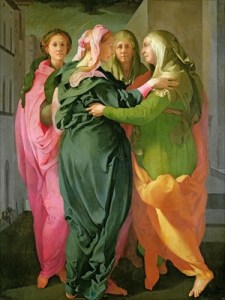
In yesterday’s Gospel reading of Mary’s visitation (Luke 1:39-45) with her cousin Elizabeth we heard again the familiar story of how the child John leapt for joy in his mother’s womb, knowing that the Redeemer was near. The pre-Messiah era was drawing to a close and these two women alone knew what the rest of the world would in time discover. The old way was about to be swept into a raw newness. The present laws of the One God with whom these people lived in covenant were about to be superseded by the Law of Love. These two women greeted one another; one was quite young and at the beginning of her life, the other was beyond child-bearing years and yet heavily pregnant. These two women shared the Good News that would be shunned by some and believed by many. Elizabeth would bring to life the child John who would announce the great coming. Mary had become the New Ark of the New Covenant.
Within you is my true birthplace.
The Jewish people into whose traditions and customs the young Jesus was born believed that God dwelt in the great Temple in the holy city of Jerusalem. Today’s Noontime reflection reminds us of how much God loves his holy city the gates of Zion, more than any dwelling in Jacob (Israel). And from this city the people of God were divided and sent into exile. As this Diaspora lived for centuries in scattered places they mourned the loss of their center, their core. When the city and Temple were later restored they made long pilgrimages to this holiest of places. The entire focus of this people rested in this one sacred site. This people saw their origin and their destiny as rising from this one hallowed place: the Jerusalem Temple.
Within you is my true birthplace.
When the angel Gabriel announces to Mary the coming of the Spirit upon her he also announces the changing of all the world knew and understood about God, and yet this change had been predicted by Judaism’s own prophets. When Mary agrees to become the Ark of the New Covenant she knows that the world will never be the same. We might wonder how much she understood the scope of this change. From her humble smallness, did she fully comprehend the effect her son would have on the history of the world? Might she have completely grasped the depth and breadth of his coming? Did she know that her simple acquiescence was a remarkable response to a complex question? Did she entirely recognize that in her singular act she had become the one true birthplace of not only the Messiah but the New Covenant as well?
Within you is my true birthplace.
Pontormo: The Visitation
Except for those who do not believe, the world holds its collective breath as it awaits the arrival of the Christ child. Within you is my true birthplace.
Except for those who refuse to follow, the world waits to burst into celebration the arrival of Healing and Redemption. Within you is my true birthplace.
Except for those who reject this new birthplace within, the world makes ready each heart for the in-dwelling of the Spirit. Within you is my true birthplace.
As this Nativity so ardently predicted and so eagerly awaited draws near, let us remember Mary’s fiat – her simple answer of Let your will be done to me – and let us celebrate this new birthplace of Salvation. Let us be glad and sing out in one accord with shepherds and kings and angels that we see and welcome this new, this true, this one . . . birthplace of Peace.