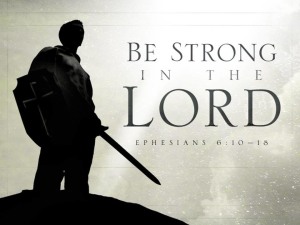
This Favorite was written on November 11, 2008, Veteran’s Day in the U.S.A., and we post it again in reprise as we consider spiritual and physical warfare.
As the words on the wall of our school’s student dining room remind us: You have been told, O man, what is good, and what the Lord requires of you: Only to do the right and to love goodness, and to walk humbly with your God. (Micah 6:8)There is no mystery in this. The requirement is simple. Spiritual warfare is this: Train self in order to invite wisdom; exercise compassion with justice in order to invite goodness. All the rest follows naturally. The outcome of good over evil is predictable. The time of final resolution is not.
All the ends of the earth will worship the Lord; all the families of nations will bow down to you.
In this end which we see but whose time we cannot predict, God is all there is. The war of life will have been waged and won by God. Any influence of evil will disappear. This we have been promised.
I will live for the Lord; my descendants will serve you. The generation to come will be told of the Lord, that they may proclaim to a people yet unborn the deliverance you brought.
When miracles happen, we must proclaim them, thanking God. We must sing God’s praise continually for our blessings great and small because in spiritual warfare the fall of darkness and deceit is brought about in an accumulation of these small songs intone grand chorus. We also remember that the tiniest of miracles is significant for those to whom they have been granted . . . and that these miracles are a sign of God’s continual presence in our lives.
It is true that sometimes we are completely innocent of any wrongdoing and yet we suffer. One of the primary questions we ask as human beings is this: Why is it that things sometimes go so wrong for us and so right for others? We also ask: What have we done to deserve suffering and how do we cope without falling apart entirely? Some of us even ask: How long can I go on? Is life worth living?
Today we hear from Job, the man who suffers through no fault of his own. His fidelity attracts Satan’s notice and so he becomes an object of play in the devil’s evil game. Job describes with beautiful metaphors how quickly his friends abandon him, being undependable as a brook, as watercourses that run dry in wadies . . . [they are] caravans [that] turn aside from their routes [to] go into the desert and perish.
In today’s Gospel (Mark 7:31-37) we hear the story of how Jesus opens ears and a throat when he says words that he also says to us: Be open! In MAGNIFICAT, the mini-reflection for Morning Prayer reads: Jesus opened the ear of the deaf man that he might hear in a new startling way the word of salvation. What we hear as good news, we proclaim as good news: that is our task as disciples.
How we arrive at not hearing is not important; nor is the question about why we have become silent in our isolation. What is important is this: That one has come who releases all of us from our bondage – whether these chains have been acquired through our own action or inaction, or whether we are innocent slaves. One has come to call us to unity, and this one calls to each of us: Be open!
Be open to a surprising newness. Be open to pardoning and being pardoned. Be open to miracles in our lives. Be open to the amazing potential we possess. Be open to proclaiming the good news that we are free and need not toil futilely. Be open to the life of discipleship. Be open to union in Christ, with Christ himself. Be open.
This is easy to hear but difficult to do. We might turn again to Job who knows the pain of separation and also the joy of reunion.
Whether we suffer in innocence or through our own action or inaction, our reply to the one who created us can be the same. When we hear the voice that calls, let us all answer: We are open to the possibility that we might live again! This is our best human reply to the divine.
And this is the greatest miracle of all – that whether we suffer through guilt or whether we are innocent we can allbe open to God for we are all sought byGod for to each of us he says: Be open!
Cameron, Peter John. “Prayer for the Morning.” MAGNIFICAT. 6.9 (2009). Print.
The King of Aram cannot win against the God of Israel who speaks to the faithful through their prophet Elisha. As I read this story I too, wish that I had such a direct route to wisdom, and then I realize that I do. Today’s story of ambush is tempered with God’s pity for the Arameans, something we do not see often in the Old Testament. It is also a reminder that God abides with those who seek him in humility and trust, that when the faithful follow in fidelity, they too will benefit from a voice that advises them as if it has heard conversations in secret places that are meant to outwit God. Today we remember that God is everywhere, hearing everything, seeing everyone, knowing every thought. At first this can be unsettling – we realize that there is no part of us that we can hold separate from God. Later it is comforting – we realize that we do not want to be without this supreme intelligence and infinite mercy. We come to see that God’s presence – and our attentive ear tuned to God’s voice – is the only force which saves us from the ambushes plotted in secret places. We begin to comprehend the depth of God’s love for us.
When an ambush is sprung upon us, we might want to turn to Psalm 143 to intone its verses: My spirit faints within me; my heart within me is desolate.
When we feel as though all our own forces have been spent in enduring the onslaught, we say: I spread out my hands to you; my soul grasps to you like a thirsty land.
When we feel ourselves about to faint from the fear or anxiety which strangles us, we pray: O Lord, make haste to answer me; my spirit fails me; do not hide your face from me or I shall be like those who go down to the Pit.
We remember the times in the past when we have survived ambush by calling on God for help: I remember the time past; I muse upon your deeds; I consider the works of your hands.
We ask for God’s assistance: Revive me, O Lord, for your Name’s sake; for your righteousness’ sake, bring me out of trouble.
When we take ourselves away from panic and pain, we come to see that we too benefit from miracles brought to us through the words and actions of our own holy women and men. When we rely on the voice of God rather than the voices of society, we too become transformed by miracles that arrive as gifts from our loving God. And when we show mercy for those who have listened to their own advice rather than words from God, we too will see that no more raiders will come into our land.
Yesterday’s and today’s Noontimes are adapted from a reflection written on Armistice Day, November 11, 2008.
All the ends of the earth will worship the Lord; all the families of nations will bow down to you.
In this end which we see but whose time we cannot predict, God is all there is. The war of life will have been waged and won by God. Any influence of evil will disappear. This we have been promised.
I will live for the Lord; my descendants will serve you. The generation to come will be told of the Lord, that they may proclaim to a people yet unborn the deliverance you brought.
When miracles happen, we must proclaim them, thanking God. We must sing God’s praise continually for our blessings great and small because in spiritual warfare the fall of darkness and deceit is brought about in an accumulation of these small songs intone grand chorus. We also remember that the tiniest of miracles is significant for those to whom they have been granted, and these miracles are a sign of God’s continual presence in our lives.
In spiritual warfare we need not connive, we need not plot. We need only do what we know is right, understanding that we are graced by God. We need to avoid thinking that we are in control, knowing that God’s plan is always better than our own. We need to give over everything to God, believing that God turns all harm to good, even – and especially – the ultimateresolution of all conflict.
We are foot soldiers in spiritual warfare, and we know our orders. We must be patient in our perseverance as we grow to become God’s harvest in God’s time. We must speak, pray, study, witness, watch and wait. We must be ready. This is all that is required of us. We do not know the hour or time of this warfare’s end; but we know the outcome. This we have been promised. This we have been told. Let us pass the word along – that in the hour when we feel most abandoned, we are most accompanied. In the hour when we believe all is lost, all is truly found.
Tomorrow, a prayer for spiritual warfare.
For a Bible Study on Ephesians 6, click on the image above, or visit: http://www.biblestudytools.com/bible-study/topical-studies/spiritual-warfare-lesson-1-understanding-the-battle-11554631.html
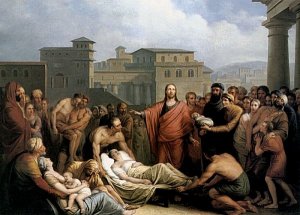
Mathieu Ignace van Bree: Christ Heals the Paralytic
Too often when we come into contact with those among us who suffer physical or mental differences, we turn away in alarm or surprise. Or worse, we give in to the temptation to whisper about someone’s condition without realizing that our behavior is clearly visible. Our gossipy whispering is audible.
Jesus teaches us a difficult lesson today.
Jesus knew what they were thinking, and said, “Why this gossipy whispering? Which do you think is simpler: to say, ‘I forgive your sins,’ or, ‘Get up and walk’?”
We know that in ancient times – and still in some cultures today – afflictions are seen as divine punishment for sin. Jesus forgives with the authority given him by the Creator.
Jesus teaches us how to measure our compassion today.
“Get up. Take your bed and go home”.
In our hearts and minds we are grateful when we do not suffer, grateful when we walk in bounty. We also know that God’s grace blesses us with the gifts that make it possible for us to earn a living, to afford shelter, food and clothing. Although in many societies we believe that everyone is entitled to an equal opportunity, we also must know that not everyone is equally endowed.
Jesus teaches us how to heal today.
And the man did it. The crowd was awestruck, amazed and pleased that God had authorized Jesus to work among them this way.
In a world that is strangely topsy-turvy, we know that we are responsible for our response to God’s call more than we are responsible for our fame, wealth or power. Jesus calls us to put aside our gossipy whispering and invite those among us who are paralyzed in any way to join us. Jesus invites all to come together with whatever gifts we have to build the infinite and boundless kingdom.
Jesus teaches us about goodness today.
When we use the scripture link above and the drop-down menus to explore other translations of this story, we hear God’s call as healing and compassionate kingdom-builders.
Jesus icon in St. Saviour Church: Chora, Istanbul, Turkey
The stories of Jesus’ healing are perhaps the most loved. They tell us in the modern era what we want and need to hear. Miracles happen. Outrageous hope is possible. Love changes everything. Faith, the cornerstone of discipleship, rises from our constant communication with God and brings reward greater than any power, wealth or fame. But to all of this goodness and compassion too many of us are too often blinded by the lures of the world that surrounds us. So great is God’s love for each of us that we are given the daily opportunity to choose Mammon or God. The blind men in today’s story choose God.
THE MESSAGE translation brings this familiar story home in a powerful way.
Two men cry follow Jesus and cry out to him, pleading for sight so they might more fully enter life. And so Jesus said to them, “Do you really believe I can do this?” They said, “Why, yes, Master!”
How often do we ask for God’s help? How often do we reply, “Why, yes, Master!”
St. Saviour Church: Jesus heals Two Blind Men
He touched their eyes and said, “Become what you believe.” It happened. They saw. Then Jesus became very stern. “Don’t let a soul know how this happened.” But they were hardly out the door before they started blabbing it to everyone they met.
Do we believe that we become what we believe? Do we covet what others have or what others are?
It happened. They saw.
Does our worldly doubt overcome our spirit’s hope? Do we turn to God when we are in turmoil or fear? Do we blab the good news to others or hold it for ourselves? Do we ask for sight and wisdom only to ignore or abuse the gift once it is given? Do we decide that Jesus’ ancient words do not suit our modern world?
Become what you believe.
St. Saviour Church in Chora, Istanbul, Turkey
We are so often blind to so much that takes place around us and this is not surprising since the world is a dichotomy of faith-inspiring creation and the frightening ugliness of evil. But we are created in God’s image, created to rise to the hope of God’s creation, created to sing in harmony with God’s Spirit. So rather than reject with cynicism the possibility of Jesus’ presence in our lives, let us share – as do these two cured men – the goodness and enormity of God’s love. When we find that we are blind . . . let us ask for Jesus’ healing . . . and let us celebrate the miracle of his love.
Compare THE MESSAGE translation of these verses with others using the scripture link and the drop-down menus to see how Jesus speaks to us today through this story.
Tomorrow, why does Jesus ask these men to keep silent about the miracle of their healing.
Jairus’ anguish over the loss of his daughter moves Jesus to return the child to life as we know it. The story also bookends another: the healing of a woman suffering from hemorrhage. These two women, one young and one elderly, show us the breadth of God’s compassion and consolation. These two women, one passed on to the next world and the other still in it, show us the goodness and mercy of the Spirit. As we consider this version and compare it to Mark’s in 5:21-40 we have the opportunity to ask for our own miracles. Let us not hesitate to ask God to grace our own lives in such a meaningful way.
To learn more, click on the images. To suggest other images we might enjoy seeing, enter the painter and the name of the work as a the comment to this post.
This week we pause to read scripture and to pray and reflect at noon, keeping those in The Noontime Circle in mid-day prayer. You may want to click on the Connecting at Noon page on this blog at: https://thenoontimes.com/connecting-at-noon/In these posts, we will have the opportunity to reflect on a scripture verse and an artist’s rendition of that event. Wishing you grace and love and peace in Christ Jesus.
It is never too late to return to God. Never too late to give or ask forgiveness. There is always time to listen, to share, to commune, to re-visit, to believe, to hope, to love. A people in exile return to the source and summit of faith. A people hoping in darkness see a great light. A people created in love to bear witness to the strength of the threads of their lives that weave together in the great sacred history of humanity.
Today we take time to open our minds to the possibility of miracles. We open our hearts to the great love God has in store for us. We discover, in this weaving, believing and hoping just how and why we have been created . . . in and for God’s great love.
The two books of Chronicles have four major portions: a genealogy of our leaders beginning with Abraham (1 Chronicles 1-9), a description of the monarchy under David and Solomon (1 Chronicles 9 – 2 Chronicles 9), the divided kingdom (2 Chronicles 10-18), and the period from Hezekiah to the Babylonian exile (2 Chronicles 19-36). This story of divine promise interwoven with human commitment and infidelity tell a story that we might see reflected in our own personal sacred history. This story is worthy of our time.
This is a story which everyone needs to read often. From the NAB Catholic Study Edition: “The Book of Tobit is a complex literary work with a very uncomplicated moral. The book narrates important incidents in the lives of three people: Tobit, Sarah, and Tobiah. It tells the story of their tragedies and triumphs. The author weaves the stories of these three people together very skillfully so that the book results from the intersection of three different but related plots. This rhetorical feat of weaving the stories of these three people so tightly has a theological purpose. The author wishes to show how God can mange the circumstances of people’s lives in order to bring God’s plans to fulfillment. Its primary religious message is simple: God rewards those who are faithful.” This is a message we need to hear.
The book is considered by some as a religious novel only, while others see it as inspired by the Holy Spirit. We like the story because it tells of healing. And this healing happens through the Archangel Raphael through whom, “God manages . . . circumstances in order to ensue that God’s own purposes come to fruition. The story assumes God’s sovereignty in people’s lives and God’s determination to reward the just. When the just suffer, there is a limit to that suffering. Once that limit occurs, God will intervene. Sometimes that intervention is miraculous.” This is a message we want to take in.
God considers that Sarah has suffered enough and so he confronts the demon who is enamored of this young woman, but the confrontation occurs in a quiet way. This demon, as we hear earlier in 6:15, “loves her, [so] he does not harm her; but he does slay any man who wishes to come close to her.” So rather than wage battle, as we humans would do, God sends Raphael to accompany the young Tobias, who in turn expulses the demon using means given him by Raphael – which is the part of the story we hear today. The footnotes in the NAB point out that this is not an exorcism. Rather, the demon retreats because of the power of the earnest prayer of the two young people. From the footnotes, “It is clear that the author places primary emphasis on the value of prayer to God, on the role of the angel as God’s agent, and on the pious dispositions of Tobiah.”
Abraham de Pape: Tobit and Anna
What can we take away from all of this? It is clear and simple. The faithful need not wage war. They need not struggle against life’s obstacles. Rather, they must seek healing through God, remain faithful to their covenant promise, practice authentic prayer, and they must believe in miracles. This is a message we will want to remember.
And so we petition our good and gracious God.
Keep us always watchful for the angels you send to us – even though we are so busy that we often miss them.
Call us in such a way that we are open to your healing miracles – because we need them.
Look kindly on us as we struggle along the torturous pathways of this life – because we are nothing without you.
Keep us ever mindful of your desire to do all good things for us – even as we rail against the suffering which disciplines us so well.
May we join with young Tobias and Sarah as they prayed to you, “’Blessed are you, O God of our fathers; praised be your name forever and ever. Let the heavens and all your creation praise you forever. . .’ They said together, ‘Amen, amen,’ and went to bed for the night.”
Today we remember as we reflect . . . we are Easter People.