We look for assurance in our families and friends, in the social networks we form, in the constant checking of posts and messages.
We seek assurance in our homes and possessions, in the many small and large objects that falsely tell us all is well, in the thousand little chores that allow us to feel safe.
We pursue assurance with our accomplishments and awards, with our private and public lives, with our wealth of titles and medals. Today Job gives us a microscope through which to examine who and what and how we seek assurance in our lives.
In this second week of Lent we pause to consider what accomplishments we relish and why. We explore what changes we have made in our lives and how. We determine what assurances we seek and from whom. Let us also pause in the flurry of our day to read Job 24 and look for ourselves in this litany of those who find false and certain assurances.
For beautiful images connecting art and faith, click on the image above or visit: https://01varvara.wordpress.com/2010/06/12/vladimir-borovikovsky-job-and-his-friends-1810s/vladimir-borovikovsky-job-and-his-friends-1810s/
In today’s Gospel we hear that Jesus made a whip out of cords and then used it to drive moneychangers out of a sacred place of worship. As we read Jesus’ words, we might consider how we have cluttered our hearts with sacrifices that mean little or with the bargains we hope to exact from a loving God.
Take these [doves] out of here, and stop making my Father’s house a marketplace.
As we read Jesus’ words we might consider our willingness to give over the false temples we have constructed to the cleansing, healing hands of Christ.
Destroy this temple and in three days I will raise it up.
As we read John’s words we might consider God’s great generosity and mercy.
Many began to believe in [Jesus’] name when they saw the signs he was doing. But Jesus would not trust himself to them because he knew them all, and did not need anyone to testify about human nature. He himself understood it well.
As we read John’s words we might consider how we might begin to cleanse our hearts and minds, and how we might willingly offer them up for destruction.
Learn about Regina at the Women for Women site
Study El Greco’s rendering of Christ Cleansing the Temple above, then explore the sites below and determine if there is an appropriate action we might take toward removing the marketplace from our temples and releasing the captive doves.
Lo, I am sending my messenger to prepare the way before me; and suddenly there will come to the temple the Lord whom you seek.
In several weeks we will witness again Christ’s passion and death. Let us prepare the temple of our hearts with God’s written Word. Today we choose a chapter and book in the Bible that we have never explored before. As we read, we allow the Spirit to open our ears to God’s words.
My messenger is like the refiner’s fire, or like the fuller’s lye. My messenger will sit refining and purifying.
In several weeks we will experience again the Easter miracle. Let us prepare our hearts and minds with the refining fire of Christ’s presence, the Living Word. Today we compose a prayer of thanksgiving to the Living God for all that heals and sustains us each day. As we write, we allow the Spirit to open our hearts to God’s living presence.
Lo, I am sending my messenger to prepare the way before me; and suddenly there will come to the temple the Lord whom you seek.
In several weeks we will experience again the phenomenon of Pentecost. Let us prepare ourselves to receive the Spirit in this special way. Today we spend time with someone who is suffering to allow the refining fire of God’s love to transform all mourning into joy.
For more on Malachi’s imagery of a smelter’s fire of a fuller’s lye, enter the word refiner into the blog search bar and explore.
In this Lenten season, we witness to the presence of Christ in our daily routine. In this time of introspection, we welcome the Spirit into the temple of our hearts. In this time of healing and re-making, we thank God for the gifts of grace and mercy and patience. In this time of transformation, we come to understand the essence of our Lenten delay.
If it delays, wait for it . . .
Like small children, we want all our woes and anxieties resolved within seconds of their borning; like small children we must learn that waiting in joyful anticipation brings the gift of wisdom.
It will surely come . . .
Like energetic teenagers, we easily slip into the thinking that the multiverse holds us at its center; like energetic teenagers we reluctantly admit that our way is not always God’s way.
It will not be late . . .
Like impatient adults, we ask the world to move at our singular command; like impatient adults we come to see that the common good is more valuable in God’s eyes than our individual desire.
The rash one has no integrity . . .
In our Lenten journey we come to understand – if we are open – that God is present in misery just as in joy.
But the just one, because of faith, will live . . .
In our Lenten passage we come to know – if we are open – that God’s delay is part of God’s plan.
As we move through this second full week of Lent, let us take all of our impatience and anxiety, all of our anger and frustration to the one who mends and heals all wounds. And let us – like Jesus – make a willing sacrifice of our waiting as we anticipate in joyful hope God’s fulfillment of our great delay.
In the beginning great darkness covered the wasteland . . . In the sterile or futile moments in our lives we remember that God creates great beauty out of desolation. During our Lenten journey, let us offer the darkness and wilderness days of our passage to God for conversion.
A mighty wind swept over the waters . . . In the empty or fruitless moments in our lives we remember that God brings light and life out of nothingness and despair. During our Lenten sojourn, let us offer any emptiness of our days to God for healing.
Then God said, “Let there be light,” and there was light. God saw how good the light was. God then separated the light from the darkness. God called the light “day,” and the darkness he called “night.” Thus evening came, and morning followed – the first day.In the confusion or turbulent moments in our lives we remember that God brings order out of chaos. During our Lenten pilgrimage, let us offer any misunderstandings in our days to God for transformation.
John, the Beloved Apostle, reminds us that: In the beginning was the Word, and the Word was with God, and the Word was God. (John 1:1) Let us trust the One who has always been and will always be. Let us trust the One who creates and loves. Let us trust the One who accompanies and heals, guides and protects. Let us place all our trust in this One.
Today we gather all the trials and difficulties we experience and we hand them all over to the One who brings light out of nothing, order out of chaos, energy out of weariness and fullness out of nothing. On this first day of our Lenten passage, we offer all to the One who is worthy of our trust. And so, we pray,
Good and powerful God, you bring all darkness to light; bring us also to your truth.
Good and gentle God, you bring all injury to healing; bring us also your comfort.
Good and gracious God, you bring all disorder into your plan; bring us also into union with your loving heart. Amen.
For more images of the world’s best view of sunrise, click on the image above or visit: http://article.wn.com/view/2012/05/28/The_worlds_best_view_of_sunrise_Space_Station_astronaut_snap/
The world watches with a kaleidoscope of emotions as we witness political upheaval in Europe. False news is used to further manipulate our thinking. As imperialism clashes with openness and inclusion, Pope Francis calls us to a day of prayer and fasting in prayer for Ukraine. When we gather our small sacrifices to offer them in hope, may we witness a quick resolution to the conflict and a renewal of peace.
In a reflection last week Fr. Richard Rohr, O.F.M. posited the thesis that all of scripture, from the beginning of Genesis to the end of Revelation, “mirrors the development of human consciousness, with its usual pattern of progression and regression”. He explains that just as in the early books of the Torah and in the narratives that follow, we humans look for a foundation of rules and regulations that govern our lives and relationships. He writes that this is “helpful for developing our first egoic identity (the container), and for most of us this represents at least the first 25 years of our life; but that is not yet a full spiritual identity (the contents). The trouble is, an awful lot of people stay at that first stage of boundary-keeping that ‘law’ and group well provide, even though it traps us inside of a black or white, dualistic consciousness. But we have to start there or we have no ego container”.
Rohr further proposes that as we mature we begin to understand “why most people are hesitant to move further, toward places where they cannot uphold themselves, or prove they are right and good”. Rohr points out that Jesus himself says “the Law actually assures a kind of certain failure so all humans have to rely entirely on God’s grace and mercy and not their own worthiness or any kind of superiority. God is actually pretty clever”.
So where does that leave us as we learn and grow in God? How might these ideas serve us as we enter the season of Lent, this season of growing in Christ? What might we do to create a dwelling place for the Spirit?
In the opening weeks of Lent we will search the Torah and narratives as we explore the materials and process we have used to construct our temple dwelling place for the Spirit. We will later move into a time when we dare to say that the Law has failed us in some way. And we will – with God’s grace – arrive at the Easter miracle with a new and open heart. If these Lenten reflections do not serve us, we might turn to the Connecting at Noon page on this blog and consider a change in our prayer life that will create a fresh place for the Spirit and allow for renewal. Or we may simply rest in God’s hands and allow the Spirit to revive any inertia and to heal any wound.
As we move from one season to another, as we approach the great gift of Eastertide, we might remember the words of Paul to the Corinthians: Brothers and sisters: Whether you eat or drink, or whatever you do, do everything for the greater glory of God. Avoid giving offense, whether to the Jews or Greeks or the church of God, just as I try to please everyone in every way, not seeking my own benefit but that of the many, that they may be saved. Be imitators of me as I am of Christ. (1 Corinthians 10:31-11:1)
Citations from Richard Rohr’s Meditation from February 12, 2015: Adapted from Scripture as Liberation:https://cac.org/richard-rohr/daily-meditations Click on the Beginner’s Mind image to explore videos that open us to renewal, or visit: http://rohr.franciscanmedia.org/user/?browse=Videos
Tomorrow we begin the season of Lent, a time when the earth shifts moods with the changing seasons. In the northern hemisphere the promise of spring and the Easter Passion hover amid the snow-covered trees while all of creation anticipates new burgeoning and promise. In the southern hemisphere autumn prepares us for winter as we gather harvests, snug in and burrow down, resting in the nurturing strength of the covenant promise. No matter our mood or circumstance, Lent offers us an opportunity to renew, re-touch, and re-encounter the risen Christ. Lent gives us a way to examine and re-define. Lent brings us a fresh wind and a new heart. Today we pray with Psalm 147 as we prepare for Lent, and look forward to the fulfillment of the Good News.
Glorify the Lord and offer praise to your God . . .
Today we give thanks for both our blessings and obstacles, realizing that grace arrives with our sufferings as well as our joys.
Who has strengthened the bars of your gates and blessed your children within you . . . ?
Today we give thanks for our progeny and our future, looking forward to the events that bring us into union with God.
Who has brought peace to your borders, and filled you with finest wheat . . . ?
Today we give thanks for all the harvests in our lives, for the opportunity to both give and receive God’s plenty that graces the earth.
The Lord sends a command to earth; God’s word runs swiftly! Snow is spread like wool, frost is scattered like ash, hail is dispersed like crumbs; before such cold the waters freeze. Again the Lord sends God’s word and they melt; the wind is unleashed and the waters flow . . .
National Geographic: Night sky in Patagonia, Argentina
And so, we pray,
Today we give thanks for all that we receive, knowing that we are asked to share these gifts from the Lord. Today we give thanks for all that we experience, knowing that we are called to love one another. Today we give thanks for all that is to come, knowing that The Lord has peace and joy in great store for us. Today, with all of creation, we give thanks and praise to God. Amen.
In today’s Gospel we hear a clear call to rise to our own potential, to experience our own transfiguration. Since Ash Wednesday we have looked at the early books in the Old Testament to examine our earliest human ideas of the Living God and the special relationship we experience with this deity. This is a God who is not distant or removed; rather, the Lord accompanies us always in all places.
As we read the Gospel at the link above, we consider whether we live outside or inside the Lord’s camp, we consider where and how we find strength, and we examine our own sense of devotion to the Lord. As we reflect on both the Gospel and the ideas brought forward in our Lenten reflections, we consider how we might be transfigured in Christ, and how we might become – or continue to be – good and faithful servants to this Living God. And we determine to bring God to one another as we engage in social justice work.
As we scroll back through the last few weeks of The Noontimes, we linger with those that open the possibility of transfiguration to us in this Easter season.
Raphael’s painting of the transfiguration was comissioned by Cardinal Giulio de Medici who later became Pope Clement VII. To learn more about the painting and the painter, click on the image.
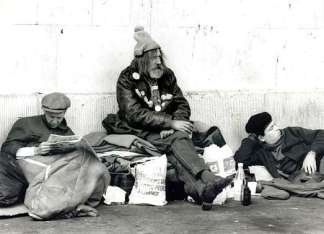
To learn how we might transfigure our own lives by helping the marginalized, we might learn about the homeless by following the link connected to the image to the left. We might also learn how we can change our lives to include the homeless in a positive way at: http://www.tillhecomes.org/how-to-help-homeless-people/
Then Delilah said to Samson, “How can you say that you love me when you do not confide in me?”
In this often-told Old Testament story we see how words can be used to deceive and conceal. Words of love can manipulate and destroy as well us build up and restore.
So he took her completely into his confidence and told her, “No razor has touched my head, for I have been consecrated to God from my mother’s womb”.
In this well-told Old Testament story we see how trust and betrayal both tug on the body, mind and soul. Acts of deceit become preludes to acts of greatness when God is central to our lives.
Delilah had Samson sleep in her lap, and called for a man who shaved off his seven locks or hair. Then she began to mistreat him, for his strength had left him.
In this familiar Old Testament story we see how intimacy and revenge are dichotomous sisters in our modern lives. But always, as in this story, malice is superseded by God’s love.
Samson cried out to the Lord and said, “Oh Lord God, remember me! Strengthen me, O God.
In any array of negative emotion we call on God for strength; and so our fear, anger, and desire for revenge become hope, mercy and love.
Jesus reminds us: “You have heard that it was said, ‘You shall love your neighbor and hate your enemy.’ But I say to you, Love your enemies and pray for those who persecute you,so that you may be children of your Father in heaven; for he makes his sun rise on the evil and on the good, and sends rain on the righteous and on the unrighteous.For if you love those who love you, what reward do you have? Do not even the tax collectors do the same?And if you greet only your brothers and sisters, what more are you doing than others? Do not even the Gentiles do the same? Be perfect, therefore, as your heavenly Father is perfect. (Matthew 5:43-48)
In this often-told Old Testament story we see how words can be used to deceive and conceal. In this often-told New Testament story we see how words of love can build up and restore. As we journey toward season of Lent and the Easter promise, let us reflect on the actions and words of Samson, Delilah and Jesus. Let us determine the source of our strength; and let us determine who we choose to follow and why.






 The Noontimes