Annibale Carracci: The Dead Christ Mourned by the Three Marys
Friday, March 25, 2015
When the Sabbath was over, Mary Magdalene, Mary, the mother of James and John, and Salome bought spices so that they might go anoint Jesus . . . Then they went out and fled from the tomb, seized with trembling and bewilderment. They said nothing to anyone for they were afraid . . .
In this ending of Mark’s Gospel, Jesus’ followers obey their fear. Our Lenten journey brings us the opportunity to examine our own temptation to obey our fears rather than trust the Easter miracle.
When he had risen, early on the first day of the week, he appeared first to Mary Magdalene . . . when they heard he was alive and had been seen by her, they did not believe . . . After this he appeared in another form to two or three of them walking along on their way to the country. They returned and told the others; but they did not believe them . . . Later, as the eleven were at the table, as the eleven were at table, he appeared to them and rebuked them for their unbelief and hardness of heart because they had not believed those who saw him after he had been raised.
In this ending of Mark’s Gospel, we see Jesus’ love overcome his followers’ distress. Our Lenten journey brings us the opportunity to believe the resurrection story and follow Christ.
God says: If you read my scripture carefully you will see how many times these sacred writers record my assurance to you that you need not be afraid. Spend time with my servant Mark today and allow my grace to fill you. Read the end of his story with its double ending and examine your own doubts and fears. Allow my story to sink into your bones and feel the promise I offer you. My love does not fail. My promise remains for eternity. Rather than obeying your fears, bring them to me . . . for I will still your uneasy heart.
Using the scripture link, study the various versions of Mark’s Chapter 16, and decide to put away your fears.
Love justice . . . seek the Lord with integrity of heart . . .
Perverse counsels separate a man from God . . .
The holy spirit of discipline flees deceit and withdraws from senseless counsels . . .
When injustice occurs it is rebuked . . .
God is the witness of the inmost self and the sure observer of the heart . . .
The spirit of the Lord fills the world, is all-embracing, and knows what each one says.
No one who utters wicked things can go unnoticed . . .
A jealous ear hearkens to everything . . .
Discordant grumblings are no secret . . .
Guard against profitless grumbling, and from calumny withhold your tongues . . .
A stealthy utterance does not go unpunished . . .
A lying mouth slays the soul . . .
Justice is undying.
God says: These words of wisdom are sent to you through my servant who recorded these thoughts for you centuries ago. They are ancient words yet they hold modern meaning. In this season of Lent as you anticipate the miracle of Easter, open your arms, widen your horizon, unbend your stiff neck and renew your heart. Separation from me does not occur like a thunder clap or an explosion; rather, it begins by tiny steps away from me, away from the light that breaks through all darkness and calls forth all healing. If you wish to hold the keys to life, remain in me as I remain in you. I will give you rest and mercy and peace.
Use the scripture link to explore different versions of these verses, and allow them to reveal the wisdom of God’s words.
Moses says to his people: So now, Israel, give heed to the statutes and ordinances that I am teaching you to observe, so that you may live to enter and occupy the land that theLord, the God of your ancestors, is giving you. You must neither add anything to what I command you nor take away anything from it, but keep the commandments of theLordyour God with which I am charging you.
Jesus tells the hypocritical leaders of his time, and he tells us today, that no matter the number of religious rules and practices we might proscribe, with God there is one Law that supersedes all others. But when the Pharisees heard that Jesus had silencedthe Sadducees, they gathered themselves together.One of them, a lawyer, asked Hima question, testing Him, “Teacher, which is the great commandment in the Law?” And He said to him,“‘You shall love the Lord your God with all your heart, and with all your soul, and with all your mind.’ This is the great and foremost commandment.The second is like it, ‘You shall love your neighbor as yourself.’On these two commandments depend the whole Law and the Prophets.” (Matthew 22:34-40)
God says: When you find yourself caught up in the details of my Law, you can be certain that what you have focused on is something I do not have in mind. My kingdom is one of forgiveness, of healing and of love for all – even, and especially, our enemies. Do as I do – call to those who would harm you. Do as Jesus does – witness to the hypocrisy in the world. Do as the Spirit does – heal the suffering and anxiety you see in your world. With all of this, you will find great peace. Through all this, you will experience deep serenity. Because of all this, you are my great love in the world.
When we spend time today with these verses and reflect on their meaning, we may discover what portion of our lives we withhold from God. And we may also discover how we honestly and fully love God with all we think, all we believe, all we say and all we do.
To learn more about the mezuzah above and The Shema, the most sacred of Jewish prayers, visit: http://www.hebrew4christians.com/Scripture/Torah/The_Shema/the_shema.html
The Prophet as Watchman:Gratitude for our Stumbling Blocks
I have appointed you as sentinel; whenever you hear a word from my mouth, warn my people from me.
God says: Do not be surprised that I have appointed you as sentinel to my people for you have been faithful in great and in little things. When I speak, send on my word, live my word.
When I say to the wicked, “You will surely die,” and you do not warn them or speak out to warn them, the wicked shall die in their iniquity, but their blood I will require at your hand.
God says: Do not be afraid to deliver news that others perceive as negative or ugly. Send on my word with mercy and justice. Be compassionate always, but deliver my message nonetheless for it is as important for you to speak as it is for others to hear.
If you have warned the wicked and they do not turn from their wickedness or from their wicked way, they shall die in his iniquity; but you have delivered yourself.
God says: Do not worry if my word returns to you empty. I do not expect you to transform hard hearts and unbend stiff necks; but I expect that you will send my word on.
When I speak to you, I will open your mouth and you will say to them, “Thus says the Lord God”. The one who hears, hear; and the one who refuses, let that one refuse; for they are a rebellious house.
God says: Speak in my name and in that alone is your reward. When you do this although it is outside of your comfort zone, you set the same example as does my son Jesus. When you speak the words that lie in the quiet of other hearts, you demonstrate your fidelity. When you act as Jesus acts you show me the heart I have planted in you. Act in me as I act in you . . . and this will be enough. Give thanks that I am with you. Give thanks that you are not alone. Give thanks that my love dwells within you . . . and that I find it great enough to share. This has been the gift of your stumbling block. It is the gift of the watch tower. It is the gift of my eternal life in you.
The prophets warn, threaten, exhort, and promise us that God is always present, even though we may not recognize this presence. The Old Testament prophecies foreshadow the good news of the New Testament, and they remind us that no matter our circumstance God’s joy rescues us from sure destruction, Christ’s joy redeems us from our recklessness, and the Spirit’s joy heals us despite the gravity of our wounds. Today Zephaniah describes how we might respond in joy even when we suffer the curse of degradation.
“The age of Zephaniah was a time of religious degradation, when the old idolatries reappeared and men worshiped sun, moon, and stars”. This prophet calls us to oppose the worship of false gods and the adulation of false priests and ministers. It is a message we cannot hear too often. (Senior 1153)
Fanaticism will always flourish whether it comes from the both ends of a political, civil, social or religious spectrum. Ancient and contemporary philosophers promote moderation and balance. Scholars assess the values presented by sophist, pluralistic and diverse viewpoints. Arguments divide families and workplaces. Corruption finds a home in an environment of fear and settle into our bones as a response to our anxieties. Extremism and division will always plague us. What then, is to be done?
Zephaniah 3:17-18:For the Lord your God has arrived to live among you. He is a mighty Savior. He will give you victory. He will rejoice over you with great gladness; he will love you and not accuse you.” Is that a joyous choir I hear? No, it is the Lord himself exulting over you in happy song. “I have gathered your wounded and taken away your reproach.
God says: So what is the great gladness that lives among you and does not accuse you? It is My Word. What is the joyous choir we hear? It is the billions of voices in my creation coming together: the songs of my trees and winds and seas, the voices of my birds, and reptiles and mammals, the songs of my faithful people. All of this beautiful, universal sound is in and with and through me. Come to me. Despite the degradation that threatens to pull you into darkness, listen for the songs of joy that the faithful are singing. And join your voice with theirs.
A week ago today more than three million people in the country of France came together to sing in the universal song of solidarity. Spend some time investigating the myriad issues that surfaced in Europe and around the world last week. Click on the image above and visit the UNESCO Free Press post. Reflect on the importance of open, free and authentic journalism, and decide how our many voices might come together in a song of joy to God.
Senior, Donald, ed. THE CATHOLIC STUDY BIBLE. New York, Oxford University Press, 1990. 1153. Print.
If this week’s Noontimes call you to search for more ways to encounter Joy or urges you to investigate the New Testament, click on the word Joy in the categories cloud in the blog’s right-hand sidebar and choose a reflection, or enter those words in the blog search bar.
The prophets warn, threaten, exhort, and promise us that God is always present, even though we may not recognize this presence. The Old Testament prophecies foreshadow the good news of the New Testament, and they remind us that no matter our circumstance God’s joy rescues us from sure destruction, Christ’s joy redeems us from our recklessness, and the Spirit’s joy heals us despite the gravity of our wounds. Today Habakkuk reminds us that too often our ways are not God’s ways.
“For what may be the first time in Israelite literature, a man questions the ways of God, as Habakkuk calls him to account for his government of the world”. God replies that he will send “a chastising rod, Babylon”. And God also replies with divine assurance the faithful will not perish. (Senior 1150)
God says: I know that my plan seems slow to you and I understand your impatience for my ways are not always your ways. My prophets deliver your anger, exasperation, and sorrow to me; and I hear your plaint. My prophets also deliver My Word to you. I walk among you as the man Jesus and although you may not see him he is with you all the same. The anger of Habakkuk has not dissolved . . . and nor has my love. Each time you throw your anger at me I return it to you transformed in and by and through love. I return it to you as the gift of love. Read the words of Habakkuk . . . and bring me your fears and desperation. Bring me your sorrow, your worries and your questions. In return, you have my answer . . . the gifts of my presence, mercy, rescue and love.
In this prophecy, it is difficult to find the joy we hope to experience.How long, O Lord? I cry for help but you do not listen! I cry out to you “Violence!” but you do not intervene.(1:2)
In this prophecy, we hear the words that speak to human fear, suffering and frustration with the divine plan. I will stand at my guard post, and station myself upon the rampart, and keep watch to see what he will say to me, and what answer he will give to my complaint”.(2:1)
In this prophecy, we hear the Lord’s reply that we will want to hold close when pain and anxiety set in, when we wonder about the promise of God’s rescue and redemption. The vision still has its time, presses on to fulfillment, and will not disappoint; if it delays, wait for it, it will surely come, it will not be late.(2:3-4)
In this prophecy, we pray with Habakkuk: God, my Lord, is my strength; he makes my feet swift as those of hinds and enables me to go upon the heights.(3:19)
In this prophecy . . . we have the eternal answers to our unrelenting questions.
Several years ago, after the terrorist attack on the Charlie Hebdomagazine offices, the nation of France prepared to welcome visitors from around the world to celebrate with joy in the face of enormous anger and grief. To learn more, click on the image above or go to: http://www.ft.com/intl/cms/s/0/d0cc3eca-9943-11e4-be30-00144feabdc0.html#slide0
Or you want to visit: https://www.britannica.com/event/Charlie-Hebdo-shooting
Senior, Donald, ed. THE CATHOLIC STUDY BIBLE. New York, Oxford University Press, 1990. 1150. Print.
If this week’s Noontimes call you to search for more ways to encounter Joy or urges you to investigate the New Testament, click on the word Joy in the categories cloud in the blog’s right-hand sidebar and choose a reflection, or enter those words in the blog search bar.
The prophets warn, threaten, exhort, and promise us that God is always present, even though we may not recognize this presence. The OldTestament prophecies foreshadow the good news of the New Testament, and they remind us that no matter our circumstance God’s joy rescues us from sure destruction, Christ’s joy redeems us from our recklessness, and the Spirit’s joy heals us despite the gravity of our wounds. Today Nahum delivers a warning to the enemies of the faithful.
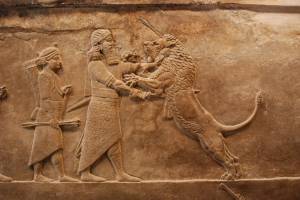
“Shortly before the fall of Nineveh in 612 B.C., Nahum uttered his prophecy against the hated city. To understand the prophet’s exultant outburst of joy over the impending destruction it is necessary to recall the savage cruelty of Assyria . . . in the wake of their conquests, mounds of heads, impaled bodies, enslaved citizens, and avaricious looters testified to the ruthlessness of the Assyrians”. (Senior 1147)
Nahum 3:19: There is no healing for your wound—it is far too deep to cure. All who hear your fate will clap their hands for joy, for where can one be found who has not suffered from your cruelty?
God says: Revenge is never a source of happiness and it is – in fact – a source of continued pain. When you inflict punishment on those who oppose you that punishment comes back to haunt you. Nothing is gained. All is lost. As my servant Paul so ably reminds you, “love does not rejoice in wrongdoing, but rejoices in the truth”. (1 Corinthians 13: 6) Keep this in mind when you see your enemies fall. Call on me when you feel the hand of vengeance grip you. When you hear a warning of impending doom . . . remember that I alone can mete out justice that brings new life. Explore the verses of my prophet Nahum and look for the words he uses to remind you that in your anger and fear you need only look to me . . . for I will keep my promises.
Look! On the mountains the feet of one who brings good tidings, who proclaims peace!
Celebrate your festivals, O Judah, fulfill your vows,
for never again shall the wicked invade you; they are utterly cut off.(Nahum 1:15)
The prophecy of Nahum is a short one. Spend a bit of time with these verses this weekend and listen for God’s response to Nahum’s warning.
Senior, Donald, ed. THE CATHOLIC STUDY BIBLE. New York, Oxford University Press, 1990. 1147. Print.
If this week’s Noontimes call you to search for more ways to encounter Joy or urges you to investigate the New Testament, click on the word Joy in the categories cloud in the blog’s right hand sidebar and choose a reflection, or enter those words in the blog search bar.
The New Testament brings us the good news of personal freedom and the reality of our individual relationship with God. Joy continues to surprise us as we rejoice in the coming of the Messiah.
In the Gospel of Matthew we hear the familiar story of three wise seekers following not only a singular star in the heavens but also a call of the heart. At the end of Matthew’s Gospel, the women who accompanied Jesus are astounded by joy when they arrive at his tomb to discover that he has risen as promised.
Matthew 2:9-10:And so the wise men left Herod, and on their way they saw the same star they had seen in the East. When they saw it, how happy they were, what joy was theirs! It went ahead of them until it stopped over the place where the child was.
God says: You do not have to travel across continents or go to faraway shores to find me. I am here within you. And just as I live in you so also does my mercy. Just as I accompany you so also does my love. Just as I guide and carry you, so does my joy.
Matthew 28:8: So the women left the tomb in a hurry, afraid and yet filled with joy, and ran to tell his disciples.
God says: Just as my first apostles ran to share the joy of Easter with the world, so might you share the joy of Christmas during this special time of year. Just as these women are open to the reality of my love for them, so might you be open to the good news that I have come to restore and heal. In this Christmastide, rest in the joy of this child’s birth and allow my joy to fully live in you.
When we hear the Christmas story we focus on the sweetness of the child and God’s provision and providence; we tend to stay away from the story of the cross . . . yet it provides us with a greater example God’s joy in us. Matthew links this joy in the vulnerable child with joy in the loving man. We might spend time with this linkage today . . . and allow God’s joy to show us something wonderful and new.
If this week’s Noontimes call you to search for more ways to encounter Joy or urges you to investigate the New Testament, click on the word Joy in the categories cloud in the blog’s right hand sidebar and choose a reflection, or enter those words in the blog search bar.
“The office of prophet was due to a direct call from God. It was not the result of heredity, just as it was not a permanent gift but a transient one, subject entirely to the divine will”. (Senior 877) Today joy comes upon us from the depths of fear experienced by a people lost and roaming . . . as we rejoice in the coming of the Messiah.
Baruch, the well-known secretary of the prophet Jeremiah, records beautiful verses in both poetry and prose that present a prayer for displaced people. Viewed in this way, the words help those who are lost or misplaced, those who suffer during this time of year when so many others celebrate. When contemplated in the silence of personal exile, these ancient words might set lost feet down on ground once thought unstable; they might give a new horizon and a clear path to those living abandoned or in pain. On this day awaiting the arrival of God in our midst, we take time with these words and rhymes . . . as we listen for God’s message of hope, healing and joy.
Take off your robe of mourning and misery . . .
God says: Your days of loss and suffering have come to an end.
Bear on your head the mitre that displays the glory of the eternal name . . .
God says: Decide to stand in the joy I shower on you . . .
God will show all the earth your splendor . . .
God says: I know that you believe I have abandoned you . . .
You will be named for God forever . . .
God says: Yet I have never left your side, I have never left your heart . . .
Look to the east and the west and see your children gathered at the word of the Holy One . . .
God says: Do not despair that all of your energy and work have been lost for in this you are incorrect . . .
Led away on foot by their enemies they left you . . .
God says: You have been apart and separate for a time but you have not been alone . . .
God will bring them back to you . . .
God says: All of your lost hopes are not, in fact, lost. They live on in all those whom you have touched as you have traveled your road of exile and sadness. Do you not see how many ripples you have sent out upon the waters?
For God has commanded that every lofty mountain be made low, and that the age old depths and gorges be filled to level ground . . .
God says: Have I not just done the impossible . . . arrived as God yet as a human babe?
For God is leading you in joy, by the light of holy glory, with mercy and justice for company.
God says: Remember that I have done all of this and more. I continue to hold you in my own heart and plans. You continue to be more important to me than you imagine. Each time you show mercy despite your painful circumstances you tell the world about my love for you. Each time you stand for justice despite your littleness you show the world the great love I have placed in you. Each time you live in me, my heart bursts with happiness in you. Remember all of this and know that I love you . . . and know that I always will.
Today we give thanks for God’s constant attendance on us . . . even in those times when we have felt alone. If the holiday season is a time of trial, spend time with Baruch today.
If this week’s Noontimes call you to search for more ways to encounter Joy or urges you to investigate the New Testament, click on the word Joy in the categories cloud in the blog’s right hand sidebar and choose a reflection, or enter those words in the blog search bar.
Senior, Donald, ed. THE CATHOLIC STUDY BIBLE. New York, Oxford University Press, 1990. RG 323. Print.

 God says: If you read my scripture carefully you will see how many times these sacred writers record my assurance to you that you need not be afraid. Spend time with my servant Mark today and allow my grace to fill you. Read the end of his story with its double ending and examine your own doubts and fears. Allow my story to sink into your bones and feel the promise I offer you. My love does not fail. My promise remains for eternity. Rather than obeying your fears, bring them to me . . . for I will still your uneasy heart.











 The Noontimes