We are familiar with the conversation between Abram and “I AM” in which God promises not only a kingship and land but a son and as many descendants as there are stars in the sky. Do not fear, Abram, I ama shield to you; your reward shall be very great (Genesis 15:1) God’s fidelity is echoed in Abram’s.
Later in this story, Hagar bears Abraham a son and her attitude toward Abraham’s wife Sarah changes. When Hagar and her child Ishmael are sent away to wander in the desert, the same God who promises so much sends a messenger to bring them tidings of peace. The angel of God called to Hagar from heaven and said to her, “What is the matter with you, Hagar? Donotfear, for God has heard the voice of the lad where he is. (Genesis 21:17) Ishmael’s cry is heard by God.
Millennia later God perseveres in watching over the marginalized and invites shepherds as the first witnesses to the arrival of the Messiah in the world. Today we reflect on the gift of fidelity that Abraham, Sarah, Hagar and Ismael teach us. We reflect on the humility and joy of the shepherds who visit the child Jesus. And we reflect on the permanence of God’s love.
Jesus persists in serving as our shield. Today let us consider the fidelity we echo back to God.
Throughout Christmastide, we continue to explore the number of ways the Creator tells us that we need not be afraid.
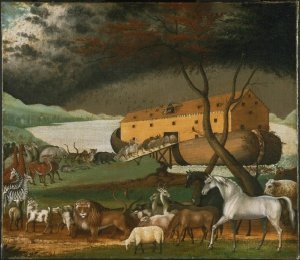
As a child, I was fascinated by the story of Noah. It presented images that both frightened and inspired; and I remember the fear I felt contrasted with my mother’s voice as she calmly read out the story to me. She sat on the side of my bed. I huddled under the blankets, grateful for her presence, dreading the outcome for those who scoffed at the idea of a great flood, knowing that I too, ignored many warnings sent to me.
As an adult, I am washed by love-dread emotions when reading the story. Perhaps the vivid pictures in my story book of drowning people banging against the side of the ark, pleading to be let in, still haunt me. As an adult, Jesus’ words today recall all the times I have thought I know the future better, all the times I thought I understood the past more deeply, and all the times I have lived my present without fully understanding myself and my surroundings. I think of our recent election in the U.S. and I wonder: who among us has taken heed of the prophecies, and who has not? Am I riding in the ark of Christ wondering if I have made the right decision? Or am I hammering at the side of the ship?
Jesus says: As it was in the days of Noah, so it will be in the days of the Son of Man; they were eating and drinking, marrying and giving in marriage up to the day that Noah entered the ark, and the flood came and destroyed them all.
Where am I in this story? Who has built the ark and how large is it? What other life does it carry? Does my name appear on the manifest?
Jesus says: Whoever seeks to preserve his life will lose it, but whoever loses it will save it.
What does this inversion mean for me today? How am I to enact this teaching in my life? How do I best demonstrate my love for God? Do I accurately reflect God’s image in a troubled world?
Jesus says: On that night, there will be two people in one bed; one will be taken, the other left.
Those who read scripture from a fundamental perspective preach the rapture, a time when the chosen are taken into heaven while the condemned are left behind. There are days and nights when I almost believe this notion, but then I remember how Jesus leaves the ninety-nine to find the one who is lost. I remember the stories of the prodigal son and his forgiving father, the woman at the well and the compassionate Jesus. I remember my mother sitting on my bed to read out the dreadful but lovely words of Noah and his family shutting themselves and the animal kingdom – two by two – into the ark to wait for another beginning.
Jesus says: As it was in the days of Noah, so it will be in the days of the Son of Man; they were eating and drinking, marrying and giving in marriage up to the day that Noah entered the ark, and the flood came and destroyed them all.
What are we to make of this story? How does it play out in our lives today? How different are we in 2016 from those who peopled the planet in the days of Noah? And how does this knowledge change the way we act as we go out into the world for a new beginning each day?
We have spent time with this psalm before and today we take a deeper look.
Do not touch my anointed ones. Do my prophets no harm.
How do we define faithfulness? Do we admire our ability to hang on no matter what? Are we stubborn to a fault in our persistence to see something through? Do we waver and zigzag in order to gain ground? Or do we model ourselves after Yahweh who is eternally faithful to his sheep?
Longevity. Perseverance. Constancy.
Do not touch my anointed ones. Do my prophets no harm.
Do we duplicate as much as possible God’s fidelity in our own relationships? Are we dedicated to truth and openness? Are we predictable? Do our relationships create a safe harbor?
Dedication. Predictability. Safety.
Do not touch my anointed ones. Do my prophets no harm.
What is it that stands in stark contrast with God’s fidelity? The pursuit of petty agendas? Egocentrism? Meanness of spirit?
Do not touch my anointed ones. Do my prophets no harm.
What do we need to jettison in our lives in order to create serenity and peace in our relationships?
Do not touch my anointed ones. Do my prophets no harm.
How do we imitate God’s bringing forth of unity out of schism?
Do not touch my anointed ones. Do my prophets no harm.
Can we see ourselves as prophets and anointed ones? If not, what do we want to change? How do we become one with such a one who loves so well?
Longevity. Perseverance. Constancy.
Dedication. Predictability. Safety.
For God all things are possible. In Christ all wounds are healed. Together with the Holy Spirit we are become one. We are invited to enter into holy communion with one another. We are invited to prophesy the Word of God. We are anointed in God. We are one in God. We are blessed in God. We are saved in God.
Do not touch my anointed ones. Do my prophets no harm.
Adapted from a reflection written on October 9, 2009.
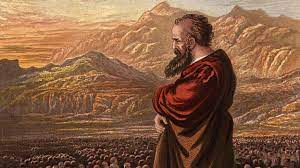
Clive Lawton presents off-beat portraits of some of the Bible’s greatest prophets. Click on the image from BBC Radio 4 at: https://www.bbc.co.uk/programmes/b0383kxs
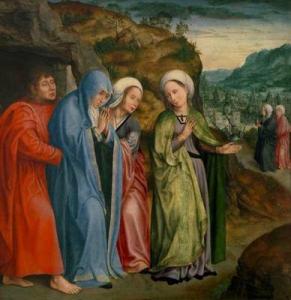
Quentin Metsys: John the Evangelist and the Three Women at the Tomb of Christ
Now there stood by the cross of Jesus, his mother, and his mother’s sister, Mary of Cleophas, and Mary Magdalen. (John 19:25)
The courage to do what others will not do. We might all, women and men, have the courage to minister to one another.
The women who had followed Jesus from Galilee went with Joseph and saw the tomb and how Jesus’ body was placed in it. (Luke 23:55)
The persistence to follow once we hear God’s call. We might all, women and men, find the tenacity to remain with one another in Christ.
“Woman, why are you crying?” Jesus asked her. “Who is it that you are looking for?” She thought he was the gardener, so she said to him, “If you took him away, sir, tell me where you have put him, and I will go and get him.” (John 20:15)
The fidelity to follow when there seems to be no hope. We might all, women and men, find faithfulness in the Holy Spirit.
We sat down and talked to the women who gathered there.One of those who heard us was Lydia from Thyatira, who was a dealer in purple cloth. She was a woman who worshiped God, and the Lord opened her mind to pay attention to what Paul was saying.After she and the people of her house had been baptized, she invited us, “Come and stay in my house if you have decided that I am a true believer in the Lord.” And she persuaded us to go. (Acts 16:12-15)
The women we find in scripture struggle against the norms of the times. They remain faithful to Christ and his promise of resurrection. They remain hopeful in good times and bad. They love endlessly with the love of the divine.
We might all, women and men, like the ministering women we see today, be willing to give voice to the voiceless, to persist where others weaken, and to share the startling good news that Christ has redeemed the world.
For more on Lydia, go to: https://www.biblegateway.com/resources/all-women-bible/Lydia
More than once in scripture we are counseled to keep eyes and ears open. The prophets encourage us, Wisdom Books advise us, and Jesus recommends to us that transformation begins with listening and watching. How then, can we go wrong by keeping our eyes and ears open?
Today’s reading also describes a symbolic preparation for exile. We are advised to do as the prophet has done – dig a hole in the wall so that we might escape under cover of darkness. All of this leads us to an examination of self.
What is in our baggage?
Our modern psychology has given us vocabulary we might use to describe the worries and anxieties we bundle and carry with us each day. Perhaps when we escape we might leave much of this behind and take instead our hopes and dreams.
Escape from what?
We become pigeon-holed by the world just as we pigeon-hole others. Perhaps we might escape this stunting habit and take up instead the loving behavior Jesus teaches us.
Why in the dark?
As small children we may fear the dark as we ask patient elders to turn on lights to ward off monsters. The darkness is the place where we decide to submit to fear or trust. As adults, we asked to step into the darkness of the future, knowing that the light of Christ is all we need to light our way. Perhaps we might allow the light of our discipleship to pierce the darkness for others.
Where are we to go and what are we to do?
The ancient patriarchs and their families placed all trust in God. Perhaps we too might step into radical trust and join in solidarity with others as we join Christ in his Way.
Who is the prince among us?
The prophet Ezekiel tells us that there is a prince among us who will shoulder his burden and set out in the darkness, going through a hole that he has dug in the wall, and covering his face lest he be seen by anyone. Perhaps we might open our ears and eyes to the words of Ezekiel as he foretells the kingdom of Christ. Perhaps we might hear and see the goodness of God amidst the darkness of the world. Perhaps.
He’s done it all and done it well. He gives hearing to the deaf, speech to the speechless.
God has gifted us with the gift of words. Today we reflect on the purpose of this gift and the use of our own words in our daily lives.
“Watch your words diligently. Words have such great power to bless or to wound. When you speak carelessly or negatively, you damage others as well as yourself. This ability to verbalize is an awesome privilege, granted only to those I created in my image. You need help in wielding this mighty power responsibly.
“Though the world applauds quick-witted retorts, My instructions about communication are quite different: Be quick to listen, slow to speak, and slow to become angry.Ask My Spirit to help you whenever you speak . . . If [people around you] are silent, pray before speaking to them. If they are talking, pray before responding. These are split-second prayers, but they put you in touch with My Presence. In this way, your speaking comes under the control of My Spirit. As positive speech patterns replace your negative ones, the increase in your joy will amaze you”. (Young 126)
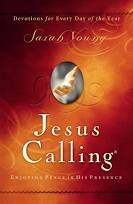
In her wonderful devotional, JESUS CALLING, Sarah Young bases daily reflections on scripture. She brings us wisdom that we might want to use in a modern climate of insults and one-liner sound bites are meant for broadcast news. Jesus comes to as THE WORD of the loving presence that created us in an image of goodness and compassion. When we take in the words that flood around us it is so frequently difficult to distinguish truth from lie; but what is easier to distinguish is ego versus selflessness, greed versus generosity, false fruit versus abundant fruit. When we are confused about whose words we are to believe or reject, Young presents us with a distillation of God’s message: we must rely on the Spirit for guidance, we must depend on Jesus as an example, and we must trust in the Creator who has created us in God’s image in and for love alone.
Tomorrow, healing the paralyzed man.
Young, Sarah. Jesus Calling. Nashville: Thomas Nelson, 2004. Print.
In this reading we see images of a merciful and sometimes wrathful God woven through practical pieces of advice.
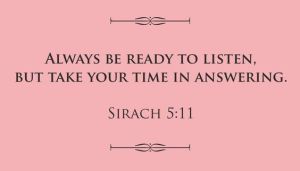
Do not say, “His mercy is great, he will forgive the multitude of my sins,” for both mercy and wrath are with him, and his anger will rest on sinners . . . Do not winnow in every wind, or follow every path. Stand firm for what you know, and let your speech be consistent. Be quick to hear, but deliberate in answering. If you know what to say, answer your neighbor; but if not, put your hand over your mouth.
Sirach reminds us that God is patient, forgiving, and understanding of our innermost thoughts and desires, and after reading the instruction from ben Sirach, we will want to explore not only our words and actions but our motivations as well. Why do we do and say what we do and say? When and why are we silent? When and how do we speak? When and where do we act? What do we value and how do we use the gifts we are given? Sirach tells gives us simple precepts for our complicated days.
Do not rely on your wealth, or say, “I have enough.” Do not follow your inclination and strength in pursuing the desires of your heart.
We live in a strange world of too many words and not enough clear information. In our search for clarity, we work to distill truth, measure honesty and reveal deceit. So often the advice of even the wisest among us is not enough so when we cannot see through the fog of abandoned promises, we must raise our eyes and hearts to the originator of our being. When we find ourselves on the knife’s edge of a demanding life, we place tired feet in the well-worn path of Jesus’ Way. And when we find ourselves falling into the depths of a dark and frightening well, we also find that we are falling not into nothingness but into the full and healing arms of the Spirit.
Sirach counsels us with his well-honed words. Jesus calls us with his proven Way. God leads us with a firm and guiding hand. And the Holy Spirit heals us as we move through wounding days. Despite all that frightens or wearies us, there is much to celebrate in our hearts and with others. Let us return to ancient advice that brings light to our darkness and joy to our hearts.
Sirach first gives us a list of “don’ts” for the road followed by what we must do
My child, do not cheat the poor of their living, and do not keep needy eyes waiting.
Do not grieve the hungry, or anger one in need.
Do not add to the troubles of the desperate, or delay giving to the needy.
Do not reject a suppliant in distress, or turn your face away from the poor.
Do not avert your eye from the needy, and give no one reason to curse you; for if in bitterness of soul some should curse you, their Creator will hear their prayer.
Endear yourself to the congregation; bow your head low to the great.
Give a hearing to the poor, and return their greeting politely.
Rescue the oppressed from the oppressor; and do not be hesitant in giving a verdict.
Be a father to orphans, and be like a husband to their mother; you will then be like a son of the Most High, and he will love you morethan does your mother.
These rules may be difficult to implement because they call for deep, transformative change. We may already have made these standards integral to our lives and if so, we will want to read on for more about the rewards of wisdom from Sirach. Wisdom teaches her childrenand gives help to those who seek her . . . Watch for the opportune time, and beware of evil, and do not be ashamed to be yourself . . . Do not refrain from speaking at the proper moment, and do not hide your wisdom. For wisdom becomes known through speech, and education through the words of the tongue. Never speak against the truth, but be ashamed of your ignorance. Do not be ashamed to confess your sins, and do not try to stop the current of a river. Do not subject yourself to a fool, or show partiality to a ruler. Fight to the death for truth, and the Lord God will fight for you . . . Do not let your hand be stretched out to receive and closed when it is time to give.
When we receive these rewards from Wisdom, it is not enough that we take them in. Sirach advises that we must speak, act and live in the confidence and knowledge. As New Testament people, we must live in The Way that Jesus encourages in us.