We are writing this so that your joy may be complete . . .
This is our anthem of love . . .
Sing it often . . .
Proclaim it aloud . . .
So that others may know this joy. Amen.
Spend some time today with the opening of John’s first letterof love to us by clicking on the scripture link above or here in this paragraph. Explore the four versions of these verses that have been selected. Choose another version by using the drop-down menus and examine the meaning of love in your life and where it is present in an unusual way. Say the prayer above or write your own prayer. Consider sending your Prayer to Love to another . . .
Tuesday, February 25, 2020: Sirach 8 & 9 – Part III
A Prayer for Friends and Friendship
The wisdom of Proverbs and Sirach may be dismissed as childish or old-fashioned, but this week we have seen the depth and breadth of their astuteness and their keen understanding of human nature. Today we see these verses as a welcome counterpoint to the material world and its headlong rush to acquire all that is new; we strive to keep all things in balance: Spurn not the discourse of the wise, but acquaint yourself with their proverbs; from them you will acquire the training to serve you in the presence of princes. Reject not the wisdom of the old ones which they have learned from their elders; from it you will obtain the knowledge how to answer in time of need. (Sirach 8:8-9)
In our modern age of hyper-communication we might draw into ourselves in fear as we hear constant news of conflict and violence. We may be tempted to look at all that is wrong and forget to look for all that is right with the world. Anxiety may outweigh optimism. Fear may trump trust. Self-protection and avoidance of vulnerability may outweigh our courage to enter into friendship with sincerity and integrity. If this is so, and if the familiar stories in scripture do not inspire us, we will want to return to the wisdom captured by Jesus ben Sirach, for he has much to offer us.
And so we pray in gratefulness for our true friends and in thanksgiving for the presence of Christ in our lives . . .
Good and gracious God, I thank you for the true friendship you have shared with me in the person of my friends. Keep me ever aware of their value. Remind me to thank them often. Guide me in returning their nurturing care of my humanity. Help me to recognize their divinity, just as these true friends affirm my divinity when I reflect you to them. Thank you for adopting me as your daughter. Remind me often that I am a citizen of the next world rather than one of this. Give me the patience to wait while the wine of relationships ages. I ask this in Jesus’ name, together with the friendship of the Holy Spirit. Amen
Let us give thanks today for the gift of friendship.
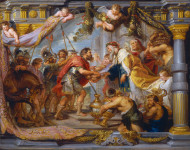
Reubens: The Meeting of Abraham and MelchizedekThe writer of this letter tells us today that with the arrival of one such as Jesus the old way of living in doubt and fear is ended. From the resurrection forward we live by a new order, a new covenant, a new intercession. Jesus has arrived to liberate all – no matter creed or race or origin. Jesus supersedes all – no matter nationality or ethnicity or orientation. Jesus fulfills all – no matter doubt or rejection or fear. This is wonderful news for us for it means that all that is good that we might possibly hope for is now guaranteed to each of us – and this promise is foreshadowed in humanity’s earliest stories.
From the CATHOLIC STUDY BIBLE: “Why is so much attention paid to a figure who appears only twice in Scripture? Because both appearances point toward Christ. In Genesis 14,7-20, Melchizedek is named a priest of God [although he was a Gentile!], whom even Abraham acknowledged. Logically, then, a priest descended from him would be superior to one descended from Abraham! And Melchizedek’s second scriptural appearance is in verse 4 of that very Psalm 110 which Christians regarded as a literal prophecy of Jesus’ resurrection. Melchizedek’s being ‘without beginning or end’ (because Scripture records neither his birth nor his death) is therefore an anticipation of the Son of God whose priesthood is eternally valid; conversely, Jesus is a priest ‘according to the order (rank) of Melchizedek’ (Ps 110,4). In his resurrection, Jesus became priest “by the power of a life that cannot be destroyed” (7,16). He ‘remains forever’ (7,24). His sacrifice is ‘once for all’ (7,27). He ‘lives forever to make intercession’ (7,25). The Jewish priesthood descended from Abraham cannot compete. God’s revelation in Jesus does not merely continue the former story, it raises it to a new plane. Jesus’ death and resurrection mark an absolute beginning”. (Senior RG 545)
Melchizedekcomes to us as a unique figure; we know so little about him and yet he holds so much importance. In a way, he mirrors many of us. History will record little about us and yet we each make an important contribution to the collective human story. Many will argue that we are far different from Melchizedek in that he was a priest and we are not. Yet others will reply that each of us – as followers of Christ – has the potential to sanctify, to bless and anoint.
This reflection does not present a theological argument but rather it posits a thought for us to mull and turn over. What do we know about Melchizedek? What does his relationship with Abraham and Jesus have to say to us today? How will our lives – and the lives of those we touch each day – improve as a result of our reflection on this mysterious man from the distant past? What and whom do we sanctify with our belief in the Living God? Why and when do we make our relationships holy – even with our enemies? How and why do we bless and anoint others with our words and actions?
What does the man Melchizedek mean to us today? And how do we show the world what we have learned from him?
Senior, Donald, ed. THE CATHOLIC STUDY BIBLE. New York, Oxford University Press, 1990. RG 545. Print.
Bridge over the Drina in Mostar, BosniaAs we read this chapter of Ezekiel we might be lured into what Richard Rohr – and many others – calls dualistic thinking.Decisions are made in a yes/no, black/white, off/on world. If we are able to step outside of our small perspective and move into a greater view of the world we understand that this kind of reasoning is dangerous in that it limits our vision . . . and therefore limits us. Rohr examines how life is a paradox in his blog posts at http://richardrohr.wordpress.com They are worth visiting as are his CD lectures, the webcasts and other resources on his Rohr Institute site at http://www.cac.org/ as we reflect on the way we think, the way we respond to conflict, and the way we seek resolutions to the difficult passages in our lives.
The portion of Ezekiel that we read today may be used as fuel for the fire of prejudice . . . if we allow the voice of revenge and conquest to go unchecked. As the recent events in our global community unfold, we are reminded that fanaticism can never be good. As my siblings and I grew, my Dad intoned to us regularly: Anything is a bad thing when taken to extremes . . . even a good thing.He understood that words like the ones we read today can be taken out of context, can be blown out of context and morphed in importance. Any single verse, Dad would say, when taken in isolation does not tell the whole story. Read the story. When my father and grandfather told us to read the whole story what they meant was this: stop, think, pray, listen, think, read, think, pray, share ideas, pray, think, pray . . . and act. We want to take this method with us as we plunge into Ezekiel’s words against the nations. To what does he call us?
The Old Testament Yahweh can be seen here as a god of vengeance and when we read these verses with anger in our hearts we might believe that God himself justifies the revenge we feel against those who have injured us; but we are also reminded that Yahweh’s love for creation knows no bounds.
The Old Testament Yahweh can be seen here as a god who exacts precise payment for wrongs committed; but we know that Yahweh’s generosity and compassion cannot be outdone when we remember his care for the enslaved and powerless.
The New Testament Jesus fulfills the promise of reunion and union first uttered by Yahweh.
The New Testament Jesus brings human hands and feet and voice to the mercy and compassion first shown by Yahweh.
When we find ourselves in turmoil and wishing to take revenge against the people who have injured us we must not let dualistic thinking close off possibilities of healing, reconciliation and union.
When we find ourselves in deep sorrow over a loss we have suffered we must not let simplistic rule-following to replace decision-making by a well-formed conscience.
When we feel ourselves being pulled into the vortex of darkness that would have us chant slogans that condemn, that would lead us to take an eye for an eye, that would ask us to rail against the nations . . . we must first stop to think and to pray, and to seek so that we might find . . . the forgiving, open, healing way of Christ. For it is Christ who embodies all that is good. It is Christ who brings us the outrageous hope that even the most dire circumstances may be righted. It is Christ who will help us to build bridges to the nations.
A re-post from September 15, 2012.
The name “Mostar” means “the city of bridges”. To read more about what happened to the bridges in Bosnia during the most recent Balkan wars, click on the image above or go to: http://balkansnet.org/mostar.html Follow more links on that page to read and reflect on reconciliation and revenge.
The New American Bible explains the inclusion of the letters of James, Peter, John and Jude in the canon of the New Testament saying that “early Christians saw the New Testament as the depository of apostolic figures to whom they are attributed”. That being said, there is ambiguity about the authorship of some of these letters; however, they were all written during the early “apostolic age” and as such are important to us – the apostles of the twenty-first century. What lessons can we take from them?
Scholars tell us that these letters demonstrate the true meaning of the word catholic. They underscore the idea that Christ came for all. Christ heals allwho seek him. Christ loves all. Christ answers allwho call upon him. So it follows that if we are Christ we, too, must have a universal view of humankind.
When I think of James, I love that he reminds us to be doersof the word and not sayers only. We cannot be saved by faith alone.
When I think of Peter, I remember that his letters did not make much sense to me until I had suffered greatly. Peter, Cephas the Rock, writes so beautifully of the way to suffer properly, of how to make our suffering holy and thus unite ourselves with Christ through the cross so that we become co-redeemers with Christ.
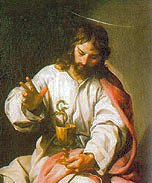
John’s letters, and in particular the first two, are beautiful anthems to love. They are surfacing as first readings at Mass this week and I am always struck by how they amplify the message of John’s lyrical Gospel, and how they give us a clear understanding that God is love and that love is God.
Jude’s one simple letter tells us how to live in a Christian community, how to beware of false teachers, and how to admonish one another properly.
Taken together or separately, there is much to be gained by sitting with a commentary and an epistle or two on a quiet afternoon to understand the allegory and the message meant for us . . . the modern apostles.
We seek God. We seek union and intimacy with God. This cannot be done unless we follow in the footsteps of those who shared bread with the Master. Jesus came as God’s expression of love to us, his creatures. He comes to us each day in the persons with whom we interact. He calls us to be the universal church.
God seeks us. He seeks union and intimacy with us. This cannot be done unless we allow our hearts to be open to the potential planted in us. We go to Jesus each day as we demonstrate our faith by loving God our creator fully. We go out to Christ each day as we unite with Christ, becoming co-creators of love. We become the universal church.
Jesus, breath of God, abide with us as we rise, become us as we go about our day, dream with us as we put our head upon the pillow at night. Jesus, we seek you even as you seek us. Amen.
Adapted from a reflection written on January 11, 2008.
Tintoretto: The Wedding FeastWhen I was a child, each time I heard this parable I thought the king to be a bit harsh. How was the man tossed into the night to know that he should have dressed up for the party? Hadn’t he been halted on his way down the road of life and invited suddenly to the Wedding? Now as an adult I understand that the point of this story is about being prepared always. It is about going about life as if each day holds an invitation for the Wedding. It is about rising each morning knowing that we are called. It is about taking the time each morning to put on the wedding garment before I step across my threshold into the world. It is about checking the garment for readiness several times a day. It is about laying out that garment each night as I go to my bed . . . in preparation for dinning the next day.
Christ is constantly prepared to receive us. God the Father is constantly guiding and protecting us. The Holy Spirit is constantly abiding and comforting us. Can I not be constantly mindful of these great gifts of being called . . . being protected . . . being loved?
May we never be reduced to silence as is the guest in today’s parable.
May we always be ready and willing to go to the feast.
May we always strive for constancy . . . just as our God is always constant with us.
A 1915 Postcard: New Year’s ResolutionsA new day dawns, a new year begins . . . we have before us a new opportunity for reconnection and rebirth. In today’s Noontimewe examine part of Paul’s farewell speech to the Ephesian elders in Miletus in which he lays out a kind of instruction manual for those whom he has brought into Christ’s infant church . . . and for whom he has great love.
As we begin a new year, we might resolve to take Paul’s admonitions seriously; we might decide to be faithful followers of the Gospel . . . and this may be more difficult than we first think.
I did not shrink from proclaiming to you the entire plan of God . . . As we begin a new year, let us resolve to be fearless in proclaiming the Good News to all we know. In our secular world it is so easy to say nothing when others rant about how the poor are lazy, about how we need to take back America from the immigrants. It is easy to remain silent in the face of such anger. It is convenient to forget that most of us are not descended from indigenous peoples.
I know that after my departure savage wolves will come among you, and they will not spare the flock . . . As we begin a new year, let us resolve to be both watchful and loving, and let us determine to be in the world but not of it. In a presidential election year it will be easy to join a drumbeat of complaint. It will be difficult to listen without judging. It will be awkward to express a view that is contrary to the majority.
Keep watch over yourselves and over the whole flock of which the Holy Spirit has appointed you overseers . . . As we begin a new year, let us resolve to maintain healthy boundaries as we take care of ourselves even as we tend to the needs of others. In a self-centered society we will often find ourselves alone when we advocate for the disenfranchised. We will be at odds with conventional wisdom. We will run counter to general opinions. We will struggle with knowing which work is our own and which is not.
Miletus: Agora with public buildingBe vigilant and remember that for three years, night and day, I unceasingly admonished each of you with tears . . . As we begin a new year, let us resolve to be prudent and compassionate in all that we do in Jesus’ name. In a time when a show of emotion is characterized as a weakness we will be against the tide. In an era when the phrase “personal responsibility” is used to erase God’s call to heal the broken-hearted and help the marginalized, we will stand out as different and even bizarre. We will be targets for people’s hatred.
In every way I have shown you that by hard work of that sort we must help the weak, and keep in mind the words of the Lord Jesus who himself said, “It is more blessed to give than to receive” . . . As we begin a new year, let us resolve to be determined to live out the Gospel message in our support of the marginalized. Let us acknowledge that the world will disparage who we are and what we do . . . and that Christ will be working right beside us.
When he had finished speaking he knelt down and prayed with them all . . . As we begin a new year, let us resolve to join others in prayer whenever and wherever possible to unite our voices and hearts in unison with the Creator. Let us recognize that the work of Christ’s disciples is difficult at best . . . but amazingly rewarding and well worth our personal cost.
Paul reminds the faithful that Christ’s call will run counter to what is comfortable or popular; yet Christ’s message will be wonderfully simple and beautifully plain. On this New Year’s Day let us remember the gift of Christmas as we resolve to both fashion and fulfill new resolutions that will ask much of us . . . but that will be well worth the sacrifice and even the pain.
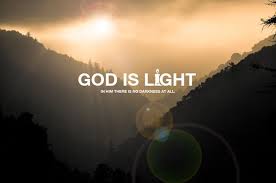
God is light, and in God there is no darkness at all. Can we imagine living a life with no dark corners and no cold secrets? Each day God offers us the opportunity to be light to the world.
If we walk in the light we have fellowship with one another. Can we imagine a world that values the common good over individual comfort? Each day God calls us together in the fellowship of the Spirit.
If we say, “We are without sin,” we deceive ourselves. Can we imagine love that forgives infinitely, heals endlessly, and guides faithfully? Each day God walks with us in the person of our brother the Christ.
God says: In the beginning was the Word, and the Word was with me, and the Word was me. Jesus was in the beginning with me. All things came into being through him and me, and apart from him and me nothing came into being that has come into being.In us was life, and the life was the Light of the human race. The Light shines in the darkness, and the darkness did not comprehend it.
God is light and we, God’s creatures, are created in this light. Let us share this good news with all who want to hear. Let us give thanks for this gift with all who have eyes to see. And let us extend God’s gift of light to others, even those who persecute us.