Suppose one of you has a hundred sheep and loses one of them—what do you do?
Jesus shows the path to us.
You leave the other ninety-nine sheep in the pasture and go looking for the one that got lost until you find it.
Jesus recalls our humanity for us.
When you find it, you are so happy that you put it on your shoulders,and with great joy you carry it back home.
Jesus models a faith-filled life for us.
Then you call your friends and neighbors together and say to them, “I am so happy I found my lost sheep. Let us celebrate!”
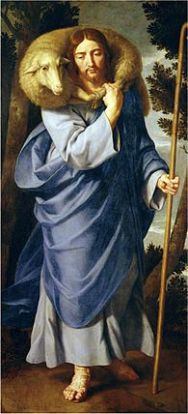
Jean-Baptiste de Champaigne: The Good Shepherd
When confronted with an enormous problem or a nagging worry, we consider the abiding faith Jesus shows us when he abandons the ninety-nine in search of the one. Might we be so courageous as to allow God to guide our actions? We also consider the hopeful persistence Jesus displays as he endures in his search for the one lost sheep. Might we persevere and allow God to bolster our work in the kingdom? And we consider the compassionate, joy-filled mercy with which Jesus celebrates. Might we be as exuberant in our love for even the darkest of our nights and the most difficult of our days, always knowing that these trials will ultimately bring us great joy?
When we use the scripture link and the drop-down menus to compare varying translations of these verses, we find that in our darkest circumstances, in our longest battles, and in the narrowest of places, Jesus shows us that with the Good Shepherd we might find the faith, hope and love to celebrate with great joy.
The Apostle Peter gives us advice we will want to explore when the path we cautiously tread leads us into oblivion.
So don’t lose a minute in building on what you’ve been given . . .we need to hear these words when we struggle to get through difficult days and endless nights.
Complementing your basic faith with good character . . .We need these verses when we have tried every suggestion, followed every lead, responded to every piece of advice.
Peter gives us specifics we may be looking past, increasing the chances that we discover The Word obscured by our state of oblivion.
Spiritual understanding . . .when we cannot comprehend our lives or the world around us, we lean back on the broad shoulders of Christ.
Alert discipline . . . when we seem to give in to every lure the world throws at us, we rely on the vigilance of the Spirit.
Passionate patience . . . when we have run out of steam and exhaust our resources, we trust the heart of Jesus.
Reverent wonder . . . when we have forgotten that this world offers nothing that lasts, we turn to the One who creates us.
Warm friendliness . . .when the world feels like a cold and lonely place, we turn to our brother Jesus.
And generous love . . .when we are disappointed or betrayed by those closest to us, we call on the Holy Spirit.
Each dimension fitting into and developing the others . . . when we allow Christ to pull the flying pieces of our days and the darkness of our nights into place, the fog rises and our way is suddenly clear.
With these qualities active and growing in your lives, no grass will grow under your feet, no day will pass without its reward as you mature in your experience of our Master Jesus. Without these qualities you can’t see what’s right before you, oblivious that your old sinful life has been wiped off the books. (THE MESSAGE)
When the chaos of bad news bends us down, Christ offers a way to rise. When the rumble of doubt threatens our carefully constructed peace, the Spirit offers a consoling heart that heals. When the realities of the world begin to pull us into oblivion, our loving God shows us the wisdom of discipline, patience, wonder, friendliness and love. Our generous God shows us the path that leads from nothingness to all.
When we spend time with other translations of these verses, the fog of oblivion fades as the light of Christ lights our path. Or enter the words 2 Peterinto the blog search bar and explore more wisdom passed on to us by Peter.
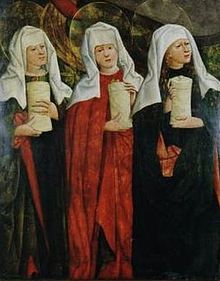
Mikołaj Haberschrack: The Three Marys, Mary Magdalene, Mary mother of Clopas, Mary mother of James
There were many women there, looking on from a distance, who had followed Jesus from Galilee and helped him. (Matthew 27:55 GNT)
For all the women who work in the margins of society to bring goodness out of darkness, we pray.
And many women were there beholding afar off, which followed Jesus from Galilee, ministering unto him. (Matthew 27:55 KJV)
For all the women who work for justice to bring change to corrupt systems, we pray.
Many women were also there, looking on from a distance; they had followed Jesus from Galilee and had provided for him. (Matthew 27:55 NRSV)
For all the women who keep quiet counsel as they nurture others through bright days and long nights, we pray.
And there were there many women afar off, who had followed Jesus from Galilee, ministering unto him. (Matthew 27:55 DRA)
For all the women who step forward to lead in spite of blatant barriers and the quiet whispering campaigns, we pray.
There were also quite a few women watching from a distance, women who had followed Jesus from Galilee in order to serve him. Among them were Mary Magdalene, Mary the mother of James and Joseph, and the mother of the Zebedee brothers. (Matthew 27:55 MSG)
For all the women in the world who follow Christ in deep fidelity, who hold hope against outrageous odds, and who love in the face of anger and abuse, we pray.
For all the women in the world, we pray. Amen.
To compare other translations of this verse, use the scripture link and the drop down menus, and give thanks for the sacred hands of many ministering women.
How much longer will you put off taking steps to possess the land which the Lord, the God of your fathers, has given you?
When the Hebrew people make their exodus from Egypt they are going back to the land that has been promised them by Yahweh. In today’s reading we arrive at the part in that story where several tribes have yet to realize their inheritance. Archaeologists have not found traces of the enormous migration described in scripture but what they dosee is evidence of cultures merging and reshaping as the peoples in the region struggle to survive through periods of famine and drought. The peoples sometimes unite against invaders. They sometimes strike out on their own to take over city-states and their surrounding territory.
Today we read about the precision and care the Israelites take in acquiring the land promised to them through the covenant established between Abraham and Yahweh. We also read about the care they take to include God’s influence and authority in their own plans. We might learn a good deal from this as we practice how to notput off taking steps to possess that which the Lord God has already given us.
We are given the gift of freedom; yet we sometimes allow ourselves to become trapped by the shackles we insist on acquiring.
We are given the gift of faith; yet we sometimes respond more to fear than reliance on God.
We are given the gift of hope; yet we sometimes sabotage our own possibilities of realizing potential.
We are given the gift of love; yet we sometimes hide this gift for fear of losing it.
We are given the gift of life everlasting; yet we sometimes cling more to life temporal in this world.
How much longer will you put off taking steps to possess the land which the Lord, the God of your fathers, has given you?
The Lord has promised us God’s care, God has assured us that we are the Lord’s, and God has already given us our inheritance. Do we abide with God in confident expectation? Do we take steps to explore and inhabit the land which God has promised? How much longer will we put off the taking of these steps?
Come aside to me, you untutored, and take up lodging in the house of instruction;
How long will you deprive yourself of wisdom’s food, how long endure such bitter thirst?
We remember the verses from Proverbs 9: Wisdom has set up her house and prepared her banquet.
I open my mouth and speak of her: gain wisdom for yourselves at no cost.
Take her yoke upon your neck; that your mind may receive her teaching.
Wisdom has sent her handmaidens to invite all who long for her consolation. (Proverbs 9)
For she is close to those who seek her, and the one who is in earnest finds her.
See for yourselves! I have labored only a little, but have found much.
Acquire but a little instruction, and you will win silver and gold through her.
Wisdom asks that we abandon our foolishness; she invites us to choose her path. (Proverbs 9)
May your soul rejoice in God’s mercy; do not be ashamed to give him praise.
Work at your tasks in due season, and in his own time God will give you your reward.
Wisdom knows that patience and openness to God bring us insight, understanding, strength and peace. Let us be faithful to the gift of God’s wisdom. Let us share in the hope of God’s Wisdom. And let us rest in the love and joy of Wisdom’s care.
This week we have looked at the many ways in which Jesus wants to heal us. We have seen him give sight to those who are blind, hearing to those who are deaf, and movement to those who are paralyzed. All he asks in return is that we use the gifts he freely gives us to bear fruit for the kingdom. Today we look at a Favorite adapted from a reflection written onOctober 26, 2009.
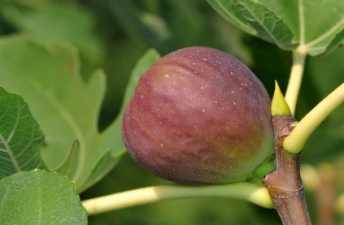
In today’s reading we come across a story that is troubling for some: the sudden way in which Jesus withers a fig tree that has not produced fruit. Here Jesus has just entered Jerusalem and has cleansed the temple of the money changers. In the next portion of this story we will see Jesus’ authority questioned and we will sit at the Master’s feet to listen to a series of parables. Footnotes tell us that we might see Jesus’ actions here as ill-tempered and arbitrary, but it is really a prophetic act portending the judgment that is to come upon Israel “that with all its apparent piety lacks the fruit of good deeds and will soon bear the punishment of its fruitlessness”. (Senior 45) Here too, besides this obvious portending of the future, Jesus affirms the amazing power of faith – that if we believe we too might cause trees to wither and mountains to be lifted up. What we read is a strange dichotomy that causes us to think . . . a tool which any good teacher will use: The placement of a puzzle before students so that they might be called to think outside of the normal typical story. What is Jesus doing when he withers the tree?
We might pose the theory that Jesus would win more converts if he had caused the tree to flourish; but then we miss the importance of our own free will. We, like the fig tree, have been planted in our particular place. We, like the fig tree, may have to exert ourselves to bear fruit. We, like the fig tree, will be held to an accounting of our stewardship of the gifts we have been given.
In one of our favorite stories, Queen Esther shrinks from the work she sees lying before her because she fears the loss of her own life and the lives of her fellow Jewish exiles. When she balks, her uncle Mordecai reminds her: Even if you now remain silent, relief and deliverance will some to the Jews from another source; but you and your father’s house will perish. Who knows but it was for a time like this you obtained the royal dignity? (Esther 4:14) Who knows for which moment in time our gifts are meant? Who are we to parcel them out in a miserly fashion or to decide to keep these gifts safely tucked away for ourselves?
In Luke 12:48 at the close of the parable about the watchful servant, we hear Jesus remind us that much will be demanded of those who have been given much. We might think of this today as we move through our many small and big chores. What is it we have been given that we are asked to share? What can we do to be certain to produce fruit with the gifts we are given? And do we ourselves have the faith to wither trees and move mountains?
Tomorrow, a gentle mastery.
Senior, Donald, ed. THE CATHOLIC STUDY BIBLE. New York, Oxford University Press, 1990.45. Print.
Then Jesus said to him, “See that you say nothing to anyone; but go, show yourself to the priest, and offer the gift that Moses commanded, as a testimony to them.”
Scholars speculate about Jesus’ request that those he cures tell no one about their healing. We find this request in a number of places in Matthew: 12:15-16, 16:20, 17:9 and we notice that neither Jesus nor Matthew rebuke the exuberance of those who receive Jesus’ gift. In the HARPERCOLLINS BIBLE COMMENTARY we find this statement: “[T]hough Jesus did not seek to attain ‘celebrity status’ for his miraculous powers, the effects of his works were simply too marvelous to be kept a secret”. (Meeks 881)
Perhaps we need to point this out to those who are our sports and entertainment icons. Celebrity is a gift to be treasured and used well.
Catholic monk welcomes Muslim worshipers in a church in Nice
Many crowds followed him, and he cured all of them, and he ordered them not to make him known. (Matthew 12:15-16) Then he sternly ordered the disciples not to tell anyone that he was the Messiah. (Matthew 16:20)
In the CATHOLIC STUDY BIBLE commentary tells us that, “To this [Matthew] adds a full citation from the First Servant Song (Is 42, 1-4) . . . emphasizing the meekness of Jesus, the Servant of the Lord, and foretelling the extension of his mission to the Gentiles”. (Senior 26)
Perhaps we need to point this out to those who would be our social or political leaders. Power is strongest when used in service to the poor and broken.
As they were coming down the mountain, Jesus ordered them, “Tell no one about the vision until after the Son of Man has been raised from the dead.” (Matthew 17:9)
Others speculate that Jesus was waiting until a particular moment to reveal his true nature to the world. Again from the CATHOLIC STUDY BIBLE commentary: “[O]nly in the light if Jesus’ resurrection can the meaning of his life and mission be truly understood; until then no testimony to the vision will lead people to faith”. (Senior 37)
Perhaps we need to point this out to our religious leaders. Influence is purest when used in the Spirit of the Living God.
And he sternly ordered them not to tell anyone about him. (Mark 8:27-30)
Muslim faithful walk behind a religious man as they attend Mass in tribute to slain priest
Jesus asks his closest followers to refrain from announcing his presence to the world. From the CATHOLIC STUDY BIBLE commentary: “Jesus acknowledges this identification [as messiah] but prohibits [the disciples] from making his messianic office known to avoid confusing it with ambiguous contemporary ideas on the nature of that office”. (Senior 81)
Perhaps we need to point this out to ourselves. Humility, sacrifice, and an authentic reverence for the Way that the Living God asks us to live. These are the marks of authentic leaders and followers.
Our modern society and instant global communication have brought a new tension to our lives; but they have also brought a rapid means of connecting with others in a positive and healing way. We must look for constructive strategies to form solidarity with those who carry the good fruits of Christ’s story into the world. “Tell no one,” Jesus said in the beginning of the ministry. Now that his resurrection has begun the transformation of the world, we must not lose heart. Now we must tell everyone we know the Good News that Jesus is among us, calling each of us to a life of faith, hope, peace and love.
Representatives of the Muslim community go to Catholic Mass at Milan’s Santa Maria
Today, let us consider an act of solidarity we might make with others as we speak to our own entertainment, sports, political, social, and spiritual leaders and ask for lasting peace that transforms society.
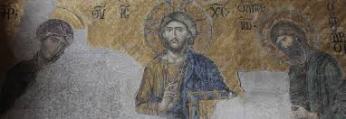
Jesus icon in St. Saviour Church: Chora, Istanbul, Turkey
The stories of Jesus’ healing are perhaps the most loved. They tell us in the modern era what we want and need to hear. Miracles happen. Outrageous hope is possible. Love changes everything. Faith, the cornerstone of discipleship, rises from our constant communication with God and brings reward greater than any power, wealth or fame. But to all of this goodness and compassion too many of us are too often blinded by the lures of the world that surrounds us. So great is God’s love for each of us that we are given the daily opportunity to choose Mammon or God. The blind men in today’s story choose God.
THE MESSAGE translation brings this familiar story home in a powerful way.
Two men cry follow Jesus and cry out to him, pleading for sight so they might more fully enter life. And so Jesus said to them, “Do you really believe I can do this?” They said, “Why, yes, Master!”
How often do we ask for God’s help? How often do we reply, “Why, yes, Master!”
St. Saviour Church: Jesus heals Two Blind Men
He touched their eyes and said, “Become what you believe.” It happened. They saw. Then Jesus became very stern. “Don’t let a soul know how this happened.” But they were hardly out the door before they started blabbing it to everyone they met.
Do we believe that we become what we believe? Do we covet what others have or what others are?
It happened. They saw.
Does our worldly doubt overcome our spirit’s hope? Do we turn to God when we are in turmoil or fear? Do we blab the good news to others or hold it for ourselves? Do we ask for sight and wisdom only to ignore or abuse the gift once it is given? Do we decide that Jesus’ ancient words do not suit our modern world?
Become what you believe.
St. Saviour Church in Chora, Istanbul, Turkey
We are so often blind to so much that takes place around us and this is not surprising since the world is a dichotomy of faith-inspiring creation and the frightening ugliness of evil. But we are created in God’s image, created to rise to the hope of God’s creation, created to sing in harmony with God’s Spirit. So rather than reject with cynicism the possibility of Jesus’ presence in our lives, let us share – as do these two cured men – the goodness and enormity of God’s love. When we find that we are blind . . . let us ask for Jesus’ healing . . . and let us celebrate the miracle of his love.
Compare THE MESSAGE translation of these verses with others using the scripture link and the drop-down menus to see how Jesus speaks to us today through this story.
Tomorrow, why does Jesus ask these men to keep silent about the miracle of their healing.