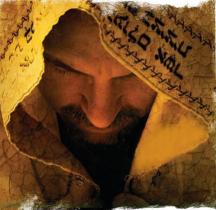
Even if we have spent time with this prayer before it is well worth our while to spend time with this chapter; it reveals a Christ who is eager to pray for each of us . . . directly . . .
I pray not only for them [my apostles gathered around me], but also for those who will believe in me through their word, so that they may all be one, as you , Father, are in me and I in you, that they may also be in us, that the world may believe that you sent me.
And we dobelievethat God sent Jesus – The Word, God’s Expression of Self to Us.
We do believe that God is in Jesus and that God is in us – and that we are in Jesus and God.
We do believethat we are given glory.
We do believe that we are to be brought to perfection as one.
We do believethat we are a gift to Jesus and to God.
We dobelieve that Jesus’ love is in us and that we are in him as love, a love that knows no bounds, no impossibilities, no constraints, no conditions, no barriers, no darkness, no death.
We dobelieve!
Written on April 17, 2008 and posted today as a Favorite.
This is welcome news: There will be an end to lies! There will come a time when false prophets, manipulation, back-stabbing, advantage-taking, favoritism, cronyism, self-preservation at the expense of others – all the trappings of a society which does not understand Jesus and his story, all of this will be swept away. Thanks be to God.
The NAB translation of verse 6 (What are these wounds on your chest?) is a change from the Douay (What are these wounds in the midst of thy hands?)is accompanied by an explanatory footnote. “The false prophets, like the prophet of Baal (1 Kings 13, 28), apparently inflicted wounds on themselves; to defend himself against the accusation of being a false prophet, a man will deny having inflicted wounds on himself and say instead that he received them at home, ‘in the house of my dear ones.’ In the liturgy this text is applied to Christ in an accommodated sense.”
The deepest wounds are those we receive from the ones we love best. The deepest wounds are those we inflict on the ones we love best. Jesus was betrayed by one of his twelve; and betrayal stings most when suffered at the hands of one we love.
Christ’s wounds of hands, feet, side, head and heart were suffered at the hands he loved most – humankind. In this act he joins with all of us who likewise suffer; yet, Zechariah tells us that there will be end to this suffering. His prophecy was written to encourage the Jews who had returned from exile to rebuild the city and temple of Jerusalem. We might take heart as we re-read his words. From what exile do we return? What false prophets must we remember as gone and put away? What changes must we make in our decisions and our habits? What city are we dreaming? What temple are we preparing? What life are we building as we walk away from falsehood?
Written on July 24, 2008 and posted today as a Favorite.
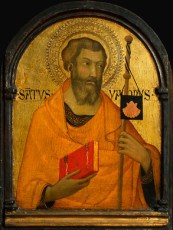
St. JamesCrucifixion. We return to Mark today to read and reflect on the crucifixion of our Lord, our God who came to live and walk among us. Who came to be one of us so that we might be one with him.
In August we celebrate the feast of Saint James, the brother of John the Beloved Apostle. James was executed by beheading as ordered by Herod sometime around the year 42; today he is the patron saint of Spain. James answered the call he heard. James took of the cup offered by Christ and became one of the early martyrs who chose to die in this life in order that he follow Christ both in this world and the next.
Today’s Gospel repeats the story we know so well of the mother of James and John asking Jesus to place her sons – the sons of Zebedee whom Jesus nicknamed Boanerges (The Sons of Thunder) – at his right and left once the kingdom about which he spoke had arrived. Her sons were present with Peter at the raising of Jarius’ daughter, at the transfiguration and in Gethsemane. They followed Jesus during his ministry and they certainly deserved special recognition in their mother’s eyes. I like Jesus’ reply: that these are the decisions best made by the Father.
This message from the Gospel is what reminds me that when things are not going as I see best for most: I must remember that just as the Son of God defers to the Creator on matters such as these. And so ought I.
Jesus suffered torture and crucifixion as an act of redemptive, salvific love. If we wish to take up this same cup, we must be willing to enter into the sacrifice. We do this best when we trust God, trust Jesus, trust the Holy Spirit. Our strength and our true power as co-redeemers with Christ lie in our trust, trust that our own suffering has value, trust that our own worth is seen by God and will be seen by all, trust that we are delivered through and with and in Christ.
From MAGNIFICAT earlier this week: Let us pray in the name of all who are suffering in our day the pain of the cross: Turn your ear to us; hear our words!
Lord, you are the Justice of God, but you were condemned as a criminal: strengthen in forgiveness those who are unjustly condemned. Turn your ear to us; hear our words!
Lord, you are the truth of God: deliver from harm all those who are threatened by lies. Turn your ear to us; hear our words!
Lord, you are the love of God made visible: save all those who are menaced by hatred, cruelty, and abuse. Turn your ear to us; hear our words!
James, John, Mary Magdalene and the other apostles followed Jesus trusting all that he had revealed to them. Christ is physically present to us in the people he sends to us and in The Word we read each day. Let us prepare to take up the Cup of Sacrifice with courage and joy in our hearts.
Written on July 25, 2008 on posted today as a Favorite.
Van der Weyden: Mary MagdaleneA Favorite from July 22, 2008.
The Evangelists tell us that the Resurrected Jesus first appeared to Mary Magdalene. July 22 is her feast day. When we pause to reflect on this singular woman, we wonder, what must she have been truly like? What was she thinking as she stooped to look into the tomb as John tells us in his Gospel? What is her real story?
St. Gregory the Great tells us something of her character. From MAGNIFICAT: It is true that she had already seen that the sepulcher was empty, and had already reported that the Lord had been taken away. Why did she stoop down again, why did she long again to see? It is not enough for a lover to have looked once, because the force of love intensifies the effort of the search. She sought a first time and found nothing; she persevered in seeking, and so it happened that she found him. It came about that her unfulfilled desires increased, and as they increased they took possession of what they found.
From the Mass readings: The Bride says: on my bed at night I sought him whom my heart loves – I sought him but I did not find him. I will rise then and go about the city; in the streets and crossings I will seek him whom my heart loves. I sought him but I did not find him. The watchmen came upon me, as they made their rounds of the city: Have you seen him whom my heart loves? I had hardly left them when I found him whom my heart loves. (Song of Songs 3:1-4b)
O God, you are my God whom I seek; for you my flesh pines and my soul thirsts like the earth, parched, lifeless and without water. ( Psalm 63)
What is the Magdalene’s story? Why does she come with the other women, worrying about who will move away the stone, carrying the funeral spices? Why does she return, bending to look another time when she knows the tomb to be empty?
Henryk Siemiradzki: The First Meeting of Christ and Mary MagdaleneThe Magdalene believes. She trusts. She hopes. She endures. She perseveres. She will not be turned away. She loves.
Any one of us who has truly loved understands this force of love about which St. Gregory writes.
Any one of us who has sought that which has been lost has felt this sorrow.
Any one of us who has persisted in our search has found this joy.
And so we wonder, what is the Magdalene’s real story?
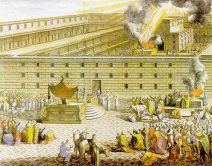
Building the Jerusalem TempleFrom time to time as we reflect at noontime, we have read about the Jerusalem temple, the holy of holies, the wisdom and power of Solomon, and relations between peoples of the Middle Eastern region. Today, as we read this chapter, we might think ahead to what we know happens to this temple, this man, and these peoples. Our thinking will bring to us many questions.
How is that measurements are scrutinized, forests are felled and then bound into rafts and ferried to the construction site, masons, carpenters, goldsmiths and sculptors are employed, splendor rises from the earth; yet, we manage to forget the covenant which gives birth to the plan in the first place?
How is it that we take so much care with our time and resources to plan, prepare and produce something so worthy of so much praise from so many; yet, we fail to tend to the principles that make this construction or this plan worthy to begin with?
How is it that we enter into so many relationships, make so many plans, see them through and then walk away from, or worse – we defile, the beauty and serenity that has coalesced around these relationships? What is it about human beings that can ignore the taste of the manna, the smell of the cedar, the sight of the gold, the touch of the friezes, the sound of so many kneeling in prayer?
The stones for this temple were formed at the quarry before taken to the construction site so that the sound of hammer on chisel would not disturb the peace of the house of God. Yet we know that years later the people, their priests and political leaders would bow to the corruption of ungodly customs. How did sacrificing babies become a fit practice for the people of God? What was left out of these careful preparations that this kind of malpractice could not be foreseen and forestalled?
One of today’s Morning Intercessions in MAGNIFICAT catches my eye: For those who delay examining their decisions and habits: let them see how quickly life passes. O Lord, listen to our prayer.
Perhaps it was not that the plans we read about today left something out. Perhaps it was that the people and their priests and their political leaders did not continue to examine their collective conscience. Perhaps the prophets’ words fell on the ears of those who were delaying the examination of their decisions and habits. Perhaps the people, their priests and their political leaders did not see how quickly life was passing them by.
This afternoon and this evening as we enter into prayer, we may want to support one another as we examine our decisions, our habits, and our preparations.
Do our actions rise from the Gospel story?
Do our decisions and habits respect human life and nature?
Do we give light to all?
Are our decisions and habits worthy of being written about or recorded?
John Everett Millais: EstherWe have no way of knowing what plans are schemed against us. We have no method of seeing into the private places where the covetous lie on couches to weave their plots that entangle others. We canbe certain, however, that when the faithful find themselves the victims of these plots – as the Jews do in the story of Esther – that God will redeem God’s people, will release them from oppression, and will decide how the connivers are to be judged.
In the story of Mordecai and Esther, Haman becomes jealous because Mordecai does not play the game of courtier as Haman would wish, yet has influence and prestige – which Haman covets. Rather than find union with Mordecai, Haman builds a gibbet on which to hang his perceived enemies only to see his family executed and himself led to the scaffold on which he had meant to exterminate the Jew he so hated.
For several weeks we have been reflecting on honesty versus deceit and today we find another clear lesson of what is expected by God of the faithful. Earlier in Chapter 4 when Esther tells her uncle that she is afraid to go to the king to tell him of Haman’s plot, Mordecai reminds her that the faithful must do as God bids for if they do not, God will find another willing to do the work. Then Mordecai reminds his niece of the fate she will suffer if she goes against God’s will (4:14).
So when we read these later chapters – and when we spend time praying, meditating and reflecting on God’s word to us – we know that we, too, hear the words of Mordecai, we also feel the tremors which Esther feels when she sees a task looming before her that is too great to bear. It will serve us well to read this story from beginning to end, including the later insertions, and to ponder God’s plan for us as we move through our days.
We need not worry about plots schemed against us; nor do we need to create a plan of reprisal. We onlyneed to be constant to God each day, to maintain our covenant, to lay all problems at God’s feet for resolution. For this is the only way we will find peace amid the noise of the world. This is the only path to a serenity that lasts and sustains. This is the only true Way in which to live the gift of Life.
Written on June 15, 2008 and posted today as a Favorite.
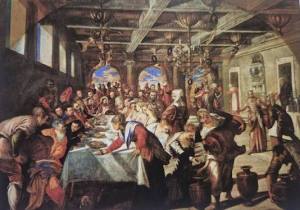
When I was a child, each time I heard this parable I thought the king to be a bit harsh. How was the man tossed into the night to know that he should have dressed up for the party? Hadn’t he been halted on his way down the road of life and invited suddenly to the Wedding? Now as an adult I understand that the point of this story is about being prepared always. It is about going about life as if each day holds an invitation for the Wedding. It is about rising each morning knowing that we are called. It is about taking the time each morning to put on the wedding garment before I step across my threshold into the world. It is about checking the garment for readiness several times a day. It is about laying out that garment each night as I go to my bed in preparation for dinning the next day.
Christ is constantly prepared to receive us. God the Father is constantly guiding and protecting us. The Holy Spirit is constantly abiding and comforting us. Can I not be constantly mindful of these great gifts of being called, being protected, being loved?
May we never be reduced to silence as is the guest in today’s parable.
May we always be ready and willing to go to the feast.
May we always strive for constancy just as our God is always constant with us.
The people healed by Christ respond with worship, they recognize that God moves among them in the person of Jesus and so, they give thanks.
I am wondering how many times I have been healed by the Christ who comes to me through friends, colleagues, students, family or even strangers. I am certain that it has been frequent. When these miracles happen, do I pause long enough, ardently thanking the God who created us? Do I ask for the next miracle as soon as this one has passed? Do I pause to allow the mystery of my encounter with God to sink into and through me?
Am I waiting actively, patiently, openly, honestly?
And for what am I waiting? An end, a beginning, a renovation?
This I know, I know that love endures an, that patience brings wisdom, and that I need not know every turn of the road that lies ahead of me. This I know, that I am well-loved, well watched over. Every small problem is noted. Each tiny sigh is heard. All sorrows and tears are seen and tended to.
We need not worry about what is to come. We only need worry about our reaction to the healing we receive each day in so many small ways. It is always the small things that matter.
Today’s Gospel is from Mark (5:21-43) in which we hear again the stories of the raising of Jairus’ daughter and the healing of the woman who suffered from endless hemorrhages. They were healed quickly and fully by Christ’s hand and life’s inversion showed itself to them completely. Christ walks among us today beckoning, calling, touching and healing. What more do we want? What do we seek? What is it we long for? Is it possible that in Christ’s inversion the miracle we search for has already touched us? Is it possible that we have allowed this healing to pass by or go entirely un-noticed, or noticed and not fully praised?
A re-post from July 2, 2012.
For more on the stories in today’s Gospel, enter the words The Tassles on Our Cloaks into the blog search bar and explore.
Desire, love, lust. Lashing back in hurt and surprise, angry retaliation, calculated revenge. Family relations churn and twist as we read this story which is similar and yet different from the stories of Bathshebaand Dinah, as the HARPER COLLINS COMMENTARY points out. Family values and family sickness shatter human lives as these people roil in deceit and turmoil. David, the father, king and leader, does nothing – can do nothing – but watch as his family self destructs for he himself is culpable. As the commentary states: David’s hands are tied because his sons are merely mimicking his own sick behavior. These people seek intimacy with one another and with God and do not find it because they look in the wrong place. True intimacy lies in the process, in the journey, in the progress of the soul.
From today’s MAGNIFICAT:
There are two messages today: first, we have to hold on to absolute responsibility for real order and commitment to the Lord God. Second, the fundamental character of life is a true waiting, hard for Occidentals to comprehend, especially for modern people. Life means waiting, not Faust-like grasping, but waiting and being ready. We are waiting for the terror of the night, and waiting for the day when this terror will have passed. “The people will languish from fearful expectation.” Anyone who remains stuck, waiting in fearful expectation just to see whether or not he will survive, has not yet laid bare the innermost strata. For the fearful expectation was sent to us in order to remove our false sense of security and behind it is this other metaphysical waiting that is part of existence. Man is always in danger of rooting himself, of running aground. Over and over again, life will shake anyone who waits in that way, in order to make him hurry out to meet what is coming. Then what vitality he has been given will come to life. Then he will feel that life goes above and beyond individual lives. Only in this way will he be truly human, by living above and beyond himself, waiting for the final reality. That is the reason for this striving and seeking further and knowing it will one day come: to wait until the lights flare up.
We have more expectation than earth can grant, because what we encounter in only a piece of reality, a piece of creation. We are waiting for the fulfillment of a promise: You will one day possess all this because God, as God, is himself reality, realness, and intimacy.
Father Alfred Delp, S.J. – condemned to death in Germany in 1945
If we might only think about the dual choice that faces us daily – complaining or rejoicing.
If we might only seek what is best for us today – our singular selves or our unity with God.
If we might only become one with God today, and all days, how much better we might see God’s creation and our place in it.
 Even if we have spent time with this prayer before it is well worth our while to spend time with this chapter; it reveals a Christ who is eager to pray for each of us . . . directly . . .