Over the last month we have sung a hymn in time of national struggle, we have argued with the Almighty, gone beyond human limits, reflected on narcissism and considered what we might learn from the story of Esther. Today we settle into these verses from Paul’s letter to the Corinthians.
Even though on the outside it often looks like things are falling apart on us, on the inside, where God is making new life, not a day goes by without God’s unfolding grace.
In the midst of turmoil, there is the promise of renewal.
These hard times are small potatoes compared to the coming good times, the lavish celebration prepared for us. There’s far more here than meets the eye.
Despite the pain that feels eternal, hope rises with the promise of restoration.
The things we see now are here today, gone tomorrow. But the things we can’t see now will last forever.
Although our fears bring us insurmountable anxiety, we have the assurance of transformation.
God puts a little of heaven in our hearts so that we’ll never settle for less.
In all times and in all places, in all sorrows and in all joys, God’s grace remains. Once we recognize this, we never settle for less.
When we compare this translation of today’s reading with others, and when we weigh our troubles with the promise of the covenant, we know that each day God’s grace brings us more than meets the eye.
Before we leave the story of Esther, we re-visit a Favorite from May of 2007. Today we consider the nature of our repentance as we move closer to the season of Lent; and we commit to enacting the fidelity, hope, and love we profess.
From the introduction in the New American Bible, “The book was intended as a consolation for Israel, a reminder that God’s providence continually watches over sincererepentance.” We have been hearing about sincerity versus insincerity in recent weeks. And again we see it today.
Yesterday’s first reading is from Sirach 17:24: “But the Lord will allow those who repent to return to him. He always gives encouragement to those who are losing hope.”And yesterday’s morning Psalm was 130:“My soul is waiting for the Lord, I count on his word. . . Because with the Lord there is mercy and fullness of redemption, Israel indeed he will redeem from all its iniquity”.
There is hope for all; yet, how do we show our gratitude for redemption? By being doers of the word and not hearers or sayers only. We show our sincerity before the Lord by not deluding ourselves.
This morning’s reading is one of my favorites from James, “Be doers of the word and not hearers only, deluding yourselves. For if anyone is a hearer of the word and not a doer, he is like a man who looks at his own face in a mirror. He sees himself, then goes off and promptly forgets what he looked like. But the one who peers into the perfect law of freedom and perseveres, and is not a hearer who forgets but a doer who acts, such a one shall be blessed in what he does.” (James 1:22-25)
May we be hearers, sayers, and doers of the Word. May we persevere in our doing. And may we, like Esther, live up to our potential in order that we too may save nations.
The book of Esther, with all of its additions and amendments, is a wonderful story. We must read it when we can.
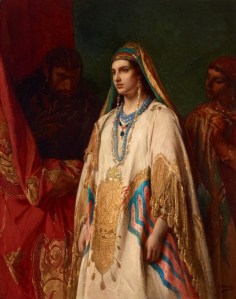
Pietro Paolini: The Intercession of Esther with King Ahasuerus and Haman
Thursday, February 20, 2025
The survival of a minority is central to the story we have explored over the last two weeks; and the threats and schemes we see in Esther’s story speak to many among us today. The reality of vulnerability rises as power corrupts. Those who live in the shadows of affluence live without the security taken for granted by the privileged. We excuse discrimination. We nurse prejudices. Rather than find root causes for the demons that stalk us, we build protective walls around our comfort zone and describe “the other” as someone to fear. Esther tells us of the danger we invite when we nurture our contentment to overlook the powerful effects of envy. None of this is limited to ancient times. Indeed, too often we live this way today.
Haman was furious when he realized that Mordecai was not going to kneel and bow to him, and when he learned that Mordecai was a Jew, he decided to do more than punish Mordecai alone. He made plans to kill every Jew in the whole Persian Empire. (3:5-6)
When we re-read these verses and insert the names we see in our headlines today, we bring this story into focus. Dislike for “the other” we do not know – or whom we do not understand – plants seeds of hatred. In contemporary society, a torrent of news loops waters nascent loathing, while social media filter bubbles create hothouses that spur growth of hatred. Those along the fringes of society find themselves far from any possible avenue of inclusion.
Haman hurried home, covering his face in embarrassment. He told his wife and all his friends everything that had happened to him. Then she and those wise friends of his told him, “You are beginning to lose power to Mordecai. He is a Jew, and you cannot overcome him. He will certainly defeat you.”(6:12-13)
If we hope to build the bridges God asks us to build, we must open ourselves to the fear of others to offer assurance. Only then will we find the tools to create unity.
If we hope to inspire the compassion Christ asks us to nurture, we must ask gentle questions with patience and understanding. Only then will we find the courage to respond to God’s call.
If we hope to build peace in a world longing for harmony, we must act in the Spirit to include, to heal, to love. Only then will we begin to erase the lines that create the margins on which too many live.
Tomorrow, a final word from Esther as we move toward our Lenten journey.
When we compare other translations of these verses, we begin to find our way through the fog of hatred.
We are quickly approaching Ash Wednesday when we will begin our Lenten journey of discovery, renewal, and transformation. We have two weeks to contemplate the state of our world and our personal circumstances. We have reflected on the violence in Esther’s world and in our own. Today, amidst bloodshed and reversals, and despite our fears, we find a way to give thanks.
In the apocryphal verses of this story, we hear Mordecai declare his praise for God’s providence. We too, might announce our acclaim.
Then Mordecai said: “This is the work of God. I recall the dream I had about these very things, and not a single detail has been left unfulfilled – the tiny spring that grew into a river, and there was light, and sun, and many waters”.
In the apocryphal verses of this story, we hear Mordecai describe God’s river of compassion, and the river is Esther. We too, might affirm God’s love.
“The river is Esther, whom the king married and made queen”.
In the apocryphal verses of this story, we hear Mordecai announce his gratitude for God’s power. We too, might proclaim our appreciation.
“The Lord saved his people and delivered us from all these evils. God worked signs and great wonders, such as have not occurred among the nations”.
In the apocryphal verses of this story, we hear Mordecai assert his joy for God’s presence. We too, might broadcast to anyone who will listen our confidence that God also abides.
“Gathering together with joy and happiness before God, they shall celebrate these days on the fourteenth and fifteenth of the month Adar throughout all future generations of his people Israel”.
With these apocryphal verses, we experience the river that is God’s power, fidelity, hope and mercy. And this river is Esther.
It is interesting that at the close of this story, we see Xerxes and Mordecai as heroes, while Esther – for whom the book is named – slips into the background. This is, of course, indicative of the ancient world in which society regarded women as possessions rather than full persons. We might then determine that the more important message is this: God loves the faithful so well and so endlessly, that salvation arrives in a time if crisis.In our contemporary era of unease, we hear this message gladly. This is good news for those who are beleaguered in physical, emotional and spiritual ways. This is redemption for those who work at transformation. This is deliverance for those who suffer.
Living in exile, Esther keeps her Jewish heritage secret. As a woman with little influence in her own life, Esther moves quietly through Xerxes’ court, maintaining a low profile. Mordecai’s petition for her assistance pulls Esther out of anonymity and moves her into a life that requires courage, patience and wisdom; and we watch as she relies on God for these qualities.
We have much to learn from this young woman who allowed herself to be led by the source that created and called her. When do we speak up? Why do we remain silent? We have much to explore in her story of quiet obedience and patient trust. When do we question? Why do we follow?We have much to share about the wisdom of this brave young woman. When do we celebrate? Why do we rejoice?
Today we ask . . . what have we learned from Esther?
Tomorrow, Mordecai’s dream . . . Esther is the river.
To learn more about the festival of Purim, click on this image or visit http://www.chabad.org
Monday, February 17, 2025
The jolly festival of Purim is celebrated every year on the 14th of the Hebrew month of Adar (late winter/early spring). It commemorates the salvation of the Jewish people in ancient Persia from Haman’s plot “to destroy, kill and annihilate all the Jews, young and old, infants and women, in a single day,” as recorded in the Megillah (book of Esther). (www.chabad.org)
In our Old Testament thinking, we celebrate victory over plotters who schemed to annihilate us. In our New Testament thinking, we ask God to soften the hearts of our enemies. In our Old Testament thinking, we commemorate the destruction of those who would harm us. In our New Testament thinking, we celebrate their transformation. In our Old Testament thinking, we rejoice with Purim in the month of Adar. In our New Testament thinking, we ask for God’s mercy each day.
We first reflected on this citation in June of 2013. Today, as we seek to soften our own hearts, we remember that just as reversal is always possible for our enemies, it is always possible for us. For this reason, we give thanks for our modern Purim.
Tomorrow, quiet patience and courage.
For a prayer, enter the word Reversalinto the blog search bar and explore.
Esther 7 concludes abruptly with the hanging of Haman. We have perhaps looked for this outcome, hoping for the justice we desire in our own lives. We suspected that inversion will take place and that the plotter will suffer the fate he planned for others; but these outcomes have not halted the plot to annihilate the Jewish nation. Today we watch as Esther and Mordecai take steps to stop the impending slaughter.
With New Testament thinking, we shrink from the violence of fighting back. Revenge has no place in the Pax Christi kingdom of Jesus where we forgive, and even intervene for our enemies. So it is with sadness that we read this chapter’s closing verse.
In fact, many other people became Jews, because they were afraid of them now.
On this first Sunday of Lent, we take time to reflect on the power of egocentric living. Experts tell us that when we acquiesce to narcissists, we give them power; and that the key to escaping one like Haman is to detach, observe, protect ourselves, and plan an escape. Esther and Mordecai stand quietly against injustice; yet they leave their own trail of bloodshed, as we will see tomorrow. Rather than establish peace for all, the envy and narcissism that haunt Esther and Mordecai continue to nurture division, suspicion, and old hatred. They may have escaped the power of the narcissist, but the power of unilateral thinking remains. The murder of the Jewish nation is averted, but slaughter nonetheless takes place.
Tomorrow, our modern Purim.
When we compare translations of this chapter, we look for ways to undo the bloodshed that happens too frequently in our lives.
Yesterday we assessed the narcissism we might discover in ourselves and how unilateral listening governs our world circumstances. Today we reflect on how Esther and Mordecai operate in their world – and what we might learn from them.
It is clear that Haman is consumed by envy of Mordecai and while we cannot analyze this character from a Biblical story, we can certainly learn from his actions. It is also clear that Esther – as a woman but especially as a Jewish woman in a non-Jewish court – fears for her life, and the life of her nation. The kingdom of Xerxes is an ancient one in which individual rights are denied to most. We might believe that we as a species have evolved and it is true that in general, we have. However, many peoples in our modern society have no benefit of personal rights. When this happens, we might speculate, it is often the result of someone, or some group, behaving in a narcissistic manner. Navigating these troubling conditions is difficult at best. What does the story of Esther have to tell us?
Queen Esther answered, “If it please Your Majesty to grant my humble request, my wish is that I may live and that my people may live”.
Humility is usually an ineffective tool against brutality; it seems to encourage even more violence. Yet, here we see that despite her humble behavior and words, Esther acts in order to save a people.
“If you keep quiet at a time like this, help will come from heaven to the Jews, and they will be saved, but you will die and your father’s family will come to an end. Yet who knows—maybe it was for a time like this that you were made queen!” (Esther 4:14)
On Wednesday when we explored Chapter 4, we considered Martin Neimöller’s advice that if we do not speak against evil and injustice, we guarantee not our safety, but our sure demise. Despite their fear, Esther and Mordecai form a solidarity of two as they begin a quiet, patient assertion of justice and truth.
An article from Psychology Today gives us guidelines to manage the effects of narcissism. These experts advise that we evaluate both our surroundings and the narcissist to look for context, that we maintain a firm sense of purpose along with a sense of humor, and that we remain realistic about how much we can accomplish when working with the self-centered. If we are in dangerous surroundings, controlled by a persecutor as Esther and Mordecai are, we begin by turning to God and finding others with whom to form solidarity. We move forward with patience, reliance on the Creator, persisting in hope, and acting in mercy.
Tomorrow, fighting back.
When we read varying translations of this story by using the scripture link and the drop-down menus, we find an opportunity to transform a world beset by narcissism.
Our current national stage, with its cast of actors, asks us to explore the concept of narcissism. Unless we are professional in the field of psychoanalysis, we must consult those who have expertise and experience in discovering and handling those among us who suffer from this disorder of unilateral listening. For the layperson, an article fromPsychology Todayoutlines six signs of narcissism, contains a quiz with which readers might assess themselves, and offers strategies to become less self-centered. Today’s reading from Esther gives us another template with which to measure ourselves.
Have royal robes brought for this man—robes that you yourself wear.
Are we able to use the criticism we receive in a positive manner? Are we willing to see that we are sometimes wrong?
Have a royal ornament put on your own horse.
Can we see that a world exists beyond our person? Do we believe that others hold truths that are, at the least, equal to our own?
Then have one of your highest noblemen dress the man in these robes and lead him, mounted on the horse, through the city square.
Are we willing to abide by the guidelines set by the group? Do we see ourselves as so special that rules do not apply to us?
Have the nobleman announce as they go: “See how the king rewards someone he wishes to honor!”
Are we willing to give others the praise we wish to have ourselves? Are we comfortable when others receive praise we seek?
Haman hurried home, covering his face in embarrassment.
Are we quick to anger? What do we do with our negative feelings? How do we manage resentment and bitterness?
Haman, his family and friends have much to teach us about ourselves; our current national and local politics ask much of us. As we move through these opening days of Lent, are we willing to explore the concept of narcissism, and how it affects us personally and collectively?
Tomorrow, dealing with the narcissists in our lives.
When we read varying translations of this story by using the scripture link and the drop-down menus, we offer ourselves an opportunity to move away from our own narcissism.
 Saturday, February 22, 2025




 The Noontimes