As we prepare for the celebration of Easter, we return to some Christmastide meditations from 2011 and we reflect on how the Passion and Easter stories begin in a stable in Bethlehem.
This is the perfect time of year to think about our relationship with God – this God who comes into our lives as one of us in such a humble way that his family must beg for shelter, and within days of the child’s delivery they must flee into exile. The Messiah’s family life is one of constant dichotomy and this is fitting for it reflects our own lives of surprises, disappointments, and promises both fulfilled and unfulfilled. Our days are a series of hills and valleys, of ups and downs that make us anxious and fearful – we wish everything to be settled and determined. These highs and lows show us our mortality and make us uncomfortable – we prefer a life in which we are in total control.
From the very beginning of Jesus’ story, we see his family’s split reality; they are welcomed and gifted by both shepherds and magi, and they are hunted by Herod’s soldiers. (Matthew 2:1-18) In today’s Noontimewe go back to the time when the people of Israel have come home to Jerusalem after exile. They too, live lives of dichotomy, lives full of fear and hope for they know that the nation’s disobedience and errant ways have separated them from God; yet they hope for a return to their special status before God.
Tomorrow, the Israelites, Ezra, flight, and return.
Scattered in a whirlwind and living in an unfamiliar, desolate land, they are not heard by the Lord of hosts when they call on his name. They refused to listen. They turned stubborn backs and stopped up their ears. They plotted evil and oppressed those who lived on the fringes and those who were unaccepted. They isolated, they divided, they did not show compassion or kindness toward each other. With all of this constant turning away, they have turned their hearts to such stoniness that they are now diamond hard. Only God can call them back. Only God can soften these people. Only God knows their true names.
Zechariah writes to those who have returned from exile and who should remember and understand how they came to be living in a hostile land. He encourages those who return to open their hearts, to soften their hearts, to give their hearts over to God.
The people who first heard this prophecy believed that they had suffered more, longer and harder than any of the other faithful before them. Zechariah offers hope to these people and to us. He encourages us to cease putting off tending to our relationship with God. He urges us to clean our temple selves, and to ready ourselves for the coming of one who will save. We do this best by forming and building community. We do this best by showing compassion and kindness to one another.
When we are in the throes of a struggle, the one thing that will lift us, open us, soften us is our choice to place ourselves in our opponents’ shoes. In doing this, we step out of ourselves and open our cold hearts to God and to others. We risk being hurt, we risk losing our safety spot. Yet we risk the total loss of self we stay encamped in our own interior tending to ourselves as our hearts turn harder each day. Eventually we turn into the hardest of materials – the cold glitter of diamonds.
When you fasted and mourned . . . was it really for me that you fasted?
We have a clear choice before us. We may either turn a pleasant land into a desert, or we may open our hearts to the possibility of divinity. What do we choose today? Diamond hardness, or the gentle, patient wisdom of God?
Baruch 2: The Road to Destruction or Redemption – Part I
Wednesday, November 23, 2022
The apocryphal book of Baruch tells us how to live in exile; and in particular Chapter 2 gives us an important, two-fold message. It reminds us that God alwaysfulfills promises, and it also gives us an outline of how we might make our way back to the covenant we have chosen to abandon.
In Chapters 16 to 18 of Revelation we come upon something that reminds us of the infinite forgiveness and mercy of God. We see once again that in God all things are possible. We have understood the importance of being faithful in small ways to God. We have understood that closed, exclusive groups which stultify possibility and potential, darknesswhich hides and subsumes potential, and silencewhich conceals and enables deceit. . . will never conquer opennesswhich spawns universal communion, light which calls forth authentic life lead in integrity, and praise of Godwhich magnifies truth and joy.
In the end, God’s will of universal openness and light leads to jubilation. The dark world which opposes this truth germinates in envy and ends in destruction. And those who work so hard at building up a closed empire of selfrather than an open kingdom of all, bring about their own destruction at their own hands. We see this countless times. What is the allure of the darkness and deceit that is so tempting? It is the same siren call of Satan to Adam and Eve in Eden, You will be like gods . . .
There is something about the road to perdition that answers our human need to control. There is something about this broad highway leading to the wide gate that brings comfort to those who travel it in their closed special groups. The aching longing to be the bride who is rescued and loved by the steadfast, powerful groom is universal. Yet we insist on filling this yearning with superficial, finite relationships which ironically do not satisfy, and which ultimately destroy. We must respond to the summons of the road and choose redemption rather than perdition.
The Sistine Chapel, The Vatican: Michelangelo’s Prophet Zechariah
Saturday, June 11, 2022
The fight for Jerusalem that Zechariah predicts is already begun . . . and we are celebrants in the newness of what is coming into being. Let us gather ourselves to face the disasters that life brings to us, for it is in these disasters that we find this new life. Let us find our places in God’s new city, for it is in this new place that we find new meaning. And let us rejoice and be glad for we know what to do when cataclysm strikes; it is in this cataclysm that we discover the refuge that is the house of the Lord of hosts.
Past, present, future. Let us step forward into the newness of our transformation. Past, present and future. Let us step away from our childish predictions of a future that is too simple. Past, present and future. Let us rest in the moment when we fully experience the three-person God who is more real and more certain than any savior we might conjure up on our own. Let us rest in the present to celebrate the God who always was, always is and always will be the peace and hope and joy of the world.
Enter the word restorationinto the blog search bar and explore the idea of cataclysm bringing joy into our lives.
Tomorrow, the feast of the Trinity.
Senior, Donald, ed. THE CATHOLIC STUDY BIBLE. New York, Oxford University Press, 1990. 425. Print.
Adapted from a reflection written on Friday, July 10, 2009.
Return from exile is celebrated but the celebration is taking place amid the ruin of former glory because our newness is more important than what was. In our child-like, dual minds we see the world as negative and positive, off or on, with or against, good or evil, black or white, up or down. When we give ourselves over to our Triune God we begin to understand that these opposites exist side by side and even intertwined. We also begin to see that God’s plan, God’s promise and God’s love are capable of turning any harm – natural or human-made – into a force for beauty and goodness. This is the promise of the Easter resurrection, and it is the miracle of Pentecost indwelling.
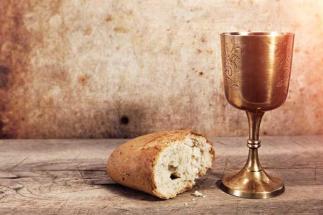
We are nearing the Feast of the Trinity and later Corpus Christi when we celebrate this gift of Jesus’ presence in gift of Eucharist. I will feed my people with finest wheat and fill them with honey from the rock (Psalm 81:16) We are one with Christ in the gift of bread and wine. Amen, amen, I say to you, whoever believe this has eternal life. I am the bread of life. Your ancestors ate the manna in the desert, but they died; this is the bread that comes from heaven so that one may eat it and not die. (John 6:47-50)
We have been transformed and made anew, and this miracle of redemption that Zechariah describes already exists today in that each of us is the libation bowl poured out for Christ. We are each a vessel fashioned by God’s hands and brought into existence for God’s purpose. We each are the hope of the Spirit to the world.
Past present, future. Let us remember the holy trinity of our lives: all that God has created and gifted, all that is here with us in the Spirit, and all that is promised by Christ in our lives to come. Then, when apocalypse befalls us, let us offer all that we have and all that we are to the triune God: courageous creator, compassionate savior and blessed comforter.
“The office of prophet was due to a direct call from God. It was not the result of heredity, just as it was not a permanent gift but a transient one, subject entirely to the divine will”. (Senior 877) Today joy comes upon us from the depths of fear experienced by a people lost and roaming . . . as we rejoice in the coming of the Messiah.
Baruch, the well-known secretary of the prophet Jeremiah, records beautiful verses in both poetry and prose that present a prayer for displaced people. Viewed in this way, the words help those who are lost or misplaced, those who suffer during this time of year when so many others celebrate. When contemplated in the silence of personal exile, these ancient words might set lost feet down on ground once thought unstable; they might give a new horizon and a clear path to those living abandoned or in pain. On this day awaiting the arrival of God in our midst, we take time with these words and rhymes . . . as we listen for God’s message of hope, healing and joy.
Take off your robe of mourning and misery . . .
God says: Your days of loss and suffering have come to an end.
Bear on your head the mitre that displays the glory of the eternal name . . .
God says: Decide to stand in the joy I shower on you . . .
God will show all the earth your splendor . . .
God says: I know that you believe I have abandoned you . . .
You will be named for God forever . . .
God says: Yet I have never left your side, I have never left your heart . . .
Look to the east and the west and see your children gathered at the word of the Holy One . . .
God says: Do not despair that all of your energy and work have been lost for in this you are incorrect . . .
Led away on foot by their enemies they left you . . .
God says: You have been apart and separate for a time but you have not been alone . . .
God will bring them back to you . . .
God says: All of your lost hopes are not, in fact, lost. They live on in all those whom you have touched as you have traveled your road of exile and sadness. Do you not see how many ripples you have sent out upon the waters?
For God has commanded that every lofty mountain be made low, and that the age old depths and gorges be filled to level ground . . .
God says: Have I not just done the impossible . . . arrived as God yet as a human babe?
For God is leading you in joy, by the light of holy glory, with mercy and justice for company.
God says: Remember that I have done all of this and more. I continue to hold you in my own heart and plans. You continue to be more important to me than you imagine. Each time you show mercy despite your painful circumstances you tell the world about my love for you. Each time you stand for justice despite your littleness you show the world the great love I have placed in you. Each time you live in me, my heart bursts with happiness in you. Remember all of this and know that I love you . . . and know that I always will.
Today we give thanks for God’s constant attendance on us . . . even in those times when we have felt alone. If the holiday season is a time of trial, spend time with Baruch today.
If this week’s Noontimes call you to search for more ways to encounter Joy or urges you to investigate the New Testament, click on the word Joy in the categories cloud in the blog’s right hand sidebar and choose a reflection, or enter those words in the blog search bar.
Senior, Donald, ed. THE CATHOLIC STUDY BIBLE. New York, Oxford University Press, 1990. RG 323. Print.
We move further into the Old Testament looking for stories of joy that might surprise us. If today’s story calls you to search further, click on the word Joy in the categories cloud in the blog’s right hand sidebar and choose a reflection, or enter the word Joy in the blog search bar. You may also want to visit the Joy for the Journey blog at www.joyforthee.blogspot.comto see how joy surprises you there. Today we come to the end of the Book of Tobit.
Tobit dies at the age of 112 and he was given a burial with honor. After regaining his sight he lived in prosperity, giving alms and continually blessing God and praising the divine Majesty. In Chapter 13 we find his Song of Praise, a hymn of thanksgiving from one who was once in the abyss but who now understands that God was with him throughout his long travail. Understanding the valuable gift of God’s presence . . . Then Tobit composed this joyful prayer . . .
Filippino Lippi: Tobias and the Archangel Raphael
Let us join Tobit in our own song of thanks.
Blessed be God who lives forever . . .
Where once we saw sorrow we now find joy.
Praise with full voice . . .
When once we were timid now we are bold.
In the land of my exile I praise him . . .
When once we were apart we are now united in Christ.
Praise the Lord for his goodness . . .
Where once we saw pain we now find thanksgiving.
A bright light will shine to all parts of the earth . . .
Where once we saw darkness we now perceive Christ’s light.
Surely I will set you free for purposes of good . . .
Before we leave the prophecy of Jeremiah, let us remember his help when we feel separate or alone, exiled or forgotten.
Before we forget the words of Jeremiah, let us remember his hope when we are discouraged or overwhelmed, empty or lost.
Before we move into the tomorrow God promises, let us remember our potential for worth, the joy of our work, and the purpose of God’s goodness.
Before we step into the gift God plants in us, let us remember that God wants nothing more than our love, nothing more than our fidelity . . . and nothing less than eternal, intimate union with us.
Adapted from a reflection first written on April 17, 2007.
As you know, we treated each one of you as a father treats his children, exhorting and encouraging you and insisting that you conduct yourselves as worthy of the God who calls you . . .
We linger with the thoughts that Jeremiah’s words bring to us in the 21st Century. This prophecy continues to move us millennia after it was first spoken. Each of us has experienced exile from a loved one or a loved place. Each of us has known the devastation of corrupt leadership and betrayal. Each of us has received God’s call to live in a manner worthy. Before we allow the words of the prophet to cease their resonating power, let us reflect on the power of God’s persistent, endless love.
God’s Eternal Call
This stillness of separation nurtures sweet embers of hope . . . for God is near.
The darkness of rejection gives way to a rising spark of confidence . . . for God is at hand.
Vertigo of displacement, sting of betrayal, agony of deception . . . consumed by God’s burning desire to live within.
Overcome not by darkness but by the piercing light of God’s love.
Fire of courage sweeps through dry tinder of exile.
Flames of resolution rise up to greet the call.
Anger, revenge, corruption . . . disappearing in the conflagration of God’s indwelling.
Hope, fidelity, love . . . living in a manner worthy of God’s eternal call.
St. Paul reminds the Thessalonians – and he reminds us – that despite trials and suffering, God’s word is at work in us. This word will not be extinguished. This words breaks forth in the darkest of times. This word is the unceasing presence of God’s fervent call. Let us live in thanksgiving of this worthy indwelling.
And for this reason we too give thanks to God unceasingly, that, in receiving not a human word but, as it truly is, the word of God, which is now at work in you . . .







 The Noontimes