Yesterday we spent time with this psalm. Today we take a deeper look.
Do not touch my anointed ones. Do my prophets no harm.
How do we define faithfulness? Do we admire our ability to hang on no matter what? Are we stubborn to a fault in our persistence to see something through? Do we waver and zigzag in order to gain ground? Or do we model ourselves after Yahweh who is eternally faithful to his sheep?
Longevity. Perseverance. Constancy.
Do not touch my anointed ones. Do my prophets no harm.
Do we duplicate as much as possible God’s fidelity in our own relationships? Are we dedicated to truth and openness? Are we predictable? Do our relationships create a safe harbor?
Dedication. Predictability. Safety.
Do not touch my anointed ones. Do my prophets no harm.
What is it that stands in stark contrast with God’s fidelity? The pursuit of petty agendas? Egocentrism? Meanness of spirit?
Do not touch my anointed ones. Do my prophets no harm.
What do we need to jettison in our lives in order to create serenity and peace in our relationships?
Do not touch my anointed ones. Do my prophets no harm.
How do we imitate God’s bringing forth of unity out of schism?
Do not touch my anointed ones. Do my prophets no harm.
Can we see ourselves as prophets and anointed ones? If not, what do we want to change? How do we become one with such a one who loves so well?
Longevity. Perseverance. Constancy.
Dedication. Predictability. Safety.
For God all things are possible. In Christ all wounds are healed. Together with the Holy Spirit we are become one. We are invited to enter into holy communion with one another. We are invited to prophesy the Word of God. We are anointed in God. We are one in God. We are blessed in God. We are saved in God.
Do not touch my anointed ones. Do my prophets no harm.
Adapted from a reflection written on October 9, 2009.
This prayer is an appropriate psalm for this time of year . . . but we might sing it often for all the good God has brought to us . . . for the good God has wrought from harm.
We are givers and receivers of hurt. Initially, apologies and reparations are difficult to make and they are sometimes difficult to receive. Yet give and receive them we must for we all err, we may all seek forgiveness, and we are all forgiven. We may or may not be forgiven by those we injure, even when the injury is unintentional.
From this morning’s MAGNIFICAT intercessions:
Forgive us our pride.
Forgive us our stubbornness of heart.
Forgive us our anger against one another.
Forgive us our greed in all forms.
Forgive us our mercilessness.
Forgive us the harm we have done.
God always waits patiently for our return and while he waits he continues to sustain us, to offer us his garden where we might bring in his harvest.
At this time of harvest, we might gather ourselves as well to offer our acts and our words back to our creator. We might join in this psalm of thanksgiving and remember that . . .
God is gracious always.
God blesses us constantly.
God saves us faithfully.
And God’s face shines upon us all days.
In the darkest of nights and the brightest of days, let us remember this . . . and be thankful.
Cameron, Peter John. “Prayer for the Morning.” MAGNIFICAT. 3.10 (2008). Print.
We have spent a week exploring a number of questions that many of us ask about the kingdom. Today we consider the kingdom as the infinite presence of God’s Spirit, and the fulfillment of God’s promise and covenant.
In the fall of 2013, Pope Francis, leader of the Roman Catholic Church, posited this idea about the kingdom Jesus describes. “Jesus says that the Kingdom of God does not come in a way that attracts attention: it comes by wisdom . . . This wisdom carries [men and women] forward,” he explained, “with this intelligent, holy, single, manifold and subtle spirit. This is journeying in life with this spirit,” underlined the Pope, “the spirit of God, which helps us to judge, to make decisions according to the heart of God. And this spirit gives us peace, always! It is the spirit of peace, the spirit of love, the spirit of fraternity.” (Pope Francis)
Next week we will return to our consideration of the mystery of God that we find in the gifts of free will, prayer, angels, the Temple, covenant and ministry. Each of these gifts brings us a unique challenge through which we grow, and through which we come closer to the kingdom Jesus describes. Today, we think about the kingdom we see around us with its complications of hunger, natural disaster, disease and scientific challenge. As we read Pope Francis’ words we consider, where is the wisdom that guides us in becoming one with others as we build the city of God?
If you want to find another parable that Jesus tells us while exploring the concept of wisdom, you may want to use a parable index like the one at http://www.ccel.org/contrib/exec_outlines/pa.htm This is a tool to sort through the stories Jesus tells us and you may have another that you want to recommend in a comment.
We may also want to re-visit the theme of climate change as the Pope addresses it in this article from the BBC: http://www.bbc.com/news/world-europe-33182065 Or we may want to read the English translation of his recent encyclical, Care for our Common Home or Laudato Si, at: http://w2.vatican.va/content/francesco/en/encyclicals/documents/papa-francesco_20150524_enciclica-laudato-si.html
For the next several days there will be no Noontimes posts but I will continue to pray with you each day at noon and record thoughts in an old-fashioned paper journal to share later. In place of receiving a daily post, you may want to explore ideas on the Connecting at Noontime page offered in the hope that you find a suggestion to feed the soul and strengthen your bond with and in Christ.
Our spiritual life is always about Call and Response. God creates and calls us. We listen, and then return God’s word. This blog is one small way for us to listen, to seek, to discern, to come together, to puzzle through and to respond in full voice to God’s mysterious and beautiful invitation to life in the Spirit. It is our daily visit with God that nourishes and sustains us. It is our persistent connecting with the one who created us that reminds us of who and why we are. It is our constant hope and our fervent prayer that buoy us up when the road is difficult. And it is Christ’s love for each of us that keeps us on The Narrow Way. Thank you for taking part in our Noontimes journey. We are creatures meant to travel together and, like Paul writing to the Romans, I am convinced that neither death, nor life, nor angels, nor principalities, nor present things, nor future things, nor powers, nor height, nor depth, nor any creature will be able to separate us from the love of God in Christ Jesus the Lord.
New posts will return later this month. In the meantime, may you each know and experience Christ’s peace. May you seek and discover God’s Wisdom. And may you be fortified in the Love and Counsel of the Spirit. I hold each of you in prayer as always. S
In our Noontime reflections we have frequently written about the pillar of smoke and fire that lead the Hebrew people in their faith-journey through desert trials in their search for the land they had been promised.
The Lord preceded them, in the daytime by means of a column of cloud to show them the way, and by night by means of a column of fire to give them light. This they could travel by both day and night. Neither the column of cloud by day nor the column of fire by night ever left its place in front of the people.
Today we reflect on our own Lenten journey, our own penitent search and we ask ourselves a few essential questions.
What is it we seek?
Is there any part of ourselves we hope to change?
Is there a relationship we must amend before healing can take place?
Are there actions we need to take before moving forward in our journey?
When confused, where do we look for guidance?
When alarmed, how do we find peace?
Are we as eager to follow God’s lead as we are to ask for God’s protection and help?
Is it possible that we cannot see the column of smoke and the pillar of fire even though it constantly precedes us?
If we cannot see ourselves as the Hebrew people who wander in the desert hoping and looking for the covenant promise, we might see ourselves as the Children of God who are well loved and well guided by God. In times of fear, pain and confusion, we might remember that after returning from death to commission his disciples, Jesus comforts and assures them. Go therefore andmake disciples ofall the nations,baptizing them in the name of the Father and the Son and the Holy Spirit, teaching them to observe all that I commanded you; and lo,I am with youalways, even tothe end of the age”. (Matthew 28:19-20)

God is with us always in the person of Jesus and in the healing person of the Spirit. When we consider our worst trials and suffering, we do well to look for the presence of the column of smoke by day and the pillar of fire by night. We do well to allow the Lord to precede us. As we spend time with these verses today, let us be open to the presence of the Spirit.
The story of Ruth is a tale of fidelity, self-sacrifice, moral integrity, faith, and divine reward for piety. The people we read about today are in Jesus’ family tree and as always, with God, the message is clear when we look and listen: If something is bound to happen, no one can intervene, and if something is not going to happen, no one can cause it to happen . . . except God. God is in charge.
This story shows the proper covenant relationship between the Creator and the created. God is always present – yet in the background. We who are made in God’s image are called to act as God does, with fidelity, compassion and persistence. We see God take action through people who respond to his call and in this way God’s actions are mediated by his people.
This story shows how tragedy can be transformed when we allow ourselves to serve as conduits for God’s love to a waiting world. It also shows how God is actualized in the lives of the faithful. Scholars point out that the story of Ruth is very much a story of Judges in reverse. She is a woman from a pagan nation whose people battled against Israel but Ruth forsakes her little gods of Moabto faithfully serve the Living God, Yahweh. Matthew includes Ruth in Jesus’ genealogy to remind us that God’s ultimate plan is to include diverse nations in his family tree. Ruth is in many ways what Israel was called to be. And she is also what we are called to be. Faithful, trusting, persistent, loving, and always returning home.
Ruth and Naomi return to Bethlehem at the start of the barley harvest – a harvest that plays an important part in the story that is unfolding – and the town celebrates this return. Recalling that women without men were less valuable than animals in these ancient times, we can only be in awe of their courage in the face of tragedy, their obedience in the face of impossibility, and their trust in the face of overwhelming odds. Ruth and Naomi return to Bethlehem, and in so doing they return to God. As we pause in our Jeremiah journey, let us consider the value of this homecoming.
Adapted from a reflection written on August 14, 2007.
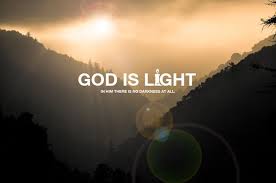
God is light, and in God there is no darkness at all. Can we imagine living a life with no dark corners and no cold secrets? Each day God offers us the opportunity to be light to the world.
If we walk in the light we have fellowship with one another. Can we imagine a world that values the common good over individual comfort? Each day God calls us together in the fellowship of the Spirit.
If we say, “We are without sin,” we deceive ourselves. Can we imagine love that forgives infinitely, heals endlessly, and guides faithfully? Each day God walks with us in the person of our brother the Christ.
God says: In the beginning was the Word, and the Word was with me, and the Word was me. Jesus was in the beginning with me. All things came into being through him and me, and apart from him and me nothing came into being that has come into being.In us was life, and the life was the Light of the human race. The Light shines in the darkness, and the darkness did not comprehend it.
God is light and we, God’s creatures, are created in this light. Let us share this good news with all who want to hear. Let us give thanks for this gift with all who have eyes to see. And let us extend God’s gift of light to others, even those who persecute us.
We hear from the prophet Isaiah frequently during Advent and Christmastide; he tells us the story we long to hear when trouble stalks us. Isaiah reminds us of the smoking cloud by day and a light of flaming fire by night. The pillar of smoke and flame was both guide and protector during the Hebrews’ desert journey. We humans need frequent assurance that someone is looking out and looking over us. We can never hear this news too often that we are a part of the Messianic branch of Jesse, a small twig on the flourishing stem that grows from the remnant root of God’s people. This is our history. It is also our salvation.
Perhaps your family has researched its ancestry. Maybe you have sat with elders and listened to stories and then passed them along to the youngster generation. Oral stories and written accounts are valuable to us as they bind us together and remind us of all that we hold in common for the good of the whole. Humans are destined to function in groups both for good and for evil. The tradition of the Jesse Treeis one that connects us not only with our heritage but with one another as well. Its symbols serve as reminders of who we are and the common journey we make no matter the time and place of our existence.
We may from time to time lose track of our destination point; our common compass begins to spin in confusion as we struggle to push and pull one another into our own idea of our joined journeys. Political and religious discussions are always minefields that threaten to endanger our joint pilgrimage for in the heat of the debate we forget that our origin and our destiny are the same; and that we make this pilgrimage together or not at all. And we also forget that no matter how complex our plan to protect ourselves and no matter how strenuous our effort to stay on course, we are not in control of our surrounding circumstances. We struggle to be our own best protection and guide but ultimately we learn – if we allow ourselves – that it is God who is our best shield against misfortune; it is God who serves as our best compass. The difficulty in trusting God so deeply is, of course, that we must engender and nurture a solid relationship with God. This is something we believe we do not have time for . . . we are so busy protecting and controlling ourselves and sometimes others.
As we move through these first days of Christmas, we ought not to leave behind the message of the season too quickly. Let us linger for a time to allow the mystery of our inheritance to take hold of us. Let us reflect on our legacy and its impact on our lives. And let us ask the Spirit to remind us of the power of our traditions that rise from the root of Jesse and flow through the Messianic Branch to nourish us.
Isaiah reminds us today that we ought not move too quickly through the Christmas season. The prophet tells us that we have much to treasure and much to consider. He recalls our heritage and predicts our future. He tells us that we are Jesus people. He explains to us that God is our best protector and guide. He reminds us to follow the pillar of smoke by day and to abide close by the column of fire by night. Isaiah gives us our best roadmap for life. Let us take heed . . . let us respond well . . . and let us allow God to be our only compass for this most important journey.
Lamentations – Poignant Grief and Unquenchable Hope
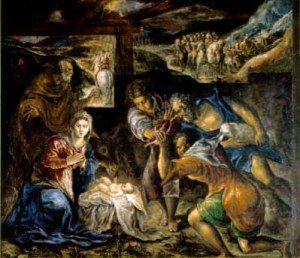
Stomer: Adoration of the Shepherds
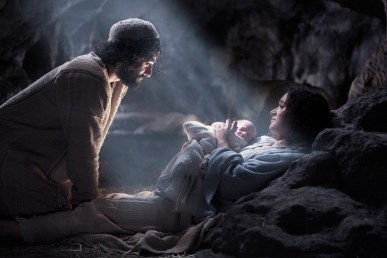
The seeming conflict between human weakness and divine power is one we humans constantly explore; we can never quite understand the inversion of logic that Jesus brings to the world much less put this inversion of thought into action ourselves. When we experience dreadful times we must turn to the truth that we are made whole in our emptiness, that sorrow always carries with it joy, and that God resides with those who are broken and forgotten. In our deepest grief transformation lies in the outrageous hope God offers us . . . in this hope beyond hope that the incredible promise of Christmas is indeed true. The Book of Lamentations may seem like as unusual point of reflection as we enter fully enter the Christmastide but we find something here today that speaks to our human circumstance. We discover that grief is always a subtle presence at any celebration . . . and that restoration accompanies all loss when we remain in the Spirit.
The five laments found in this book of the Bible “combine confession of sin, grief over the suffering and humiliation of Zion, submission to merited chastisement, and strong faith in the constancy of Yahweh’s love and power to restore. The union of poignant grief and unquenchable hope reflects the constant prophetic vision of the weakness of man and the strength of God’s love; it also shows how Israel’s faith in Yahweh could survive the shattering experience of national ruin”. (Senior 1017) The inversion the Christ Child brings to the world is the same conversion of the Old Testament Yahweh.
A few weeks ago we studied Psalm 90 and reflected on its truth. In this sacred poem we find our human limitations compared with God’s infinite goodness; we are told that God transforms even our most crushing suffering when we hand over our pain. It remains for us to act on this knowledge. It is for us to see the connection between the deep heartache of human distress and the nativity of inestimable hope in the person of Jesus. Why reflect on a centuries-old lament when we celebrate happiness? Because Christ represents the only true passage from the inconsolable grief we experience to the indescribable joy we say we seek.
And so we might spend a bit of time today reflecting.
Do we really want to be happy or do we sabotage our chance to know true delight? Each of us must make this journey to uncover our hidden plots against ourselves and others.
Do we honestly want to experience true gladness or do we dwell in the lamentation of our lives refusing to step into the joy fearing that the promise of Christ is yet another disappointment? Each of us must be willing to hand ourselves over to God and to give a full and candid accounting of our days.
Do we truly believe in the conversion of poignant grief through the transforming power of unquenchable hope? If so, and if we honestly wish to live in true Christmas joy promised by the Christ Child, we must plumb our own depths of lamentation and ask: What do we prefer, a life of frustration and illusion or a life filled with promise, trust, and joy?
It is for each of us to pause today. What is the true message of the Christ Child?
It is for each of us to decide today. Do we believe in the message of Jesus’ Nativity?
It is for each of us to act today. Are we prepared to carry God’s unquenchable Christmas hope into the world for the conversion of our most poignant grief?
Senior, Donald, ed. THE CATHOLIC STUDY BIBLE. New York, Oxford University Press, 1990.1017. Print.