Ask and it will be given to you . . .can we say that we believe that God is this generous?
Seek and you will find . . . can we say that we believe that God is this kind?
Knock and the door will open . . .can we say that we believe that God is this good?
For everyone who asks, receives . . . can we say that we believe that God is this faithful?
Everyone who seeks, finds . . .can we say that we believe that God is this hopeful?
Everyone who knocks, finds the open door . . . can we say that we believe that God is this loving?
Can we say that we believe that God is present even in the midst of calamity? Can we say that we believe that God is determined to bring us into eternal union? Can we say that we believe that God has only our joy in mind?
If we cannot, let us consider the miracle of the Easter resurrection that is offered to each of us each day. If we can, then let us share this good news with a world waiting in sorrow.
Is the central question here God’s ability and readiness to answer our prayers . . . or is it our ability and readiness to accept God’s loving universal plan? The answer to this lies not in God but within our own hearts.
For another reflection on these verses, enter the words The Answer to Prayer into the blog search bar and explore.
Celebrating the Beatitudes, striving to fully take in Jesus’ teachings, we remind ourselves of our heritage and our commitment. Our relationship with God is one we entered into at our creation; and it is a connection and support that will hold us forever.
Today the Lord is making this agreement with you . . .
These are such simple and beautiful words coming from the book of Deuteronomy, or “second law”. Here we find a kind of re-hashing of the historical events which brought the Hebrews to the Moab desert where they waited for forty days before crossing the Jordan to enter their promised land.
You are a people peculiarly God’s own . . . as God promised you . . .
Jesus uses words from this book in his interchanges with Satan when he goes to the desert for forty days just before the beginning of his public ministry (Matthew 4). Jesus again quotes Deuteronomy when he explains the first and greatest commandment of love to a young man (Matthew 22). Matthew, who was writing for a Jewish audience to help his reader understand the implications of these Deuteronomy citations by Jesus, stirred up the corrupt Jewish leadership who had tended to the letter of the law while neglecting its spirit.
God will raise you high in praise and renown and glory . . .
Just so might these words stir up contention today; yet just so will these words bring consolation to those who live a just and authentic life.
God will make you a people sacred to the Lord . . .
Jesus becomes the fulfillment of this Old Covenant because he is the New Covenant. As this new agreement and promise, he is also hope. In this season when we continue to celebrate the miracle of Easter, let us be careful to observe Jesus’ statute of loving one another – even our enemies – with our whole heart and our whole soul. Let us continue to walk in his ways, and hearken to his voice. And let us continue to be a people sacred to God . . . as he has promised.
Why do you notice the splinter in your brother’s eye, but do not perceive the wooden beam in your own?
This is perhaps one of the most often quoted verses in scripture . . . and the most ignored.
What is it we must do to remove our blinders, to open our ears, to unclutter our hearts?
God says: I know that you cannot help but see the shortcomings of those around you. I also know that you have great difficulty observing your own need to change; but you need not worry. Rather than punish yourself, imagine that you are the very people you accuse. Rather than punish others, treat them with kindness and acceptance. When you have been wronged, protect yourself as best you can and then rely on me. Allow me to judge. Allow me to operate. Allow me to abide. The injustices of the world are well within my view . . . and well within my capacity to manage. When you believe that I have abandoned you, it is you have abandoned me. So when splinters and beams clutter your lives, manage what you can and rely on me. Abide in me as I abide in you. Live in kindness and mercy rather that anger and vengeance. Live in hope and fidelity rather than worry and anxiety. Live in me rather than in the woes of the world.
Enter the word judginginto the blog search bar and explore the possibilities of trust in God, forgiveness of our enemies, and mercy toward all. Click on the image of Matthew above to access a series of reflections on Matthew’s Gospel.
Enter the words Stop Judging in the blog search bar and explore.
Blessed are the clean of heart, for they will see God. (Matthew’s account of the Sermon on the Mount)
How do we strive to be clean or pure of heart? Richard Rohr, O.F.M., write and speaks frequently about our compulsion to see the world as dual rather than united. We humans are drawn to a divisive “us-versus them” world in which we earn God’s attention and grace. What we fail to consider with this model is God’s true identity. We choose to see God as we have created God; and we disregard God as revealed through scripture and the person of Jesus. In this non-dual, unitive concept of the creator we create God in our own image rather than God to create us as sisters and brothers in Christ.
God says: You have read the story of my journey on earth with you in the person of Jesus. Return to those stories and read my words to the people of the first century. I repeat them to you today. You have heard of the hope and promise I have in mind for you. Return to the words of the prophets and remember the plans I have in mind for you. They are plans for your joy and not your woe. You have witnessed the perfection of my kingdom in the persistence on my apostles and disciples. Imitate my followers and do not be surprised when you fail. The pure of heart are not free from error; rather, they have learned that my kingdom has room for the sinner, accepts the fallen and care-worn, lifts up those who have been trampled by life’s woes and worries. Come then, and live in my perfection, a way that perseveres in faith, lives in hope and acts in love.
It is not possible for humans to attain perfection except in their perseverance in belief, except through the fire of Christ’s Easter passion, except by the healing call of the Spirit. It is in this way that we cleanse our hearts and truly come to see the face of God. It is in this way that we witness the goodness of God’s kingdom.
Blessed are they who mourn, for they will be comforted. (Matthew’s account of the Sermon on the Mount)
Blessed are you who are now weeping, for you will laugh. (Luke’s account of the Sermon on the Plain)
God says: When you sink into deepest grief, remember me – for I am with you. When you believe you will never smile again, remain in me – for I live in you. When the darkness is so dense that the light of hope struggles to pierce it, call on me – for I am that light that no darkness can hold back. The prophets foretold and my son retells you that your mourning will become dancing. The psalmist reminds you that those who go out weeping as they carry seed to sow will also return with triumphant sheaves of joy.
As part of our Beatitudes thanksgiving, let us consider how we might bring the gift of presence to someone who mourns the loss of a person, employment, or a lifestyle.
Find out more about the NILMDTS (Now I Lay Me Down to Sleep) organization, a group of photographers whose mission is to introduce remembrance photography to parents suffering the loss of a baby with a free gift of professional portraiture. Visit: https://www.nowilaymedowntosleep.org/
Then Delilah said to Samson, “How can you say that you love me when you do not confide in me?”
In this often-told Old Testament story we see how words can be used to deceive and conceal. Words of love can manipulate and destroy as well us build up and restore.
So he took her completely into his confidence and told her, “No razor has touched my head, for I have been consecrated to God from my mother’s womb”.
In this well-told Old Testament story we see how trust and betrayal both tug on the body, mind and soul. Acts of deceit become preludes to acts of greatness when God is central to our lives.
Delilah had Samson sleep in her lap, and called for a man who shaved off his seven locks or hair. Then she began to mistreat him, for his strength had left him.
In this familiar Old Testament story we see how intimacy and revenge are dichotomous sisters in our modern lives. But always, as in this story, malice is superseded by God’s love.
Samson cried out to the Lord and said, “Oh Lord God, remember me! Strengthen me, O God.
In any array of negative emotion we call on God for strength; and so our fear, anger, and desire for revenge become hope, mercy and love.
Jesus reminds us: “You have heard that it was said, ‘You shall love your neighbor and hate your enemy.’ But I say to you, Love your enemies and pray for those who persecute you,so that you may be children of your Father in heaven; for he makes his sun rise on the evil and on the good, and sends rain on the righteous and on the unrighteous.For if you love those who love you, what reward do you have? Do not even the tax collectors do the same?And if you greet only your brothers and sisters, what more are you doing than others? Do not even the Gentiles do the same? Be perfect, therefore, as your heavenly Father is perfect. (Matthew 5:43-48)
In this often-told Old Testament story we see how words can be used to deceive and conceal. In this often-told New Testament story we see how words of love can build up and restore. As we journey toward season of Lent and the Easter promise, let us reflect on the actions and words of Samson, Delilah and Jesus. Let us determine the source of our strength; and let us determine who we choose to follow and why.
“A lament of a person betrayed by friends. The psalmist prays that the evildoers be publicly exposed as unjust (1-8) and gives thanks in anticipation of vindication (9-10). Old friends are the enemies (11-16). May their punishment come quickly (17-21)! The last part (22-26) echoes the opening in praying for the destruction of the psalmist’s persecutors. This psalm may appear vindictive, but one must keep in mind that the psalmist is praying for publicredress now of a publicinjustice. There is at this time no belief in an afterlife in which justice will be redressed. 35, 1-6: The mixture of judicial, martial, and hunting images shows that the language is figurative. The actual injustice is false accusation of serious crimes (11, 15, 20-21). The psalmist seeks lost honor through a trial before God”. (Senior 668)
Defend me because you are just, Lord; my God, do not let them gloat over me.
It has been my experience that when enemies gloat over their opponents’ pain and loss, they later suffer the same pain and loss.
I have seen so often the trap dug by one to catch another ends up as the death-bed of the one who dug it.
I know in my bones that God defends those who are his faithful. I have seen too many examples of God’s fidelity to think otherwise.
I believe that God’s plan for conversion of my enemies is far better than any punishment I might ask . . . and so I send intercessory prayers for those who do me harm – whether they are friends from long ago or friends who are newly arrived.
With today’s psalm, we might be tempted to ask God to pull down fire on those who betray us, but this is not what Jesus does. We have the gift of knowing what Jesus has told us: That we are to witness, watch, and wait. Only this way of life will bring us the peace we seek.
So we ask ourselves . . . how much better is it to pray for those who betray us rather than ask for their fiery end? Is it not so that God punishes with the punishment we lay out for others? What then do we fear? Do we believe God incapable of making a just decision that brings about transformation of the soul?
And we also ask . . . now that we know of this precious gift of eternal life . . . why do we jeopardize it for a fleeting, ugly satisfaction that might come when we see our enemies suffer? Can we not intercede for those who are hateful while we await our trial before God? How much more effective it is for God to call each one to him as we move through his plan for our good than it is for us to plot someone else’s downfall?
We find a place for Christ-like thinking when we read this psalm and pray for those who wrong us unfairly. In this season of Lent, let us approach the day of Christ’s sacrifice on our behalf with the joy that comes from leaving our worries with him in willing obedience to The Word . . . as we look forward to the day of vindication in Jesus’ name, in Jesus’ Way, in Jesus’ hope for all of humanity.
Senior, Donald, ed. THE CATHOLIC STUDY BIBLE. New York, Oxford University Press, 1990.668. Print.
What images come to mind when we hear the word Apocalypse? What are our hopes? What are our fears? And what image of God do we offer to the world with all we say and do?
“Resurrection is explicitly affirmed only here in the OT, though belief subsequently spread until it finally became orthodox Jewish doctrine. But who is to be revived? ‘Many’ appears to mean only ‘some’, but it includes righteous and wicked. The scenario makes best sense if we see the problem being addressed as one of justice. There are those who have suffered undeservedly and those who have sinned without punishment. Both groups must be revived so that justice can be administered”. (Barton, and Muddiman 570)
And so we pray . . .
Good and faithful God, teach us to remain in you as you remain in us.
Good and patient Christ, help us to love our enemies as you love yours.
Good and encouraging Spirit, heal us of all our wounds and worries, our hates and fears . . . so that we might remain ever in and with you. Amen.
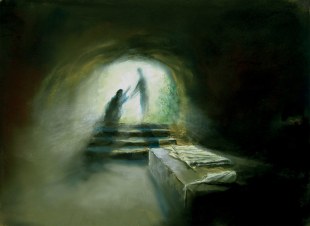
Louisa Anne, Marchioness of Waterford: Christ Raising the Dead
Barton, John, and John Muddiman. THE OXFORD BIBLE COMMENTARY. Oxford, UK: Oxford University Press, 2001. 570. Print.
For more reflections on the words of this prophet, enter the words Danielor Apocalypseinto the blog search bar and explore.
Daniel 12: 3: The wise shall shine brightly like the splendor of the firmament, and those who lead the many to justice shall be like the stars forever and ever.
“Daniel’s apocalyptic view of history is most fully laid out in Chapters 10-12, which make up one long vision. There an angel explains to Daniel that there is an ongoing battle in heaven between the archangels Michael and Gabriel on the one hand and the angelic “princes” of Persia and Greece on the other. This battle is reflected on earth in the wars of the Hellenistic age, which are described at length in Chapter 11 . . . At the end Michael will arise in victory and the resurrection will follow”. (Senior RG 349)
Apocalyptic writing was popular in the centuries before and after Jesus’ birth and although it is characterized by symbolism and descriptions of cataclysmic events, it is rooted in the teachings of the prophets. Dire circumstances and extreme conditions experienced by the Jewish people provided fertile ground for early writers as they warned, predicted and called the remnant people to fidelity. Living in times of hopelessness and desperation, the faithful took heart as they heard the stories of rescue, redemption and salvation. These images laid the groundwork for the genesis of Christianity, and Jesus’ introduction of the work of discipleship.
Many shall be refined, purified, and tested, but the wicked shall be proven wicked, none of them shall have understanding, but the wise shall have it. (Daniel 12:10)
Jesus describes the life of a disciple clearly in his Sermon on the Mount:Blessed are you when peopleinsult you and persecute you, and falsely say all kinds of evil against you because of me. Rejoice and be glad, for your reward in heaven is great; forin the same way they persecuted the prophets who were before you.(Matthew 5:11-12)
Daniel 12:12: Blessed is the one who has patience and perseveres . . .
Jesus tells a parable of the persistent widow who patiently returns to a corrupt judge, asking endlessly for justice. Now He was telling them a parable to show that at all times they ought to pray and not to lose heart . . .(Luke 18:1-8)
Daniel 12:13: Go, take your rest, you shall rise for your reward . . .
Jesus asks us that to give him our worries and anxieties that are too great for us to bear. Come to me, all who are weary and heavy-laden, and I will give you rest. Take my yoke upon you and learn from me, for I am gentle and humble in heart, and you will find rest for your souls. For my yoke is easy and my burden is light. (Matthew 11:28-30)
This portion of Daniel’s prophecy brings a new perspective of an old vision. Battle between good and evil are not new. But what Daniel brings us is the foreshadowing of a new and wonderful reason for hope and joy. Daniel opens up for us a new dimension. The world of joy born out of pain, of celebration rising from sorrow, and of new hope burgeoning from old wounds.
When we spend time with Daniel 12 today, we see new light leading us into a world of new dimension.
Senior, Donald, ed. THE CATHOLIC STUDY BIBLE. New York, Oxford University Press, 1990.RG 149. Print.
For more reflections on this prophecy, enter the word Danielinto the blog search bar and explore.


_-_Saint_Matthew_-_266907_-_National_Trust.jpg)




![BiblicalLaw-and-Justice[1]](https://thenoontimes.com/wp-content/uploads/2012/12/biblicallaw-and-justice1.jpg?w=282&h=211)



 The Noontimes