If we sit patiently with Job to read his story, we are rewarded – just as Job is rewarded for sitting with the Lord through suffering.
If we take in the ideas Job exchanged with his friends, we are healed – just as Job is healed when he remains in God.
If we live in fidelity to God as Job does, we experience humility – just as Job does when he hears the Lord speak.
If we seek wisdom as Job does, we find satisfaction – just as Job does when he hears the Lord address his friends. After God had finished addressing Job, he turned to Eliphaz the Temanite and said, “I’ve had it with you and your two friends. I’m fed up! You haven’t been honest either with me or about me—not the way my friend Job has.”
Honesty, authenticity, perseverance, courage, fidelity. These are the signposts we might follow as we move through life. They are antecedents of the meekness and fulfilment we see in Christ nearly a thousand years later. They are the presence of the consolation and healing we encounter in the Holy Spirit we experience in our own lives. They are the wisdom and peace we seek today.
If you listen to me, you will know what is right, just, and fair. You will know what you should do.
This advice brings us comfort.
You will become wise, and your knowledge will give you pleasure. Your insight and understanding will protect you and prevent you from doing the wrong thing.
These words are ones we want to hear.
They will keep you away from people who stir up trouble by what they say—those who have abandoned a righteous life to live in the darkness of sin, those who find pleasure in doing wrong and who enjoy senseless evil, unreliable people who cannot be trusted.
In out tumultuous world, change permeates every facet of life. We look for places to stand when familiar foundations crumble. We ask for assurance. We know that we must put aside fear and replace it with trust in the Lord.
God says: Although the world seems a dangerous place, you must trust that I hold each of you in my hands. My servant Paul tells the Ephesians – and he tells you – that I chose you to be holy, with every spiritual blessing, before the foundation of the world. My son Jesus tells you that you ought not let your hearts be troubled. I tell you that despite the troubles surrounding you, my mercy and justice will lift you above the battles of your days and the uncertainties of your nights. Remain in me as I remain in you so that my peace and love will permeate your every fiber to bring you even closer to me.
When we move against injustice, we must allow God to guide us. When we speak up about hatred, we must allow Christ to show us the way. When we are betrayed by people and institutions we once thought just, we must allow the Spirit to heal and bless. And this allowing will show us clearly what we are to do.
When we compare varying translations of these words, the light if understanding will lead us to Christ’s serenity.
Click on the image to read an NPR Science opinion piece about how confusion con sometimes be helpful. Or visit: https://www.npr.org/sections/13.7/2015/12/14/459651340/sometimes-confusion-is-a-good-thing
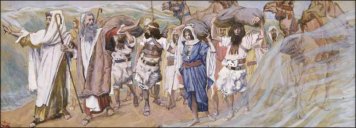
We are familiar with the elements of this story: the birth of Moses, the call from the burning bush, the killing plagues, crossing the Red Sea, wandering in the desert, and finally a glimpse of the Promised Land. This is Moses’ story, it is Jesus’ story, it is the story of the faithful servant, and it is our own.
From DAILY REFLECTIONS FOR LENT: NOT BY BREAD ALONE 2018 written by Michelle Francl-Donnay. Exodus reminds us we are not to settle into our pews, to watch events unfold like an epic movie in which the hero rises in the very last scene, only to pour back out into the lobby at intermission, tossing our crumpled worship aids into the recycling bins. No, sit on the edge of your seats, and be ready to fly forth with only what you have in hand”.(Francl-Donnay 92-93)
Francl-Donnay reminds us that as faithful servants, we must be ready for flight.
The Eucharist is fast food, trail food. This is not a private feast, a family dinner to be lingered over, however reverent, and beautiful the liturgy is. This is a public meal, food for those in flight, food for those about to be dispatched on a mission. (Francl-Donnay 92-93)
James Tissot: The Last Supper
Francl-Donnay reminds us that as faithful servants, we must be prepared to receive God’s promise in the person of Jesus.
Tonight we will do as Jesus commanded at the Last Supper. We will wash each other’s feet, to show each other in the presence of the faithful what we have vowed to do. (Francl-Donnay 92-93)
Francl-Donnay reminds us that as faithful servants, we must go into the world with words and acts of peace.
So now we wrap Christ around us, and kneel before the hungry child, the homeless mother, the refugee whose shoes are worn through, to care tenderly for what the world would trample underfoot. (Francl-Donnay 92-93)
Francl-Donnay reminds us that as faithful servants – and no matter the sorrow or pain we suffer – we must make our exodus into the world with words and acts of joy.
On the eighth day of Christmas, my true love gives to me eight maids a-milking.
The ancient carol reminds us that happiness comes to us in a variety ways; and as Jesus tells us, all ways lead to The Way. Christ continues to lead us along the path that asks us to reduce ourselves so that he may increase in our lives. This Way is narrow yet full of blessing and promise that come to us through inversion – as does so much that Christ explains to us.
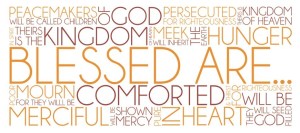
Blessed are the poor in spirit, the mourning, the meek, the ones who hunger and thirst, the merciful, the pure in heart, the peacemakers, and those who suffer persecution for righteousness’ sake.
Rather than encourage self-centered thinking, Jesus asks us to care for others as readily – or even more – than ourselves. This is difficult living, Christ reminds us, yet the reward will be great indeed.
Theirs is the kingdom of heaven, they will be comforted, they will inherit the earth, they will be filled, for they will receive mercy, they will see God and be called children of God, for again . . . theirs is the kingdom of heaven.
Contrary to a world that tells us to tend to ourselves, Christ asks us to show preference for those on the margin. Despite this apparent contradiction to survival, Jesus promises a life that is beyond any we might have expected. A life that produces fruit in endless abundance.
Rejoice and be glad, for your reward is great.
On this first day of the new year, let us explore the words Christ has for us about happiness, one of the gifts he brings to us this Christmastide; and let us consider how we might find this eternal bliss today and all days.
For notes on the Beatitudes, click on the post image, or enter the word Happinessinto the blog search bar and explore.
We may well want to consider how we react to the news that we are chosen loved ones.
As God’s chosen ones, holy and beloved, clothe yourselves with compassion, kindness, humility, meekness, and patience.
Do we step ahead quickly to shove our way forward in response to God’s call? Or do we tend to those along the margins who cannot find a way into the unifying force of God’s hope?
Bear with one another . . .
Do we follow Christ in fits and starts? Or do we move constantly and slowly forward, always remaining faithful in reflection of God’s fidelity?
If anyone has a complaint against another, forgive each other . . .
Do we greet one another with greed or compassion? Anger or mercy? Chaos or peace?
Just as the Lordhas forgiven you, so you also must forgive.
Do we welcome the stranger, speak out against injustice, console the sorrowful, and heal the sick?
Above all, clothe yourselves with love, which binds everything together in perfect harmony.
Do we work for reconciliation? Do we open our eyes, ears, hearts, hands and minds? Do we act as if we are chosen in God’s humble love?
When we use the scripture link and the drop-down menus, we find that being chosen is more than we have first thought.
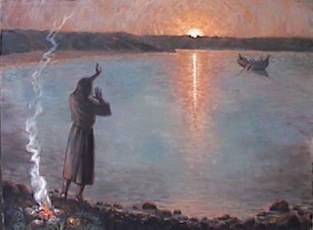
In this Eastertide, we spend time with the Gospels of the Easter Octave, the eight days comprising the celebration of Easter. We hear John’s familiar story of Jesus appearing at the Sea of Galilee. The details in the story open doors of Easter joy and hope for us.
First, we choose a translation that speaks to us most clearly. Then we reflect. If we want to hear an audio version of today’s verses, visit the USCCB site. We may find other versions by using the scripture link and drop-down menus.
In the MESSAGE translation, we see again that the disciples do not recognize Jesus when they first see him. Jesus was standing on the beach, but they didn’t recognize him.
We reflect on the number of times Christ has stood before us, and our eyes have not seen. The unwanted visitor. The neighbor who challenges us. The colleague who asks a question we do not want to answer.
Jesus asks the disciples to expect something new when he asks them to do something they have been doing for hours. Throw the net off the right side of the boat and see what happens.
We reflect on the number of times Christ has asked us to once more open ourselves to optimism when we have already given up on hope. The task we have already completed. The cause we believe to be dead. The optimism we see as pointless.
Jesus prepares a meal for his friends, and then he says, “Breakfast is ready.” Not one of the disciples dared ask, “Who are you?” They knew it was the Master.
We reflect on the number of times Christ has waited on us, served us, healed us and loved us. We recall the worries and anxieties that too often govern us. We remember the doubts and fears that too frequently control us. We remember the Easter promise of healing and transformation. And we look toward the end of John’s Gospel when he tells us, There are so many other things Jesus did. If they were all written down, each of them, one by one, I can’t imagine a world big enough to hold such a library of books.(John 21:25)
And we ask ourselves . . . can we recognize the Christ moments in our lives? Are we willing to muster the courage to throw our nets another time where we have already thrown them endlessly? Are we prepared to welcome the joy and peace of Easter? And are we willing to witness to these life-giving encounters with Christ so that others might live and believe?
Whether we know it or, once we commit to loving God as we see God in others, we begin to generate light in the darkness.
Those who love the LORD rise in the darkness as a light for the upright; they are gracious, merciful, and righteous.
We may be unaware that others are watching us but they are. When we say that are committed to Christ, do our actions betray or support our words?
It is well with those who deal generously and lend, who conduct their affairs with justice.
If we hope to make a mark in human history, all we need do is follow Christ. In this way we will find ourselves in the story of hope and generosity rather than the story of fear and exclusion.
For the righteous will never be moved; they will be remembered forever.
Once we begin to think and move in Christ, all fear falls away for we know that we are not in charge and that the long arc of human history is moving toward the light of Christ.
They are not afraid of evil tidings; their hearts are firm, secure in the Lord.
When we feel ourselves moving in that great tide of humanity that yearns for universal justice, impartial freedom and eternal peace, we will know that all is well.
Their hearts are steady, they will not be afraid; in the end they will look in triumph on their foes.
The honor we seek is not the reward of this life; it is the quiet, humble, everlasting honor that Christ bestows when we follow after him.
They have distributed freely, they have given to the poor; their righteousness endures forever;they are exalted in honor.
We cannot think that our progress is smooth for the way of discipleship is difficult in the best of circumstances.
The wicked see it and are angry; they gnash their teeth and melt away; the desire of the wicked comes to nothing.
And we must remember that in our gladness of living and loving in Christ, we are called to invite all those who weary from their journey of opposition, mistrust, and manipulation to join in this great generation of life and light and love.
Those who love the LORD rise in the darkness as a light for the upright; they are gracious, merciful, and righteous.
We give thanks for the times when are the light. We ask forgiveness for the times we have brought darkness to others and ourselves. And we remember to look for the face of Christ in every soul that passes our way.
When we spend time with various translations of this psalm, we find that our hearts are lighter, our path more easily seen and trod, and our journey more full of peace.
Isaiah’s words might be spoken to one who teaches the very young.
Share your food . . .
Isaiah’s words might be heard in a meeting of those who sponsor refugees.
Open your home . . .
Isaiah’s words might be spoken in a classroom where tomorrow’s adults are formed.
Give clothes to those who have nothing to wear . . .
Isaiah’s words might be heard in a workshop offered on how to embody scripture.
Do not refuse to help your own relatives . . .
Isaiah’s words might be brought to life by anyone who hopes to incarnate The Word, to follow The Word, to live, breathe and be The Word among us.
Put an end to oppression, to every gesture of contempt . . .
Isaiah’s words might be spoken on a picket line.
Put an end to every evil word . . .
Isaiah’s words are a rubric to measure our actions, a template to codify life, a handbook for those who yearn to walk in the land of the living.
If you satisfy those who are in need, then the darkness around you will turn to the brightness of noon.
And so we pray with Isaiah.
Good, and holy and generous God, guide us as we struggle with our fears of darkness and evil. Direct us as we look for the best way to become your Word. Remain with us as we gather in dissent against the tactics of bullies who hope to divide us. Walk with us as we navigate the thin line between resistance and violence. Abide with us in our struggle for clarity, compassion and peace. For we wish to do your will. We wish to be light to the world. We wish to bring hope to the marginalized. We wish to be the eyes and ears, the voice and heart, the hands and feet of Christ for you. We ask this in Jesus’ name, together with the Holy Spirit. Amen.
When we compare varying versions of these words, we find patience, clarity, and the beginnings of peace for a troubled heart.
For ten lessons history teaches us about leadership with exemplars like Mahatma Gandhi and Abraham Lincoln, click on the image of the clasped hands, or visit: http://www.andysowards.com/blog/2016/10-lessons-history-teaches-us-about-leadership/