In days when political and civic leaders grapple with the realities of our common world, Isaiah reminds us that the wicked are always with us, obscuring truth, engendering deceit.
The wicked are storm-battered seas that can’t quiet down. The waves stir up garbage and mud. (THE MESSAGE)
In times when religious and community leaders struggle to bring light to a present darkness, Isaiah reminds us that evil relies on chaotic upheaval and unpredictable alliances.
Evil people are like the restless sea, whose waves never stop rolling in, bringing filth and muck. (GOOD NEWS TRANSLATION)
In the hour of darkness when friends and family clash over how to move forward for the good of all, Isaiah tells us that God’s promise of healing and restoration is authentic.
But the wicked are like the tossing sea that cannot keep still;its waters toss up mire and mud. (NRSV)
In the moment of fear and division when anxiety and confusion threaten our relationship with God, Isaiah tells us that there is one person, one person, one bond that calms all fear and quiets all anxiety. Isaiah reminds us that there is a voice that persists as it calls out: Let my people return to me. Remove every obstacle from their path! Build the road and make it ready!
Help and healing, humility and repentance, confidence and hope, eternal promise and love. Isaiah comforts us as he has done for millennia. Isaiah reminds us that God waits eternally for those who look to move from mourning to joy.
Tomorrow, at the table . . .
When we use the scripture link and the drop-down menus to explore various translations of these verses, we discover how we might all survive the restless seas.
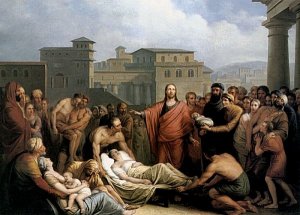
Mathieu Ignace van Bree: Christ Heals the Paralytic
Too often when we come into contact with those among us who suffer physical or mental differences, we turn away in alarm or surprise. Or worse, we give in to the temptation to whisper about someone’s condition without realizing that our behavior is clearly visible. Our gossipy whispering is audible.
Jesus teaches us a difficult lesson today.
Jesus knew what they were thinking, and said, “Why this gossipy whispering? Which do you think is simpler: to say, ‘I forgive your sins,’ or, ‘Get up and walk’?”
We know that in ancient times – and still in some cultures today – afflictions are seen as divine punishment for sin. Jesus forgives with the authority given him by the Creator.
Jesus teaches us how to measure our compassion today.
“Get up. Take your bed and go home”.
In our hearts and minds we are grateful when we do not suffer, grateful when we walk in bounty. We also know that God’s grace blesses us with the gifts that make it possible for us to earn a living, to afford shelter, food and clothing. Although in many societies we believe that everyone is entitled to an equal opportunity, we also must know that not everyone is equally endowed.
Jesus teaches us how to heal today.
And the man did it. The crowd was awestruck, amazed and pleased that God had authorized Jesus to work among them this way.
In a world that is strangely topsy-turvy, we know that we are responsible for our response to God’s call more than we are responsible for our fame, wealth or power. Jesus calls us to put aside our gossipy whispering and invite those among us who are paralyzed in any way to join us. Jesus invites all to come together with whatever gifts we have to build the infinite and boundless kingdom.
Jesus teaches us about goodness today.
When we use the scripture link above and the drop-down menus to explore other translations of this story, we hear God’s call as healing and compassionate kingdom-builders.
Jesus icon in St. Saviour Church: Chora, Istanbul, Turkey
The stories of Jesus’ healing are perhaps the most loved. They tell us in the modern era what we want and need to hear. Miracles happen. Outrageous hope is possible. Love changes everything. Faith, the cornerstone of discipleship, rises from our constant communication with God and brings reward greater than any power, wealth or fame. But to all of this goodness and compassion too many of us are too often blinded by the lures of the world that surrounds us. So great is God’s love for each of us that we are given the daily opportunity to choose Mammon or God. The blind men in today’s story choose God.
THE MESSAGE translation brings this familiar story home in a powerful way.
Two men cry follow Jesus and cry out to him, pleading for sight so they might more fully enter life. And so Jesus said to them, “Do you really believe I can do this?” They said, “Why, yes, Master!”
How often do we ask for God’s help? How often do we reply, “Why, yes, Master!”
St. Saviour Church: Jesus heals Two Blind Men
He touched their eyes and said, “Become what you believe.” It happened. They saw. Then Jesus became very stern. “Don’t let a soul know how this happened.” But they were hardly out the door before they started blabbing it to everyone they met.
Do we believe that we become what we believe? Do we covet what others have or what others are?
It happened. They saw.
Does our worldly doubt overcome our spirit’s hope? Do we turn to God when we are in turmoil or fear? Do we blab the good news to others or hold it for ourselves? Do we ask for sight and wisdom only to ignore or abuse the gift once it is given? Do we decide that Jesus’ ancient words do not suit our modern world?
Become what you believe.
St. Saviour Church in Chora, Istanbul, Turkey
We are so often blind to so much that takes place around us and this is not surprising since the world is a dichotomy of faith-inspiring creation and the frightening ugliness of evil. But we are created in God’s image, created to rise to the hope of God’s creation, created to sing in harmony with God’s Spirit. So rather than reject with cynicism the possibility of Jesus’ presence in our lives, let us share – as do these two cured men – the goodness and enormity of God’s love. When we find that we are blind . . . let us ask for Jesus’ healing . . . and let us celebrate the miracle of his love.
Compare THE MESSAGE translation of these verses with others using the scripture link and the drop-down menus to see how Jesus speaks to us today through this story.
Tomorrow, why does Jesus ask these men to keep silent about the miracle of their healing.
Michelangelo: Manasseh (on the right – the figure on the left is likely Manasseh’s wife)
Tuesday, June 6, 2023
He did evil in the site of the Lord.
It is easy to point to leadership and begin to make a litany of their defects. What is more difficult is to look inward to ourselves to examine the way we bring Christ into our interactions with others. It is helpful when we hear those around us criticize our political, social, family and workplace leaders to study carefully how these leaders call us into action. Do they appeal to our care and concern for all and one another; or do they activate our anxiety for a special group of clique? Do they look for ways to build bridges and overcome division; or do they relish splits and schisms? Do they delight in mercy and compassion for all; or do they gloat at the misfortune of those not included in their group? By these signs and by the fruits of their labor, we will know who is doing evil and who is doing good and we will know whom to follow.
He did evil in the site of the Lord.
In the Old Testament we see this sentence used frequently in the writer’s description of how leaders who have been given the gift of servant to a people misunderstand the trust placed in them. Manasseh and Amon allow and even encourage the people to turn from God and to turn to the worship of whatever gives them pleasure: money, sex, politics, the newest fashion, and so on.
He did evil in the site of the Lord.
I am reading a book I bought recently by Caroline Myss which I will keep by my side this summer as part of my reflective reading. It is entitled ANATOMY OF A SPIRIT: The Seven Stages of Power and Healing, and the first page I opened carried the bold sub heading: Challenging Toxic Tribal Power. Out of respect for the writer, I am the sort of reader who begins a book at its first page and reads through to the last; but this page was too much of a temptation for me. I was drawn to skim this chapter which deals with Loyalty, Honor and Justice and how these concepts can be used to either counterbalance evil or to be “restrictive or narrow when interpreted narrowly”. (Myss 113) Myss tells us that before we can allow healing to begin, we must examine our attachments to tribal prejudices. I suspect these pages will hold many thoughts for reflection this summer but I am struck by how the strategies and tactics of these ancient wicked kings still have power over us. When the leader of the pack tells us that a thing or a person or an event is good or bad, do we accept this statement blindly as truth? Or do we challenge toxic behavior with compassion, openness and a heart of mercy?
He did evil in the site of the Lord.
We can never allow toxic behavior to hold us captive. We must, speak, act and rebuke with compassion. And we must always leave ourselves open to the outrageous hope that those who do evil may find transformation. Indeed, it is this very transformation that we as the victims of abuse must petition before God, because with God all things are possible, even the redemption of wicked kings.
He did evil in the site of the Lord.
Let us, today, petition God to soften the hearts and open the souls of the those who do evil that they, with us, may come to know the richness and depth of God’s love.
We ask for good health, security, predictability, fidelity. We look for mercy, wisdom, hope and love. We anticipate salvation, healing, transformation and resurrection. But these gifts we believe we need to acquire have already been generously given.
The beasts of the field will glorify me, the jackals and the ostriches, because I have given waters in the wilderness and rivers in the desert, to give drink to my chosen people.
When we feel as though the world has let us down, we come to understand that all that we need we already hold.
The people whomI formed for myself will declare my praise.
All that is required of us is that we remain faithful in our gratitude.
I, even I, am the one whowipes out your transgressions for my own sake, and I willnot remember your sins.
All that we need remember is that God wants to forgive and heal. All that is confusion and mystery becomes peace-filled and comforting. All that we seek we already have in abundance. So let us give thanks, for once we begin to practice thankfulness, we also begin to fully experience what the Lord has freely and wonderfully already given.
In the opening verses of this Chapter, Jesus begins to explain that misfortune or disability is not a sign of our sin; it is only misfortune or disability. Jesus cures a man of blindness as if to make a point. A miracle occurs yet in verses 8 through 12 we see how the people doubt that the cure has taken place: No, he just looks like him. In verse 13 the Pharisees become involved. The healing happened on a Sabbath; work has occurred. This is a transgression for which the temple leaders must have an accounting. This man is not from God. The healed man is called a second time and asked what has happened, to which he replies in verse 24. I told you already and you did not listen. Why do you want to hear it again?The Pharisees continue to question and he replies: This is what is so amazing, that you do not know where he is from, yet he opened my eyes . . . If this man were not from God he would not be able to do anything.This is a challenge to them. They cannot comprehend – or accept – the miracle before them and so . . . Then they threw him out.
In the final verses of this chapter Jesus speaks to the healed man to assure him that they have not broken God’s truelaw – the Law of Love. Explaining that he is the light that has come into this world of darkness, Jesus gives his listeners something to think about: I came into this world for judgment, so that those who do not see might see, and those who do see might become blind. This tweaks the Pharisees – who have refused to see and accept this cure as coming from God. Jesus says to them: If you were blind, you would have no sin; but now you are saying, “We see”, so your sin remains.Jesus points out to these men that they have seen the truth and reject it, so that they might believe themselves to be in control. They irony is this: They were never in control as they have imagined themselves to be.
Christ Healing the Blind Man at Bethsaida: Gioacchino Assereto
In this story we are again in the world of inversion where up is down and down is up, poor is good, disability is a plus. Jesus is the light and the Pharisees set themselves against this healing force. We have the opportunity to examine our reaction to miracles. Do we accept the gift of life which each of us is offered? Or do we put aside our petty haranguing with one another in order to unite in Christ? Are we stubborn Pharisees or are we blind people cured?
Do we flail against the light and insist that what we see is not really happening? Can we accept in confidence the gift of healing and give back to God our total trust?
If this man were not from God he would not be able to do anything . . . so when the light enters our lives as it so often does let us not thrash against the goodness and the warmth.
Jesus has walked on the surface of the water to save those who love him from wilds winds and high seas. His followers were terrified and so he brings the boat immediately to the point on the shore where they had been aiming – despite the fact that the fishermen had rowed three or four miles from the coast. Just so are we terrified when tossed by life. Just so are we brought to our goal. Just so are we loved by Christ.
Jesus pauses to dialog with the enormous crowd that follows him – despite the fact that they do not believe him. Just so do we seek Jesus. Just so do we find him. Just so we doubt the very love that has rescued us.
Today we see how those who have struggled to follow and those who have argued still do not understand the beautiful gift Jesus hands them, the gift of bread that feeds eternally, the gift of bread from heaven. Just so do they take Jesus literally. Just so do they doubt the miracle before them. Just do we look past the evidence of healing and love that stands before us. Just so . . .
At this, because Jesus said, “I am the Bread that came down from heaven,” the Jews started arguing over him: “Isn’t this the son of Joseph? Don’t we know his father? Don’t we know his mother? How can he now say, ‘I came down out of heaven’ and expect anyone to believe him?”
We have watched Jesus walking on water toward us. Do we still doubt?
We have raced after Jesus, doing all we can to capture this essence of peace and serenity. Do we still persist?
We have found Jesus in the most unsuspecting places – with the homeless, with the poor, among the refugees, the abandoned and alone. Do we still fail to recognize God among us?
Tomorrow, bickering.
Enter the words Bread of Life into the blog search bar and reflect on our own doubt and persistence, understanding and peace.
We must always be prepared for the surprise of God’s goodness when tragedy encircles us. We must always be open to God’s gift of healing when trauma haunts us. We must always be willing to accept God’s gift of mercy when anxiety overtakes us. We must always be seeking a more intimate relationship with God, for this is what God seeks in us.
Yesterday we reflected On John 6 with Henry Tanner’s painting The Disciples See Christ Walking on the Water. Today we reflect on the verses that follow that story, and we watch as those who seek Jesus use any available means to pursue the healing, prophetic presence of God among them. We explore the depth of our relationship with God, the breadth of our love for God, and the infinity of peace that comes with our seeking.
And the Apostles said in reply: We must obey God rather than men . . .
Do we see Jesus’ Apostles as only the twelve who followed him? Do we believe that Jesus’ followers were men alone? Can we stretch beyond any narrowness to believe that we number among Jesus’ Apostles today? Are we willing to stand during difficult times to say . . . we must obey God rather than men . . .?
When we read these verses in their varying translations, how do they speak to us of Jesus’ remarkable gift of resurrection? What do they reveal to us about God’s generous promises? And why do they call us – or perhaps not call us – to become one with the Spirit that wants to heal a troubled world? When we use the scripture link to explore this story of the Apostles who carry out miracles in Jesus’ name well after his death, we find new life and new energy to carry out the Gospel in all we say and do. When we allow God’s goodness to settle into our bones, we find new courage and new patience to smile in the face of adversity.
A video presentation of Acts 5:17-42 may be of interest. While we may not be in accord with all the speaker tells us, we are invited to reflect on this story of the importance of obeying God. Click on the image above or go to: https://www.youtube.com/watch?v=0MiSr5yx9nA








 The Noontimes