We continue with the theme of Captivitytoday – but here we see the epiphany of understanding. We experience the surprise which always springs upon the faithful when they are low. We live the promise of our God who loves us relentlessly, persistently yet gently. God loves us to the extent that he is willing to wait and abide infinitely while we find our way to God’s mercy, justice and joy.
5:7 – God makes all things level. God straightens all paths. God awaits us at every turning of the road.
5:2 – God creates us, names us, calls us his own. God yearns for the intimacy God has foreseen with us.
5:5 – God sends out the universal call. God will not leave a single sheep unbidden.
5:7 – God has in mind for us a place of beauty. God has brought forth life from the desert. God also brings forth life from the desert of our lives.
Look to the east, Jerusalem! Behold the joy that comes to you from God.
God has not forgotten a single hair on our heads.
God has felt each agonizing and joyful step of our journey.
And when we arrive it is God who welcomes us home.
Even with its times of Captivity,the journey is joy. The journey is our most intimate encounter with God.
May Christ’s presence and peace dwell within you.
May God’s Spirit and love abide with you forever.
And may you continue to celebrate your return from Captivity as one of God’s own, as one of God’s called, as one of God’s well-loved Easter Children.
The Ark of the CovenantWritten on July 19, 2008 and posted today as a Favorite . . .
The HARPERCOLLINS COMMENTARY gives a wonderful exegesis of all four books of the Maccabees, but today we look at just these first 2 chapters of 2 Maccabees which the Douay Version refers to as the incident of the hidden temple fire or as “The Hidden Ark during the Captivity.” All of this sets me to thinking about the wonder of our creation, about the mystery of our personal and collective evolution, and about how and when we go into captivity, how and when we return from exile.
We all experience captivity. Some say that life here on earth is nothing more than that – an exile, a place of suffering and pain. Optimists see life as a series of experiences, gifts, blessings and celebrations. Still others see life as a combination of many opposites, dichotomies, bifurcations and amalgamations. From any of these perspectives, when we look honestly and carefully, we see that each life has its own Captivity with its own Ark in which reposes the Fire of the Spirit. This fire is the very breath of God at our creation, the mission for which we are destined, the karma for which we are to live, the potential gift God offers to the world as an act of love. And when we are led away into captivity, all of this is held hidden for a time to be called forth at a precise moment.
Recently I have come to understand that Captivity is not all bad. It can be a time of suffering and separateness, and it can also be a time of forced retreat, a time of letting go and giving over to God, a time of healing and restoration. Taken this way, we understand that exile is a time to behidden, to be held confined for a time away from something we have thought we desired, to be held safely just long enough that we reach the precise point in our pilgrimage where we see something clearly for the first time. Captivity of the Spiritendures long enough for us to cease thrashing against the world and against ourselves. It lasts to the precise tipping point at which we jettison all that has pained us, because there is nothing else to do.
And all the while that we have been apart and away, the spark of our creation has burned as brightly as ever even though it appears – as we read today in Maccabees – to be mud and water. Nothing has diminished; rather, all has been clarified, magnified. All that was captive and hidden now glorifies God more than before. Imagine our surprise when we, like the Jews who rededicated their temple, lay the tinder to offer holocausts to our God and we realize that we have ignited the offering with the mud from the hidden place of our exile. Suddenly we see our captivity as gift rather than punishment.
There is a need from time to time to go into exile, to find the place that is to remain unknown and to hide away in this secret place the tent and tabernacle, the altar of incense and fire, and the ark. We are meant to block this place off and to seal it up so that the hidden spirit and temple fire might be rediscovered when God calls it forth. And this tabernacle, with its sacred fire appearing as mud, is meant to be reopened and rededicated.
We have learned to fear captivity and the restriction it symbolizes. How much better we will be when we come to see it as a quiet time in which the living fire of our soul learns to rekindle in God. Like the people in today’s reading, once we begin to look for resurrection in loss, we will be amazed that the fire of our spirit comes forth from the mud and we will see as gift what we thought to be punishment. We will marvel that God again resides in the Ark of our lives and we will finally come to understand Christ’s constant message to each of us. He was never truly gone.
Acts 20:7-12: Absolute Claim
Monday, April 13, 2026
Paul raises EutychusOn Saturday we reflected on Christ making an absolute claim on his audience at the synagogue of Capernaum on the Sabbath as he combined teaching and miraculous actions of exorcism and healing. Today we see the Apostle Paul give over to this absolute claim that Christ places on him when we read about the energy, the passion and determination with which Paul preaches the good news of liberation. He is so much in the Spirit that he goes on for hours about The Word, and then is able to revive Eutychus from death.
I love this story. We can picture Paul talking well into the night. All the lamps are lit; everyone has shown up and packed into the upstairs room. The crowd is so dense that Eutychus perches on a window sill, all the better to see and hear. But as midnight approaches, this young man dozes off and tumbles to the ground three stories below. This young man who fallen asleep while listening to Paul speak!
We can continue to imagine how everyone must have hurdled down the stairs to find Eutychus dead on the ground. But just as Christ has made absolute claim on Paul to ask him to speak fully the Gospel, so too does he make this claim of Eutychus. Whom he returns to life through the Apostle Paul.
And they took the boy away alive and were immeasurably comforted.
I have always thought that Eutychus was changed irreparably from that day onward. I like to think that he told and retold the story continually, each time realizing with more depth the importance of the event: Christ has absolute claimon each of us. Christ calls. Eutychus answers this call to return to life to tell the wonderful story of the good news he has experienced.
This is a truth. We are made. We are loved. We are sent forth to bear fruit, no matter our circumstances. We are always the children of God, the sisters and brothers of Christ.
Have we dozed off listening to the Word being preached well into the night? Have we perched ourselves dangerously on the windowsill where we tell ourselves we will be better able to see and hear? When we tumble to hit the hard ground, will we respond to the absolute claim Christ has on us? When we hear his Voice, will we answer the Call? Will we gather round those who live again in the life to move back into this world immeasurably comforted. And immeasurably changed?
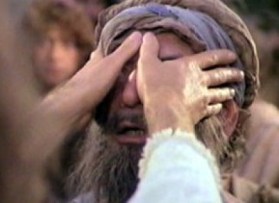
Lent is a time for tumbling, recovering and reviving. It is a time for measuring, asking and hoping. As we move through these last cold days of winter in anticipation of a warm breeze and clear skies, let us stand again as Eutychus did, and give over to Christ’s absolute claimon us. Let us allow our friends to gather us up, let us allow ourselves to be touched by the healing hand of Christ, and let us give ourselves over to the one who has the only legitimate absolute claim on our body, mind and soul.
Let us be immeasurably comfortedby the Christ.
A re-post written on March 4, 2009 and posted on March 7, 2012 as a Favorite . . .
The Nisa helmeted warrior, a Hellenistic figure or deity, from the Parthian royal residence and necropolis of Nisa, Turkmenistan, 2nd century BC (Wikipedia.org)
The definition of Hellenization in conjunction with scripture refers to the time when the Jewish people were lured into imitating the Greeks who placed much importance on transacting business in the gymnasium. When Jews entered this place were nudity was the norm, circumcision suddenly took on new meaning. This outward sign of fidelity to Yahweh sometimes became a stumbling block to transacting business and some Jewish men went to the extreme of enduring a painful surgical reversal of this mark of Abraham in order to hide this mark from others. The important point for us today is this: how do we allow ourselves to become Hellenized? What small places in our lives that have been places of constancy to God become inconvenient? What small steps entice us to give up God in small ways? What small detours become major deviations from the truth?
Not long ago I asked some of the girls we teach what they do when they feel embarrassed by “doing what is right” when they are with friends rather than going along with the crowd? They looked at me in an odd way and then said: “Those people would not be my friends.” How simple. How true.
In today’s reading we read about laws put in force and also abolished. We read about intrigue and sedition, the lure of power and money, about violence and deceit. This is a bloody time in Jewish history which we have visited often. We usually come away with the same truth: When we find ourselves embroiled in schemes and complex schemes, the only way out is to revert to simple truths that bring true satisfaction and joy. We remember that we find our power in our willingness to empty self and listen for God’s voice. We recall that we find our strength in our eagerness to put aside any personal agenda so that we might listen for God’s agenda. When we reflect and turn to God in this way, the tension, the anxiety, and the pain that had been paralyzing us begin to melt away.
When we have a sense that we have entered into our own Hellenization, it is time to assess and re-evaluate. When the world intrudes and asks us to forfeit our intimacy with God, we know for certain that these will be the first small steps away from God rather than steps toward God. When this happens, we know what we must do, and we remember the simple statement: Those people would not be my friends.
But the Lord did not choose the nation for the sake of the holy place, but the place for the sake of the nation.
So many times, we get things backwards. We forget that we become weak in order to be made strong, that we serve in order to lead, and that we die that we may live in Christ. We have looked at the books of Maccabees many times before and just last spring we spent time with this chapter reflecting on the stark difference between mystery and problem, impatience and trust, pride and humility, anxiety versus openness to God’s awesome power, sedition versus fidelity. Here is some of what we were thinking.
We need to relax into the mystery of life more. We need to adapt a humble stance with our Creator and a willingness of heart to do as we are bidden. We need to immerse ourselves in God who is always with us, rather than trying to swim upstream or downstream with him. We need to move away from sedition, death and the slandering and killing of fellow pilgrims. We need to move toward the light, toward the mystery and allow it to embrace us.
We can view the mysterious way that God moves in our lives with awe or with skepticism. We can choose to believe or to disbelieve that Christ overcomes the barrier that death presents to the rest of us. We can choose to be faithful to our covenant agreement and call, or we can strike out on our own to find another God to worship. Or we can even choose to worship ourselves and our own ideas. But none of this will satisfy because we will be making holy places where there is no holiness. We will be creating holy communions where there are none with whom to commune, for nothing can be made holy without God’s presence.
In 1 Corinthians Paul tells us several times in the opening chapters do you not know that you are living temples of God, members of the body of the living Christ? He echoes this on his other letters when he asks us to step away from immorality, from idolatry and to turn to the one true source of life: God the creator, God the redeemer, and God the love that exists in an inscrutable way deep within the mystery of each of us.
This is all that we are asked to do; yet we so often make life much more complicated than it really is. We are a holy people who come together when God calls us and thus, we make holy places in which the Spirit will abide. And in so doing we will rise even amidst the worst of circumstances, even above the pillaging of the temple to be sheltered in God, to live eternally in the Spirit, to be renewed in hope and forged in fidelity, to remain of and in Christ. For we are his holy people, and he is our holy place.
Whoever speaks on his own seeks his own glory, but whoever seeks the glory of the one who sent him is truthful, and there is no wrong in him.
Another Gospel writer, Matthew, tells us that the Christ urged us to cease judging one another (7:1-5) and to take care of the timbers in our own eyes rather than accuse others of not tending to the sawdust in theirs.
It is difficult to discern which voice of the many we hear is the genuine voice. It is difficult to separate ourselves from our own ego to stand back in order to get a clear view of how we act in the world. It is also impossible for us to separate ourselves from our life experiences which always form our thinking and acting. It seems that rather than trying to split ourselves into two halves – one side dealing with unpleasantness, the other avoiding it – we might try to use our daily experiences and the beams in our eye as a spiritual microscope to take a look at how we represent God in the world.
We might ask: Am I looking at the whole picture? Am I rushing to judgment? Am I enabling myself or others to preserve a narrow view? Do I work toward finding common ground in difficult situations or do I add to the turmoil? Do I obfuscate and cross lines or do I seek reason and order wherever I go? How do I express God in my daily living? These questions are endless, but nonetheless important. They provide us with a means to look at self. They also remind us that God is in charge, that when we find ourselves in difficulty we need to look to ourselves first and then turn to help others, always relying on God as the guide, the scientist who focuses our microscope so that we might better see ourselves.
When we read the Gospel we also find something else as we examine ourselves and then act on our reflections and the urgings of the true inner voice, we must expect rejection from those around us. The Pharisees we read about today are angry with the truth the Christ brings them. Jesus asks:are you angry with me because I made a whole person on a Sabbath? Jesus does the Father’s will and is heavily punished. The Pharisees go away grumbling, plotting his death. They are angry that his teaching is not his own, but comes from God.
When we turn our spiritual microscope inward to examine who we are and how we act, we must allow God to focus the lenses. When we speak, we must speak from God, not from our fears or anger. When we listen, we must listen for God for it is the only one true voice that guides to fullness, to glory, to peace.
Two years ago we looked at the struggle to save the child king Joash who is the centerpiece of today’s reading. Today we take time to reflect on his life and how he did what was pleasing to the Lord as long as Jehoiada the priest lived.
Joash is an example of one who restores all that was lost; and he is also an example of a leader who is empty of God’s promise. As long as Jehoiada lives, Joash focuses on what is good and true. Once the priest is gone, the king shows who he truly is: someone who lacks an authentic core.
Suffering is deepest when first we hold goodness for a time. Pain is more searing when we have known harmony. Sorrow is more keenly felt when we have experienced great joy. So it is with the people ruled by Joash. The dreams they once thought reality become dim memories. In their anger and grief, the people in this story ask for revenge. And they receive it.
It is likely that we have all loved someone or followed someone who showed great promise and have later been disappointed. Perhaps we have discovered a dark emptiness in one we thought held a solid center. If we have been wounded deeply by a Joash, we must not act in anger but in love. We must not look for revenge for when we do we sink into the same emptiness we see in today’s story.
As followers of Christ, rather than asking for a settling of scores, we intercede for our enemies to ask for peace. As disciples of Christ, rather than falling back on hatred, we act in love. As true apostles of Jesus, we seek concord so that darkness, and cruelty, ignorance and disunity have no place to take hold. As children of God we pray, we witness, we watch for the opportunity to be Christ-like, and we act in love, always in love.
We might see Joash as the resounding gong or clashing cymbal St. Paul describes in his first letter to the Corinthians, for he is one who worships God because it makes a good appearance or because it gains him something. When we meet Joash in our lives, let us ask God for the mercy and compassion to turn away from dark thoughts, and let us go to the Lord with our petitions of forgiveness and love.
Saint Anne de Beauprés church in Quebec, Canada: Wall of discarded crutches
It is in this second chapter of Mark that we see the power of freedom against the power of restraint. Jesus arrives in the world as an expression of God’s love for us to transform our paralysis into movement and even action. This is no easy model for us to follow as we see him in constant collision with the nearly overpowering influence of the Jewish church and social framework. Jesus speaks truth and mercy to corruption, jealousy and greed every day. He does not relent. In the end, he is crucified and thought dead and out of the way in what appears to be a bitter irony. Yet the beautiful inversion and paradox of the story of Christ is that he triumphs over his enemies by dying for them, by loving them more than they love themselves.
It is easy to read these stories of a man who lived two thousand years ago and smile at the authority and courage with which he moved through the world in a brilliant flash of compassion and simplicity: Love one another as I have loved you . . . child, your sins are forgiven.
It is another matter to follow this man and repeat his actions endlessly knowing that obstacles will be thrown in our path which will be impossible to circumvent: Follow me.
The secret to following Christ is to give ourselves over to him and accept his offer of newness: No one sews a piece of unshrunken cloth on an old cloak . . . no one pours new wine into an old wine skin.
We so often allow the familiar to govern our lives, even when it paralyzes us and prevents us from accepting what can be new about us. We would rather dance with the devil we know than with the God we do not. We prefer the dirge of a sadness known to us and reject the hope that the news we have heard from this God Among Us is true. It is so strange to me that we would prefer our paralyzing fear and reject the freedom offered by the one who comes to forgive and heal: I did not come to call the righteous but sinners.
When we are paralyzed by life, we must choose freedom offered by the Spirit. When we are overcome by fear or sadness, we must give ourselves over to joy as we take the hand of the groom who comes to bring us to the feast: As long as they have the bridegroom with them they cannot fast.
During Lent we are accustomed to giving alms, making reparation and examining our motives and actions. Perhaps this Lent we might begin to allow ourselves to dream of what we might do with the freedom we already possess, the freedom to allow ourselves to be healed of our paralysis and to follow Christ when he invites us into true and eternal union with God.
Imagine if we only had the courage and strength to . . . how do we want to finish this thought? What chains do we yearn to throw off?
The possibilities are endless when we drop our crutches, when we put away our paralysis.
This a chapter in the story of Christ as told by Luke where we hear and see Jesus explaining mysteries; we also hear and see his followers trying to understand and to follow his instruction. The chapter is book-ended by two parables: the Dishonest Servant – followed by an explication – and the parable of the Rich Man and Lazarus – which is so clear it needs no further comment. It only must be believed.
Sandwiched between these stories, Jesus speaks to the sneering Pharisees who are ardent followers of the Mosaic Law and the Prophets yet do not understand the concept of Jesus’ New Kingdom which the Prophet Isaiah has so clearly predicted. In the heart of the chapter is are brief verses regarding marriage and divorce which are often held against those who must – for one reason or another – seek civil and church sanction to annul a bond thought to have been made in reverence. We read these two simple verses in the context of Paul’s instruction on marriage in his letter to the Ephesians 5:21-32. These words follow Paul’s thinking on our duty to live in the light in God’s kingdom. They speak of mutual respect, mutual holiness, and mutual love. They give us a view on reciprocated union as read differently in Colossians 3:18-25 where Paul writes about The Christian Family and Slaves and Masters. Here he speaks about the significance of obedience to one’s vocation; and they reflect the thinking found in 1 Thessalonians 4:3-17 where he writes about holiness in sexual conduct, mutual charity, and hope for the Christian dead. To the people of Colossae and of Thessalonica he speaks of the reciprocal character of all holy relationships, and the honor we bring to others, ourselves and our creator when we consider all relationships with the gravity they are due. Jesus reiterates this idea.
When Moses gave permission for husbands to divorce their wives, he did so in order to prevent the murders which happened regularly when men grew tired of the women they had taken into homes and beds. This sort of casual disregard for life and the lack of a mutually nurturing relationship is what Jesus addresses here in Luke and again in Matthew 5and 19, and Mark 10. He warns that flitting across the surface of our relationships will not prepare us properly for the life we are to live in this New Kingdom of which he speaks.
As we read this chapter, we might consider two thoughts here that will bring us to something new: perhaps the divorce which ends an abusive relationship is a saving moment of blessed grace, and perhaps each relationship into which we enter is as holy as a marriage in that it is meant to be nurtured in order to glorify God when the two parties strive to imitate God’s love rather than a superficial, self-serving demand on one another.
The lessons brought to us in this chapter of Luke remind us that kingdom work is constant; and it is present in every breath we take, every gesture we offer to one another.
During this time of introspection we might want to consider the times we have been called to be stewards of not only money but of our emotional and spiritual resources. Have we allowed our physical, spiritual and psychological assets to drain dangerously low?
During this time of examination we might also want to consider the many divorces we have entered into in our lives. Have we walked away from organizations, communities, families and friends without following every avenue open to us at the time for remediation in ourselves and others?
During this time of Lent, we might want to spend time reflecting on the Laws we obey, the Kingdoms for which we seek citizenship. What do our gestures tell us about what we hold important? What air do we long to breath? What prophets do we read? What master do we follow?
Are we people who are trustworthy in small things so that we might enter into great ones? We will find the answers to these questions by examining the fruit we bear back to the one who created us.